
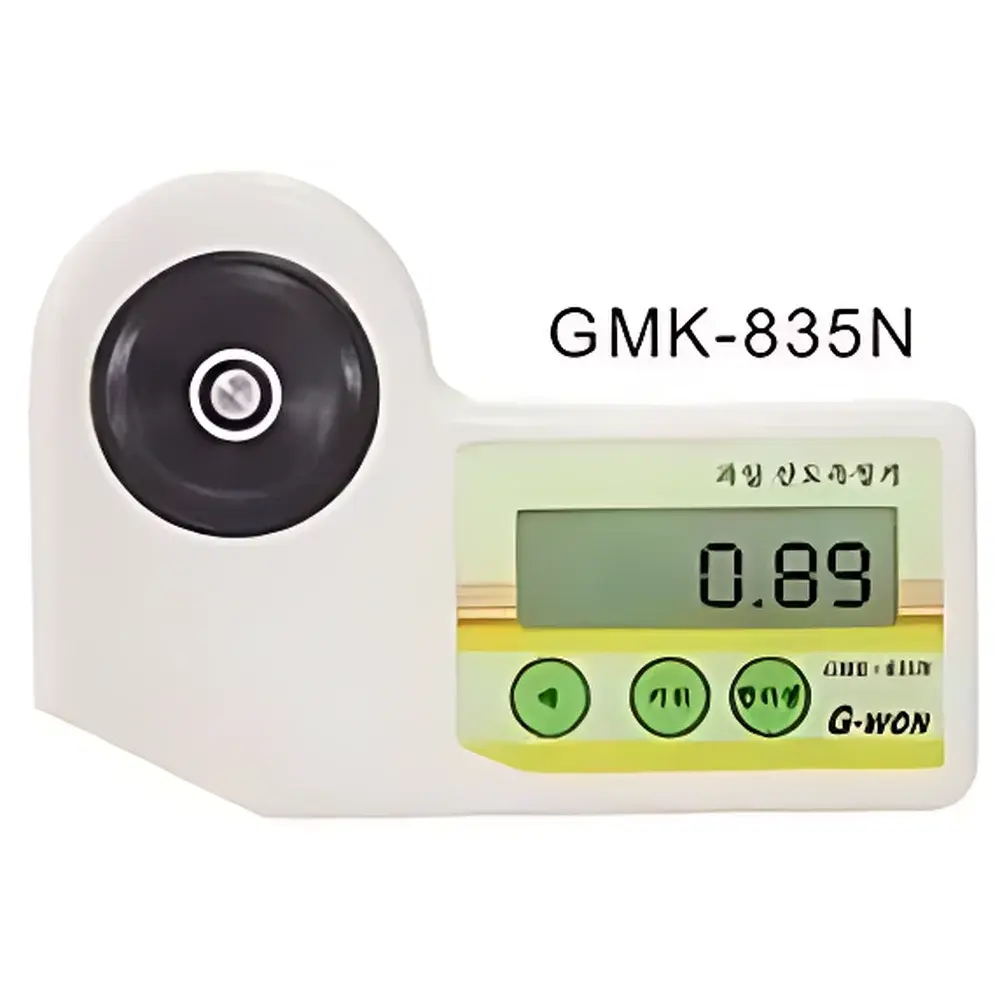
GMK-835F/835N Fruit Acidity Meter
| Origin | South Korea |
|---|---|
| Manufacturer Type | Authorized Distributor |
| Origin Category | Imported Instrument |
| Model | GMK-835F/835N |
| Price Range | USD 1,400 – 7,000 |
| Measurement Principle | Capacitive Sensing |
| Measurement Range | 0.00–3.50% (as citric acid equivalent) |
| Resolution | 0.01% |
| Accuracy | ±0.5% |
| Temperature Compensation | Automatic (0–40 °C) |
| Calibration | Auto-calibration with pre-stored fruit-specific calibration curves |
| Power Supply | 9 V alkaline battery (IEC 6LR61) |
| Dimensions | 154 mm (W) × 108 mm (L) × 43 mm (H) |
| Weight | 1.0 kg |
| Predefined Fruit Profiles | 12 (Citrus, Grape, Apple, Orange, Pineapple, Pear, Strawberry, Kiwi, Plum, Peach, Mango, Tomato) |
| Selectable Fruit Modes | 3 per device configuration |
Overview
The GMK-835F/835N Fruit Acidity Meter is a handheld, field-deployable instrument engineered for rapid, non-destructive estimation of titratable acidity in fresh fruits—expressed as percentage citric acid equivalent. Unlike traditional titration-based methods requiring sample homogenization, extraction, and reagent handling, this meter employs capacitive sensing technology to infer acidity from the dielectric properties of intact or minimally prepared fruit tissue. The underlying principle relies on the correlation between ionic concentration (primarily H⁺ and associated organic anions such as citrate, malate, and tartarate) and the material’s permittivity at a fixed excitation frequency. This approach enables repeatable, operator-independent measurements without consumables or laboratory infrastructure. Designed specifically for post-harvest quality assessment, orchard monitoring, and incoming inspection at processing facilities, the GMK-835N supports standardized evaluation across diverse fruit varieties while maintaining compliance with routine food quality control workflows.
Key Features
- Capacitive measurement principle eliminates need for chemical reagents, electrodes, or sample dilution
- Pre-programmed calibration algorithms for 12 major fruit species—including Citrus, Apple, Grape, Orange, Pineapple, Pear, Strawberry, Kiwi, Plum, Peach, Mango, and Tomato—each optimized for typical pH-acidity relationships and tissue density
- User-selectable configuration for up to three fruit types per unit, enabling dedicated deployment in multi-crop operations
- Automatic temperature compensation (0–40 °C) ensures consistent output across ambient field conditions
- Integrated auto-calibration sequence using internal reference standards; no external calibration solutions required
- Low-battery indicator and automatic power-off after 5 minutes of inactivity enhance operational reliability and battery longevity
- Rugged ABS housing with IP54-rated ingress protection for dust and splash resistance during harvest or warehouse use
Sample Compatibility & Compliance
The GMK-835N is validated for use with intact or halved fruits, as well as freshly cut sections where surface moisture is controlled. It is not intended for processed products (e.g., juices, purees, or dried fruit), nor for fruits with high wax content (e.g., apples with commercial coatings) unless peel is removed prior to measurement. While the instrument does not replace official AOAC or ISO titrimetric methods (e.g., ISO 750:2017 Fruit and vegetable products — Determination of titratable acidity), it serves as a validated screening tool aligned with internal quality specifications defined under HACCP-based food safety plans. Data outputs meet traceability requirements for Good Agricultural Practice (GAP) and Good Manufacturing Practice (GMP) documentation when paired with manual log entries. Device firmware conforms to IEC 61000-6-3 (EMC emission standards) and IEC 61010-1 (safety requirements for electrical equipment for measurement).
Software & Data Management
The GMK-835N operates as a standalone instrument with no embedded memory or digital connectivity. All measurement results are displayed in real time on a backlit LCD screen and must be manually recorded. This architecture intentionally avoids data export functionality to maintain simplicity, reduce maintenance overhead, and ensure uninterrupted operation in environments lacking IT infrastructure. For users requiring electronic recordkeeping, integration is supported via external digital logbooks or LIMS-compatible mobile applications that accept manually entered values. Though the device does not implement FDA 21 CFR Part 11 electronic signature controls, its deterministic response, fixed calibration curves, and absence of user-modifiable firmware support audit-ready usage in GLP-aligned environments when documented per site-specific SOPs.
Applications
- On-site maturity assessment during harvest scheduling for citrus, apple, and stone fruits
- Receiving inspection at juice concentrate plants to verify acidity thresholds prior to blending
- Quality sorting in packinghouses to segregate lots by acidity grade (e.g., “high-acid” vs. “low-acid” strawberries)
- Research trials evaluating varietal differences in organic acid accumulation under varying irrigation or fertilization regimes
- Extension service demonstrations for growers seeking rapid feedback on crop ripening trends
- Teaching laboratories introducing principles of dielectric property–based food analysis
FAQ
Does the GMK-835N require electrode cleaning or replacement?
No—this instrument contains no electrochemical sensors or consumable electrodes. The capacitive probe is sealed and maintenance-free.
Can the same unit be used for both citrus and tomato samples?
Yes, provided the device is configured for those two fruits during setup; switching between preloaded profiles requires no recalibration.
Is the ±0.5% accuracy specification traceable to NIST or other national standards?
The accuracy is validated against reference titration data per ISO 750:2017 across representative batches of each supported fruit type; full validation reports are available upon request from the authorized distributor.
What is the expected battery life under typical field use?
A single 9 V alkaline battery supports approximately 1,200–1,500 measurements, assuming average ambient temperature (20–25 °C) and standard display usage.
Does the instrument comply with CE or UKCA marking requirements?
Yes—the GMK-835N carries CE marking per Directive 2014/30/EU (EMC) and 2014/35/EU (LVD), verified by independent notified body testing.






