
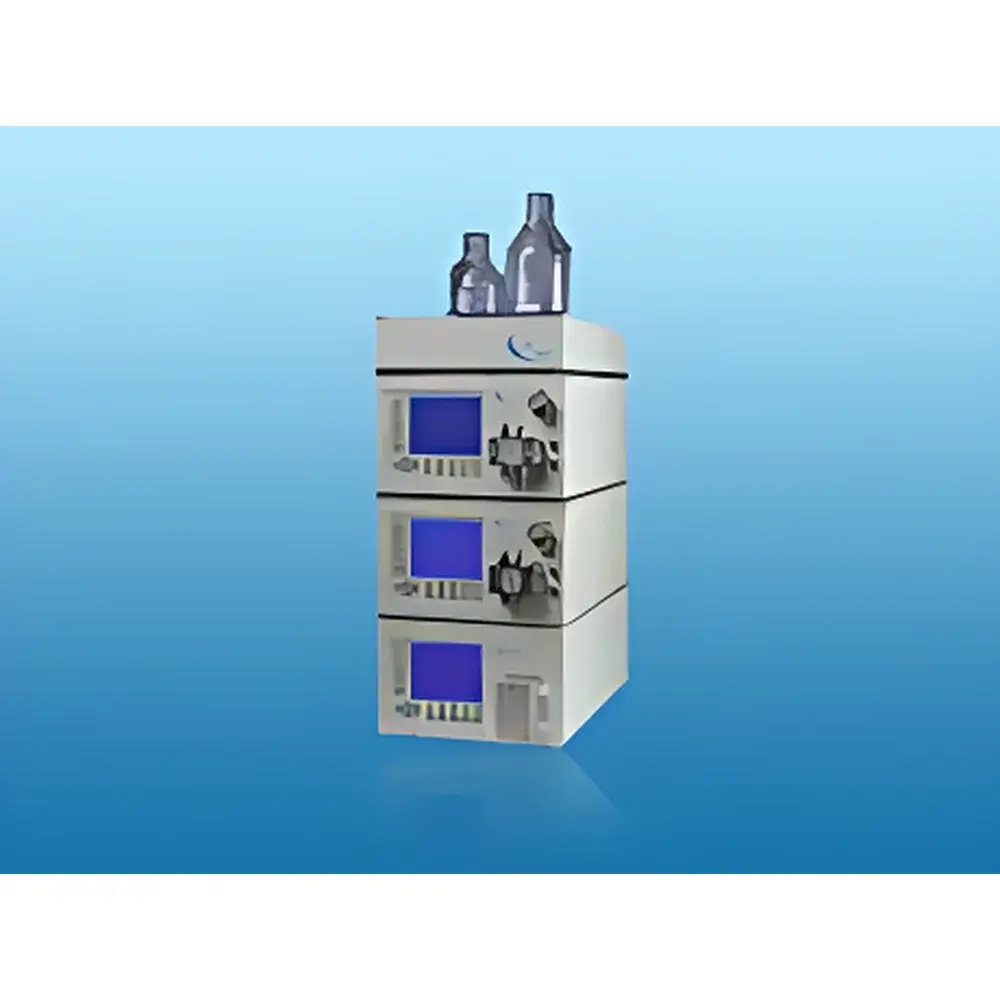
Golden Promise LC-3000 Gradient Liquid Chromatograph
| [Brand | Golden Promise |
|---|---|
| Model | LC-3000 |
| Pump Type | Dual-plunger reciprocating high-pressure gradient system |
| Max Pressure | 42 MPa (P3110), 30 MPa (P3120) |
| Flow Range | 0.002–9.998 mL/min (P3110), 0.01–49.99 mL/min (P3120) |
| Flow Accuracy | ±2% (2–5% of set flow, MeOH/H₂O 80:20) |
| Flow RSD | <0.1% |
| Detector | UV/VIS (UV3000) |
| Wavelength Range | 190–700 nm |
| Wavelength Accuracy | ±2 nm |
| Wavelength Repeatability | 0.4 nm |
| Scan Modes | Programmable stop-flow scanning (start/end/step configurable) |
| Absorbance Range | 0–2 AU |
| Baseline Noise | 2×10⁻⁵ AU/h (1 mL/min, MeOH/H₂O 80:20, 254 nm) |
| Baseline Drift | 15×10⁻⁵ AU/h (1 mL/min, MeOH/H₂O 80:20, 254 nm) |
| Time Constants | 0.1/0.2/0.5/1/2/5/10 s |
| Lamp Options | Deuterium (standard), Tungsten (optional) |
| Display | 320×240 dot-matrix LCD with adjustable blue backlight |
| Communication | RS-232 interface |
| Power | 220 V ±10%, 50 Hz (pump: 400 W |
| detector | 60 W) |
| Dimensions (D×H×W) | 398×149×267 mm |
| Weight | 14 kg |
| GLP Features | Lamp operating time logging, lamp cycle count, lamp replacement history, serial number traceability] |
Overview
The Golden Promise LC-3000 Gradient Liquid Chromatograph is a modular, high-performance HPLC system engineered for routine analytical and semi-preparative separations in regulated and research laboratory environments. Built upon the P3000 series dual-plunger reciprocating high-pressure pump architecture and paired with the UV3000 programmable UV/VIS absorbance detector, the LC-3000 delivers robust gradient elution capability, precise flow control, and spectral flexibility across the 190–700 nm range. Its operational principle follows classical reversed-phase liquid chromatography (RPLC), where separation is achieved via differential partitioning of analytes between a polar mobile phase (e.g., water/acetonitrile or methanol/water gradients) and a non-polar stationary phase under controlled pressure and temperature conditions. The system supports both independent front-panel operation and external computer control via RS-232, enabling integration into automated workflows while maintaining full local accessibility for method development and troubleshooting.
Key Features
- Dual-plunger reciprocating pump design with active solvent suction — ensures stable pulse-free flow delivery and minimizes baseline disturbance during gradient transitions.
- Configurable maximum pressure limits (up to 42 MPa for P3110, 30 MPa for P3120) and wide dynamic flow range — accommodates analytical-scale columns (2.1–4.6 mm ID) as well as semi-preparative applications (up to 10 mm ID).
- High-precision flow accuracy (±2% within 2–5% of setpoint) and exceptional reproducibility (RSD <0.1%) verified under standard MeOH/H₂O (80:20) conditions — critical for retention time stability and quantitative method validation.
- UV3000 detector with deuterium lamp (standard) and optional tungsten lamp — provides continuous spectral coverage from deep UV to visible region, supporting multi-wavelength quantitation and peak purity assessment.
- Programmable stop-flow scanning with user-defined start/end wavelengths and step increments — enables rapid spectral acquisition without column elution interference.
- Comprehensive GLP-compliant audit trail: real-time logging of lamp operating hours, total lamp cycles, lamp replacement events, and instrument serial number — fully traceable for FDA 21 CFR Part 11 readiness when coupled with validated third-party chromatography data systems (CDS).
- 320×240 dot-matrix LCD with adjustable blue backlight — offers clear visualization of real-time pressure, flow rate, gradient profile, wavelength, and absorbance under varied ambient lighting conditions.
Sample Compatibility & Compliance
The LC-3000 is compatible with a broad spectrum of sample matrices, including pharmaceutical actives and excipients, natural product extracts, environmental water extracts, food additives, and polymer degradation products. Its stainless steel and PEEK pump head options (PH005–PH008) allow selection based on chemical compatibility requirements: stainless steel for general-purpose use and PEEK for aggressive solvents (e.g., THF, DMSO, high-pH mobile phases). Analytical, semi-preparative, and preparative flow cells (Sell01–Sell03) support detection sensitivity scaling from ng-level quantitation to mg-level fraction collection. The system adheres to core instrumental performance criteria outlined in USP , ASTM E260, ISO 17025 (when operated within a certified quality management system), and ICH Q2(R2) guidelines for method validation. All electronic components meet CE safety standards (EN 61010-1) and electromagnetic compatibility requirements (EN 61326-1).
Software & Data Management
While the LC-3000 operates autonomously via its integrated front panel, it is designed for seamless interoperability with industry-standard chromatography data systems (CDS) such as Chromeleon, Empower, or OpenLab CDS through its native RS-232 serial interface. The detector and pump modules transmit real-time telemetry—including pressure, flow, UV signal, lamp status, and gradient composition—enabling synchronized data acquisition, method sequencing, and report generation. Instrument control parameters (e.g., gradient slope, dwell volume compensation, wavelength switching) are fully scriptable. Raw absorbance and pressure data are exported in ASCII-compatible formats (.csv, .txt) for secondary analysis in MATLAB, Python (NumPy/Pandas), or statistical packages. Audit trail records—including lamp usage logs and parameter change timestamps—are stored internally and exportable for regulatory review, satisfying foundational requirements for GLP and GMP documentation integrity.
Applications
- Pharmaceutical quality control: assay of active pharmaceutical ingredients (APIs), related substances testing, dissolution profile analysis, and stability-indicating method development per ICH Q5C/Q1A(R2).
- Food and beverage safety: detection of preservatives (e.g., benzoates, sorbates), artificial colors, mycotoxins (aflatoxin B1, ochratoxin A), and pesticide residues in complex matrices.
- Environmental monitoring: quantification of polycyclic aromatic hydrocarbons (PAHs), phenolic compounds, and endocrine-disrupting chemicals (e.g., bisphenol A) in wastewater and soil extracts.
- Natural product research: fingerprinting of herbal extracts, isolation-guided fractionation support, and characterization of flavonoid and alkaloid profiles.
- Academic and method development labs: platform for teaching HPLC fundamentals, optimizing mobile phase composition, evaluating column selectivity, and validating new detection strategies.
FAQ
Is the LC-3000 compliant with FDA 21 CFR Part 11?
The LC-3000 hardware includes essential features required for Part 11 compliance—including electronic signature support, audit trail generation, and secure parameter access—but full compliance requires implementation within a validated CDS environment that enforces user authentication, role-based permissions, and electronic record retention policies.
Can the system perform gradient elution with more than two solvents?
Yes — the LC-3000 supports high-pressure binary or quaternary gradient mixing when configured with up to four independently controlled P3000-series pumps in master/slave mode, with real-time gradient verification via on-screen curve display.
What is the recommended maintenance interval for the UV3000 detector lamp?
Deuterium lamps typically require replacement after 1,000–2,000 hours of operation; the system automatically tracks cumulative lamp hours and alerts users when service thresholds are approached.
Does the LC-3000 support temperature-controlled column compartments?
The base configuration does not include an integrated column oven; however, the system is fully compatible with third-party column heaters (e.g., Thermo Scientific, Waters, or JASCO models) via standard 1/8″ stainless steel tubing connections and external power interfaces.
Are PEEK pump heads suitable for use with 100% acetonitrile or THF?
Yes — PEEK pump heads (PH006, PH008) exhibit excellent chemical resistance to acetonitrile, tetrahydrofuran, chloroform, and other organic solvents commonly used in normal-phase and reversed-phase chromatography.





