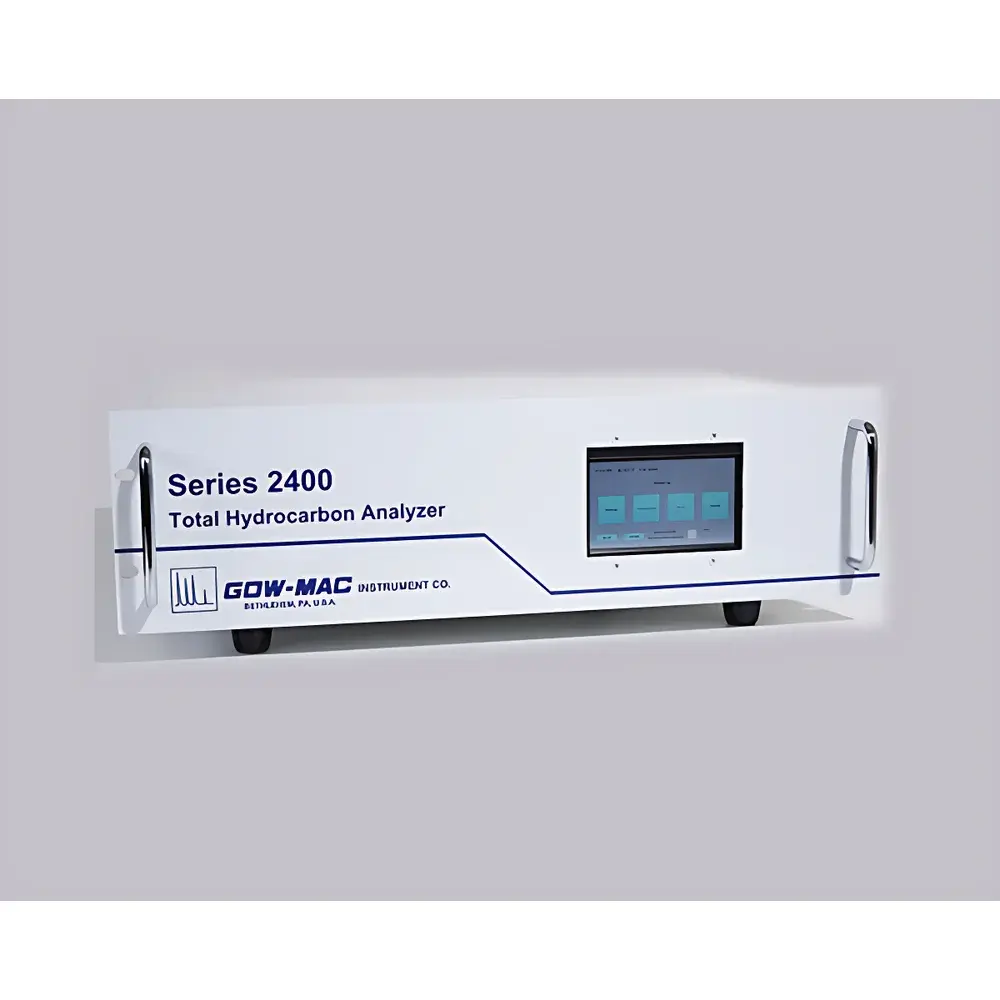
GOW-MAC 2400 Total Hydrocarbon Analyzer
| Brand | GOW-MAC |
|---|---|
| Origin | USA |
| Model | GOW-MAC 2400 |
| Detector | Flame Ionization Detector (FID) |
| Detection Limit | 0.05 ppm (as CH₄) |
| Operating Temperature | 15–35 °C |
| Response Time | <5 s (to 90% of full response) |
| Drift | <1% FS/24 h |
| Repeatability | ±1% |
| Flow Control | Electronic Pressure Control (EPC) for fuel, air, and sample |
| Zero Interval | User-programmable auto-zero |
| Range Selection | 4 fixed ranges (0–10, 0–100, 0–1000, 0–10,000 ppm) or auto-ranging |
| Analog Output | 4–20 mA / 0–5 VDC (standard) |
| Digital Interface | USB + RS-232 |
| Relay Outputs | 2 programmable (high/low alarm) |
| Sample Inlet | 1/8" tubing, min. pressure 2 psig, flow 5–70 cc/min |
| Fuel Gas | H₂, min. 2 psig |
| Combustion Air | Zero-air (<1 ppm THC), min. 25 psig, flow 10–350 cc/min |
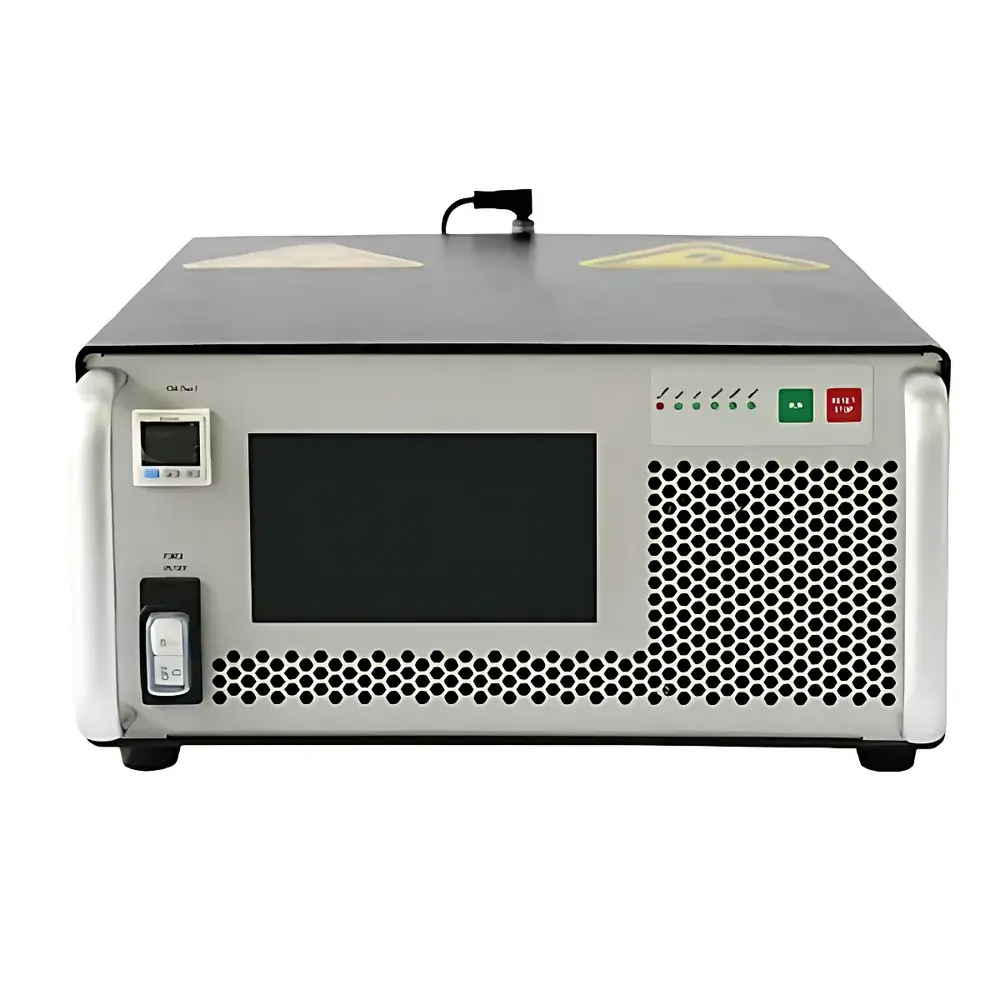
| Enclosure | 3U rack-mount (19″) or benchtop |
| Dimensions | 48.3 × 13.3 × 52.1 cm |
| Weight | 15.9 kg |
| Power | 100 W, 115 V 60 Hz (2400-CM) or 230 V 50 Hz (2402-CM) |
Overview
The GOW-MAC 2400 Total Hydrocarbon Analyzer is a robust, laboratory-grade online gas chromatograph engineered for continuous, real-time quantification of total hydrocarbons (THC) in industrial process streams, ambient air, and stack emissions. Utilizing flame ionization detection (FID) — a universally accepted, highly sensitive, and linear quantitative technique per ASTM D6348 and ISO 8573-5 — the instrument delivers trace-level detection (0.05 ppm as methane) with high reproducibility and minimal baseline drift. Its design adheres to fundamental principles of gas-phase combustion chemistry: organic compounds eluting from the column are pyrolyzed in a hydrogen-air flame, generating ions proportional to carbon mass flow. This signal is collected at the collector electrode and converted into a calibrated concentration output. The analyzer integrates an optional methanizer for co-detection of CO and CO₂ as equivalent hydrocarbons, extending its utility in combustion efficiency monitoring and catalyst performance evaluation. Built for unattended operation in demanding environments, the 2400 operates within a tightly controlled thermal envelope (15–35 °C), ensuring retention time stability and detector response consistency essential for regulatory-compliant reporting.
Key Features
- Flame Ionization Detector (FID) with <0.05 ppm detection limit (as CH₄), optimized for linear dynamic range up to 10,000 ppm
- Integrated electronic pressure control (EPC) for precise, independent regulation of hydrogen fuel, zero-air oxidant, and sample gas flows — eliminating mechanical regulators and enhancing long-term calibration stability
- 4.7-inch diagonal resistive touchscreen LCD (4″ W × 2.4″ H) with intuitive graphical interface for real-time chromatogram viewing, method configuration, and alarm management
- Auto-zero function with user-definable interval scheduling — critical for maintaining baseline integrity during extended monitoring campaigns
- Dual programmable relay outputs configured for high/low concentration alarms, compatible with plant-wide SCADA and DCS integration
- Flame-safety circuit with automatic hydrogen shutoff upon flame-out detection, compliant with NFPA 54 and IEC 60079-0 intrinsic safety prerequisites
- Modular 3U 19-inch rack-mount chassis (also benchtop-capable), designed for seamless integration into control rooms or field-mounted enclosures
Sample Compatibility & Compliance
The GOW-MAC 2400 accepts gaseous samples introduced via pressurized cylinders, process lines, or ambient air sampling manifolds — requiring only 2 psig minimum inlet pressure and 5–70 cc/min flow. It supports analysis of saturated and unsaturated aliphatic/aromatic hydrocarbons (C₁–C₁₂), including methane, ethane, propane, benzene, and toluene, without pre-concentration. For regulatory applications, the system meets key performance criteria outlined in EPA Method 25A, EN 12619, and US EPA 40 CFR Part 60 Appendix A–2. Its analog 4–20 mA output satisfies legacy PLC interfacing requirements, while USB and RS-232 digital ports enable secure data logging aligned with GLP/GMP audit trails. All firmware operations retain timestamped event logs (e.g., zero/calibration events, alarm triggers, power cycles), supporting FDA 21 CFR Part 11 compliance when deployed with validated IT infrastructure.
Software & Data Management
Data acquisition and instrument control are managed through embedded firmware — no external PC required for basic operation. Real-time concentration values, chromatographic peak areas, and system diagnostics are continuously logged to internal memory and exported via USB mass storage or serial ASCII stream. The unit supports configurable data export intervals (1 sec to 60 min), CSV-formatted files, and user-defined header metadata. For enterprise integration, the RS-232 port supports Modbus RTU protocol (optional configuration), enabling direct polling by historian systems such as OSIsoft PI or Emerson DeltaV. All calibration records — including span gas lot numbers, date/time stamps, and operator IDs — are stored with cryptographic integrity to meet ISO/IEC 17025 documentation requirements.
Applications
- Continuous emission monitoring (CEMS) of THC in refinery flare stacks and incinerator exhausts
- Process gas purity verification in semiconductor manufacturing nitrogen/helium supply lines
- Leak detection and repair (LDAR) program support per EPA 40 CFR Part 60 Subpart VV
- Biogas quality control in anaerobic digestion facilities (CH₄ + VOC quantification)
- Ambient air quality stations measuring non-methane hydrocarbons (NMHC) after subtraction of methane baseline
- Catalytic converter efficiency testing in automotive R&D labs
FAQ
What carrier gas does the GOW-MAC 2400 require?
The instrument uses hydrogen as both fuel gas and, optionally, as a carrier gas in specific FID configurations; however, standard operation employs nitrogen or helium as the chromatographic carrier, with hydrogen dedicated solely to the FID flame.
Can the analyzer quantify individual hydrocarbons, or only total hydrocarbons?
By default, the 2400 reports total hydrocarbon concentration as methane-equivalent. With optional column oven upgrades and customized GC methods, it can resolve and quantify discrete C₁–C₅ species — though this requires application-specific validation and is not part of the base configuration.
Is the 2400 suitable for Class I, Division 1 hazardous locations?
No — the standard 2400 is rated for general-purpose use (non-hazardous area). For classified locations, GOW-MAC offers explosion-proof variants (e.g., 2400-XP) certified to UL 1203 and ATEX II 2G Ex d IIB T4.
How often must the FID be calibrated?
Initial calibration is performed with certified methane-in-air standards. Under stable operating conditions, quarterly calibration verification is recommended; however, daily auto-zero and weekly span checks satisfy routine QA/QC protocols per ISO 17025 Clause 7.7.
Does the unit support remote diagnostics or firmware updates?
Yes — firmware updates are delivered via USB stick. Remote access to real-time status and historical logs is possible via optional Ethernet module (2400-E), enabling SNMP-based network monitoring and TLS-secured HTTP API endpoints.