
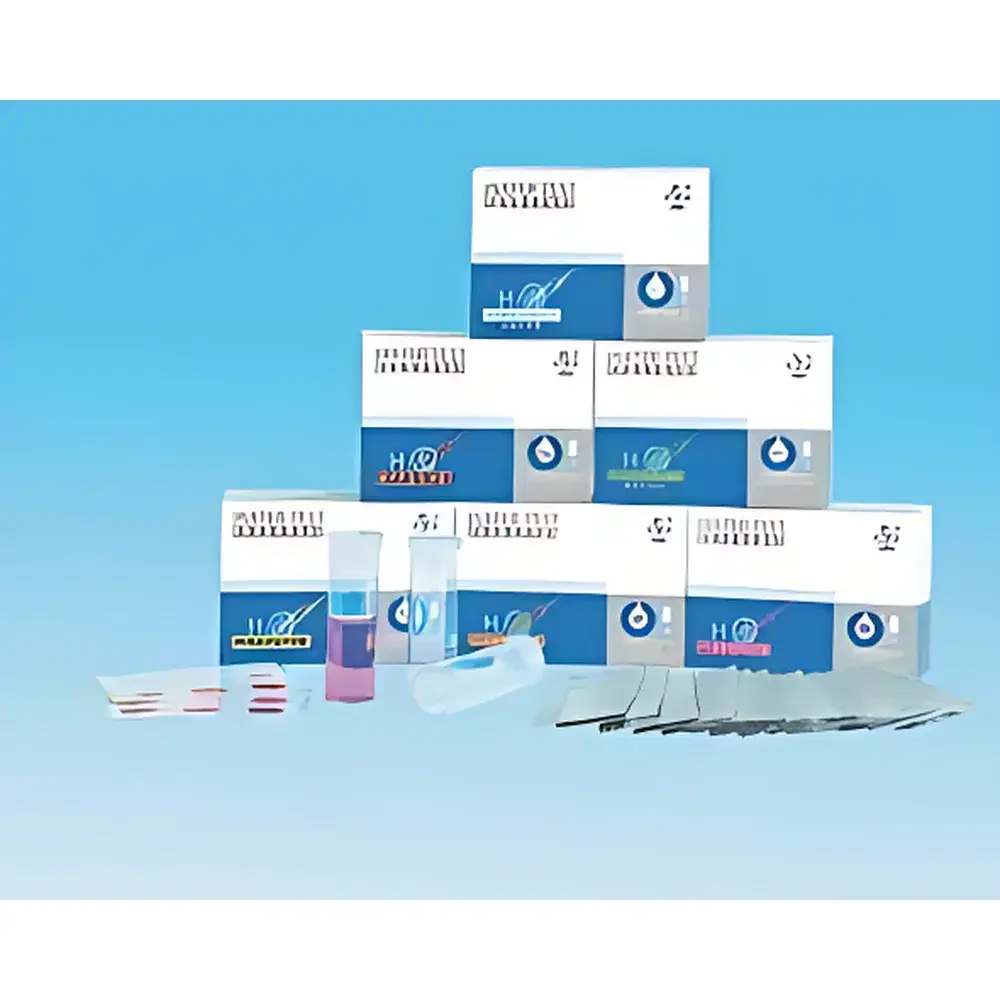
Gowang Chemical DPD Residual Chlorine, Total Chlorine & Ozone Rapid Test Kit
| Origin | Shanghai, China |
|---|---|
| Manufacturer Type | Authorized Distributor |
| Product Origin | Domestic (China) |
| Model | DPD |
| Pricing | Available Upon Request |
Overview
The Gowang Chemical DPD Residual Chlorine, Total Chlorine & Ozone Rapid Test Kit is a field-deployable, colorimetric reagent system engineered for quantitative determination of free residual chlorine, total chlorine, and aqueous ozone concentrations in potable water, process water, and disinfection validation samples. Based on the standardized N,N-diethyl-p-phenylenediamine (DPD) oxidation method—recognized by ISO 7393-2:2018, APHA Standard Methods 4500-Cl G, and US EPA Method 334.0—the kit delivers reliable semi-quantitative results through visual comparison against calibrated color standards. Each test relies on stoichiometric reaction between DPD and oxidants to generate a stable pink-to-red quinonediimine dye, with intensity proportional to analyte concentration within the linear range of 0.05–1.0 mg/L (ppm). The method is widely accepted for routine monitoring under drinking water regulations, including WHO Guidelines for Drinking-water Quality and national standards such as GB/T 5750.11–2023 (China).
Key Features
- Triple-analyte capability: One kit supports parallel testing for residual chlorine, total chlorine, and dissolved ozone using identical DPD tablet format and standardized procedure.
- Stable dual-aluminum foil packaging: Each tablet is hermetically sealed in laminated aluminum foil to prevent moisture ingress and oxidation, ensuring shelf life up to 24 months when stored at 2–8 °C.
- Rapid dissolution formulation: Tablets contain pharmaceutical-grade disintegrants enabling complete dissolution within 10 seconds in 10 mL sample volume—no grinding or pre-dilution required.
- Precision-calibrated visual reference: Includes three dedicated color comparator cards (residual Cl₂, total Cl₂, O₃), each printed with 11 discrete color steps from 0.05 to 1.0 mg/L, traceable to KIO₃-based primary standards.
- Dedicated borosilicate glass comparator tubes: Supplied with matched 10-mL tubes featuring engraved meniscus marks and UV-stabilized polymer caps for consistent light-path geometry and reduced parallax error.
- Patented formulation: Protected under Chinese Utility Model Patent ZL01215726.0, covering optimized DPD:buffer:stabilizer ratio for enhanced specificity and minimized interference from monochloramine or nitrite.
Sample Compatibility & Compliance
This kit is validated for use with clarified, low-turbidity (<5 NTU) aqueous samples including municipal drinking water, bottled water, swimming pool water, cooling tower make-up, and post-disinfection effluent from membrane filtration or UV/O₃ systems. It meets performance criteria outlined in ISO/IEC 17025:2017 for qualitative/semi-quantitative field methods and supports compliance with regulatory frameworks requiring routine oxidant verification—including FDA 21 CFR Part 129 (bottled water), EU Directive 98/83/EC Annex I (parametric values), and China’s Hygienic Standard for Drinking Water (GB 5749–2022). Interference studies confirm minimal cross-reactivity with ≤0.5 mg/L nitrite, ≤2.0 mg/L bromide, and ≤0.2 mg/L manganese when pH is maintained between 6.2–6.5 using included phosphate buffer tablets.
Software & Data Management
While this is a manual visual method, the kit integrates seamlessly into structured quality management workflows. Colorimetric results can be digitally documented using calibrated smartphone spectrophotometry apps (e.g., Colorimetrix™ or iQube™) that convert RGB pixel values into concentration estimates traceable to NIST-traceable reference standards. All comparator cards include batch-specific calibration certificates aligned with ISO/IEC 17025-accredited reference laboratories. For GLP/GMP environments, the kit supports audit-ready recordkeeping: each box includes a lot-numbered Certificate of Analysis (CoA) listing expiration date, manufacturing date, and stability test data per ICH Q5C guidelines.
Applications
- Real-time verification of chlorine residual at water treatment plant final disinfection points and distribution system entry points.
- Validation of ozone dosing efficacy in bottled water production lines (e.g., brands including Nongfu Spring, Evian, and Nestlé Pure Life).
- Monitoring of chlorine demand in food processing rinse water and CIP (Clean-in-Place) return streams.
- Pharmaceutical facility PW (Purified Water) and WFI (Water for Injection) system sanitization cycle endpoint detection.
- Field-based QA/QC for HVAC cooling tower biocide control programs in commercial building management.
- Educational use in environmental engineering laboratories for teaching standardized oxidation-reduction titration principles.
FAQ
What is the shelf life of unopened DPD tablets?
Unopened foil-sealed tablets retain full reactivity for 24 months when stored refrigerated (2–8 °C) and protected from light. Do not freeze.
Can this kit be used for wastewater or seawater samples?
Not recommended without pretreatment; high turbidity (>5 NTU), salinity (>500 mg/L Cl⁻), or organic load may cause false positives or incomplete color development. Clarify via 0.45 µm filtration and dilute with deionized water if necessary.
How does the DPD method differentiate residual vs. total chlorine?
Residual chlorine is measured immediately after adding DPD tablet. Total chlorine requires addition of potassium iodide (KI) prior to DPD—this step converts combined chloramines to free iodine, which then reacts with DPD. KI reagent is supplied separately in multi-test kits.
Is the color scale traceable to international standards?
Yes. Each comparator card is calibrated against KIO₃ standard solutions prepared gravimetrically per ISO 6353-2, with uncertainty <±0.02 mg/L at 0.5 mg/L level (k=2).
Does the kit comply with FDA 21 CFR Part 11 requirements?
As a manual visual method, it does not generate electronic records. However, when paired with validated digital imaging tools and SOP-controlled documentation, it supports ALCOA+ data integrity principles required for regulated environments.
Related Products







