
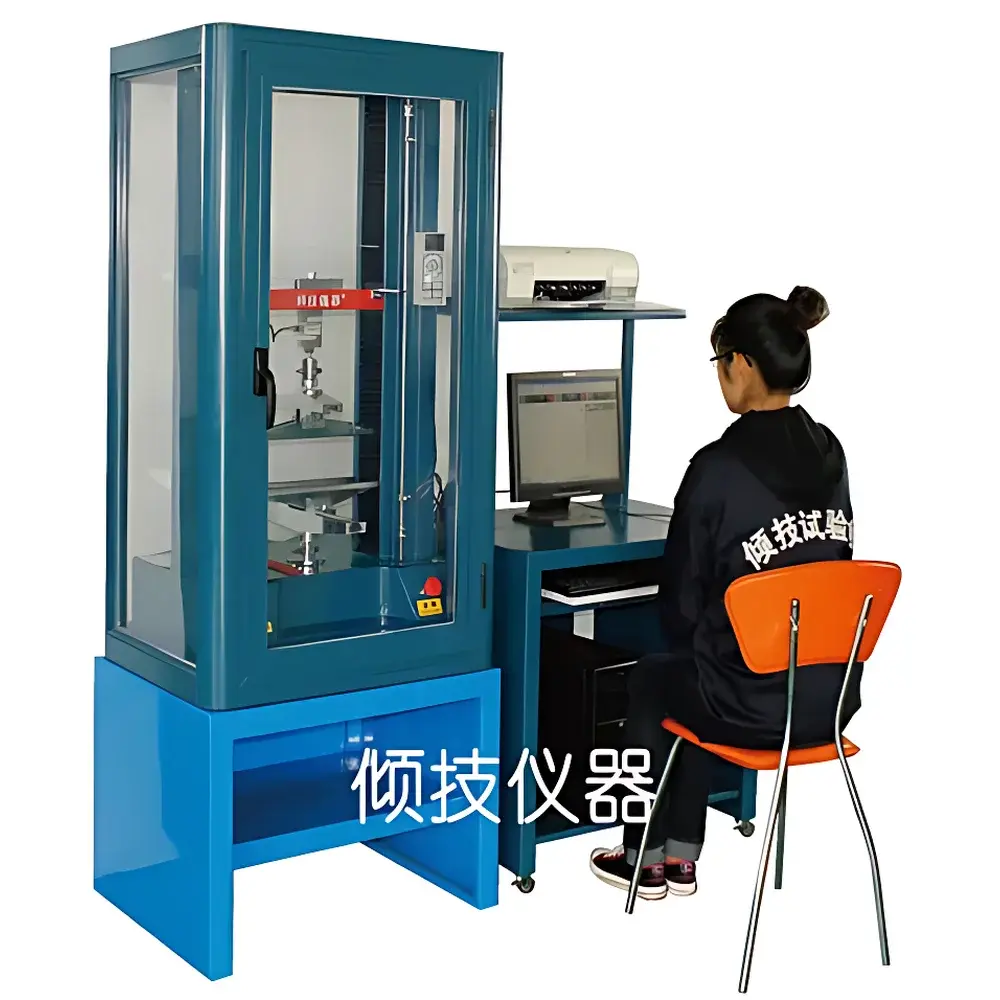
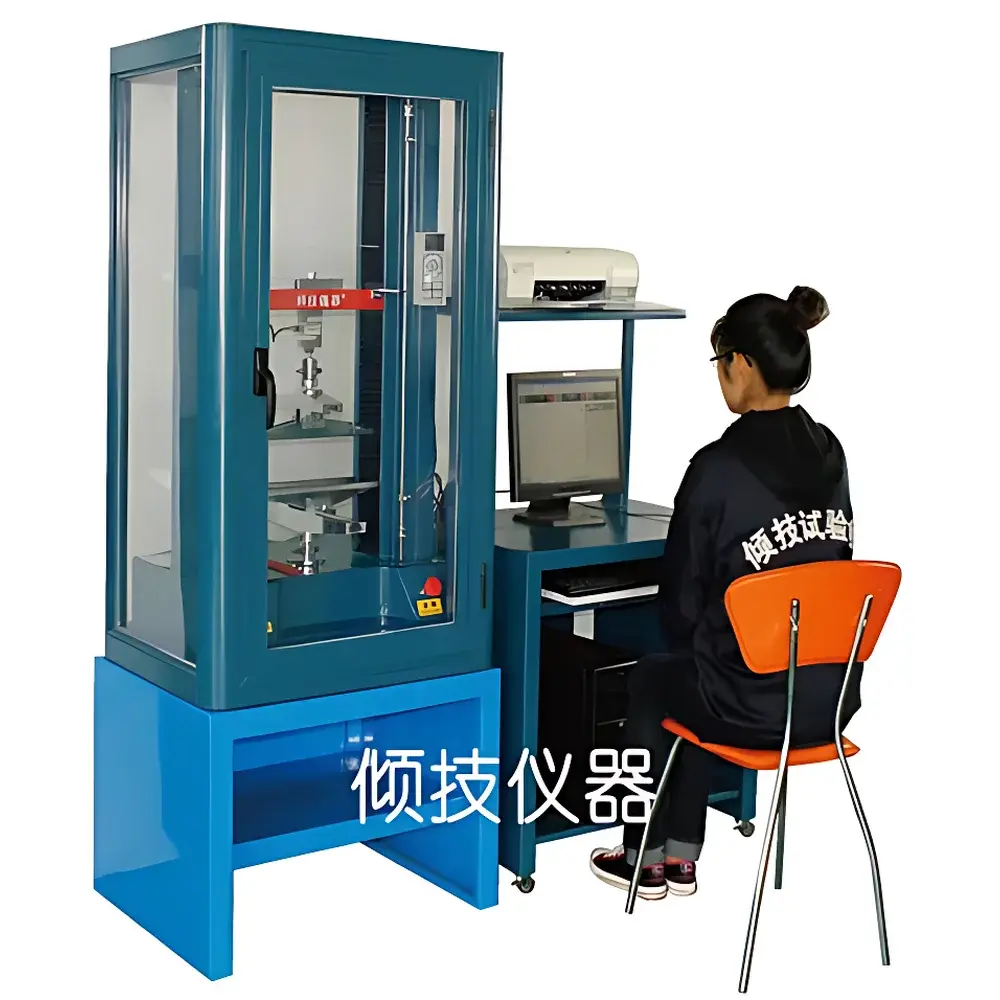
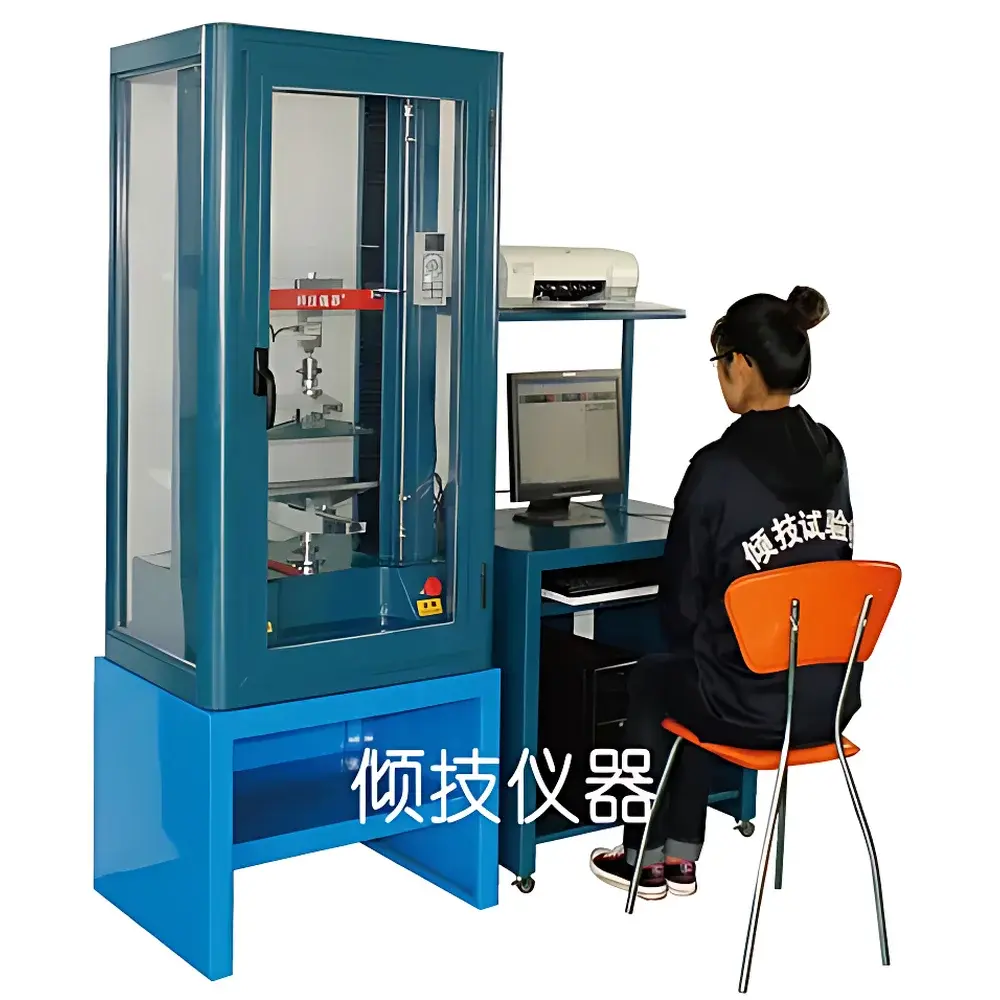
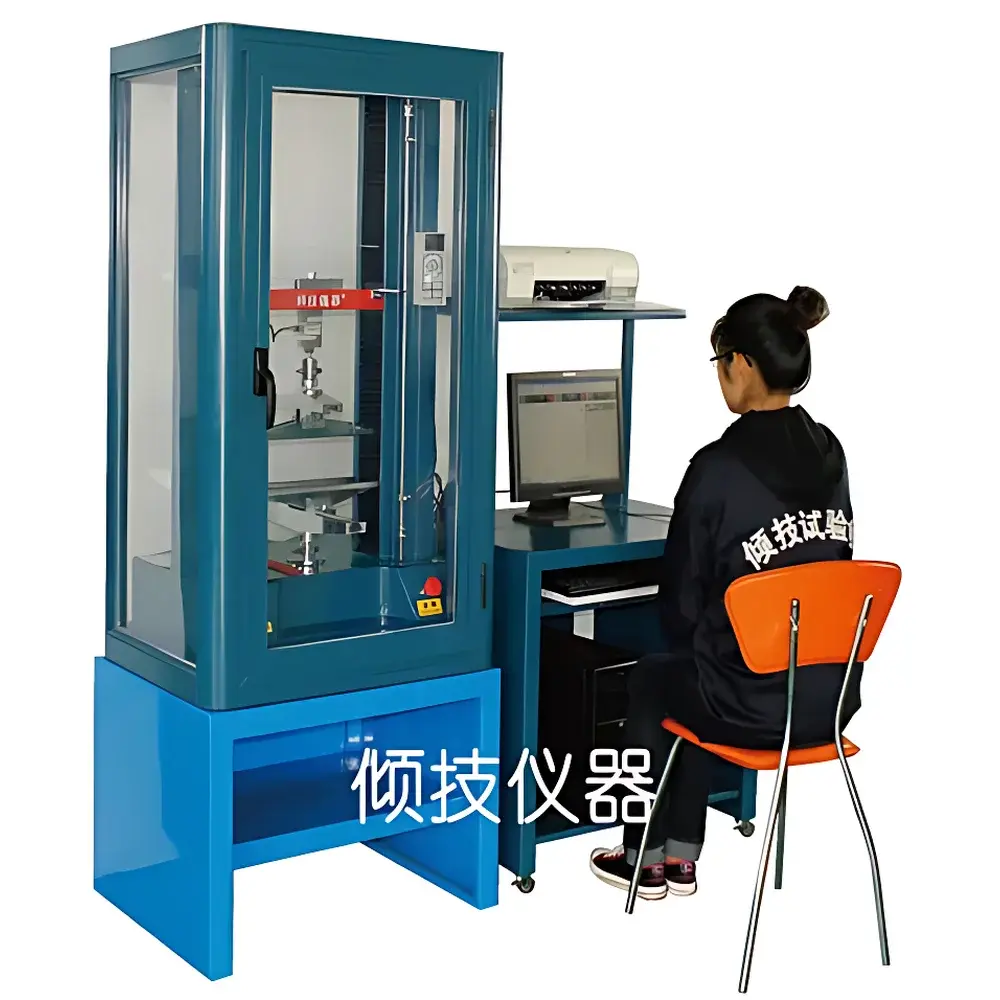
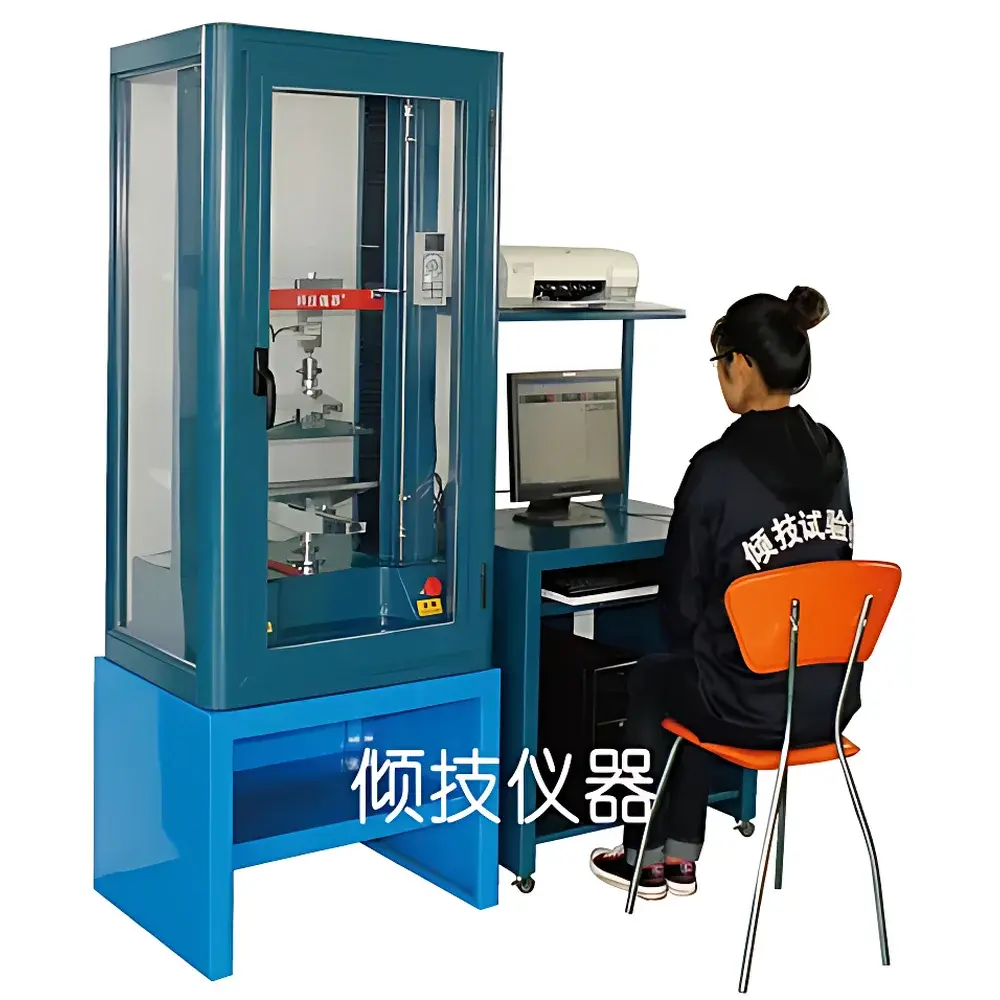
QJ211S Qinskey ROR Dual-Ring Testing Machine
| Brand | Qinskey |
|---|---|
| Origin | Shanghai, China |
| Model | QJ211S |
| Type | Electromechanical Universal Testing Machine |
| Load Capacity | 20 kN |
| Accuracy Class | 0.5 |
| Effective Force Range | 0.02–100% of full scale |
| Force Resolution | 500,000 counts (no internal/external range switching, constant resolution) |
| Effective Test Width | 460 mm |
| Effective Vertical Travel (excluding fixtures) | 1500 mm |
| Speed Range | 0.001–1000 mm/min (programmable) |
| Speed Accuracy | ±0.5% of indicated value |
| Displacement Measurement Accuracy | ≤0.2% of indicated value |
| Strain/Deformation Measurement Accuracy | ≤0.2% of indicated value |
| Noise Level | ≤76 dB(A) |
| Continuous Operational Duration | ≥2000 h |
| Critical Component Service Life | ≥8000 h |
| Overload Protection | Automatic shutdown at >110% of rated load |
| Motor Power | 0.75 kW |
| Dimensions (W×D×H) | ≈670×600×2220 mm |
| Weight | ≈195 kg |
Overview
The QJ211S Qinskey ROR Dual-Ring Testing Machine is an electromechanical universal testing system engineered for high-precision mechanical characterization of brittle and semi-rigid optical materials used in display manufacturing and consumer electronics. Its dual-ring loading configuration enables standardized application of concentric, radially symmetric force distribution—critical for evaluating flexural strength, fracture resistance, and structural integrity of flat-panel substrates under controlled bending modes. The instrument operates on the principle of servo-controlled axial displacement actuation, with real-time closed-loop feedback of load, displacement, and deformation signals. It complies with fundamental mechanical test methodologies defined in ISO 178 (flexural properties of plastics), ISO 24343-1 (glass for building—determination of bending strength), and ASTM C158 (standard test methods for strength of glass by flexure). Designed specifically for the photonic device supply chain, it supports repeatable evaluation of tempered glass, sapphire cover lenses, chemically strengthened LCD substrates, capacitive touch panel assemblies, and precision optical mirrors.
Key Features
- Dual-ring fixture geometry optimized for three-point and four-point bending per ISO 6892-1 and GB/T 232, ensuring uniform stress field generation across thin, high-modulus specimens.
- 0.5-class accuracy certified force measurement system with 500,000-count resolution, maintaining full-scale linearity without range switching—eliminating step errors during low-load or high-sensitivity tests.
- Programmable crosshead speed from 0.001 to 1000 mm/min, enabling quasi-static fracture initiation studies as well as dynamic response assessment within regulatory-compliant velocity tolerances.
- Integrated electronic limit protection, overload cutoff (>110% FS), and motorized return-to-home function with selectable manual or automatic mode—enhancing operational safety and throughput consistency.
- Low-noise (<76 dB(A)) operation and ≥2000-hour continuous runtime rating ensure suitability for QA/QC laboratories operating under ISO/IEC 17025-accredited conditions.
- Modular fixture interface supporting ASTM D638 (tensile), D790 (flexural), D1876 (peel), D3330 (adhesion), and D7264 (flexural stiffness of composites) configurations via optional accessories.
Sample Compatibility & Compliance
The QJ211S accommodates rigid and semi-rigid planar specimens up to 460 mm wide and 1500 mm tall, including finished smartphone cover glass (e.g., Gorilla Glass, Dragontrail), sapphire wafers (≥0.3 mm thickness), laminated touch sensor stacks, and annealed or heat-strengthened display-grade soda-lime silicate. It meets mechanical stability requirements for GLP-compliant test environments and supports audit-ready documentation when paired with validated software. Fixture selection aligns with ISO 14125 (fiber-reinforced composites), IEC 60068-2-78 (environmental testing—damp heat), and JEDEC JESD22-B117A (mechanical shock for optoelectronic components).
Software & Data Management
Control and analysis are performed via Qinskey’s proprietary PC-based testing software compliant with FDA 21 CFR Part 11 requirements—including electronic signatures, audit trail logging, user access levels, and data immutability settings. Raw force-displacement curves are exported in CSV and XML formats compatible with MATLAB, Python (SciPy/Pandas), and industry-standard LIMS platforms. Calibration certificates include traceability to NIM (National Institute of Metrology, China) and uncertainty budgets per ISO/IEC 17025 Annex A.5.
Applications
- Three- and four-point flexural strength testing of display cover glass per ISO 14125 and GB/T 30019.
- Static compression and indentation resistance evaluation for anti-scratch performance validation.
- Yellow-spot (yellowing) stress-corrosion susceptibility screening under sustained load conditions.
- Tensile adhesion strength of OCA (optically clear adhesive) layers in laminated touch modules.
- Peel and shear strength quantification of conductive ink patterns on flexible PET substrates.
- Mechanical reliability qualification of foldable display hinge-integrated glass hybrids.
FAQ
What standards does the QJ211S support for glass flexural testing?
It implements ISO 24343-1, EN 1288-3, and GB/T 15763.2 for load application geometry, support span ratios, and deflection measurement protocols.
Can the system perform creep or stress-relaxation tests?
Yes—when configured with time-controlled hold segments and high-stability load control mode, it satisfies ISO 899-1 for tensile creep and ISO 899-2 for flexural creep in thermoset and thermoplastic optical polymers.
Is third-party calibration and certification available?
Qinskey provides factory calibration with NIM-traceable certificates; optional UKAS or DAkkS-accredited calibration services are arranged through authorized regional metrology partners.
How is data integrity ensured during long-duration tests?
The embedded controller buffers all sensor data at ≥100 Hz sampling rate locally, preventing PC communication dropouts from compromising dataset continuity.
What maintenance intervals are recommended for routine operation?
Preventive maintenance—including guide rail lubrication, load cell zero-check, and encoder verification—is advised every 500 operational hours or semiannually, whichever occurs first.



