
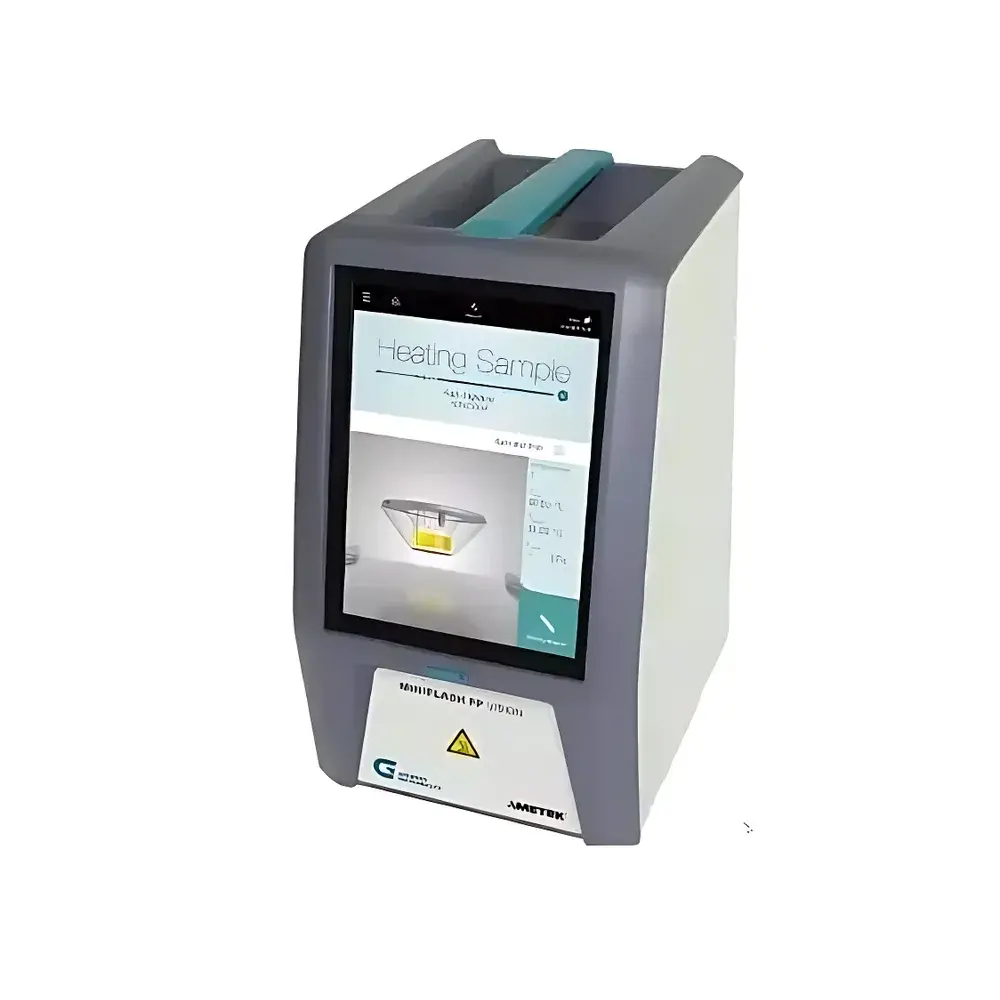
Grabner MINIFLASH FP VISION Automated Closed-Cup Flash Point Analyzer
| Brand | Grabner |
|---|---|
| Country of Origin | Austria |
| Manufacturer Type | Original Equipment Manufacturer (OEM) |
| Import Status | Imported |
| Model | MINIFLASH FP VISION |
| Detection Method | Closed-Cup |
| Operation Mode | Fully Automatic |
| Temperature Range | −25 °C to 400 °C |
| Ignition Method | Electric Arc Ignition |
Overview
The Grabner MINIFLASH FP VISION is a next-generation automated closed-cup flash point analyzer engineered for precision, safety, and regulatory compliance in demanding industrial and laboratory environments. Based on the Peltier-controlled dynamic equilibrium principle, it employs a sealed test chamber and electric arc ignition to determine the lowest temperature at which vapors of a liquid sample ignite momentarily under standardized thermal and atmospheric conditions. Unlike open-cup or traditional Pensky-Martens instruments, the FP VISION operates exclusively in a continuously closed environment—eliminating exposure to ambient air, uncontrolled vapor dispersion, and open flame hazards. Its core measurement methodology aligns with ASTM D6450 and ASTM D7094, two modern flash point standards developed specifically to address limitations of legacy methods (e.g., ASTM D93, ISO 2719) in low-flash, high-volatility, or thermally unstable samples. The instrument’s real-time combustion imaging capability enables qualitative assessment of trace flammability events—critical for contamination screening, fuel dilution analysis, and forensic volatility profiling.
Key Features
- Fully automated closed-cup operation with zero manual intervention from sample loading to result reporting
- Electric arc ignition system with self-cleaning cycle—removes carbonaceous residue without solvent or disassembly
- Integrated Peltier-based heating/cooling architecture enabling rapid thermal ramping (−25 °C to 400 °C) and precise temperature stabilization (±0.05 °C for FP Vision; ±0.07 °C for FPH Vision)
- 10-inch full-color capacitive touchscreen with intuitive, icon-driven navigation—no operator training required
- Automated sample chamber door actuation prevents spillage, ensures reproducible headspace geometry, and enhances operator safety
- Real-time high-resolution video capture of ignition events—exportable for root-cause analysis of borderline or ambiguous flash responses
- Onboard method library supporting ASTM D6450/D7094, ASTM D93/ISO 2719 correlation protocols, ISO 3679/3680, ASTM D3828A/B, IP 523/524, and user-defined custom procedures
- Integrated fuel dilution assay and rapid “flash/no-flash” screening mode for in-service oil diagnostics
Sample Compatibility & Compliance
The MINIFLASH FP VISION accommodates a broad spectrum of petroleum-based and non-petroleum liquids—including gasoline, diesel, jet fuels, lubricants, biodiesel blends, solvents, fragrances, coatings, transformer oils, and process chemicals. It meets stringent safety and performance requirements across multiple international regulatory frameworks: approved by the U.S. Department of Transportation (DOT), U.S. Environmental Protection Agency (EPA) under RCRA, U.S. Navy, and NATO for field-deployable hazard classification; referenced in ASTM D6450 (adopted as SH/T 0768 in China), ASTM D7094, and cited in ASTM Committee D02’s official statistical validation report confirming equivalence with ASTM D93 Method A. Instrument firmware and data handling comply with GLP/GMP principles—including audit-trail-enabled user authentication, electronic signatures, and time-stamped raw data archiving per FDA 21 CFR Part 11 readiness guidelines.
Software & Data Management
The FP VISION is natively compatible with Grabner’s Cockpit™ software suite—deployable as standalone desktop application or centralized server-based platform. Cockpit™ supports multi-instrument fleet management, remote configuration, real-time status monitoring, and automated report generation in PDF, CSV, or XML formats. The Cockpit™ SQC edition implements statistical quality control per ASTM D6299, enabling laboratory managers to monitor repeatability, reproducibility, and control chart trends across batches and operators. All test parameters, video logs, thermal profiles, and ignition event timestamps are stored in an encrypted SQLite database with configurable retention policies. USB and dual-LAN interfaces facilitate seamless integration into LIMS, ERP, and MES systems—supporting HL7, ASTM E1384, and ISO/IEC 17025-compliant data exchange protocols.
Applications
- Petrochemical QC/QA: Rapid flash point verification of crude fractions, distillates, and finished fuels per refinery specifications
- Hazardous Materials Classification: UN GHS Category 1–4 flammability determination for SDS authoring and transport documentation
- Condition Monitoring: Detection of fuel dilution in engine oils via flash point depression analysis
- Flavor & Fragrance R&D: Safe evaluation of volatile aroma compounds with flash points below 0 °C
- Coatings & Inks: Stability testing of solvent-borne formulations during formulation development
- Power Generation: Transformer oil degradation assessment per IEEE C57.106 and IEC 60156 guidelines
- Field Deployment: Portable operation enabled by optional DC power converter (12/24 V) for mobile labs and offshore platforms
FAQ
What flash point standards does the MINIFLASH FP VISION support natively?
ASTM D6450, ASTM D7094, ASTM D93 (correlation mode), ISO 2719, ISO 3679, ISO 3680, IP 170, IP 523/524, and customizable user methods.
How much sample volume is required for standard testing?
1 mL for ASTM D6450/SH/T 0768 compliant tests; 2 mL for ASTM D7094 applications.
Can the instrument detect partial or weak ignition events not captured by conventional testers?
Yes—its high-sensitivity optical detection system coupled with synchronized video recording enables visualization and quantification of sub-threshold combustion phenomena.
Is remote instrument control and data retrieval possible?
Yes—via Cockpit™ software over LAN/Wi-Fi, with full parameter configuration, live thermal profiling, and historical data export capabilities.
Does the system meet regulatory requirements for auditable electronic records?
Yes—it supports 21 CFR Part 11-compliant user access control, electronic signatures, and immutable audit trails for GLP/GMP environments.





