
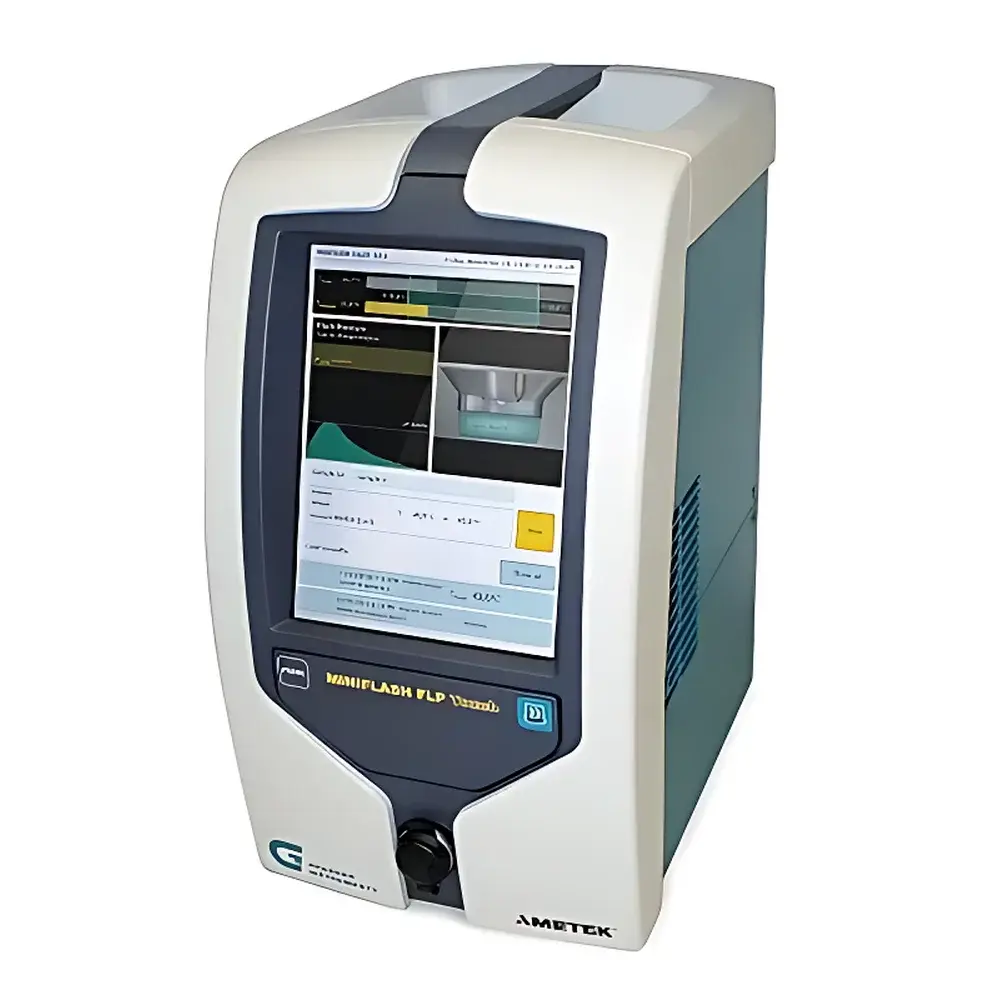
Grabner MiniFlash Touch FLP/FLPH Automated Flash Point Tester with Color Touchscreen
| Brand | Grabner |
|---|---|
| Origin | Austria |
| Manufacturer Type | Manufacturer |
| Origin Category | Imported |
| Model | MiniFlash Touch FLP / FLPH |
| Temperature Range | 0–200°C (FLP) / 0–400°C (FLPH) |
| Sample Volume | 1–2 mL |
| Measurement Principle | Modified Continuously Closed Cup (MCCCFP) per ASTM D7094 |
| Compliance | ASTM D6450, ASTM D7094, ASTM D93, EN ISO 2719, EN ISO 3679, EN ISO 3680, ISO 13736, IP 170, ASTM D56 |
| Accuracy (Repeatability / Reproducibility) | ±3.8°C / ±5.4°C per ASTM D7094 |
| Ignition Source | High-energy electric arc |
| Cooling | Peltier-based active cooling (FLPH model supports external chiller) |
| Interfaces | USB 2.0, Ethernet (10/100 Mbps), LIMS-ready, PC-compatible |
| Software Platform | Microsoft® Windows®-based proprietary software with GLP-compliant audit trail |
| Data Storage | Unlimited method and result storage on internal SSD |
| Portability | 12 kg, 253 × 368 × 277 mm, 12 V DC vehicle power option |
Overview
The Grabner MiniFlash Touch FLP/FLPH is an automated flash point tester engineered for precision, safety, and regulatory compliance in petroleum, chemical, pharmaceutical, and transportation safety laboratories. It implements the Modified Continuously Closed Cup (MCCCFP) method defined in ASTM D7094 — a thermodynamically robust, closed-system technique that detects flash point via transient pressure rise within a sealed 7-mL aluminum test cup upon electric arc ignition. Unlike open-cup or traditional Pensky-Martens (ASTM D93) methods, the MiniFlash Touch eliminates manual lid lifting, open-flame exposure, and sample vapor loss. Its core innovation lies in real-time pressure transduction synchronized with controlled Peltier heating/cooling and magnetic stirring — enabling detection of minute combustible volatiles even in complex matrices such as fuel-diluted lubricants, biodiesel blends (B5–B100), or ethanol-contaminated glycerol. The instrument operates across a validated range of 0–200°C (FLP) or 0–400°C (FLPH), with optional external chiller integration for sub-ambient stabilization. Designed for global standard equivalence, it delivers statistically indistinguishable results versus ASTM D93 Procedure A (p > 0.05 in multi-laboratory round-robin studies), while also satisfying EN ISO 3679 and EN ISO 3680 for transport classification.
Key Features
- Patented MCCCFP measurement principle per ASTM D7094 — highest repeatability (±3.8°C) and reproducibility (±5.4°C) among automated closed-cup testers
- True closed-system architecture: no open-cup ignition, zero sample evaporation loss, and elimination of operator exposure to flammable vapors
- Ultra-low sample consumption: only 1–2 mL required — critical for high-value samples (e.g., fragrances, APIs, spent catalysts)
- Integrated Peltier thermal control with dual-mode heating/cooling: achieves ramp rates up to 15°C/min and stabilizes at target temperature within ±0.1°C
- Real-time combustion curve visualization: graphical pressure-vs.-temperature output enables qualitative assessment of contaminant presence (e.g., residual methanol in FAME, gasoline in diesel)
- Go/No-Go pass-fail mode with programmable threshold logic — ideal for QC release testing and transport hazard screening
- Automated post-test cleaning cycle with integrated spark electrode purge — ensures cross-contamination-free sequential analysis
- Full remote operation via Ethernet or USB: supports LAN/WAN deployment, LIMS integration (ASTM E1578-compliant data export), and unattended overnight runs
- GLP-compliant software: role-based user access control, electronic signatures, full audit trail (21 CFR Part 11 ready), and immutable raw data archiving
Sample Compatibility & Compliance
The MiniFlash Touch accommodates liquids, semi-solids (e.g., bitumen emulsions, spent frying oils), and suspended particulates without pre-filtration. It is routinely deployed for ASTM D6751 biodiesel certification, EN 14214 compliance verification, and ISO 8217 marine fuel grading. Its pressure-triggered detection mechanism remains insensitive to sample color, opacity, or minor particulate load — unlike optical flame-detection systems. Regulatory alignment includes full support for ASTM D6450 (CCCP), ASTM D7094 (MCCCFP), EN ISO 2719 (equivalent to ASTM D93), EN ISO 3679/3680 (transport flash point determination), and ISO 13736 (low-flash-point liquids). For pharmaceutical applications, it meets ICH Q5C stability protocol requirements for solvent residue flash point mapping in drug substance intermediates. All calibration and verification procedures follow NIST-traceable reference standards (e.g., n-decane, xylene, heptane mixtures) and are documented per ISO/IEC 17025.
Software & Data Management
The Windows-based MiniFlash Control Suite provides intuitive touchscreen navigation, multilingual UI (EN/DE/FR/ES/JP/CN), and context-aware help. Methods are stored as encrypted XML files with embedded metadata (operator ID, calibration date, ambient conditions). Raw pressure/time and temperature/time datasets are exported in CSV or ASTM E1382-compliant format. Audit logs record every parameter change, result override, or calibration event with timestamp, user ID, and IP address. Network deployment allows centralized method distribution and firmware updates via HTTPS. Optional LIMS drivers support direct bidirectional communication with Thermo Fisher SampleManager, LabVantage, and STARLIMS. Data integrity safeguards include write-once-read-many (WORM) SSD storage, automatic daily backups to network shares, and SHA-256 hash validation of all archived results.
Applications
- Petroleum refining: rapid detection of low-flash contaminants in jet fuel (ASTM D1655), diesel (ASTM D975), and base oils
- Biodiesel production: monitoring methanol removal efficiency across transesterification stages per ASTM D6751
- Lubricant condition monitoring: quantifying diesel fuel dilution in engine oils using programmable dilution curves (ISO 3104 viscosity correlation)
- Hazardous materials transport: UN 3.1 classification per TDG/ADR/IMDG Code using EN ISO 3679 methodology
- Pharmaceutical manufacturing: flash point verification of ethanol/IPA/glycerin blends in API synthesis per USP
- Fragrance & flavor R&D: safe handling of volatile aroma compounds with minimal sample sacrifice
- Waste stream characterization: flash point screening of mixed hydrocarbon wastes, filter cakes, and aqueous emulsions
- Military logistics: field-deployable fuel quality assurance for NATO STANAG 2280 and US Navy MIL-PRF-16884
FAQ
What distinguishes ASTM D7094 from ASTM D93?
ASTM D7094 employs continuous closed-cup pressurization and electric arc ignition, eliminating subjective visual flame detection and manual lid manipulation inherent in D93. It demonstrates superior precision (RSD < 0.8% vs. D93’s ~1.5%) and requires no operator training in flame recognition.
Can the MiniFlash Touch test viscous or non-homogeneous samples?
Yes — its magnetic stirring system ensures uniform vapor-phase equilibrium even in heavy fuel oils or asphaltene suspensions. No filtration or dilution is needed prior to analysis.
Is external cooling mandatory for FLPH operation above 300°C?
Not mandatory, but recommended for extended high-temperature stability; the internal Peltier system maintains ±0.3°C accuracy up to 400°C, though external chiller integration improves thermal recovery between consecutive high-T tests.
How does the instrument handle samples with very low flash points (< 30°C)?
The active cooling module rapidly equilibrates the test cup to sub-ambient start temperatures (down to 5°C), preventing premature vapor accumulation and ensuring accurate onset detection.
Does the software support 21 CFR Part 11 compliance?
Yes — with enabled electronic signatures, audit trail logging, and role-based permissions, the system satisfies FDA requirements for regulated pharmaceutical and biologics environments when deployed on validated IT infrastructure.




