
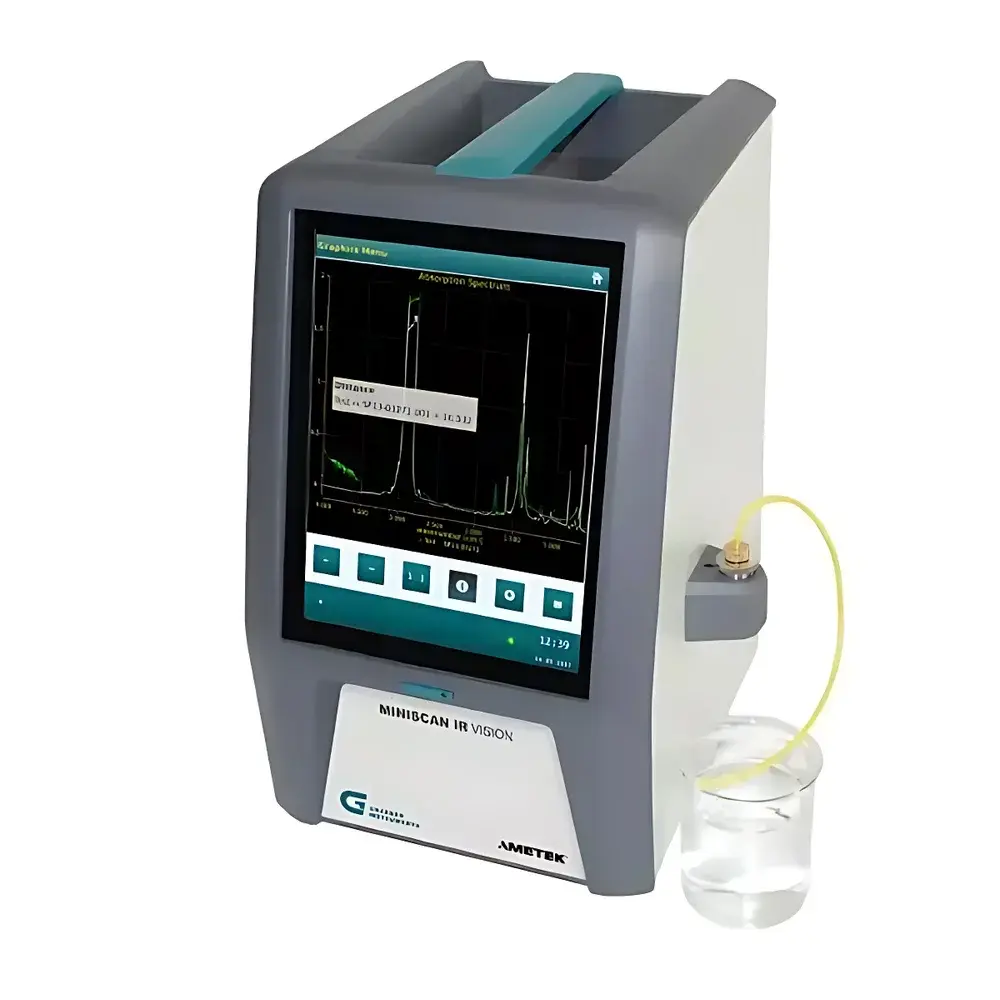
Grabner MINISCAN IR Vision Diesel Portable Mid-Infrared Cetane Number Analyzer
| Brand | Grabner |
|---|---|
| Origin | Austria |
| Manufacturer | Grabner Instruments GmbH |
| Product Type | Imported Industrial Analyzer |
| Model | MINISCAN IR Vision Diesel |
| Measurement Parameter | Cetane Number |
| Portability | Portable |
| Detection Principle | Mid-Infrared (MIR) Spectroscopy |
| Measurement Range | 20–80 CN |
| Measurement Accuracy | ±0.1 CN |
| Analysis Time | ≤60 s |
| Sample Volume | 10 mL |
Overview
The Grabner MINISCAN IR Vision Diesel is a field-deployable, mid-infrared (MIR) spectrometer engineered for rapid, precise, and standardized determination of diesel cetane number (CN) and over 20 additional fuel quality parameters. Based on Fourier-transform infrared (FTIR) spectroscopy with dual interferometer architecture, the instrument captures full-spectrum absorbance data (typically 4000–600 cm⁻¹) from neat diesel samples. Quantitative analysis is performed using chemometric calibration models—primarily Partial Least Squares (PLS) regression—trained on reference datasets traceable to ASTM E1655 and GB/T 29858, the internationally recognized standards for multivariate spectral quantification. Unlike empirical or combustion-based methods, this optical approach eliminates consumables, moving parts, and high-temperature ignition systems, delivering robust performance in both laboratory and non-laboratory environments.
Key Features
- Portable FTIR platform with integrated thermoelectrically controlled sample cell, density sensor, and optical path—ensuring temperature-stabilized measurements critical for volumetric and mass-based parameter accuracy (e.g., CN, aromatic content, FAME, oxygenates)
- Dual-mirror auto-calibrating interferometer system, validated for shock and vibration resistance (IEC 60068-2 series), enabling reliable operation after transport over rough terrain or in mobile labs
- 10-inch industrial-grade capacitive touchscreen with anti-glare, wide-temperature-range LCD—operable from –10 °C to +50 °C and compatible with gloved handling
- Patented bubble-free metallic sampling system, designed and validated by Grabner in Vienna, minimizing air entrapment and ensuring reproducible 10 mL fill volumes without manual degassing
- Onboard thermal regulation of the built-in digital densitometer (ASTM D1298 / ISO 3675 compliant), enabling simultaneous density and spectral acquisition for normalized parameter reporting
- Pre-loaded calibration database comprising >1,200 real-world diesel samples analyzed by SGS and certified reference laboratories—each spectrum linked to primary method validation (e.g., ASTM D6890 for CN, EN 14078 for FAME)
Sample Compatibility & Compliance
The MINISCAN IR Vision Diesel is validated for undiluted petroleum diesel fuels (EN 590, ASTM D975, GB 19147), biodiesel blends (B5–B20), and low-sulfur diesel formulations. It complies with regulatory and industry-standard test methods including ASTM D5845 (oxygen content), ASTM D6277 / EN 238 / SH/T 0797 (benzene), EN 14078 / ASTM D7806 / GB/T 23801 (FAME), and ASTM D4715 (cetane index estimation). All calibrations adhere to ASTM E1655 guidelines for PLS model development, validation, and ongoing performance monitoring. Instrument firmware supports audit trails and user-access logging aligned with GLP and GMP documentation requirements; electronic records meet FDA 21 CFR Part 11 criteria when deployed with optional networked data export and LIMS integration.
Software & Data Management
Operating firmware is built on a real-time Linux kernel with intuitive touchscreen interface supporting multilingual UI (English, German, Chinese, Spanish). The embedded software suite includes method editor for custom PLS model import, spectral preprocessing tools (baseline correction, normalization, derivative filtering), and automated QC flagging based on spectral residual thresholds and density deviation alerts. Raw spectra and processed results are stored in vendor-neutral .spc and .csv formats. Optional Ethernet/Wi-Fi connectivity enables secure remote diagnostics, firmware updates, and direct upload to enterprise LIMS or cloud-based QA/QC dashboards. All data exports include timestamp, operator ID, instrument serial number, and calibration version—ensuring full traceability per ISO/IEC 17025 clause 7.7.
Applications
This analyzer serves as a primary tool for process control and release testing across upstream, midstream, and downstream petroleum operations: refinery blending optimization, terminal quality assurance, marine bunker fuel verification, and roadside fuel inspection. It is widely adopted by national metrology institutes, customs laboratories (e.g., CIQ, U.S. CBP), OEM engine development centers requiring rapid fuel screening, and third-party certification bodies performing EN/ISO conformity assessments. Its portability and battery-free 12 V DC operation (via vehicle adapter) make it suitable for unpowered field sites, offshore platforms, and emergency response deployments where traditional GC or ignition-based analyzers are impractical.
FAQ
Does the MINISCAN IR Vision Diesel require external calibration standards for routine operation?
No—factory-installed calibrations are fully self-contained and maintained via internal reference checks. Users may optionally verify performance using NIST-traceable diesel reference materials (e.g., NIST SRM 2721), but daily recalibration is not required.
Can the instrument be used for gasoline octane analysis?
No—this model is specifically configured and validated for diesel-range hydrocarbons and cetane-related parameters. Grabner offers a separate MINISCAN IR Vision Gasoline variant for RON/MON determination.
Is spectral data export compliant with laboratory data integrity standards?
Yes—raw interferograms and processed spectra retain full metadata (wavenumber axis, resolution, scan count, detector voltage) and are exportable without loss of fidelity. Audit logs record all user actions, including method changes and result overrides.
What maintenance is required beyond routine cleaning?
The solid-state optical design eliminates alignment drift. Recommended annual verification includes density sensor calibration check and interferometer energy output assessment—both supported remotely by Grabner service engineers.
How does temperature stabilization affect measurement uncertainty?
Thermoelectric control of the sample cell and density module reduces thermal expansion artifacts, contributing to ≤±0.05 CN repeatability under ambient fluctuations of ±5 °C—verified per ASTM D6890 repeatability criteria.





