
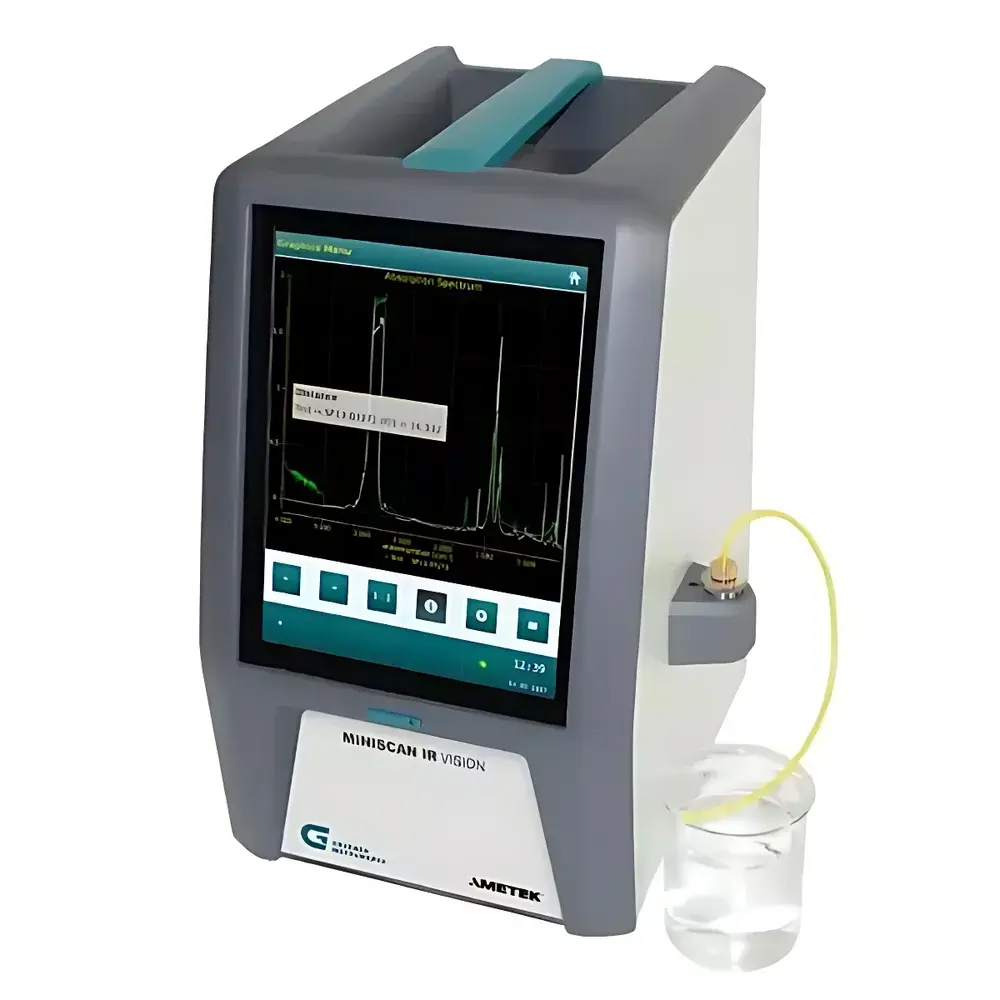
Grabner MINISCAN IR Vision Pro Portable Mid-IR Petroleum Fuel Analyzer
| Brand | Grabner |
|---|---|
| Origin | Austria |
| Manufacturer Type | Original Equipment Manufacturer (OEM) |
| Import Status | Imported |
| Model | MINISCAN IR Vision Pro |
| Pricing | Upon Request |
Overview
The Grabner MINISCAN IR Vision Pro is a field-deployable, mid-infrared (MIR) spectrophotometric fuel analyzer engineered for rapid, quantitative determination of compositional and performance parameters in gasoline, diesel, and aviation turbine fuel (Jet A-1). Operating on the principle of Fourier-transform infrared (FTIR) spectroscopy coupled with chemometric modeling—primarily Partial Least Squares (PLS) regression—the instrument acquires full-spectrum MIR absorbance data (typically 4000–600 cm⁻¹) from undiluted liquid fuel samples. This spectral fingerprint enables simultaneous prediction of over 100 physicochemical properties without reagent consumption or sample preparation. Designed to meet regulatory and industrial testing requirements—including GB/T 33648–2017 for detection of non-conventional additives in automotive gasoline—the MINISCAN IR Vision Pro delivers laboratory-grade accuracy in a ruggedized portable platform suitable for refinery blending control, terminal quality assurance, roadside inspection, and mobile field verification.
Key Features
- Integrated thermoelectrically controlled sample handling system: temperature-regulated autosampler, flow cell, and built-in digital density meter (ASTM D1298/D4052 compliant) ensure volumetric and mass-based quantification stability across ambient fluctuations.
- Dual-mirror interferometer with automatic optical alignment: self-calibrating mirror position compensation maintains spectral fidelity after mechanical shock or transport over rough terrain.
- 10-inch industrial-grade capacitive touchscreen display: sunlight-readable, glove-compatible interface with customizable soft-key layout; supports multilingual operation (English, Chinese, German, Spanish, French).
- Robust mechanical design: IP54-rated enclosure; MIL-STD-810G certified for shock (40 g), vibration (5–500 Hz), and thermal cycling (−10 °C to +50 °C operational range).
- Modular power architecture: dual-mode operation—100–264 V AC, 47–63 Hz, 130 W—or 12 V DC vehicle adapter (included) for uninterrupted field deployment.
- Non-pressurized metal fluidic path: bubble-free, corrosion-resistant stainless-steel inlet system validated for >100,000 cycles; eliminates solvent wash steps and cross-contamination risk.
Sample Compatibility & Compliance
The MINISCAN IR Vision Pro is validated for direct analysis of neat hydrocarbon fuels without dilution or derivatization. Compatible matrices include unleaded gasoline (including ethanol- and MTBE-blended variants), ultra-low-sulfur diesel (ULSD), biodiesel blends (B5–B20), and aviation turbine fuel (Jet A/A-1). All embedded calibrations are traceable to reference materials certified by NIST, PTB, and SGS. Method compliance includes ASTM D5845 (oxygenates), ASTM D6277/EN 238/SH/T 0797 (benzene), EN 14078/ASTM D7806/GB/T 23801 (FAME), and ASTM E1655/GB/T 29858 (multivariate calibration validation protocols). Calibration datasets originate exclusively from >12,000 real-world fuel samples collected and analyzed by SGS laboratories under ISO/IEC 17025-accredited conditions.
Software & Data Management
The onboard firmware implements GLP-compliant audit trail functionality with time-stamped, user-identifiable records for all measurements, calibration updates, and method changes. Raw interferograms and processed spectra are stored in vendor-neutral JCAMP-DX format. Data export supports CSV, PDF, and XML formats compatible with LIMS integration via Ethernet (dual LAN ports) or USB mass storage. Software includes PLS model management tools for local calibration refinement, outlier detection (Mahalanobis distance), and residual analysis. Firmware updates are delivered via encrypted USB key or secure HTTPS download; all versions comply with IEC 62443-4-2 for embedded device cybersecurity.
Applications
- Real-time blending optimization in refinery process units and additive injection skids.
- In-line QC at distribution terminals and bulk storage facilities per API RP 1162 guidelines.
- Regulatory compliance screening for oxygenates (ethanol, MTBE, ETBE), aromatics (benzene, toluene), and illicit additives (dimethyl carbonate, methylal, sec-butyl acetate) in accordance with national fuel specifications.
- Forensic fuel authentication and adulteration detection during customs inspections or commercial arbitration.
- Supporting ASTM D975, D3699, and D1655 specification conformance testing without off-site lab dependency.
FAQ
Does the MINISCAN IR Vision Pro require daily recalibration?
No—factory-installed calibrations remain stable for ≥6 months under routine use; verification checks using certified reference fuels are recommended weekly.
Can users develop custom PLS models for proprietary fuel formulations?
Yes—the instrument includes full-featured chemometric software (Grabner ChemCal™) licensed for local model development, validation, and deployment under ISO 11095 and ASTM E1655 guidelines.
Is the system compliant with FDA 21 CFR Part 11 for electronic records?
While not a pharmaceutical instrument, its audit trail, electronic signature, and data integrity controls meet the technical prerequisites of Part 11 for regulated petroleum QA/QC environments.
What maintenance is required beyond routine cleaning?
Annual verification of density meter accuracy and interferometer alignment by authorized Grabner service engineers is recommended; no consumables or lamps require replacement.
How is spectral drift compensated during extended field operation?
The dual-interferometer architecture continuously monitors and corrects for intensity drift via real-time reference beam normalization—no user intervention needed.





