
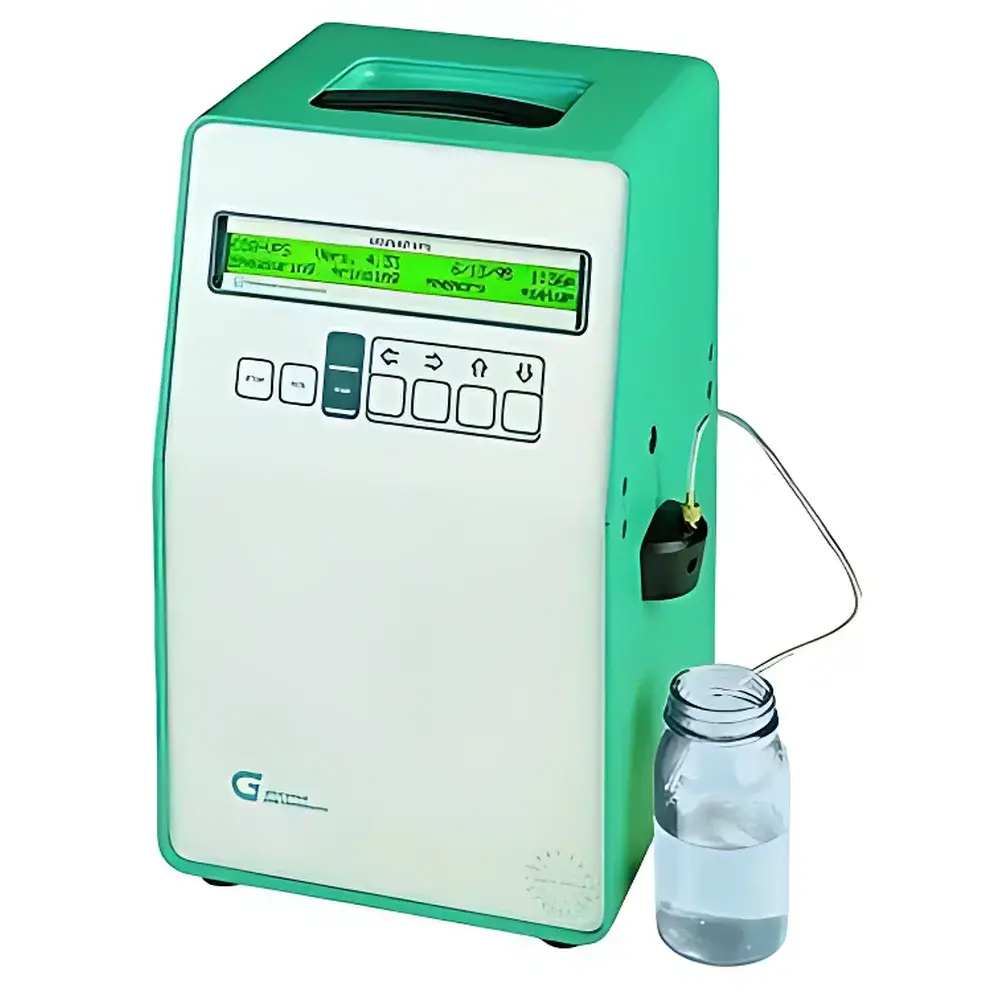
Grabner MiniVAP VPS/VPSH Automatic Vapor Pressure Analyzer
| Brand | Grabner |
|---|---|
| Origin | Austria |
| Manufacturer Type | Manufacturer |
| Origin Category | Imported |
| Model | MiniVAP VPS/VPSH |
| Analysis Method | Three-Stage Expansion Method |
| Pressure Range | 0–1000 kPa |
| Temperature Range | 0–100 °C |
Overview
The Grabner MiniVAP VPS/VPSH Automatic Vapor Pressure Analyzer is a precision-engineered instrument designed for the rapid, accurate, and fully automated determination of true vapor pressure (TVP) and Reid vapor pressure (RVP) of volatile petroleum products and chemical substances. It operates on the internationally validated three-stage expansion method—a thermodynamically rigorous approach that enables direct measurement of absolute vapor pressure without equilibrium assumptions or empirical corrections. Unlike traditional methods such as ASTM D323 (Reid Method), which rely on fixed-volume, fixed-temperature conditions and require post-test hot-water purging—introducing significant bias for oxygenated fuels—the MiniVAP eliminates sample contamination and thermal hysteresis through its patented piston-driven expansion sequence. Its methodology is formally recognized by the U.S. Environmental Protection Agency (EPA) and codified in 40 CFR Part 79 and 58 Fed. Reg. 14478 (March 17, 1993), establishing it as one of only a few instruments granted regulatory acceptance for compliance testing under federal fuel specifications.
Key Features
- Three-stage expansion measurement principle ensures traceable, thermodynamic consistency with NIST-traceable pressure and temperature sensors
- Integrated automatic sample introduction, vapor-phase equilibration, expansion cycling, and post-measurement pneumatic cleaning—no manual intervention required
- Compact benchtop architecture (196 × 315 × 175 mm; 8 kg) with dual-power capability: 100–230 V AC, 50 Hz / 65 W or 12 V DC, 8 A for field deployment
- Full automation via intuitive one-touch interface; all operations—including calibration verification, system self-check, and result export—are initiated with a single command
- Real-time pressure and temperature monitoring with high-stability platinum RTD (±0.05 °C) and piezoresistive transducer (±0.1 kPa)
- Onboard data storage supporting ≥1,000 test records with timestamp, operator ID, ambient conditions, and full expansion curve metadata
Sample Compatibility & Compliance
The MiniVAP VPS/VPSH accommodates a broad spectrum of volatile liquid matrices including gasoline (conventional, oxygenated, ethanol-blended), crude oil fractions, liquefied petroleum gas (LPG), biofuels (e.g., Fischer–Tropsch syncrude), and industrial solvents. It meets or exceeds the technical requirements of multiple global regulatory and standardization frameworks: ASTM D6377 (Standard Test Method for Determination of Vapor Pressure of Crude Oil), ASTM D6378 (Standard Test Method for Determination of Vapor Pressure of Petroleum Products—Three-Stage Expansion Method), ASTM D5191, ASTM D4953, ASTM D323, EN 13016-1/2, IP 394, IP 409, and SH/T 0769–2005 and SH/T 0794–2007 (Chinese petroleum industry standards). Its design supports REACH Annex XIV substance evaluation and GHS Classification criteria for flammability (Category 1–3), fulfilling laboratory audit requirements under ISO/IEC 17025, GLP, and FDA 21 CFR Part 11 when paired with compliant LIMS integration.
Software & Data Management
The instrument is compatible with Grabner’s proprietary VAPSoft™ software suite (Windows-based), enabling full remote control, method configuration, real-time expansion curve visualization, statistical trend analysis, and automated report generation per ASTM or internal QA templates. Data export options include CSV, PDF, and XML formats compliant with LIMS interfaces (via RS-232, USB, or optional Ethernet). Audit trail functionality logs all user actions, parameter changes, calibration events, and measurement history with immutable timestamps—meeting ALCOA+ (Attributable, Legible, Contemporaneous, Original, Accurate, Complete, Consistent, Enduring, Available) principles for regulated environments. Optional 21 CFR Part 11-compliant electronic signature modules are available upon request.
Applications
- Quality control of gasoline blending components and finished fuels in refinery QC labs
- Regulatory compliance testing for EPA Tier 3, EU Fuel Quality Directive (2009/30/EC), and China VI fuel specifications
- Research and development of low-RVP reformulated fuels and renewable hydrocarbon blends
- Hazard classification and SDS authoring under GHS and CLP Regulation (EC No. 1272/2008)
- Field-based vapor pressure assessment during pipeline transfer, terminal receipt, or marine bunkering operations
- Supporting REACH registration dossiers requiring reliable TVP data for volatile organic compounds (VOCs)
FAQ
What distinguishes the three-stage expansion method from the Reid method (ASTM D323)?
The three-stage expansion method measures absolute vapor pressure directly under thermodynamic equilibrium conditions across controlled volume increments, eliminating reliance on fixed-temperature water baths and subjective visual endpoint detection. It avoids systematic errors introduced by hot-water purging—particularly critical for ethanol- and MTBE-containing fuels where Reid values overestimate actual volatility.
Is the MiniVAP suitable for crude oil analysis?
Yes. The VPSH variant includes an extended temperature range (up to 100 °C) and enhanced pressure sensor stability optimized for heavier distillates and unstable crudes, satisfying ASTM D6378 requirements for crude TVP determination.
Does the instrument support GLP-compliant data integrity?
When used with VAPSoft™ and configured with audit trail and electronic signature modules, the system fulfills core GLP data governance requirements—including data immutability, operator accountability, and version-controlled method storage.
Can it be operated outside a fixed laboratory environment?
Its lightweight, shock-resistant chassis, low power consumption, and 12 V DC input make it deployable in mobile labs, offshore platforms, or roadside inspection units without compromising measurement reproducibility.
How frequently does calibration verification need to be performed?
Daily verification using certified reference fluids (e.g., n-pentane, n-heptane) is recommended prior to routine use; full recalibration per Grabner’s service protocol is advised every 12 months or after 500 measurements, whichever occurs first.





