
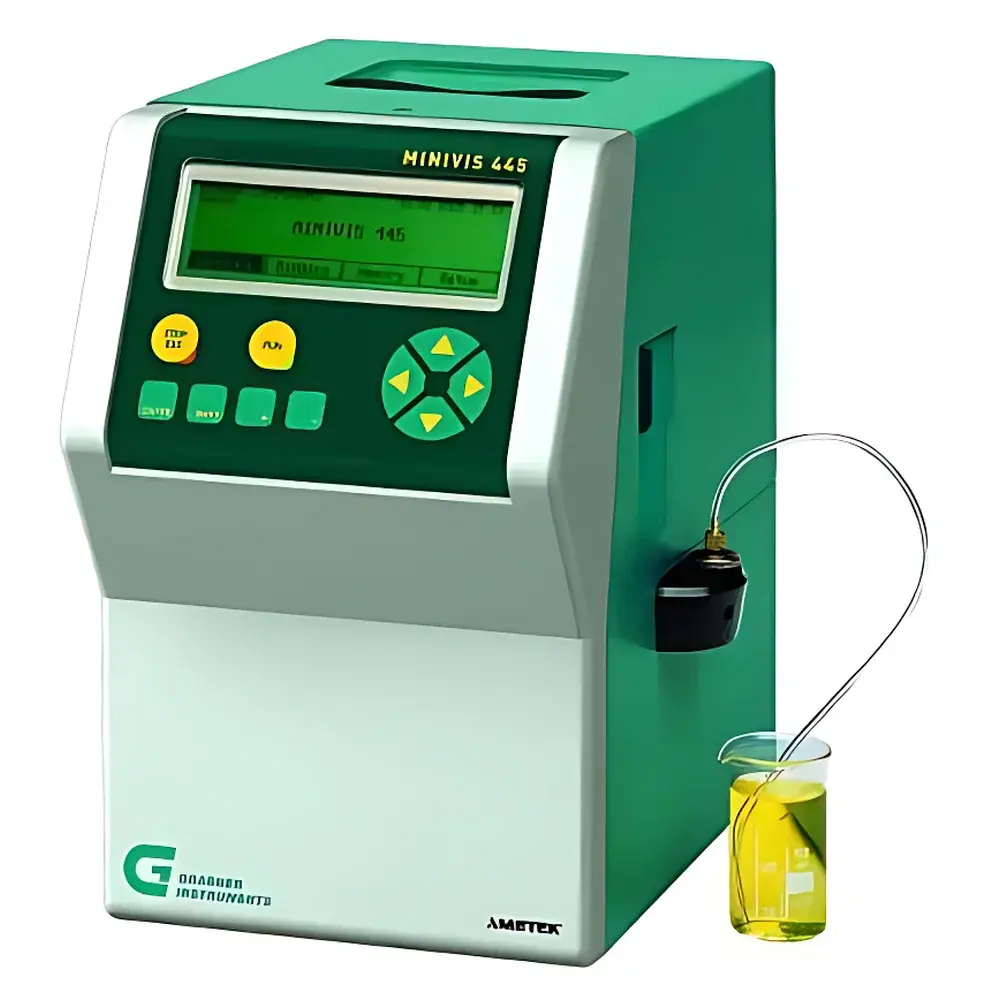
Grabner MiniVIS 445 Automated Kinematic Viscosity Tester
| Brand | Grabner |
|---|---|
| Origin | Austria |
| Model | MiniVIS 445 |
| Kinematic Viscosity Range | 0.2–2000 mm²/s (cSt) |
| Density Range | 0.62–2.00 g/cm³ |
| Temperature Range | −20 to +110 °C (Peltier-controlled, with 4 °C water cooling) |
| Temperature Stability | ±0.02 °C |
| Viscosity Resolution | 4 significant digits |
| Density Resolution | 0.0001 g/cm³ |
| Repeatability | ±0.3% of measured value (viscosity), ±0.0005 g/cm³ (density) |
| Sample Volume per Test | 5 mL (measurement), 25 mL total (including cleaning) |
| Throughput | 20 tests/hour (incl. cleaning at 100 cSt, 40 °C) |
| Compliance | ASTM D445, ISO 3104, ASTM D2270 |
| Power | 100–240 V AC, 50/60 Hz, 85 W |
| Dimensions (W×H×D) | 200 × 320 × 240 mm |
| Weight | 11 kg |
Overview
The Grabner MiniVIS 445 Automated Kinematic Viscosity Tester is an integrated, benchtop-capable instrument engineered for precise and fully automated determination of kinematic viscosity, density, and viscosity index (VI) in petroleum liquids—including base oils, lubricants, fuels, and heavy residual fractions—under controlled thermal conditions. It employs the滚球 method (rolling ball viscometry), a gravity-driven capillary principle standardized in ASTM D445 and ISO 3104, where the time-of-fall of a calibrated sphere through a thermostatted sample column is converted into kinematic viscosity via calibration constants. Unlike traditional U-tube or capillary viscometers, the MiniVIS 445 implements a sealed, removable measurement cell with reflective optical sensors that detect ball transit without physical contact—eliminating meniscus reading errors and enabling robust operation even with opaque, dark, or highly viscous samples such as bunker fuel or asphaltene-containing distillates. Its Peltier-based thermal management system delivers rapid, bidirectional temperature control from −20 °C to +110 °C with ±0.02 °C stability—removing dependency on external water baths while maintaining metrological traceability across the full operating range.
Key Features
- Fully automated workflow: Integrated syringe-based autosampler, programmable solvent-assisted cleaning cycle, and dual-cell configuration (one in use, one standby for inspection or ultrasonic cleaning)
- Optical rolling-ball detection: Non-contact, reflection-mode photodiode array ensures high reproducibility (<0.3% RSD) independent of sample color or turbidity
- Simultaneous density measurement: Built-in oscillating U-tube densitometer compliant with ASTM D4052 and ISO 12185, delivering 0.0001 g/cm³ resolution
- Viscosity Index (VI) calculation per ASTM D2270: Automatic dual-temperature testing at 40 °C and 100 °C with synchronized thermal equilibration and data export
- Low sample consumption: Only 5 mL required for measurement; total 25 mL per test cycle (including 20 mL for automated cleaning)
- Ruggedized industrial design: IP54-rated enclosure, shock-absorbing chassis, and corrosion-resistant fluid path materials suitable for refinery labs, marine environments, and mobile field units
- Flexible power options: Operates on standard AC mains or 12 V DC input—enabling deployment in remote locations, offshore platforms, or transportable QC vans
Sample Compatibility & Compliance
The MiniVIS 445 accommodates a broad spectrum of petroleum-derived fluids—from low-viscosity naphthas (0.2 cSt) to heavy fuel oils (2000 cSt)—without dilution or preheating. Its sealed measurement cell resists fouling from asphaltene deposition, particulate carryover, or oxidation residues, and its quick-release mechanism allows visual inspection and ultrasonic cleaning without tools. All viscosity and density results are traceable to NIST-certified reference standards and comply with regulatory and quality assurance frameworks including ASTM D445 (Standard Test Method for Kinematic Viscosity of Transparent and Opaque Liquids), ISO 3104 (Petroleum products — Determination of kinematic viscosity), ASTM D2270 (Calculation of Viscosity Index), and ISO 12185 (Crude petroleum and petroleum products — Determination of density). The instrument supports GLP-compliant audit trails when connected to LIMS via RS232, and firmware logging meets basic requirements for FDA 21 CFR Part 11 data integrity when paired with validated software environments.
Software & Data Management
Controlled via an integrated membrane keypad or external PC using Grabner’s proprietary ViscoSoft™ application (Windows-compatible), the MiniVIS 445 generates timestamped, user-attributed result files in CSV and XML formats. Each test record includes raw transit times, temperature logs, density values, calculated kinematic viscosity, VI, and cleaning cycle status. The software enables method storage (up to 99 user-defined protocols), statistical batch reporting (mean, SD, CV%), and automatic pass/fail flagging against configurable specification limits. Audit trail functionality captures operator ID, parameter changes, and calibration events. Data export supports integration with enterprise QMS platforms and satisfies documentation requirements for ISO/IEC 17025-accredited laboratories.
Applications
- Refinery process control: Real-time monitoring of distillate cuts, lube oil blending, and vacuum gas oil viscosity grading
- Finished product QC: Certification of engine oils, hydraulic fluids, transformer oils, and jet fuels per OEM and military specifications (e.g., MIL-PRF-23699, SAE J300)
- Condition monitoring: In-service oil analysis for viscosity drift, oxidation, or fuel dilution in diesel and turbine applications
- Research & development: Formulation screening of synthetic base stocks, bio-lubricants, and low-SAPS additives
- Field verification: On-site testing at depots, terminals, and third-party inspection agencies under variable ambient conditions (+5 to +35 °C)
FAQ
Does the MiniVIS 445 require external calibration standards for routine operation?
No—factory calibration is performed using NIST-traceable viscosity and density reference fluids. Users may perform periodic verification with certified standards (e.g., Cannon-Manning or Paragon fluids), but recalibration is not required unless hardware maintenance is performed.
Can the instrument measure samples above 1000 cSt without pre-dilution?
Yes—the rolling-ball principle and optimized cell geometry enable direct measurement up to 2000 cSt at temperatures down to −20 °C, provided the sample remains fluid enough to allow sphere descent within the timing window.
How is cleaning validated between samples?
The system monitors solvent flow pressure, rinse duration, and optical clarity of the cell post-rinse. A “clean cell” confirmation is issued only after three consecutive blank readings fall within predefined baseline thresholds.
Is the Peltier cooling capacity sufficient to maintain −20 °C during continuous operation?
Yes—when coupled with an external 4 °C recirculating chiller, the Peltier module sustains −20 °C at the measurement cell with <±0.02 °C deviation over 8-hour runs, verified per internal thermal mapping protocol.
What maintenance intervals are recommended for long-term reliability?
Daily: Visual inspection of cell cleanliness and solvent levels. Quarterly: Replacement of inlet filter and verification of syringe seal integrity. Annually: Full calibration check and Peltier efficiency validation by authorized service technician.






