
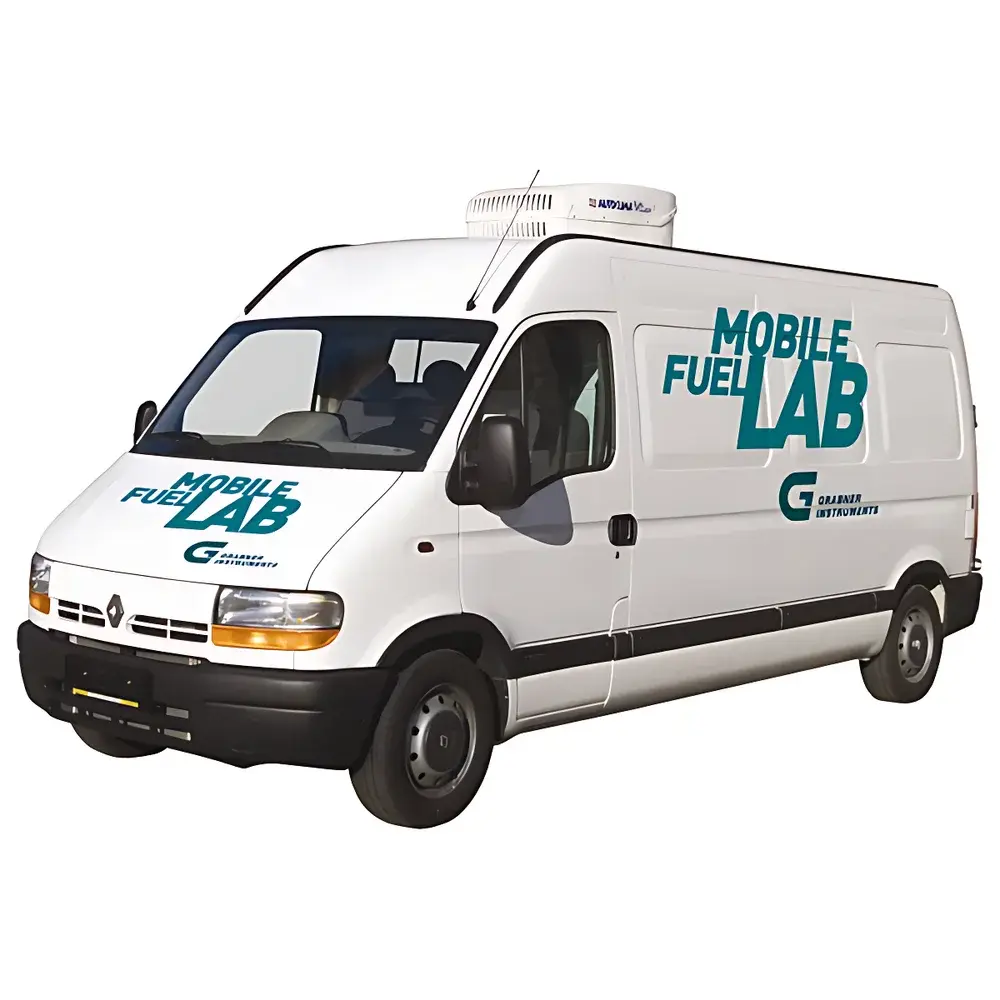
Grabner MobileLab Fuel Testing Vehicle
| Brand | GRABNER |
|---|---|
| Origin | Austria |
| Model | MobileLab |
| Application | Gasoline Octane Number (RON/MON) and Diesel Cetane Number (CN) Analysis |
| Portability | Fully Mobile Laboratory Vehicle |
| Measurement Principle | Near-Infrared (NIR) Spectroscopy |
| Measurement Range | 40–120 (Octane/Cetane Scale) |
| Accuracy | ±1 unit |
| Analysis Time | <15 minutes per sample |
| Sample Volume | 10 mL |
| Power Supply | Dual-source — rechargeable 12 V DC battery + external 240 V AC input |
| Compliance | Designed to support ASTM D2699, D2700, D613, ISO 5164, ISO 5163, EN 228, EN 590, GOST R 51105, GOST R 51463 |
Overview
The Grabner MobileLab Fuel Testing Vehicle is a fully integrated, road-certified mobile laboratory engineered for on-site, real-time analysis of gasoline octane number (RON/MON) and diesel cetane number (CN). Unlike conventional benchtop analyzers requiring centralized lab infrastructure, the MobileLab deploys near-infrared (NIR) spectroscopy — a non-destructive, calibration-transfer-stable technique — to deliver reference-grade results directly at fuel terminals, refineries, blending facilities, customs checkpoints, or roadside inspection sites. Its core architecture eliminates sample preparation: raw fuel samples (as received, without filtration or stabilization) are introduced directly into the analyzer via a dedicated 10 mL sampling port. The NIR optical module acquires spectral data across defined wavelength bands sensitive to hydrocarbon composition, branching, and aromaticity; chemometric models—pre-validated against primary reference fuels and traceable to NIST-traceable standards—convert spectra into certified octane/cetane values in under 15 minutes. All instrumentation operates within a temperature- and vibration-controlled environment, ensuring metrological continuity regardless of ambient conditions or vehicle motion.
Key Features
- Fully self-contained mobile platform compliant with EU road traffic regulations (type-approved chassis options available)
- Integrated NIR-based fuel analyzer with factory-calibrated chemometric models for RON, MON, and CN—fully aligned with ASTM D2699/D2700/D613 and ISO 5164/5163
- Vibration-isolated instrument mounting system using custom-engineered elastomeric dampers (tested to ISO 5073 shock profiles)
- Climate-controlled cabin with independent HVAC system delivering ≥20 air changes per hour, maintaining 20–25 °C ±2 °C during operation
- Dual-power architecture: 12 V DC battery bank (with automatic switchover) + 240 V AC input (IEC 60309 connector), enabling uninterrupted operation during transit and stationary use
- Onboard water management: stainless-steel sink with fresh/distilled water reservoir and dedicated waste container (door-mounted, sealed, leak-proof)
- Modular instrumentation bay accommodating additional Grabner analyzers (e.g., flash point, distillation, sulfur content) or third-party devices via standardized DIN rails and RS-232/USB interfaces
- Dedicated control panel for HVAC, lighting, emergency ventilation, and power distribution—accessible without entering the main lab zone
Sample Compatibility & Compliance
The MobileLab accepts undiluted, unfiltered gasoline (including ethanol-blended E5–E85), diesel (EN 590, ASTM D975), biodiesel (FAME, HVO), and jet fuel (Jet A-1). No solvent addition, phase separation, or pre-heating is required. All measurements comply with internationally recognized test methods: ASTM D2699 (RON), D2700 (MON), D613 (CN), ISO 5164 (RON), ISO 5163 (MON), EN 228 (gasoline specification), EN 590 (diesel specification), and GOST R 51105 / GOST R 51463 (Russian Federation national standards). The system supports full audit trails, electronic signatures, and 21 CFR Part 11–compliant data integrity features when paired with Grabner’s LabLink software suite.
Software & Data Management
Data acquisition, reporting, and instrument coordination are managed through Grabner LabLink v5.x — a Windows-based platform supporting multi-device synchronization via serial, USB, and TCP/IP protocols. Each analysis generates a timestamped, digitally signed PDF report containing raw spectra, calibration metadata, uncertainty estimates (k=2), and compliance flags against target specifications (e.g., EN 228 Table 1 limits). All data are stored locally on an encrypted SSD with optional cloud backup (AWS S3 or on-premise NAS). Audit logs record user logins, method changes, calibration events, and result modifications—enabling full GLP/GMP traceability. Optional integration with LIMS systems is supported via ASTM E1384-compliant HL7 or CSV export.
Applications
- Regulatory fuel quality surveillance at ports, border crossings, and bulk terminals
- Real-time blend verification during refinery off-gas or pipeline transfer operations
- Field validation of fuel deliveries prior to acceptance by commercial fleets or aviation ground handlers
- Forensic investigation of fuel adulteration or mislabeling incidents
- Support for ISO/IEC 17025-accredited mobile testing services (scope documentation provided upon request)
- Rapid troubleshooting of engine knock or ignition delay issues via direct correlation between measured octane/cetane and field performance data
FAQ
Does the MobileLab require periodic recalibration using primary reference fuels?
Yes — initial commissioning includes traceable calibration against CRM-certified primary reference materials. Subsequent recalibration intervals are determined by usage frequency and regulatory requirements (typically every 6–12 months); Grabner provides on-site recalibration services with full certificate of calibration.
Can the system analyze fuels containing oxygenates such as MTBE or ETBE?
Yes — the NIR chemometric models are explicitly trained on oxygenated gasoline matrices up to 15 vol% and validated per ASTM D4814 Annex A3.
Is GPS positioning data embedded in analytical reports?
Yes — optional GNSS module (u-blox M8T) records WGS84 coordinates, altitude, and UTC timestamp with each analysis, enabling georeferenced quality mapping.
What maintenance is required for the onboard NIR spectrometer?
The solid-state optical module has no moving parts; routine maintenance is limited to quarterly cleaning of the quartz sampling window with IPA and annual verification of wavelength accuracy using NIST-traceable holmium oxide filters.
Can the MobileLab be configured for hazardous area (ATEX Zone 1) operation?
Yes — explosion-proof variants (II 2G Ex db IIB T4 Gb) are available upon request, including intrinsically safe sampling ports and purged electrical enclosures compliant with IEC 60079-0/10/13.






