
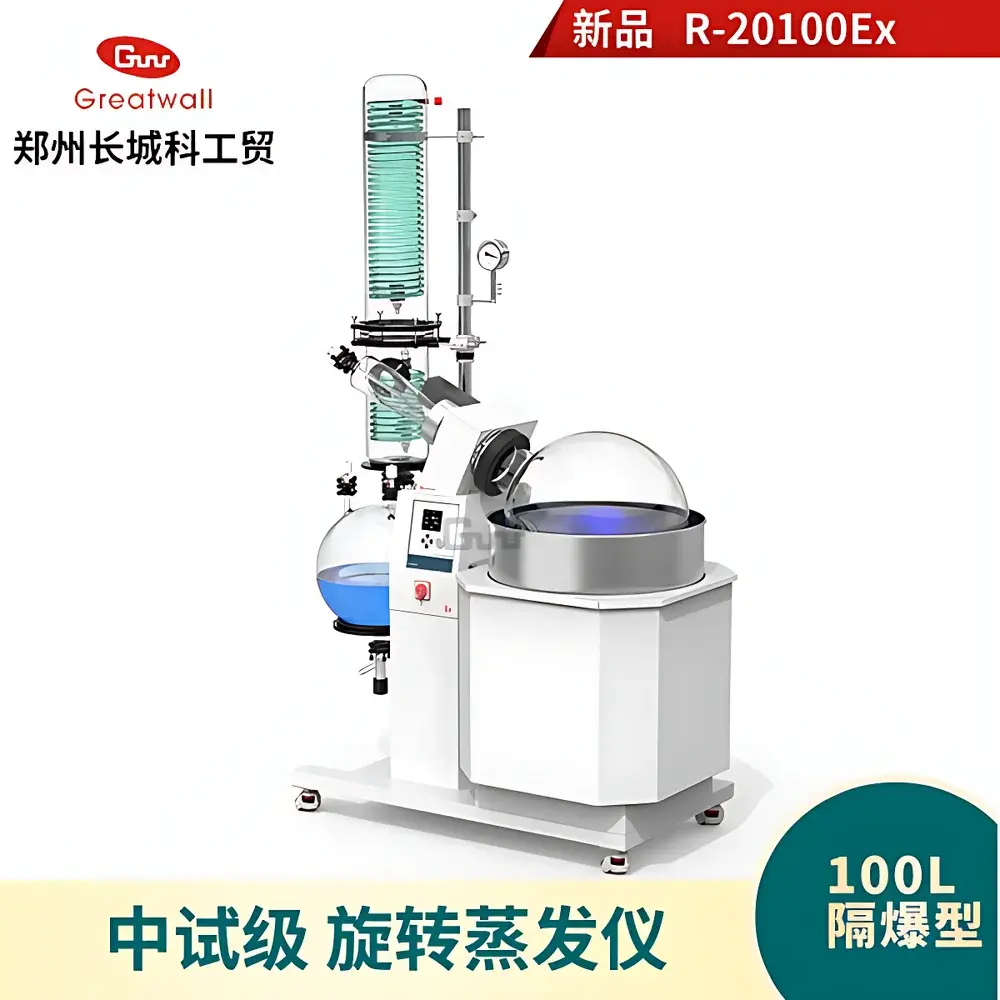
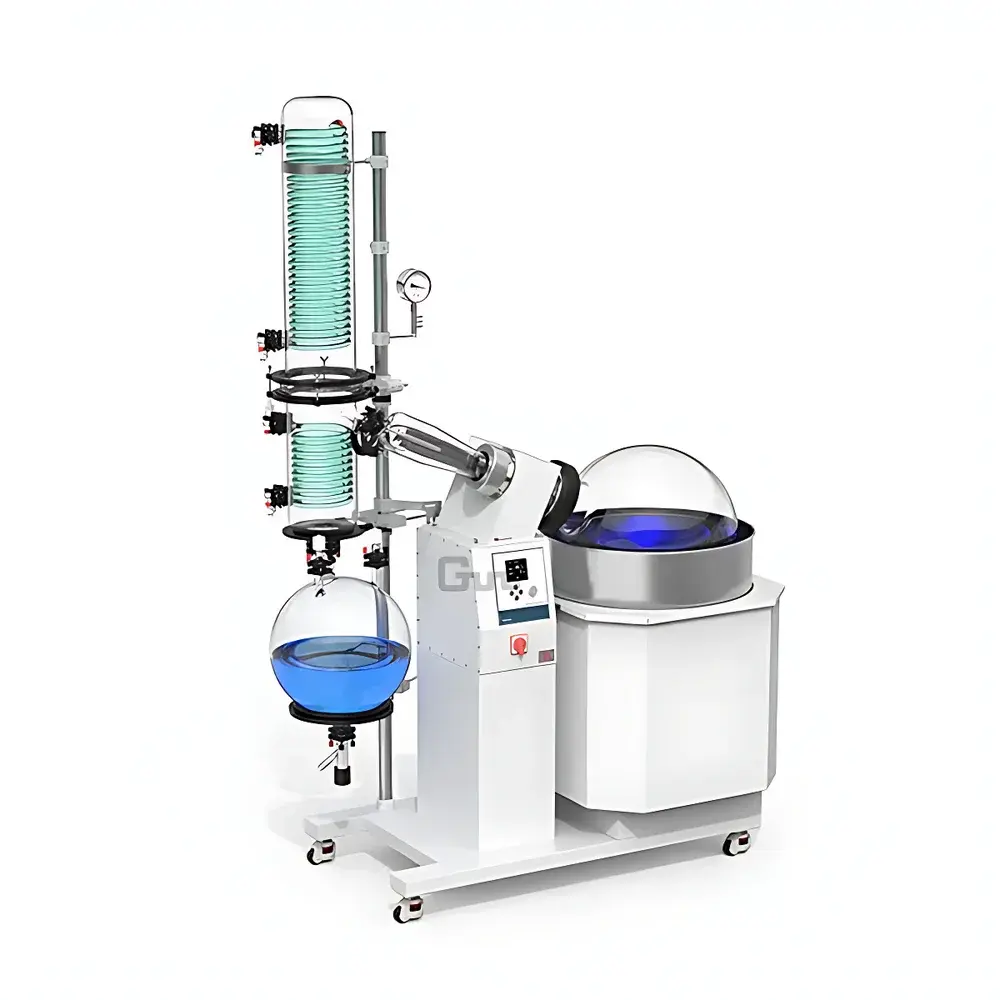
The Great Wall R-20100Ex Explosion-Proof Rotary Evaporator
| Brand | The Great Wall |
|---|---|
| Origin | Henan, China |
| Manufacturer Type | Direct Manufacturer |
| Origin Category | Domestic |
| Model | R-20100Ex |
| Capacity | 100 L |
| Rotational Speed | 20–80 rpm |
| Temperature Control Range | Ambient +5°C to 80°C |
| Condensing Area | Main Condenser: 2.1 m² |
| Explosion Protection | Ex d IIB T4 Gb (IEC 60079-1) |
| Display | LCD Interface |
| Drive & Control Components | Intrinsically Safe Encoded Input for Temp/Speed |
| Condenser Design | Dual-Cooling (Main + Auxiliary) Triple-Return Glass Condenser |
| Flask Material | DIN 3.3 Borosilicate Glass (ISO 3585) |
| Bath Lift | Motorized with Liquid-Level Detection and Dry-Run Prevention |
| Drain Valve | PTFE-Sealed Corrosion-Resistant Valve |
| Joint Type | Ground-Glass Flange Connections (ISO KF/DIN 28178 Compatible) |
| Mobility | Locking Casters with Brake Mechanism |
Overview
The Great Wall R-20100Ex Explosion-Proof Rotary Evaporator is an industrial-scale purification system engineered for safe, continuous solvent removal under hazardous area conditions. It operates on the principle of reduced-pressure distillation: a rotating evaporation flask increases surface area and promotes uniform thin-film formation, while controlled bath heating and vacuum application lower the boiling point of solvents. The integrated explosion-proof architecture conforms to IEC 60079-1 (Flameproof “d” enclosure), certified for Zone 1 (Group IIB, T4, Equipment Protection Level Gb), enabling deployment in Class I, Division 1 environments where flammable vapors such as acetone, ethanol, ethyl acetate, or hydrocarbon solvents may be present during operation. Designed specifically for batch processing up to 100 L, it bridges the gap between laboratory-scale rotovaps and pilot-plant evaporators—offering scalability without compromising intrinsic safety integrity.
Key Features
- DIN 3.3 borosilicate glass assembly: All major glass components—including evaporation flask, condenser, receiving flask, and three-way buffer bottle—meet ISO 3585 specifications, ensuring thermal shock resistance (>160°C ΔT), chemical inertness against organic solvents and mild acids/bases, and optical clarity for process monitoring.
- Triple-return condenser with dual cooling zones: Combines a primary condenser (2.1 m² effective surface area) and auxiliary cooling section to maximize vapor capture efficiency; achieves >95% solvent recovery under typical operating conditions (e.g., 40°C bath, 100 mbar vacuum, 60 rpm).
- Full-system explosion protection: Motor, heating bath controller, temperature sensor, speed encoder, and electrical control cabinet are individually certified to Ex d IIB T4 Gb (EN 60079-1). No spark-generating components are exposed to the hazardous atmosphere.
- Motorized lift mechanism with safety interlocks: Electrically actuated bath elevation includes ultrasonic liquid-level sensing and thermal cutoff to prevent dry-heating; lift行程 supports flask handling across standard floor-to-bench height variations.
- PTFE-sealed bottom discharge valve: Chemically resistant, zero-leakage valve enables safe, quantitative transfer of concentrated residue without breaking vacuum or interrupting distillation continuity.
- Modular flange-based assembly: All glass joints utilize standardized ISO-KF/DIN 28178-compatible ground-glass flanges with PTFE-coated clamps—enabling rapid, repeatable disassembly for cleaning, inspection, or maintenance without torque-sensitive alignment.
Sample Compatibility & Compliance
The R-20100Ex accommodates a broad range of thermally labile and volatile samples, including natural product extracts, polymer solutions, pharmaceutical intermediates, and fine chemical reaction mixtures. Its design supports compatibility with common low-boiling solvents (e.g., dichloromethane, diethyl ether, pentane) as well as higher-boiling media (e.g., toluene, DMF, ethylene glycol) when operated within the specified 20–80°C bath range. Regulatory alignment includes conformity with IEC 60079 series for explosive atmospheres, CE marking per ATEX Directive 2014/34/EU (Category 2G), and mechanical safety compliance per EN 61000-6-2/-6-4 (EMC). While not inherently GLP-compliant, the system supports audit-ready operation when integrated with validated external vacuum controllers and temperature loggers meeting FDA 21 CFR Part 11 data integrity requirements.
Software & Data Management
The R-20100Ex features a dedicated LCD interface with encoded rotary dial input for precise, tactile adjustment of rotational speed (20–80 rpm, ±1 rpm resolution) and bath temperature (ambient +5°C to 80°C, ±0.5°C accuracy). Though standalone, the unit provides analog 0–10 V output signals for both temperature and speed—enabling integration into centralized SCADA or DCS platforms via optional signal conditioners. Real-time parameter logging requires external acquisition hardware; however, the control logic includes built-in fault memory that records the last five operational errors (e.g., dry-run trigger, overtemperature event, vacuum loss) with timestamps for root-cause analysis.
Applications
- Concentration of heat-sensitive botanical extracts in compliance with EU GMP Annex 15 solvent recovery guidelines
- Removal of reaction solvents from API synthesis batches under OSHA 1910.119 Process Safety Management (PSM) requirements
- Recycling of high-purity solvents in semiconductor-grade chemical manufacturing (SEMI F57 compatible workflows)
- Preparative-scale isolation of nanomaterial dispersions where static charge accumulation must be mitigated
- Continuous-feed evaporation of wastewater streams containing VOCs in EPA-regulated treatment facilities
FAQ
What hazardous area classifications does the R-20100Ex support?
It is certified for Zone 1 (IEC/ATEX) and Class I, Division 1 (NEC) locations, Group IIB (propane-level ignition energy), with maximum surface temperature ≤135°C (T4), EPL Gb.
Can the system operate under deep vacuum (<10 mbar)?
Yes—when paired with a certified explosion-proof vacuum pump (e.g., KNF NRP series with Ex d motor), the system maintains structural integrity and seal performance down to 1 mbar; however, condensation efficiency decreases below 5 mbar without cryogenic assistance.
Is the 100 L capacity rated for working volume or total flask volume?
The 100 L designation refers to the nominal evaporation flask volume; recommended working volume is 40–70 L to ensure stable film formation and avoid bumping or foaming-induced carryover.
Does the unit include vacuum regulation capability?
No—vacuum control is external; the system includes a vacuum-tight stopcock and pressure gauge port (¼” NPT) for integration with PID-controlled vacuum regulators or solenoid-valve manifolds.
What maintenance intervals are recommended for explosion-proof components?
Per IEC 60079-17, flameproof enclosures require visual inspection before each use and detailed verification (joint gap measurement, corrosion assessment, gasket integrity) every 12 months by a competent person certified to IEC 60079-14.



