
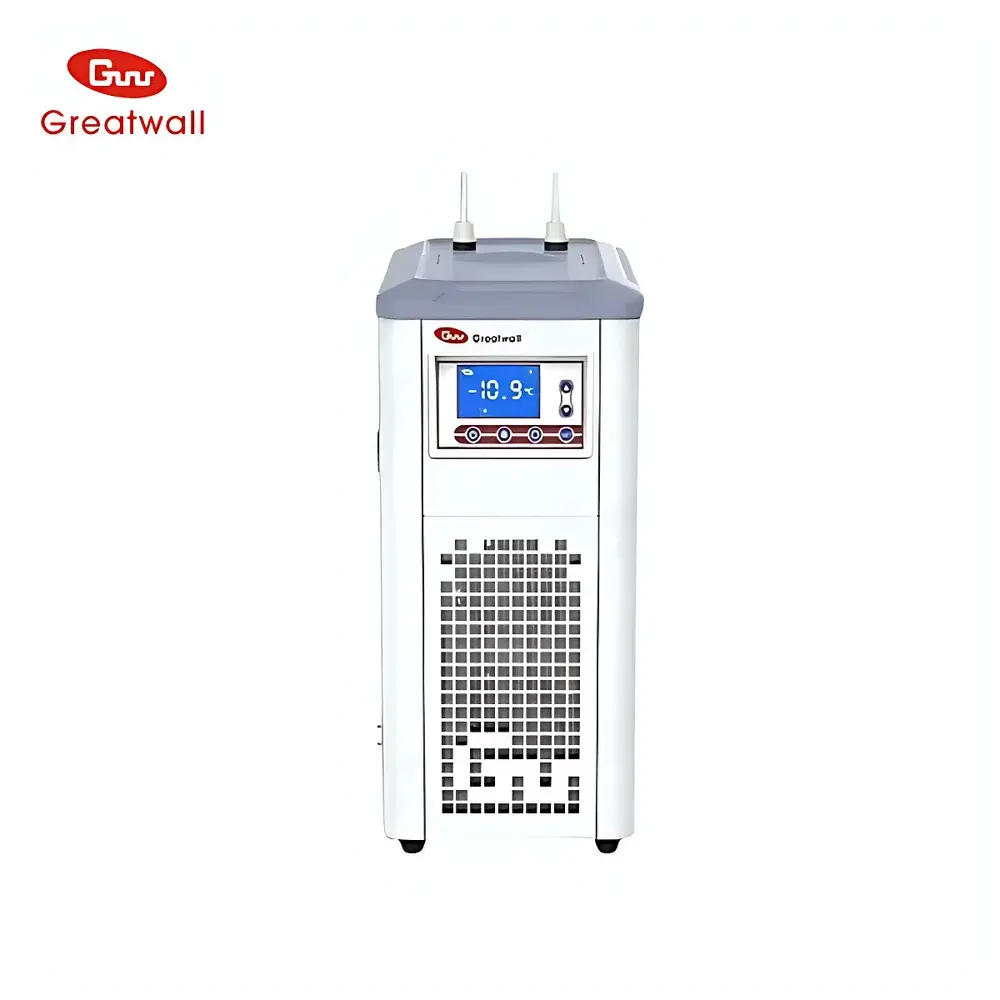
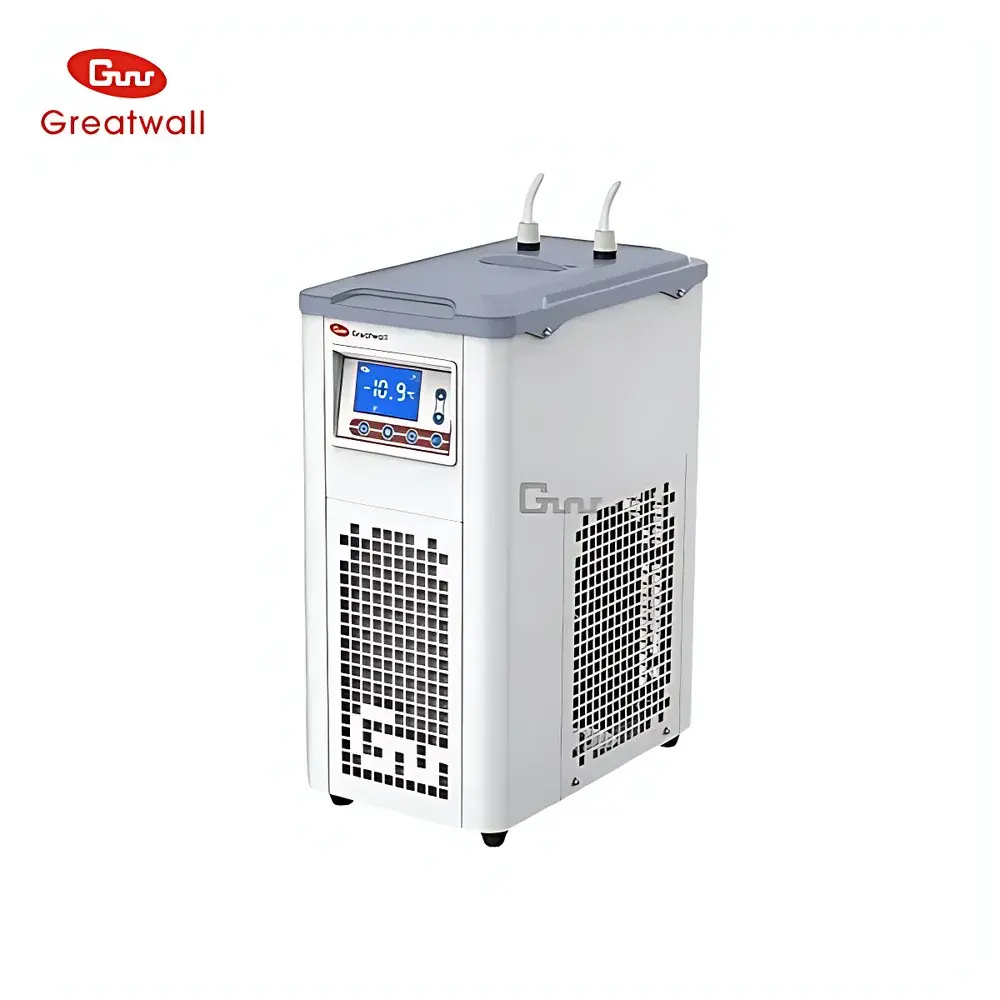
Great Wall DL-400 Circulating Chiller for Rotary Evaporator Support
| Brand | Great Wall |
|---|---|
| Origin | Henan, China |
| Manufacturer Type | Direct Manufacturer |
| Equipment Type | Integrated Circulating Chiller |
| Cooling Method | Air-Cooled |
| Temperature Control Range | −15 °C to 25 °C |
| Temperature Stability | ±2 °C |
| Refrigeration Capacity | 400 W @ 0 °C |
| Circulating Pump Flow Rate | 17 L/min |
| Pump Pressure | 0.2 bar |
| Reservoir Volume | 3 L |
| Power Supply | 220–240 V~, 50 Hz |
| Refrigerant | R134a |
| Sensor | Pt100 |
| Display Resolution | 0.1 °C |
| Safety Protections | Compressor Delay Start, Thermal Overload Protection, Overcurrent Protection |
| Certifications | CE (TUV certified) |
| Ambient Operating Conditions | 5–35 °C, ≤70% RH |
| Reservoir Material | SUS304 Stainless Steel |
| External Connection | Ø10 mm OD, compatible with silicone tubing (Ø13×Ø9 mm) |
| Dimensions (W×D×H) | 260×410×550 mm |
| Net Weight | 26 kg |
Overview
The Great Wall DL-400 Circulating Chiller is an air-cooled, integrated refrigeration system engineered specifically to support rotary evaporators and other low-heat-load laboratory instruments requiring precise, continuous coolant delivery. It operates on the vapor-compression cycle using environmentally compliant R134a refrigerant and delivers stable thermal output across a wide operating range—from −15 °C to +25 °C—with a nominal refrigeration capacity of 400 W at 0 °C. Designed for integration into compact benchtop workflows, the unit features a 3 L stainless steel (SUS304) reservoir, a high-efficiency centrifugal circulation pump (17 L/min at 0.2 bar), and a microprocessor-controlled temperature regulation system with Pt100 sensor feedback. Its thermally optimized chassis and quiet air-cooled condenser enable reliable 24/7 operation in standard laboratory environments (5–35 °C, ≤70% RH), making it suitable for routine solvent removal, cold-trap conditioning, and auxiliary cooling of condensers, reflux systems, or vacuum pumps.
Key Features
- Integrated air-cooled architecture with sealed R134a refrigeration circuit—no external water supply or drainage required
- High-resolution LCD interface displaying setpoint and actual bath temperature to 0.1 °C resolution
- 360° rotatable fluid coupling ports for ergonomic, strain-free connection to rotary evaporator condensers and other equipment
- Multi-layer safety system including compressor delay start (prevents short-cycling), thermal overload protection, and electronic overcurrent cutoff
- SUS304 stainless steel reservoir and wetted components ensure chemical compatibility with common solvents (e.g., acetone, ethanol, ethyl acetate, dichloromethane) and long-term corrosion resistance
- Low-noise operation (<65 dB(A) at 1 m) suitable for shared lab spaces and QC environments
- CE-marked per EN 61000-6-3 (EMC) and EN 61000-6-2 (immunity), certified by TÜV Rheinland
Sample Compatibility & Compliance
The DL-400 is intended for use with non-corrosive, non-viscous heat-transfer fluids—including deionized water, 30% ethylene glycol/water mixtures, or approved silicone-based coolants. It is not rated for flammable, highly acidic, or halogenated solvents as primary circulating media. The unit complies with IEC 61010-1:2010 for electrical safety in laboratory equipment and meets essential requirements of the EU Machinery Directive 2006/42/EC. While not explicitly validated for GMP or GLP environments, its robust construction, traceable temperature control, and built-in safety interlocks support audit-readiness when deployed within documented laboratory procedures aligned with ISO/IEC 17025 or FDA 21 CFR Part 11–compliant workflows (where electronic records are managed externally).
Software & Data Management
The DL-400 operates as a standalone analog-digital hybrid controller with no embedded data logging or network interface. Temperature setpoints and real-time readings are accessible only via the front-panel LCD. For laboratories requiring digital recordkeeping, optional third-party USB or RS-485 interface modules (sold separately) may be integrated with LabVIEW, MATLAB, or SCADA platforms using Modbus RTU protocol—subject to firmware compatibility verification. All operational parameters—including power-on duration, fault codes (E1–E4), and temperature deviation history—are retained in volatile memory during active use but are not persistently stored or exportable without external instrumentation.
Applications
- Coolant source for rotary evaporators (e.g., Buchi R-300, IKA RV 10, Heidolph Hei-VAP) during solvent evaporation under reduced pressure
- Temperature stabilization of cold traps in vacuum distillation or freeze-drying pre-chilling stages
- Secondary cooling loop for jacketed reactors, condensers, or chromatography column ovens operating below ambient
- Support for benchtop NMR sample chillers, electrophoresis apparatus, or laser cooling where moderate sub-ambient stability suffices
- General-purpose chilling for QA/QC testing environments requiring repeatable thermal conditioning of samples or fixtures
FAQ
What is the minimum achievable temperature with a full load of coolant?
The DL-400 achieves a no-load minimum of −15 °C; under typical rotary evaporator load (e.g., 2–3 L flask, 150 mbar vacuum), sustained output remains within −10 °C to −5 °C depending on ambient conditions and coolant composition.
Can this chiller be used with organic solvents directly in the reservoir?
No. Only water-miscible, non-aggressive heat-transfer fluids are permitted. Pure acetone or chloroform will degrade seals and compromise refrigeration efficiency.
Is remote monitoring or control possible out of the box?
No. The unit lacks native Ethernet, Wi-Fi, or analog output interfaces. Integration requires external signal converters and custom driver development.
How often does the refrigerant require servicing or replenishment?
Under normal operation and proper maintenance (clean condenser fins, unobstructed airflow), the sealed R134a circuit requires no periodic recharge. Leakage is indicated by loss of cooling capacity and should be addressed by authorized service personnel.
Does the chiller meet requirements for ISO 17025-accredited testing labs?
While the unit itself is not accredited, its CE certification, traceable Pt100 sensor, and documented thermal stability (±2 °C) permit inclusion in method validation protocols when calibrated per ISO/IEC 17025 Clause 6.4 and associated uncertainty budgets.



