
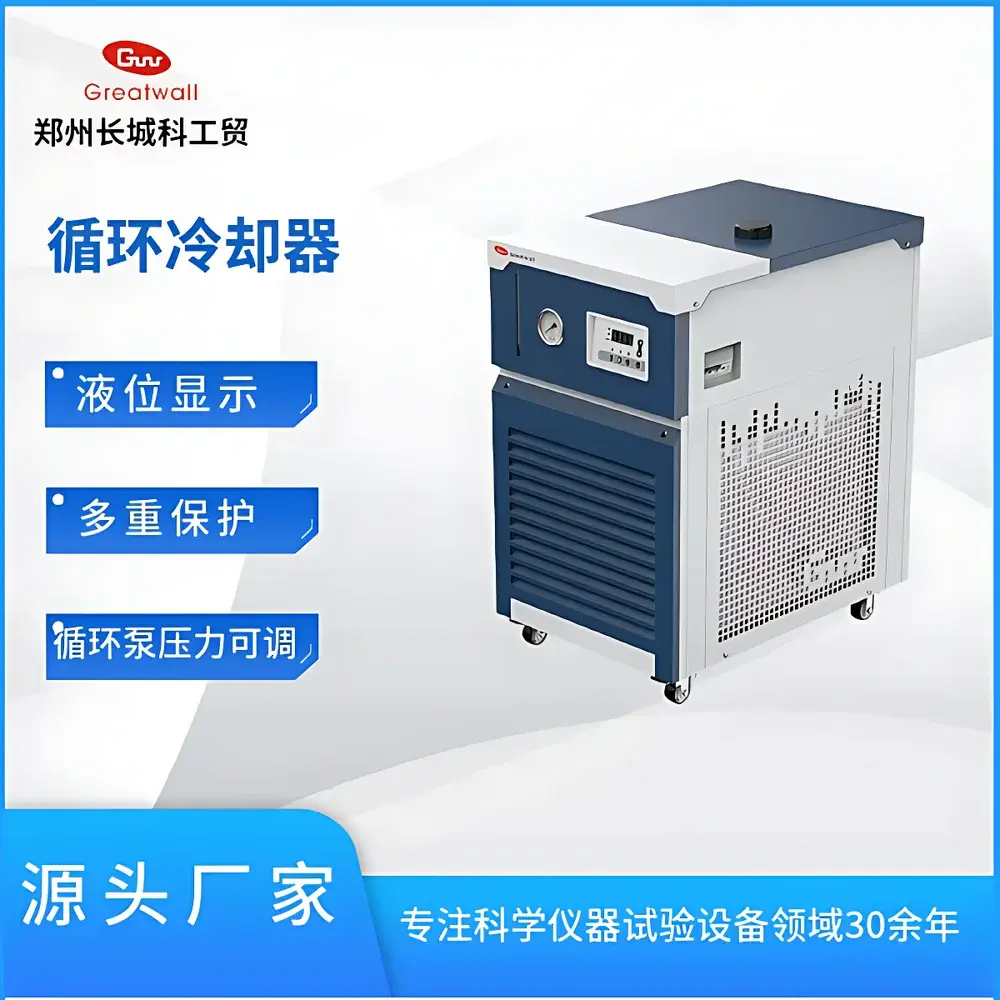
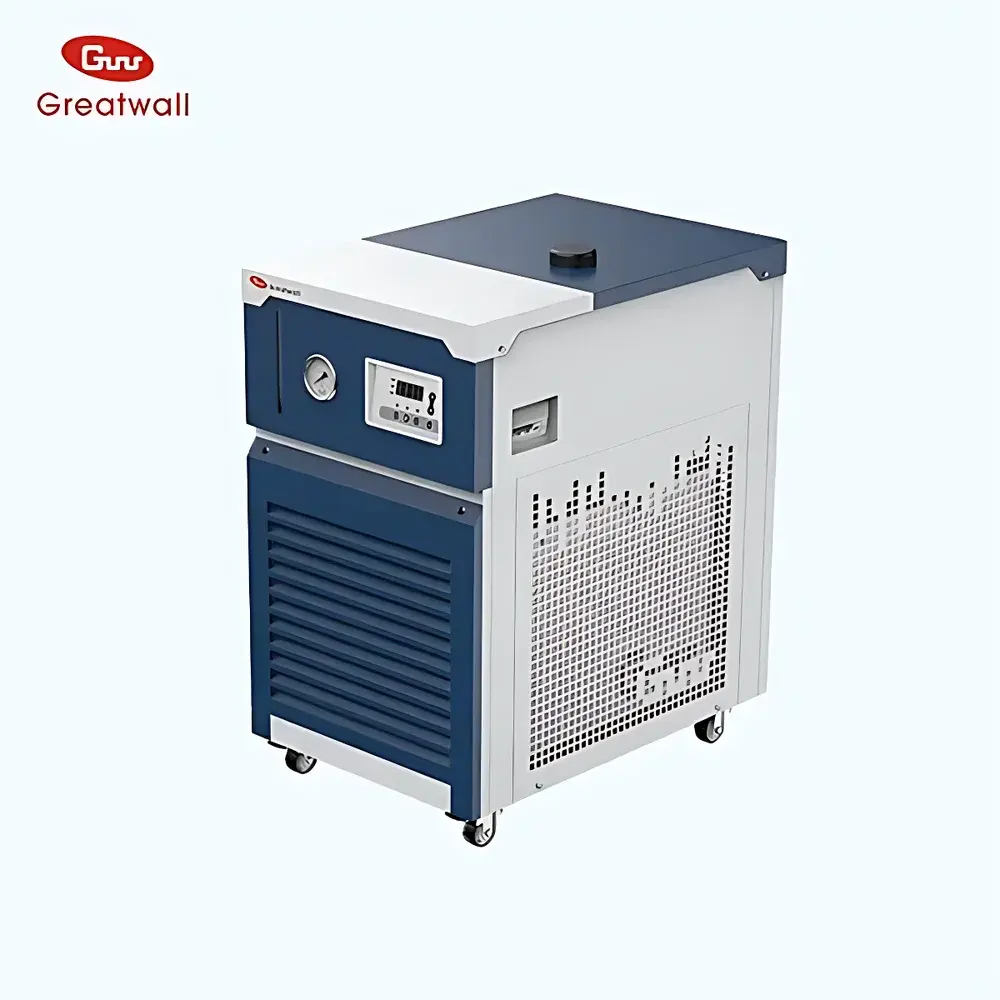
The Great Wall DL10-1000G Adjustable-Pressure Circulating Chiller
| Brand | The Great Wall |
|---|---|
| Origin | Henan, China |
| Manufacturer Type | Direct Manufacturer |
| Equipment Type | Integrated Circulating Chiller |
| Cooling Method | Air-Cooled |
| Temperature Range (Heat Transfer Fluid Output) | −10 °C to 25 °C |
| Refrigeration Capacity | 1000 W (tested at 25 °C ambient) |
| Temperature Stability | ±2 °C |
| Circulating Pump Pressure Range | 1–10 bar |
| Flow Rate | 7 L/min |
| Operating Mode | Continuous |
| Refrigerant | R134a |
| Reservoir Volume | 10 L |
| Reservoir Material | 304 Stainless Steel |
| Power Supply | 220–240 V~, 50 Hz |
| Rated Power | 1165 W |
| Rated Current | 6.2 A |
| Dimensions (W×D×H) | 435 × 690 × 720 mm |
| Net Weight | 73 kg |
| Ambient Operating Conditions | 5–35 °C, ≤70% RH |
| Sensor Type | Pt100 |
| Display | Digital LED |
| External Port | Rc 1/2 internal thread |
| Fill Opening Diameter | Ø60 mm |
Overview
The Great Wall DL10-1000G Adjustable-Pressure Circulating Chiller is an integrated, air-cooled refrigeration system engineered for precise thermal management in demanding laboratory environments. It operates on the vapor-compression cycle using environmentally compliant R134a refrigerant and delivers stable, controllable cooling to external instrumentation via a sealed, closed-loop heat transfer fluid circuit. Unlike open-bath chillers, the DL10-1000G maintains fluid integrity through its hermetic design—minimizing evaporation, moisture absorption, and oxidation of the thermal medium (typically water-glycol mixtures or specialized heat transfer fluids). Its core function is to sustain reaction or operational temperatures within a defined range (−10 °C to 25 °C) with ±2 °C stability under continuous duty, making it suitable for applications requiring extended unattended operation and reproducible thermal conditions.
Key Features
- Adjustable circulating pump pressure (1–10 bar): Enables optimization of flow dynamics across diverse instrument interfaces—including high-backpressure systems such as vacuum coating chambers, NMR cryoprobes, and ICP-MS nebulizer gas lines.
- Robust safety architecture: Integrates compressor delay-start protection, high-pressure cut-off, thermal overload protection, overcurrent interruption, and earth-leakage detection—all compliant with IEC 61000-6-2/6-4 electromagnetic compatibility standards.
- Real-time fluid level monitoring: Optical or float-based level sensing provides visual and relay-triggered alerts to prevent dry-run damage to the pump and heat exchanger.
- Corrosion-resistant 304 stainless steel reservoir: Ensures long-term chemical compatibility with common coolant formulations and resists degradation from repeated thermal cycling and trace contaminants.
- Digital Pt100 temperature feedback loop: Provides high-fidelity temperature measurement with class B accuracy (IEC 60751), supporting stable PID-controlled output across the full operating range.
- Continuous-duty rated motor and condenser fan: Designed for 24/7 operation under ambient conditions of 5–35 °C and ≤70% relative humidity—validated per ISO 5171 for industrial chiller performance testing.
Sample Compatibility & Compliance
The DL10-1000G is routinely deployed as a cold source for analytical and process equipment requiring stable low-temperature fluid circulation. It is compatible with atomic absorption spectrometers (AAS), inductively coupled plasma instruments (ICP-OES, ICP-MS), nuclear magnetic resonance (NMR) consoles, scanning/transmission electron microscopes (SEM/TEM), vacuum sputtering systems, bioreactors, and laser-based optical platforms. Its sealed-loop architecture aligns with GLP and GMP requirements for controlled environment documentation, while its electrical safety certifications meet CE marking criteria (EN 61000-6-2, EN 61000-6-4, EN 61000-3-2). Though not inherently 21 CFR Part 11 compliant, the unit supports integration into validated workflows when paired with audit-trail-capable external control software and calibrated temperature logging systems.
Software & Data Management
The DL10-1000G features a standalone digital controller with LED display and tactile membrane keypad—designed for reliability rather than network connectivity. While it does not include built-in Ethernet, USB, or Modbus interfaces, analog 0–10 V or 4–20 mA output signals (optional upon request) allow integration into centralized building management systems (BMS) or SCADA platforms. Temperature setpoints, real-time fluid temperature, pump status, and alarm states are locally viewable and retainable for manual logbook entry. For laboratories implementing electronic lab notebooks (ELNs) or LIMS, third-party data acquisition modules can be interfaced via the analog outputs to record thermal parameters alongside experimental metadata—supporting traceability per ISO/IEC 17025 Clause 7.7.
Applications
- Cooling of plasma torches and sample introduction systems in ICP-MS to suppress polyatomic interferences and improve signal stability.
- Thermal regulation of superconducting magnets and cryogenic probe assemblies in high-field NMR spectroscopy.
- Condensation management in rotary evaporators and short-path distillation systems operating below ambient dew point.
- Heat dissipation from high-power RF generators used in magnetron sputtering and plasma-enhanced CVD reactors.
- Temperature stabilization of photomultiplier tubes and CCD detectors in fluorescence and Raman spectrometers.
- Process cooling of microbial fermentation vessels where exothermic metabolic activity must be counterbalanced without introducing contamination risks associated with open-loop tap water systems.
FAQ
What types of heat transfer fluids are recommended for use with the DL10-1000G?
Deionized water, 30–50% aqueous ethylene glycol solutions, or certified synthetic heat transfer oils compatible with stainless steel and EPDM seals are suitable. Avoid chloride-containing or highly acidic formulations.
Can the unit operate continuously at its minimum temperature setting (−10 °C)?
Yes—provided ambient conditions remain within specification (≤35 °C, ≤70% RH) and the connected load does not exceed 1000 W at that setpoint. Sustained operation near the lower limit may reduce compressor lifespan if ambient humidity is high due to potential coil frosting.
Is remote monitoring or control possible without hardware modification?
No native communication interface is included; however, optional analog output modules enable connection to PLCs or DAQ systems for basic telemetry and setpoint adjustment.
Does the chiller meet international export certification requirements?
It carries CE marking for EMC and low-voltage directives and complies with RoHS 2011/65/EU. UL/cUL listing is available for North American markets upon request with model-specific validation.
How often should the refrigerant charge and pump seals be serviced?
Under normal laboratory use, refrigerant integrity is verified during annual preventive maintenance. Pump mechanical seals require inspection every 18–24 months or after 6000 hours of cumulative runtime—whichever occurs first.



