
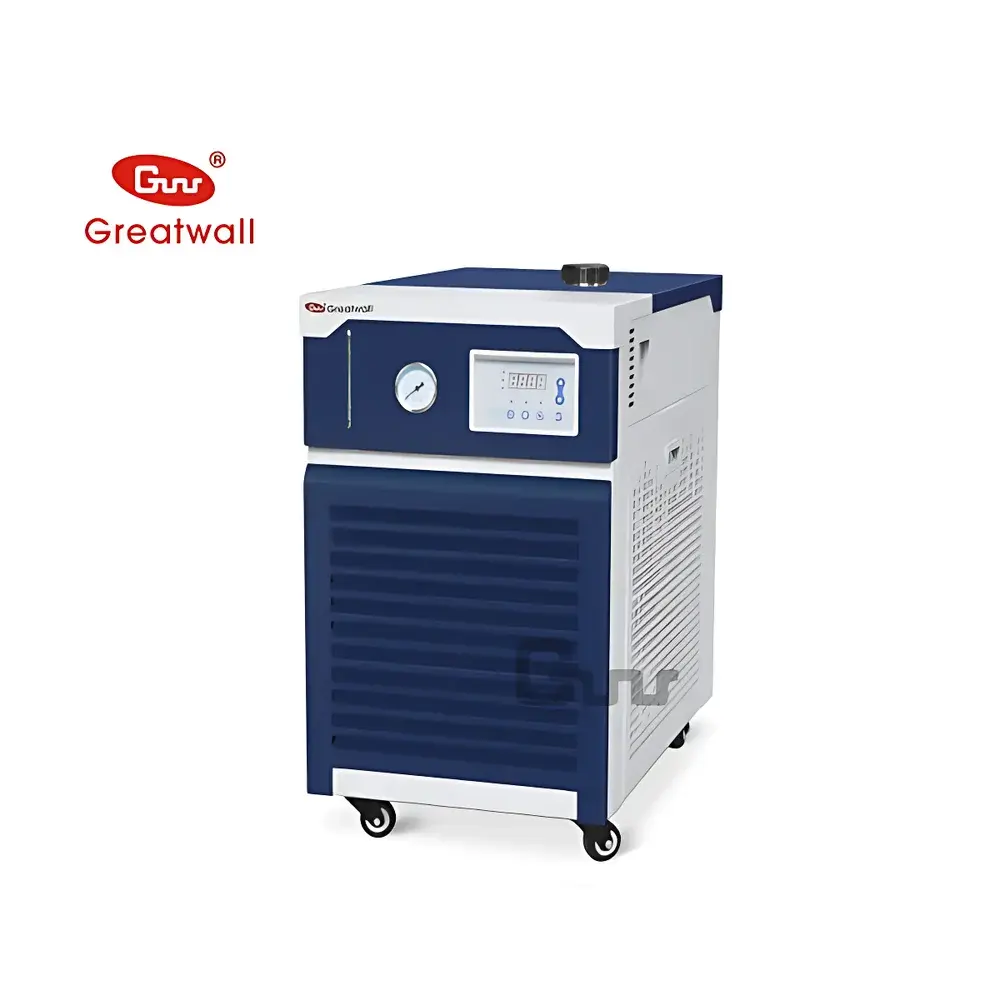
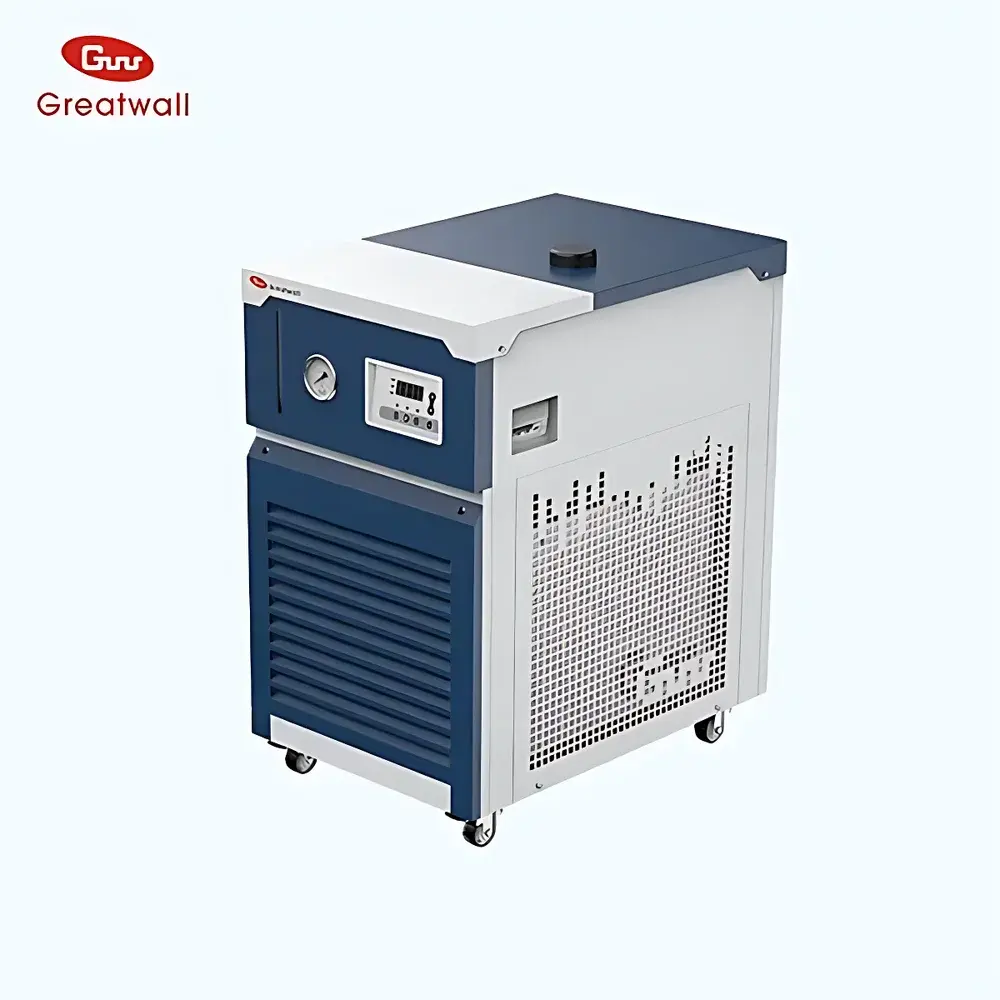
The Great Wall DL10-1000G Circulating Chiller
| Brand | The Great Wall |
|---|---|
| Origin | Henan, China |
| Manufacturer Type | Direct Manufacturer |
| Product Category | Domestic |
| Model | DL10-1000G |
| Instrument Type | Integrated Unit |
| Cooling Method | Air-Cooled |
| Temperature Control Range | −10 °C to 25 °C |
| Refrigeration Capacity | 1000 W @ 25 °C |
| Temperature Stability | ±2 °C |
| Circulating Pump Pressure | 1–10 bar |
| Circulating Pump Flow Rate | 7 L/min |
| Reservoir Volume | 10 L |
| Operation Mode | Continuous |
| Refrigerant | R134a |
| Reservoir Material | 304 Stainless Steel |
| Power Supply | 220–240 V~, 50 Hz |
| Rated Power | 1165 W |
| Rated Current | 6.2 A |
| Ambient Operating Temperature | 5–35 °C |
| Max. Relative Humidity | ≤70% |
| External Port Thread | Rc 1/2 (internal) |
| Fill Opening Diameter | Ø60 mm |
| Dimensions (W×D×H) | 435 × 690 × 720 mm |
| Net Weight | 73 kg |
Overview
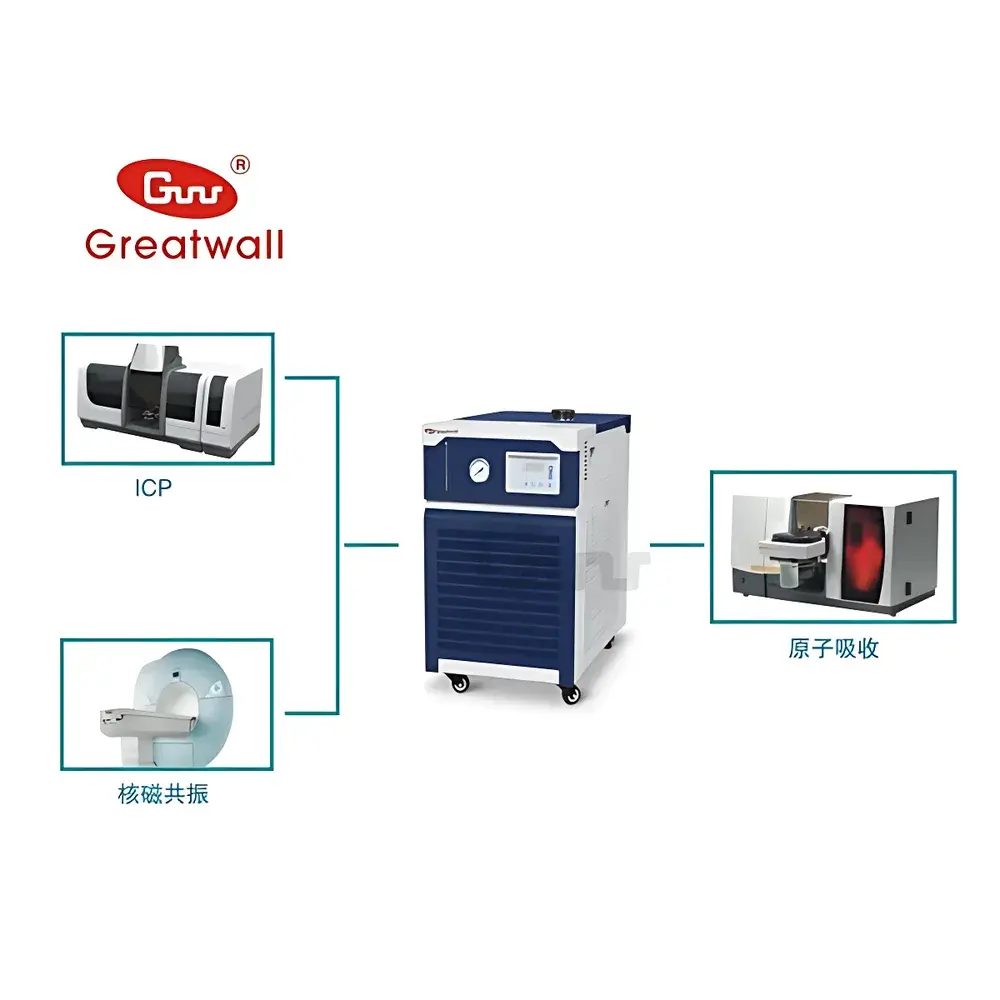
The Great Wall DL10-1000G Circulating Chiller is an integrated, air-cooled refrigeration system engineered for stable, continuous thermal management in demanding laboratory environments. It operates on a closed-loop circulation principle, delivering precisely regulated coolant—typically water or water-glycol mixtures—at temperatures ranging from −10 °C to 25 °C to external instruments and reactors. Unlike open-bath chillers, its sealed architecture minimizes evaporation loss and prevents moisture absorption or oxidation of the heat transfer fluid, ensuring long-term fluid integrity and consistent thermal performance. Designed for compatibility with high-value analytical and process equipment—including atomic absorption spectrometers (AAS), inductively coupled plasma (ICP and ICP-MS) systems, NMR spectrometers, electron microscopes, vacuum deposition chambers, and bioreactors—the DL10-1000G serves as a critical infrastructure component for temperature-sensitive experiments requiring reproducible cooling under ambient lab conditions.
Key Features
- Robust air-cooled refrigeration system using environmentally compliant R134a refrigerant, eliminating dependency on chilled water supply lines or external cooling towers.
- Stainless steel (304 grade) reservoir with 10 L capacity, corrosion-resistant and compatible with common aqueous and glycol-based heat transfer fluids.
- Adjustable pressure-regulated circulation pump (1–10 bar) and constant flow rate of 7 L/min, enabling flexible integration across varying hydraulic resistance requirements—from low-backpressure condensers to high-resistance jacketed reactors.
- Digital Pt100 temperature sensor with ±2 °C stability over the full operating range (−10 °C to 25 °C), supported by real-time liquid level monitoring to prevent dry-run operation.
- Comprehensive safety architecture including compressor delay start, high-pressure cut-off, thermal overload protection, overcurrent interruption, and earth-leakage detection—fully compliant with IEC 61000-6-2/6-4 EMC and IEC 61010-1 safety standards for laboratory equipment.
Sample Compatibility & Compliance
The DL10-1000G is not a sample analysis device but a thermal utility system supporting instrumentation that requires active cooling. Its design aligns with standard laboratory infrastructure expectations for Class II equipment per ISO/IEC 17025:2017 clause 6.4 (environmental conditions), and its electrical safety certification meets UL/CSA 61010-1 and GB 4793.1 requirements. While no direct regulatory compliance is mandated for chillers themselves, its stable output supports GLP/GMP-critical applications such as ICP-MS sample introduction cooling or NMR magnet cryo-shielding—where temperature drift directly impacts spectral resolution and quantitation accuracy. The closed-loop system also facilitates adherence to ASTM E2912-21 (Standard Guide for Laboratory Environmental Monitoring) by reducing ambient humidity fluctuations caused by evaporative cooling units.
Software & Data Management
The DL10-1000G operates via a dedicated front-panel digital controller with LED display, offering local setpoint adjustment, real-time temperature readout, and status indicators for pump, compressor, and alarm conditions. It does not feature embedded Ethernet, USB, or analog output interfaces; however, its operational parameters are fully compatible with third-party building management systems (BMS) or lab-wide SCADA networks via optional external signal converters (e.g., 4–20 mA temperature transmitters or relay-based dry-contact alarms). For audit-trail compliance in regulated environments, users may integrate the chiller’s status signals into validated LIMS or ELN platforms that support 21 CFR Part 11-compliant electronic recordkeeping—provided all connected hardware and software layers undergo formal qualification per IQ/OQ protocols.
Applications
- Cooling of high-power optical components in laser spectroscopy setups and confocal microscopy systems.
- Thermal stabilization of plasma sources in ICP-OES and ICP-MS instruments to maintain ionization efficiency and reduce polyatomic interferences.
- Condenser cooling in rotary evaporators and short-path distillation apparatuses handling thermally labile compounds.
- Temperature control of fermentation vessels and bioreactors during microbial or mammalian cell culture processes.
- Heat extraction from vacuum coating chambers and sputtering targets to prevent thermal deformation and film stress accumulation.
- Supporting cryogenic pre-cooling stages in superconducting magnet systems and low-temperature physics experiments.
FAQ
What is the minimum ambient temperature required for reliable operation?
The unit is rated for continuous operation between 5 °C and 35 °C ambient temperature. Below 5 °C, compressor oil viscosity increases and refrigerant return may be impaired; supplemental heating of the compressor compartment is recommended if installed in unconditioned spaces.
Can the chiller operate with ethylene glycol solutions?
Yes—up to 30% v/v aqueous ethylene glycol is compatible with the 304 stainless steel reservoir and internal wetted components. Higher concentrations require verification of pump seal compatibility and recalibration of flow-dependent temperature response.
Is remote monitoring or control possible out of the box?
No. The base model provides only local control. Integration with supervisory systems requires external analog/digital interface modules and validation per site-specific SOPs.
How often should the refrigerant charge be verified?
Under normal use and absence of leakage indicators (e.g., abnormal pressure readings, reduced cooling capacity), refrigerant verification is not routine. A full service check—including leak testing, oil analysis, and charge validation—is recommended every 24 months or after any compressor service event.
Does the unit meet noise emission standards for ISO Class 5 cleanrooms?
With a typical sound pressure level of ≤62 dB(A) at 1 m distance, it exceeds ISO 14644-4 requirements for ancillary equipment in non-critical zones. For placement inside cleanroom buffer areas, acoustic enclosures or remote installation with extended coolant lines are advised.



