
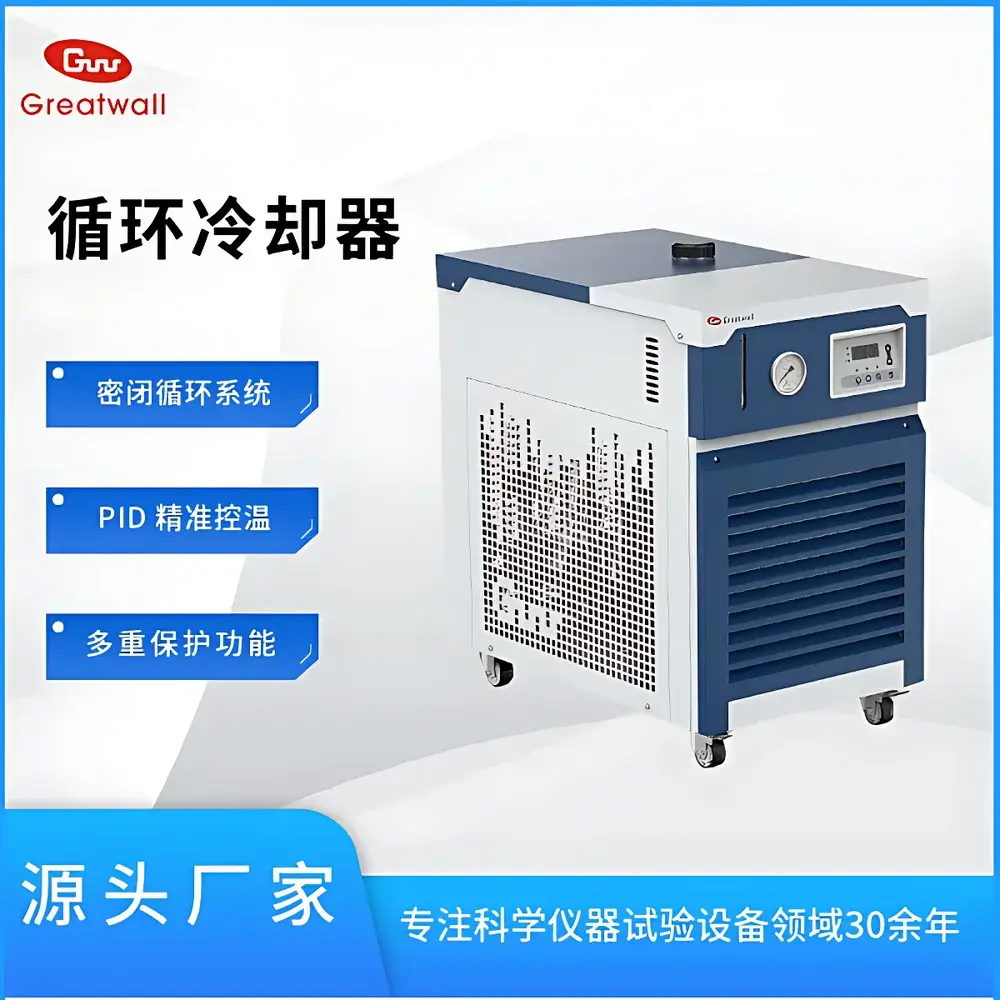
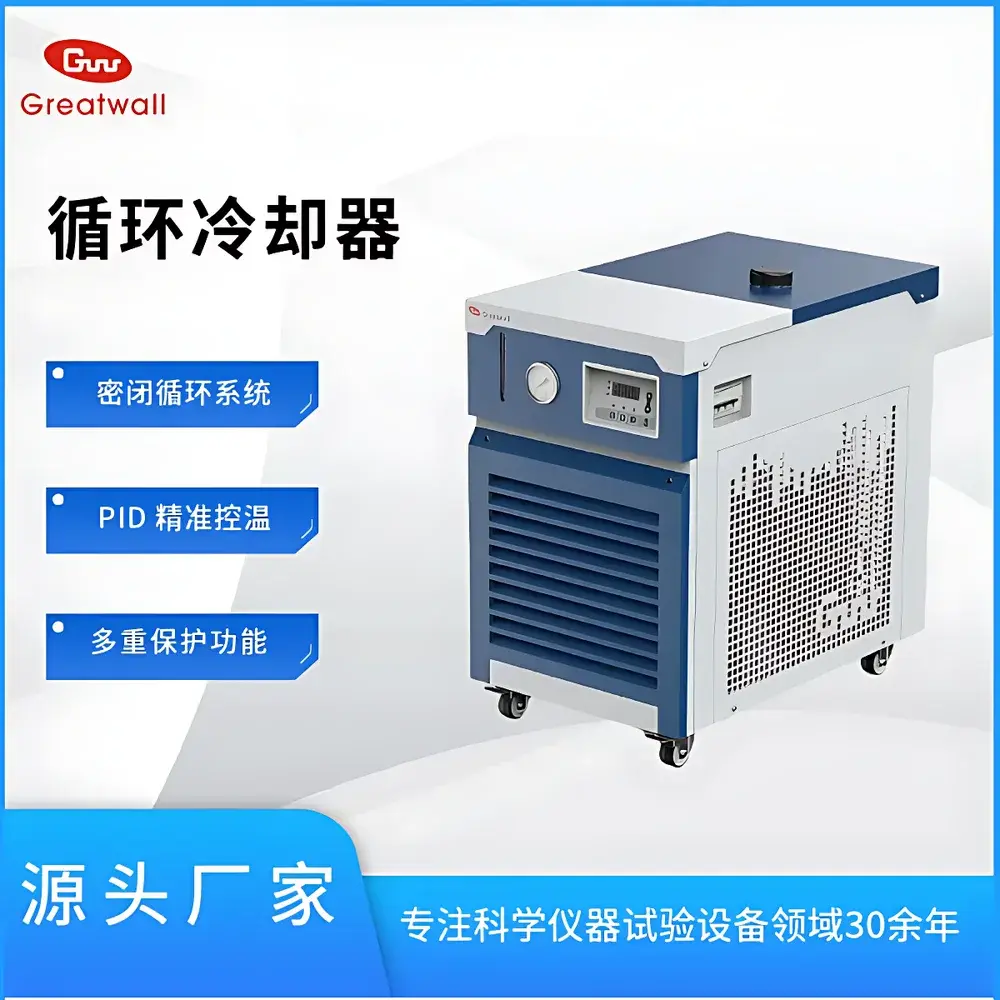
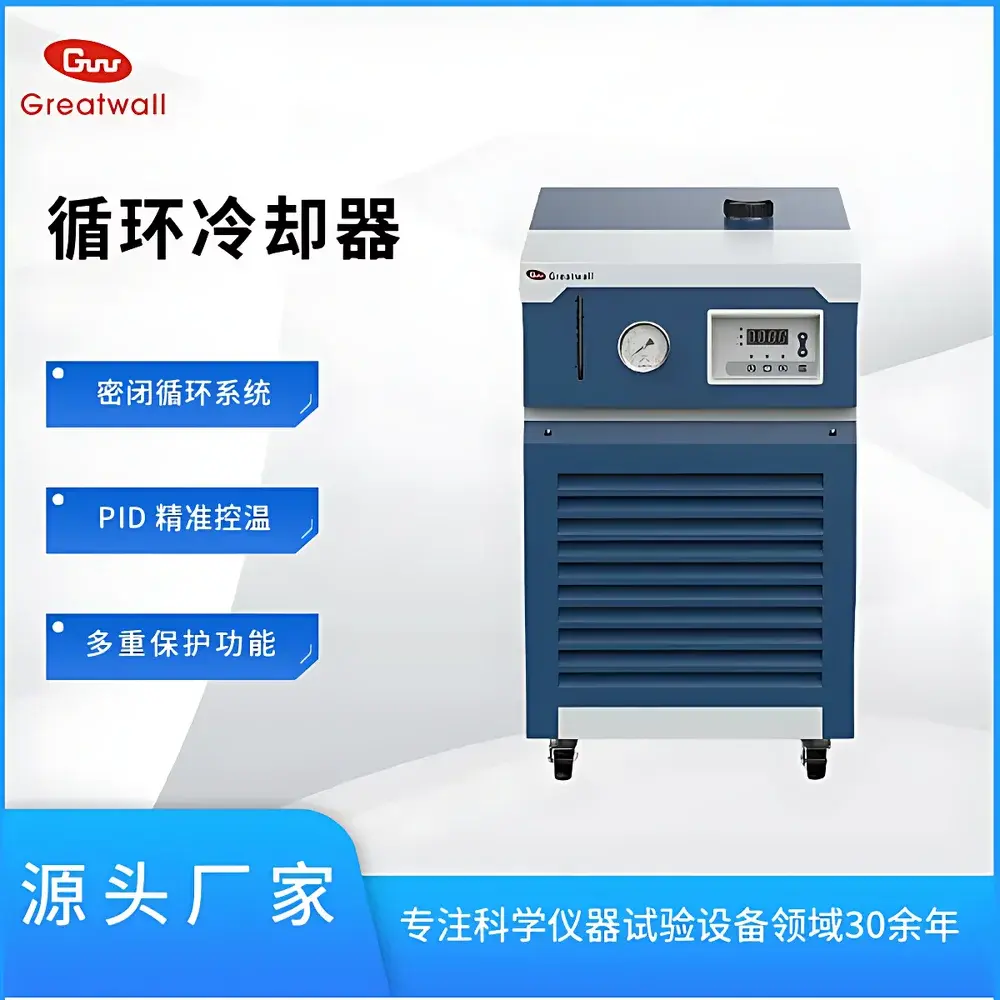
The Great Wall DL30-300 Circulating Chiller
| Brand | The Great Wall |
|---|---|
| Origin | Henan, China |
| Manufacturer Type | Direct Manufacturer |
| Product Type | Integrated Circulating Chiller |
| Cooling Method | Air-Cooled |
| Temperature Range | –30 °C to +5 °C |
| Refrigeration Capacity | 1250 W @ 0 °C |
| Temperature Stability | ±2 °C |
| Circulation Pump Pressure | 0.4 bar |
| Circulation Flow Rate | 20 L/min |
| Reservoir Volume | 10 L |
| Operating Mode | Continuous Duty |
Overview
The Great Wall DL30-300 Circulating Chiller is an integrated, air-cooled refrigeration system engineered for precise and stable low-temperature control in laboratory and analytical environments. It operates on a vapor-compression refrigeration cycle using R410A—a chlorine-free, environmentally compliant refrigerant meeting current Chinese national regulations (GB/T 7778–2017) and global ODS phase-out standards. Designed for continuous-duty operation under ambient conditions of 5–35 °C and ≤70% RH, the unit delivers consistent thermal management across demanding applications including reactor jacket cooling, cryogenic fixture conditioning, and low-temperature material testing. Its operational range of –30 °C to +5 °C enables reliable support for exothermic reaction quenching, cold-trap condensation, and temperature-sensitive instrumentation requiring auxiliary cooling—without reliance on external chilled water infrastructure.
Key Features
- High-Efficiency Compressor: Equipped with a Panasonic Wanbao rotary compressor, delivering compact footprint, low acoustic emission (<65 dB(A)), and high mechanical reliability over extended service life.
- Optimized Heat Exchange System: Features an air-cooled finned-tube condenser with oxygen-free copper spiral tubing and proprietary middle-expansion joint technology for enhanced thermal transfer and simplified maintenance.
- Robust Evaporator Design: Stainless steel (SUS304) coil-type evaporator fully immersed in the reservoir—preventing mechanical damage during freeze events and ensuring uniform heat extraction from the heat-transfer fluid.
- Stable Circulation Architecture: High-performance shielded circulation pump (100 W) maintains consistent flow (20 L/min at 0.4 bar) even at sub-zero temperatures; inlet filtration prevents particulate ingress into tubing and instrument interfaces.
- Real-Time Monitoring & Safety: Front-panel analog pressure gauge and calibrated Pt100 digital temperature display (0.1 °C resolution) provide immediate operational feedback. Integrated safeguards include compressor delay start, high-pressure cut-off, overload protection, and overcurrent interruption per IEC 61000-4-5 compliance.
- Material & Environmental Compliance: All wetted components—including 10 L reservoir, piping, and fittings—are constructed from corrosion-resistant SUS304 stainless steel. R410A refrigerant conforms to ASHRAE Standard 34 classification and carries zero ozone depletion potential (ODP = 0).
Sample Compatibility & Compliance
The DL30-300 is compatible with common heat-transfer fluids including deionized water, 30% ethylene glycol/water mixtures, and low-viscosity silicone oils (kinematic viscosity <50 cSt at –30 °C). Its –30 °C minimum operating point supports cryogenic sample handling in pharmaceutical stability chambers, polymer characterization rigs, and spectroscopic cryostats. The unit meets general-purpose laboratory safety requirements per GB 4793.1–2019 (equivalent to IEC 61010-1) and incorporates electrical insulation, grounding continuity, and thermal cutoffs suitable for Class II laboratory installations. While not certified for GMP or GLP-regulated production environments, its stable temperature output and audit-ready parameter logging (via optional RS485 interface) support method validation workflows aligned with ISO/IEC 17025 and USP <1058> analytical instrument qualification guidelines.
Software & Data Management
The DL30-300 operates as a standalone unit with local digital setpoint control and real-time display. For integration into automated lab networks, an optional RS485 communication module (Modbus RTU protocol) enables remote temperature setpoint adjustment, status monitoring (running/stopped/fault), and data logging of reservoir temperature, system pressure, and compressor runtime. When paired with third-party SCADA or LIMS platforms, it supports traceable temperature history recording—facilitating compliance with FDA 21 CFR Part 11 requirements for electronic records where audit trails and user authentication are implemented at the host system level. No embedded firmware-based data storage is provided; all archival responsibility resides with the connected supervisory system.
Applications
- Cooling jackets of glass reactors and pilot-scale bioreactors during controlled exothermic synthesis
- Thermal conditioning of cryo-milling tools and low-temperature mechanical test fixtures
- Stabilizing laser sources, CCD detectors, and NMR preamplifiers requiring sub-ambient thermal sinks
- Supporting HPLC column ovens, GC injectors, and mass spectrometer ion sources with precise coolant delivery
- Maintaining constant bath temperatures for viscometers, calorimeters, and rheometers operating below ambient
- Providing auxiliary cooling to vacuum pumps, X-ray generators, and plasma etching systems in materials science labs
FAQ
What is the minimum achievable temperature when using a 30% ethylene glycol/water mixture?
The –30 °C specification applies to pure water under standard test conditions (25 °C ambient). With 30% glycol, the practical lower limit is approximately –25 °C due to freezing-point depression and reduced heat-transfer efficiency.
Can the unit be installed in an enclosed cabinet?
No. Sufficient airflow must be maintained around the air-cooled condenser; minimum clearance of 300 mm on all sides and unobstructed top ventilation are required to prevent overheating and capacity derating.
Is the reservoir level sensor compatible with automated top-up systems?
The unit includes a visual sight tube but lacks an electronic level switch or 4–20 mA output; integration with external fill-control logic requires aftermarket float-level transducers.
Does the chiller meet CE or UL certification requirements?
It complies with GB 4793.1–2019 (IEC 61010-1 equivalent) for laboratory equipment safety but does not carry CE marking or UL listing; users requiring these certifications should consult regional regulatory pathways for equivalency assessment.
What maintenance intervals are recommended for long-term reliability?
Compressor oil and refrigerant charge require no scheduled replacement under normal operation. Condenser fins should be cleaned quarterly; desiccant filter (Danfoss DML series) replacement is advised every 24 months or after any refrigerant service event.



