
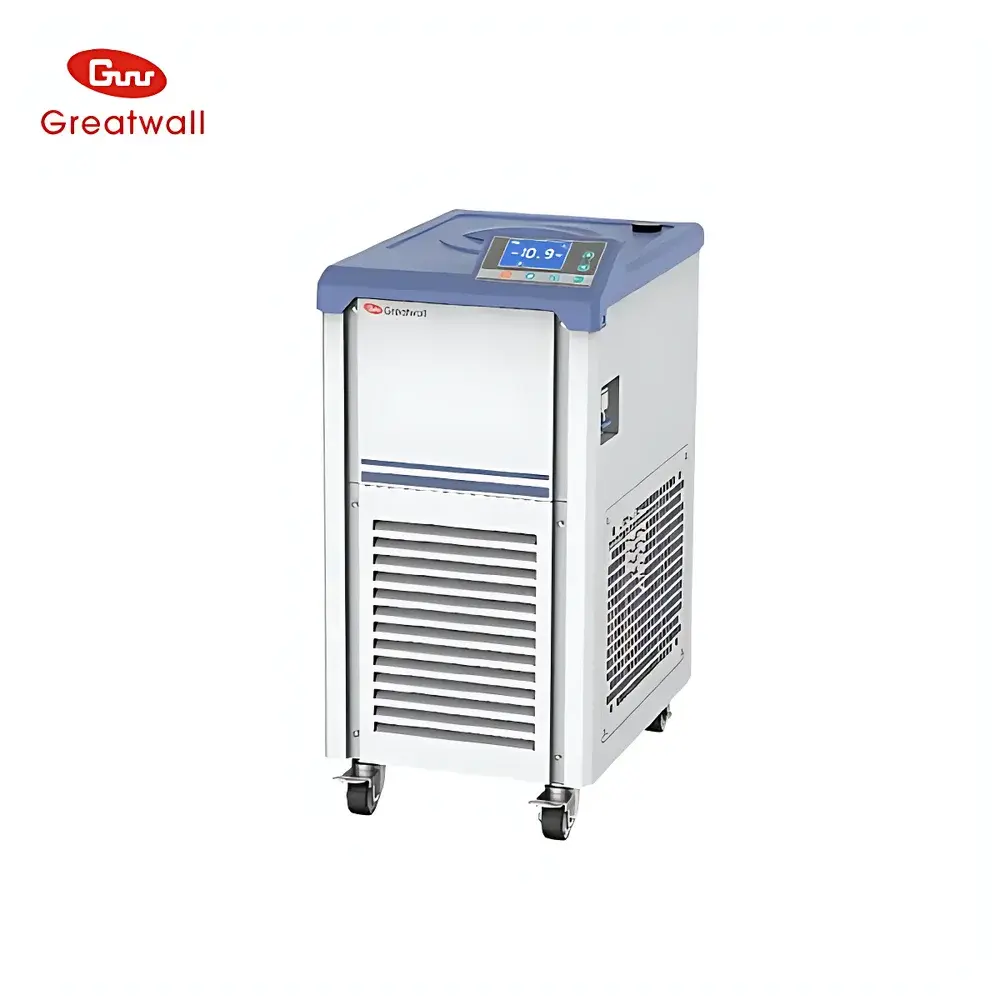
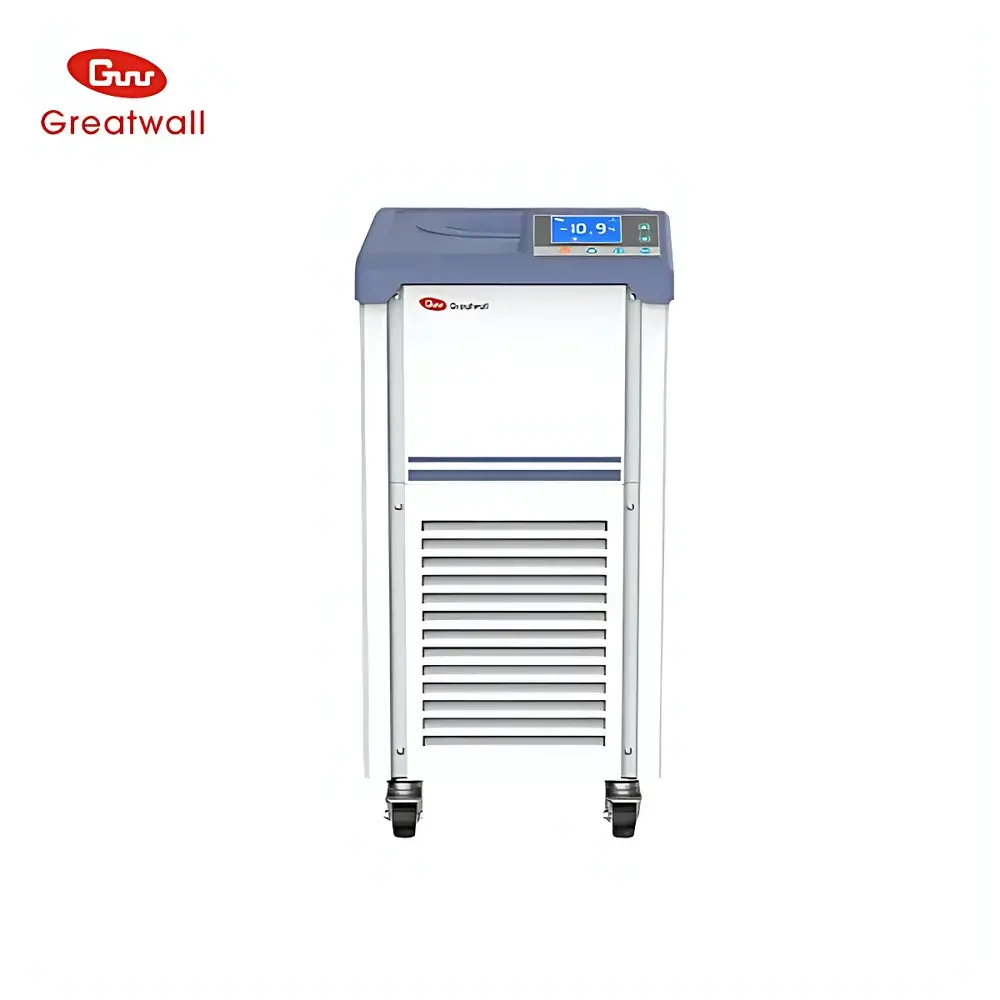
The Great Wall DLSB-5/20D Low-Temperature Circulating Chiller
| Brand | The Great Wall |
|---|---|
| Origin | Henan, China |
| Manufacturer Type | Direct Manufacturer |
| Product Category | Domestic |
| Model | DLSB-5/20D |
| Instrument Type | Integrated Unit |
| Cooling Method | Air-Cooled |
| Temperature Range | −20 °C to 25 °C |
| Temperature Stability | ±2 °C |
| Refrigeration Capacity | 680 W @ 10 °C |
| Circulating Pump Pressure | 1.1 bar |
| Circulating Pump Flow Rate | 22 L/min |
| Reservoir Volume | 5 L |
| Operating Mode | Continuous |
| Refrigerant | R404A |
| Power Consumption | 670 W |
| Protection Features | Compressor Delay Start, Overcurrent, Overheat, High-Pressure, Ground Fault |
| IP Rating | IP20 |
| Ambient Operating Conditions | 5–35 °C, ≤70% RH |
| Power Supply | 220 V~, 50 Hz |
| Fluid Connection | 1/2″ BSP |
| Tubing Compatibility | Silicone Hose (Φ13×Φ9 mm) |
| Reservoir Material | 304 Stainless Steel |
| Dimensions (W×D×H) | 335×473×684 mm |
| Net Weight | 40 kg |
| Communication Interface | RS485 with Standard Modbus Protocol |
| Sensor Type | Pt100 RTD |
| Display Resolution | 0.1 °C |
Overview
The Great Wall DLSB-5/20D is an integrated air-cooled low-temperature circulating chiller engineered for precise thermal management in laboratory and pilot-scale applications. It operates on a vapor-compression refrigeration cycle using R404A — a zeotropic blend selected for its stable thermodynamic performance across extended sub-zero operating ranges. The unit maintains a controlled coolant loop between −20 °C and 25 °C, delivering consistent heat extraction to external equipment such as rotary evaporator condensers, jacketed reactors, laser diode mounts, and material testing fixtures. Its design prioritizes operational reliability under continuous duty cycles, with compressor protection logic (including delay-start sequencing), dual-stage pressure monitoring, and real-time thermal feedback via Pt100 resistance temperature detectors. Unlike immersion-style cooling baths, the DLSB-5/20D isolates refrigeration mechanics from the fluid path, minimizing contamination risk and enabling closed-loop recirculation of compatible heat-transfer fluids including water-glycol mixtures or specialized silicone oils.
Key Features
- Integrated air-cooled architecture with compact footprint (335 × 473 × 684 mm) and 40 kg net weight — suitable for benchtop or floor-mounted deployment in space-constrained laboratories.
- LCD interface with 0.1 °C display resolution and intuitive menu navigation for setpoint adjustment, status monitoring, and alarm acknowledgment.
- RS485 serial communication port compliant with Modbus RTU protocol, supporting integration into centralized lab automation systems or SCADA platforms for remote parameter control and event logging.
- Dual-layer safety architecture: hardware-level protections include overcurrent cutoff, high-pressure shutdown, compressor thermal overload sensing, ground-fault detection, and ambient temperature interlock (disabled below 5 °C or above 35 °C).
- Stainless steel (304 grade) reservoir resistant to corrosion from common aqueous and glycol-based coolants; 5 L capacity balances thermal inertia and portability requirements.
- High-flow, low-pulsation centrifugal circulation pump rated at 22 L/min maximum flow and 1.1 bar maximum head — sufficient to overcome typical pressure drops across condenser coils, jacketed vessels, and inline heat exchangers.
Sample Compatibility & Compliance
The DLSB-5/20D is designed for use with non-aggressive, non-flammable heat-transfer fluids meeting ASTM D1384 (corrosion inhibition for engine coolants) or ISO 2105 (glycol-based heat transfer fluids) specifications. It is not intended for direct circulation of solvents, acids, or halogenated compounds without prior compatibility verification. Select models in the DLSB series have undergone third-party assessment by TÜV SÜD and conform to the essential health and safety requirements of the EU Machinery Directive 2006/42/EC and Electromagnetic Compatibility Directive 2014/30/EU — evidenced by CE marking. While not certified to IEC 61000-6-2/6-4 for industrial immunity/emission, the unit meets EN 61326-1:2013 Class A criteria for laboratory-use electrical equipment. Its IP20 enclosure rating indicates protection against solid objects >12.5 mm but no ingress protection against moisture — installation must occur in dry, ventilated indoor environments per IEC 60529.
Software & Data Management
The DLSB-5/20D does not incorporate embedded data logging or proprietary software. Instead, it provides deterministic, register-mapped access to operational parameters (setpoint, actual temperature, pump status, fault codes) via Modbus RTU over RS485. This enables seamless integration with industry-standard platforms such as LabVIEW, MATLAB Data Acquisition Toolbox, or custom Python-based controllers using minimal configuration. All communication adheres strictly to Modbus function codes 03 (Read Holding Registers) and 06 (Write Single Register), with documented register addresses provided in the technical manual. Audit trails are maintained externally by the host system; no internal clock or timestamping functionality is implemented. For GLP/GMP-aligned workflows, users may configure external PLCs or SCADA servers to enforce 21 CFR Part 11-compliant electronic signatures and change-control logs during remote operation.
Applications
- Cooling of rotary evaporation condensers in organic synthesis labs, ensuring efficient solvent recovery at low bath temperatures.
- Temperature stabilization of photoluminescence spectrometers and Raman probe stages where thermal drift compromises spectral resolution.
- Controlled cooling of polymer rheometers and dynamic mechanical analyzers (DMA) during viscoelastic characterization below room temperature.
- Thermal conditioning of semiconductor wafer probers and RF test fixtures requiring stable junction temperatures during parametric validation.
- Simulated environmental stress testing of electronic components using programmable ramp-and-soak profiles executed via external Modbus master.
- Low-temperature crystallization studies in pharmaceutical development, where precise nucleation onset control depends on reproducible coolant delivery.
FAQ
What heat-transfer fluids are recommended for use with the DLSB-5/20D?
Water-glycol mixtures (e.g., 30% propylene glycol / 70% deionized water) are preferred for sub-zero operation. Avoid ethylene glycol in biological labs due to toxicity concerns. Confirm fluid pH remains between 6.5–9.0 to prevent reservoir corrosion.
Can the unit operate continuously at −20 °C ambient temperature?
No. The specified ambient operating range is 5–35 °C. Operation below 5 °C risks refrigerant migration and oil foaming; above 35 °C reduces condensing efficiency and may trigger high-pressure shutdown.
Is the RS485 interface optically isolated?
No. The RS485 port uses standard differential signaling without galvanic isolation. Install appropriate surge suppression and grounding practices when connecting to long cable runs or electrically noisy environments.
Does the chiller support external temperature feedback for cascade control?
No. The unit regulates based solely on internal reservoir temperature measurement. External process temperature control requires a separate PID controller interfaced to the chiller’s analog setpoint input (if equipped) or Modbus register override.
What maintenance intervals are recommended?
Inspect air intake filters quarterly; clean condenser coils semiannually using compressed air. Verify refrigerant charge integrity annually via pressure-temperature correlation checks. Replace circulating pump seals every 24 months under continuous operation.



