
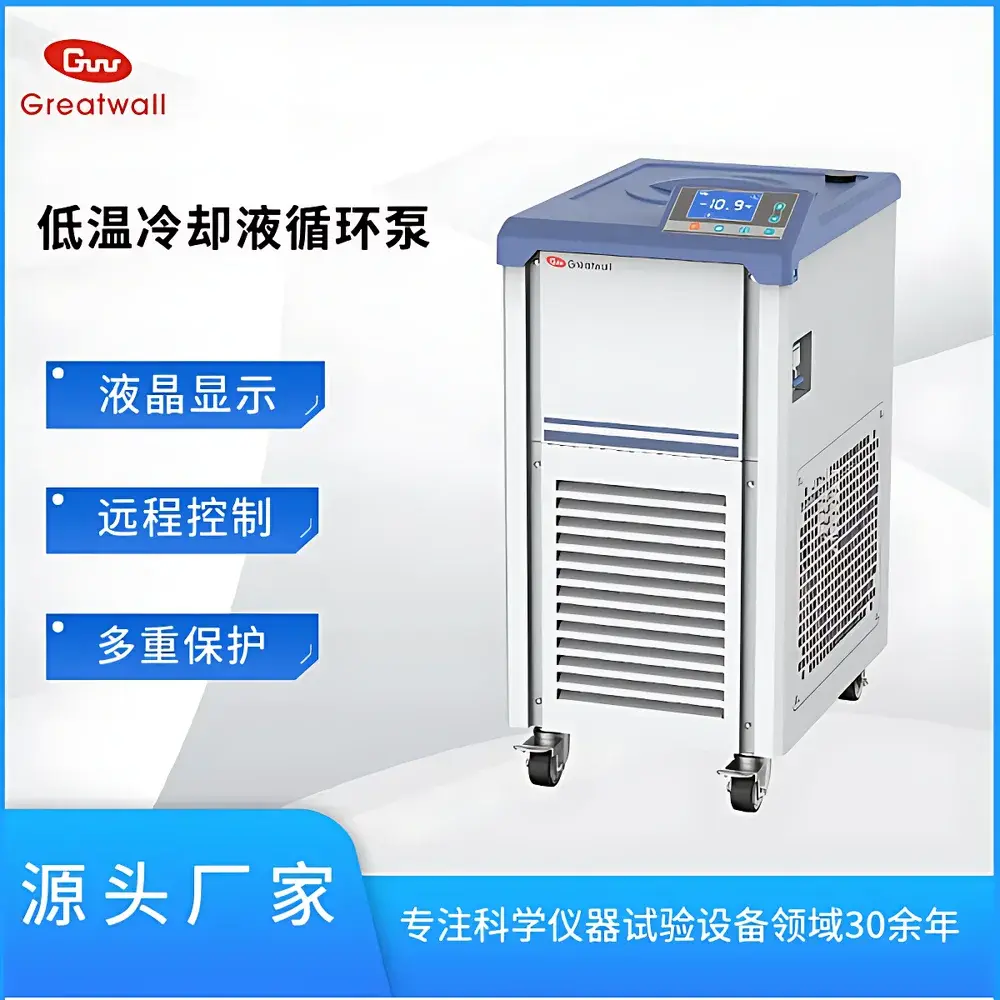
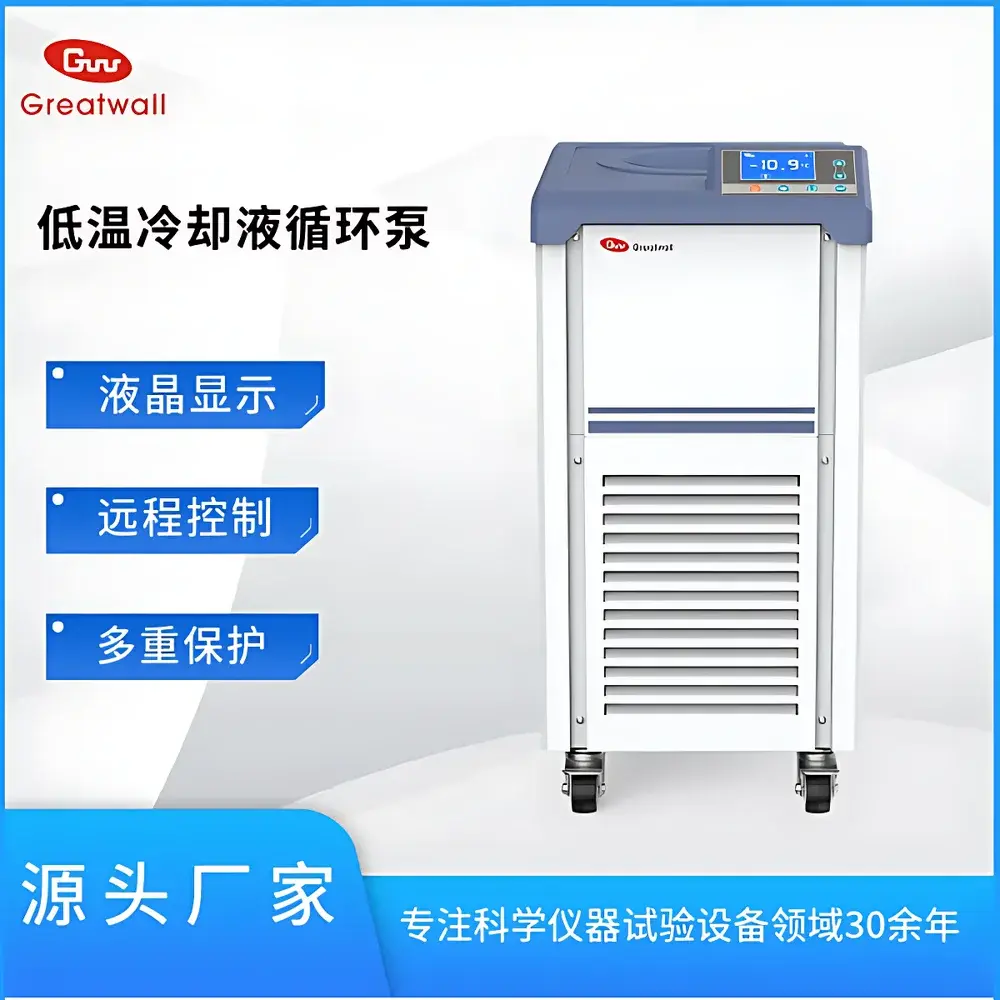
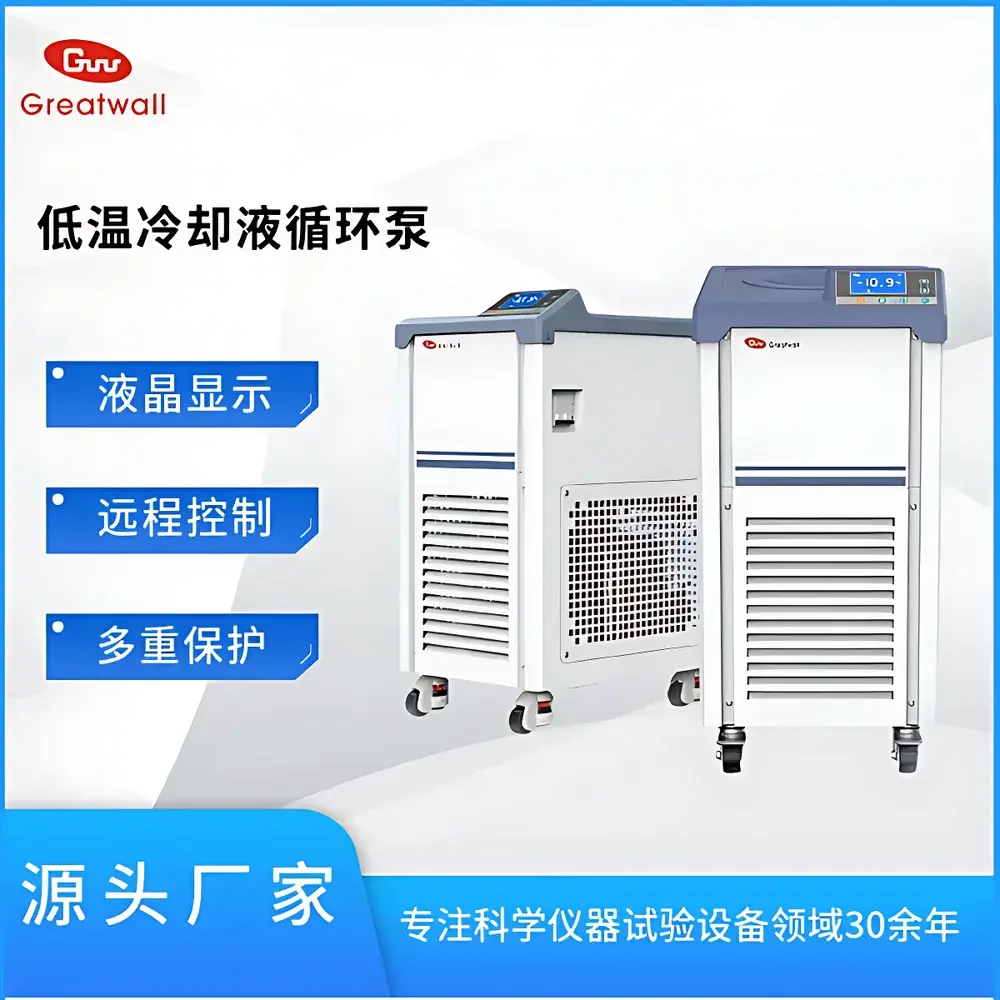
The Great Wall DLSB-5/20D Low-Temperature Circulating Chiller
| Brand | The Great Wall |
|---|---|
| Origin | Henan, China |
| Manufacturer Type | Direct Manufacturer |
| Equipment Type | Integrated Circulating Chiller |
| Cooling Method | Air-Cooled |
| Temperature Range | −20 °C to 25 °C |
| Temperature Stability | ±2 °C |
| Refrigeration Capacity | 600 W at 0 °C |
| Max. Circulation Pressure | 1.1 bar |
| Max. Flow Rate | 20 L/min |
| Reservoir Volume | 5 L |
| Duty Cycle | Continuous Operation |
| Display Resolution | 0.1 °C |
| Communication Interface | RS485 with Modbus RTU Protocol |
| Compressor Protection | Delayed Start, Overcurrent, Overheat, High-Pressure, Ground-Fault |
| Refrigerant | R404A |
| Power Supply | 220 V~, 50 Hz |
| IP Rating | IP20 |
| Ambient Operating Conditions | 5–35 °C, ≤70% RH |
| Reservoir Material | 304 Stainless Steel |
| Dimensions (W×D×H) | 335×473×684 mm |
| Net Weight | 40 kg |
Overview
The Great Wall DLSB-5/20D Low-Temperature Circulating Chiller is an integrated, air-cooled refrigeration system engineered for precise thermal management in laboratory and pilot-scale applications. It operates on a vapor-compression refrigeration cycle using R404A refrigerant—a zeotropic blend selected for its balanced performance across low-temperature operation (down to −20 °C) and compatibility with standard hermetic compressors. Unlike immersion chillers or dry ice baths, the DLSB-5/20D delivers stable, controllable cooling via forced circulation of heat-transfer fluid (typically 30–50% ethylene glycol/water mixture) through external equipment—enabling active temperature regulation rather than passive cooling. Its design targets continuous-duty operation under ambient conditions ranging from 5 °C to 35 °C, making it suitable for integration into rotary evaporator condenser loops, material testing chambers, semiconductor thermal test fixtures, laser diode cooling manifolds, and controlled-rate reaction systems.
Key Features
- Integrated air-cooled architecture with compact footprint (335 × 473 × 684 mm) and 40 kg net weight—optimized for benchtop or under-bench installation in space-constrained labs.
- Liquid crystal display (LCD) interface with 0.1 °C resolution and real-time monitoring of setpoint, actual bath temperature, and system status indicators.
- RS485 serial interface compliant with Modbus RTU protocol—enables bidirectional communication for remote setpoint adjustment, temperature logging, alarm interrogation, and integration into SCADA or LIMS environments.
- Comprehensive protection suite: compressor start-delay logic (prevents short-cycling), overcurrent cutoff, high-pressure cutout, overtemperature shutdown, ground-fault detection, and reservoir-level monitoring.
- Stainless steel (304) reservoir with corrosion-resistant internal finish and calibrated fill line—compatible with common aqueous and glycol-based heat-transfer fluids.
- High-efficiency centrifugal circulation pump rated for up to 20 L/min flow at 1.1 bar maximum head—capable of supporting multi-point distribution networks with minimal pressure drop.
Sample Compatibility & Compliance
The DLSB-5/20D supports standard laboratory fluid circuits using 1/2″ BSP or NPT fittings and accommodates silicone or fluoropolymer-lined tubing (e.g., Φ13 × Φ9 mm ID/OD silicone hose). Its −20 °C minimum operating temperature meets ASTM E2913-20 requirements for low-temperature calibration verification of thermocouples and RTDs. While not certified to UL 61010-1 or IEC 61010-1 out-of-the-box, the unit incorporates design elements aligned with Clause 6.4 (Protection Against Hazardous Energy) and Clause 7.3 (Temperature Limits) of those standards. For GLP/GMP-regulated workflows, the Modbus interface supports audit-trail-capable data acquisition when paired with compliant SCADA software (e.g., Ignition SCADA or LabVIEW with DAQmx drivers). No FDA 21 CFR Part 11 compliance is claimed; however, timestamped temperature logs exported via Modbus can be archived under institutional SOPs.
Software & Data Management
No proprietary PC software is bundled with the DLSB-5/20D. Instead, its open Modbus RTU implementation allows interoperability with industry-standard platforms including Python (via pymodbus), MATLAB (Instrument Control Toolbox), and commercial HMI systems. Users may configure polling intervals (default: 2 s), register mapping (holding registers 40001–40010 cover setpoint, PV, status bits, and error codes), and trigger event-based alerts (e.g., deviation >±3 °C for >60 s). Raw data export requires external logging—no onboard memory or SD card slot is provided. Firmware updates are not field-upgradable; revisions are managed exclusively through factory service channels.
Applications
- Cooling condensers of rotary evaporators during solvent recovery (e.g., acetone, dichloromethane, ethanol) at sub-ambient temperatures to maximize condensation efficiency and minimize vapor loss.
- Thermal conditioning of polymer samples during dynamic mechanical analysis (DMA) or differential scanning calorimetry (DSC) sample preparation stages.
- Stabilizing operating temperature of CW laser diodes (e.g., 808 nm, 980 nm pumps) where junction temperature drift directly impacts wavelength stability and output power.
- Simulating process cooling profiles in pharmaceutical crystallization studies—particularly for metastable zone width determination under controlled sub-zero nucleation conditions.
- Serving as a chilled bath for cryogenic sample storage racks, microcentrifuge rotor pre-cooling, or cold-trap support in vacuum distillation setups.
FAQ
What is the recommended heat-transfer fluid for operation below 0 °C?
A 40% (v/v) aqueous solution of ethylene glycol provides freeze protection down to approximately −25 °C and maintains adequate viscosity and thermal conductivity at −20 °C.
Can the DLSB-5/20D maintain ±0.5 °C stability?
No—the specified temperature stability is ±2 °C under static load conditions per GB/T 21391-2008 (Chinese national standard for circulating chillers); tighter control requires external PID feedback integration.
Is R404A refrigerant being phased out globally?
Yes—R404A has a GWP of 3922 and is subject to EU F-Gas Regulation phase-down; replacement units using R449A or R452A are available upon request for new orders.
Does the unit include a built-in filtration system for the circulating fluid?
No—external inline particulate filters (e.g., 5 µm stainless steel mesh) are recommended if using reclaimed or non-distilled glycol solutions to prevent pump wear.
What maintenance intervals are advised for long-term reliability?
Compressor oil inspection every 24 months; condenser coil cleaning every 6 months in dusty environments; reservoir fluid replacement annually or after contamination events.



