
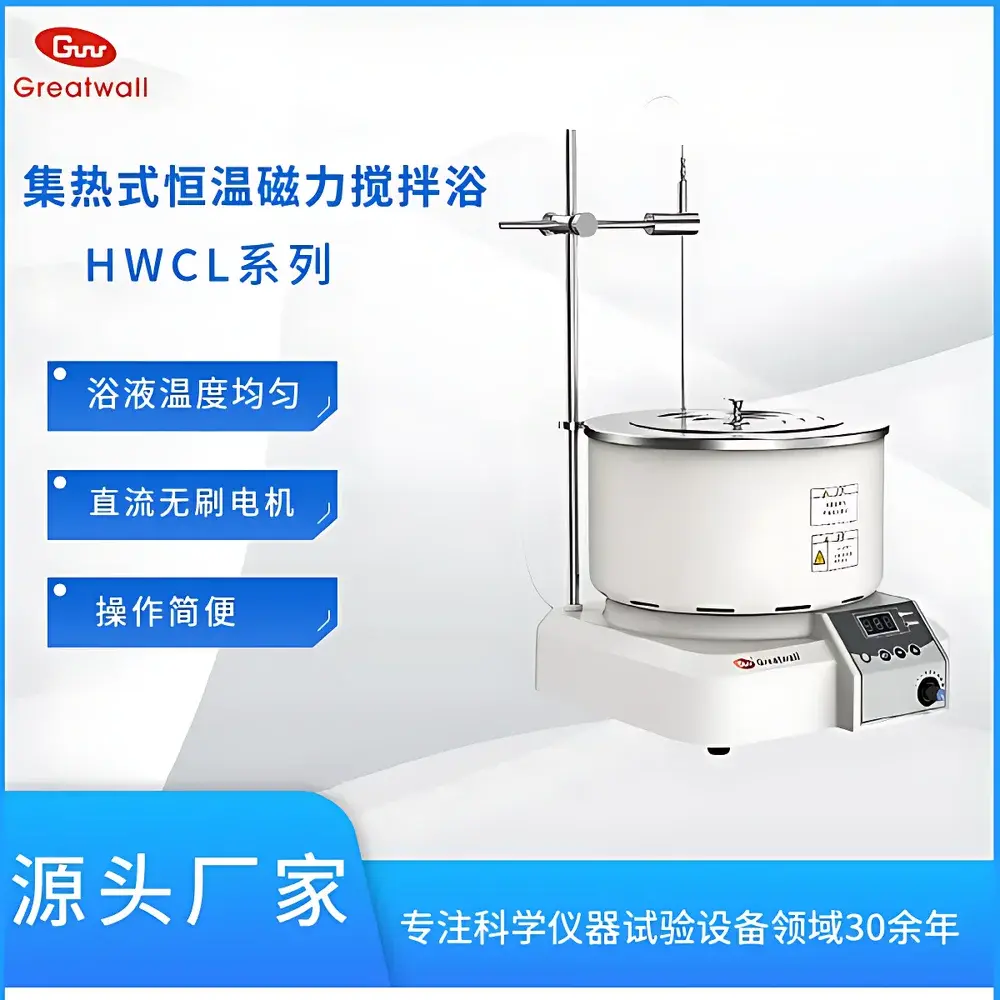
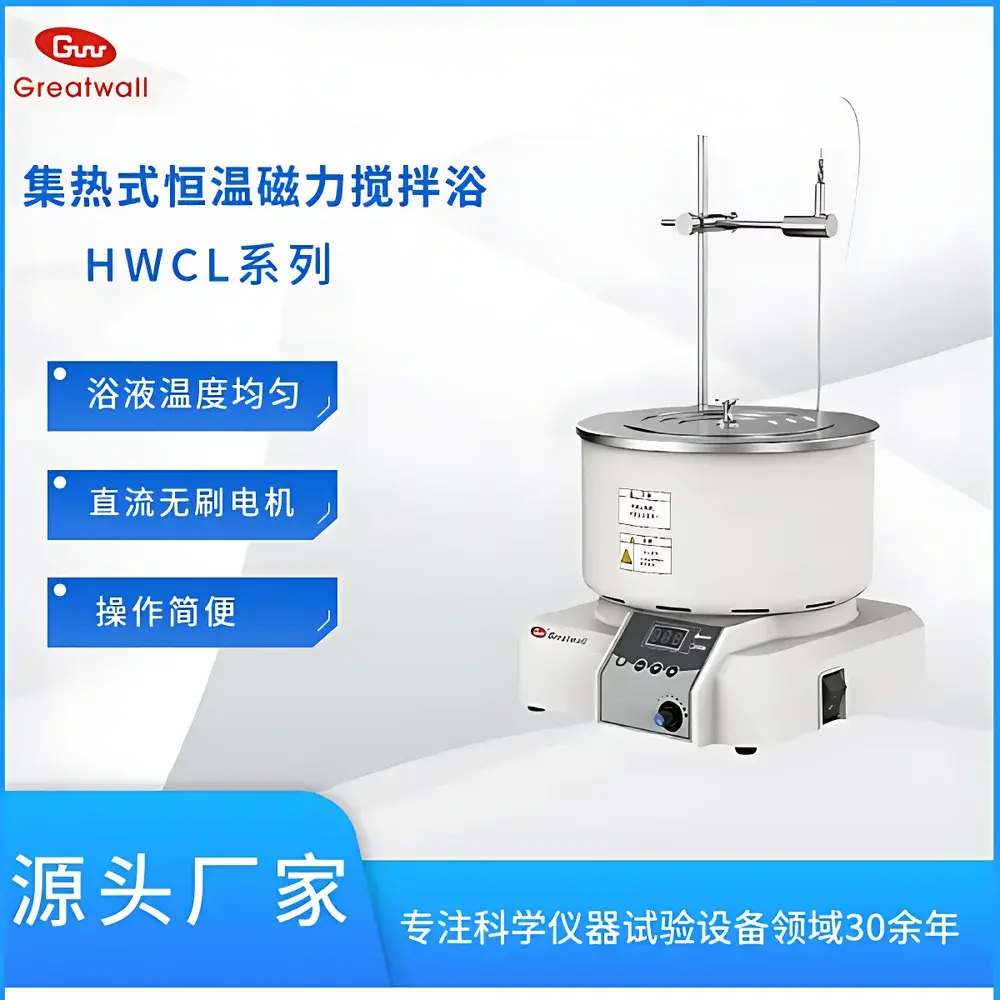
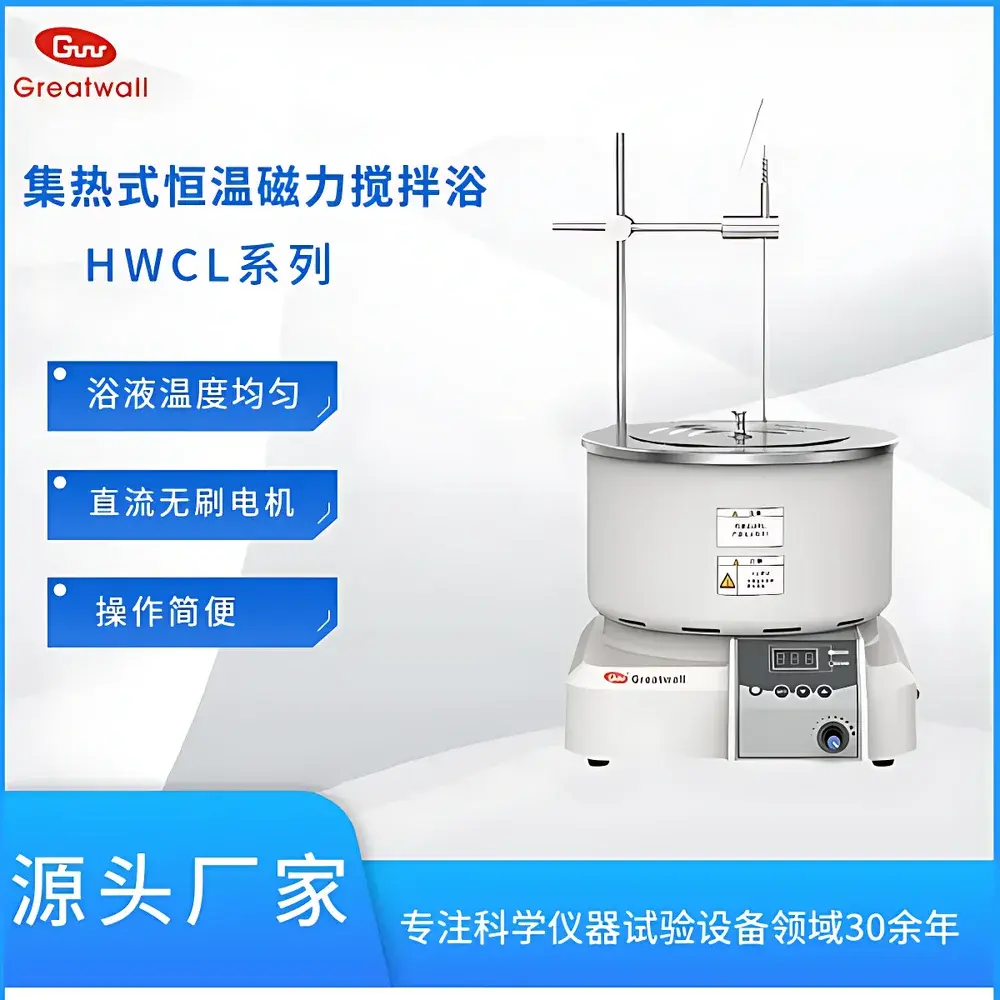
The Great Wall HWCL-3 Integrated Heating Magnetic Stirring Bath
| Brand | The Great Wall |
|---|---|
| Origin | Henan, China |
| Manufacturer Type | Direct Manufacturer |
| Instrument Type | Magnetic Stirrer |
| Max Stirring Volume | 3000 mL |
| Speed Range | 0–2000 rpm |
| Temperature Control Range | Ambient +5°C to 200°C (Oil Bath), Ambient +5°C to 95°C (Water Bath) |
| Temperature Stability | ±1°C |
| Heating Power | 500 W |
| Bath Dimensions | Ø220 × 110 mm |
| Bath Capacity | 4 L |
| External Dimensions | 260 W × 300 D × 440 H mm |
| Net Weight | 5 kg |
| Protection Features | Overcurrent, Ground Fault, and Overtemperature Protection |
| Power Supply | 110 V~, 60 Hz or 220–240 V~, 50/60 Hz |
| Display | LED |
| Control Method | PID with Keypad Input & Rotary Speed Adjustment |
| Dual-Sensor Capability | Simultaneous monitoring of bath fluid temperature and reaction vessel internal temperature |
Overview
The Great Wall HWCL-3 Integrated Heating Magnetic Stirring Bath is an engineered laboratory platform designed for precise thermal regulation and homogeneous mixing in open-bath configurations. Unlike conventional hotplates or standalone stirrers, the HWCL-3 integrates a high-efficiency SUS304 stainless steel immersion heater, a high-torque DC brushless motor, and a robust magnetic coupling system within a single compact housing. Its operational principle relies on electromagnetic induction to drive PTFE-coated stirring bars—ensuring contamination-free agitation without mechanical seals or shaft penetrations. The unit supports both water and oil media, enabling controlled heating up to 95°C (water) or 200°C (oil), while maintaining thermal uniformity across the bath volume via optimized heater geometry and forced convection from magnetic rotation. This architecture makes it suitable for applications requiring stable temperature setpoints under continuous stirring, including synthesis, dissolution testing, calibration standard preparation, and accelerated stability studies.
Key Features
- Integrated dual-function design: Combines thermostatic bath and magnetic stirrer in one unit—eliminating inter-device alignment issues and reducing benchtop footprint.
- SUS304 stainless steel heating element rated for oil/water compatibility and long-term corrosion resistance at elevated temperatures.
- High-strength rare-earth magnet assembly engineered for uninterrupted operation up to 300°C—ensuring consistent torque transmission even during extended high-temperature protocols.
- PID temperature control algorithm with LED digital display ensures rapid thermal equilibration and minimal overshoot (<±1°C stability under steady-state conditions).
- Dual-sensor configuration allows real-time switching between bath fluid temperature and internal reaction vessel temperature—critical for validating thermal transfer efficiency in glassware of varying wall thickness and geometry.
- DC brushless motor delivers smooth speed modulation (0–2000 rpm), low acoustic emission, and maintenance-free continuous-duty performance exceeding 10,000 hours MTBF.
- Comprehensive safety suite includes overcurrent cutoff, ground-fault interruption, and independent overtemperature shutdown—fully compliant with IEC 61010-1:2010 requirements for laboratory electrical equipment.
Sample Compatibility & Compliance
The HWCL-3 accommodates standard laboratory glassware up to 3000 mL capacity—including round-bottom flasks, beakers, and jacketed reactors—with optimal coupling achieved using stirring bars ranging from 20 mm to 60 mm in length. Its 4 L bath volume and Ø220 mm × 110 mm cylindrical cavity ensure full submersion of vessels up to 200 mm in height. The unit conforms to key international safety standards, including IEC 61010-1 (Electrical Safety for Laboratory Equipment) and RoHS Directive 2011/65/EU. While not certified for use in explosion-proof environments, its grounding integrity and thermal cut-off logic support routine GLP-compliant workflows where traceable temperature and agitation parameters are required.
Software & Data Management
The HWCL-3 operates as a standalone analog-digital hybrid instrument with no embedded firmware or network interface. All operational parameters—including setpoint temperature, actual bath temperature, rotational speed, and safety status—are displayed locally via 4-digit LED indicators. For laboratories requiring audit-ready records, external data loggers (e.g., Omega OM-DAQPRO-5300 or Keysight 34972A) may be connected via optional PT100 probe outputs (available on request). The device supports manual SOP documentation per ISO/IEC 17025:2017 clause 7.7, and its mechanical durability enables inclusion in equipment qualification protocols (IQ/OQ/PQ) under GMP Annex 15 guidelines.
Applications
- Controlled-temperature synthesis of metal-organic frameworks (MOFs) and nanoparticle dispersions.
- Dissolution testing per USP using calibrated USP Apparatus II (paddle) vessels placed directly in the bath.
- Preparation of calibration standards for viscometry, density, and refractive index measurements.
- Accelerated aging studies of polymer solutions and emulsions under isothermal shear conditions.
- Enzyme kinetic assays requiring simultaneous thermal stabilization and gentle homogenization of viscous biological matrices.
- Calibration of thermocouples and RTDs against NIST-traceable reference probes in liquid-phase media.
FAQ
Can the HWCL-3 be used with silicone oil at 180°C for extended periods?
Yes—the SUS304 heater and high-Curie-point magnet assembly are rated for continuous operation up to 200°C in compatible heat-transfer fluids.
Is the temperature sensor calibrated to NIST standards?
The unit ships with factory-calibrated sensors; users may perform field verification using a NIST-traceable reference thermometer per ASTM E74-22.
Does the HWCL-3 support external temperature feedback control?
Not natively—but the dual-sensor output can be interfaced with third-party PID controllers via analog voltage signals (0–5 V) upon custom modification.
What is the maximum viscosity this stirrer can handle reliably?
Performance depends on stir bar geometry and vessel shape; typical upper limit is ~10,000 mPa·s for 3000 mL volumes using 40 mm elliptical bars at 800–1200 rpm.
Is the unit compatible with 110 V/60 Hz power systems in North America?
Yes—dual-voltage input (110 V~ or 220–240 V~) with auto-sensing frequency detection ensures plug-and-play operation across major global grids.



