
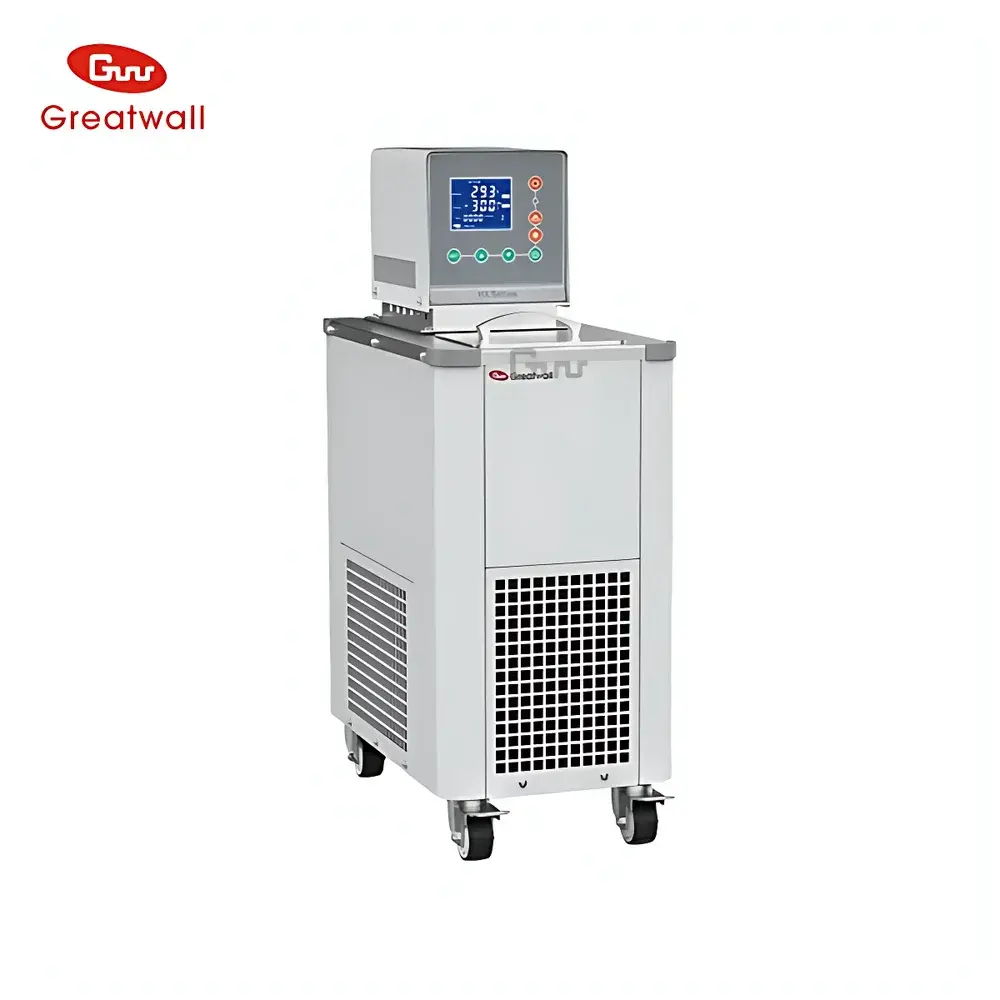
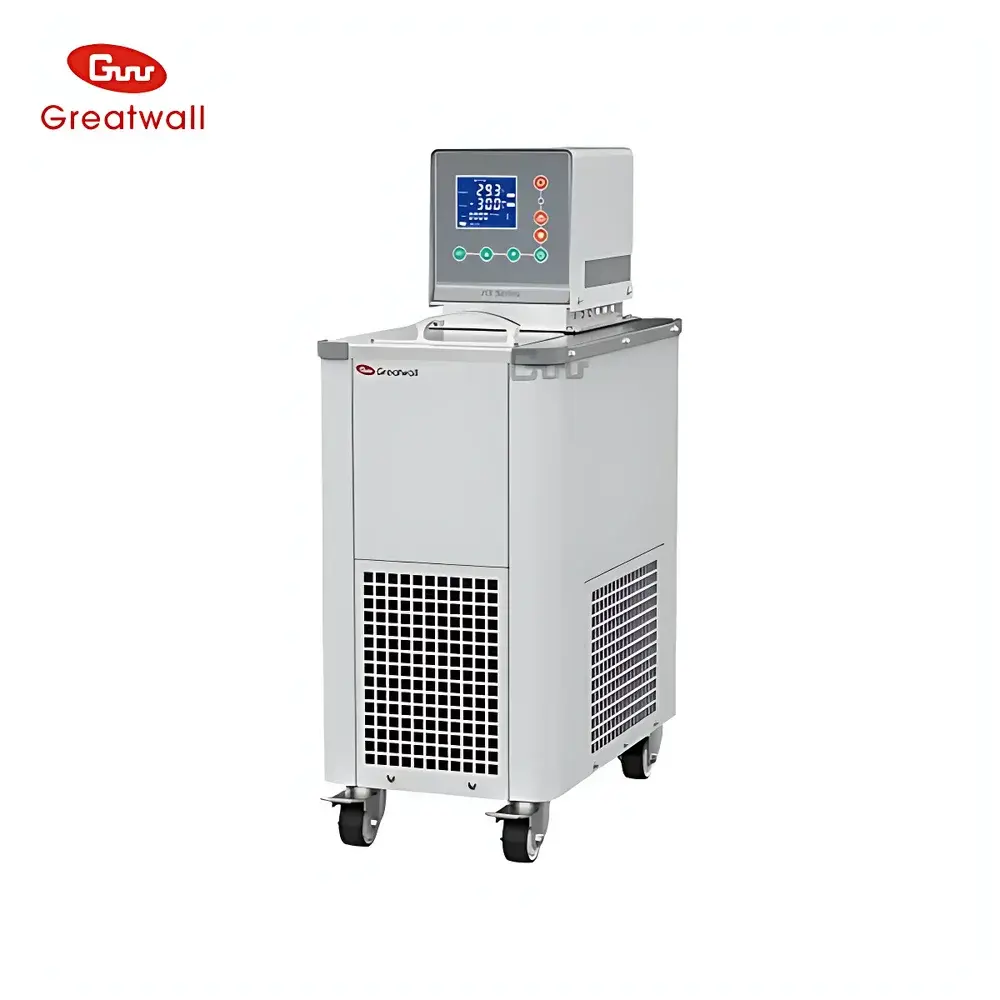
Great Wall HX-3010 Benchtop Circulating Chiller/Heater
| Brand | Great Wall |
|---|---|
| Origin | Henan, China |
| Manufacturer Type | Direct Manufacturer |
| Instrument Type | Vertical |
| Temperature Stability | ±0.2 °C |
| Operating Temperature Range | −30 °C to 99 °C |
| Bath Opening Dimensions | 120 W × 141 D mm |
| Heating Power | 1750 W |
| Bath Volume | 10 L |
| External Dimensions | 255 W × 490 D × 693 H mm |
Overview
The Great Wall HX-3010 is a vertically configured benchtop circulating chiller/heater engineered for precise temperature control in laboratory and industrial R&D environments. It operates on a dual-mode thermoregulation principle—integrating resistive heating with vapor-compression refrigeration—to deliver stable thermal output across a wide operational range of −30 °C to +99 °C. Unlike passive baths or single-function chillers, the HX-3010 employs a closed-loop circulation system with integrated PID-based feedback control, enabling dynamic compensation for external thermal loads (e.g., exothermic reactions, heat dissipation from analytical instruments). Its design supports both open-bath immersion applications and closed-loop external jacketing—making it suitable for temperature-sensitive processes requiring reproducible thermal conditioning over extended durations.
Key Features
- PID-controlled temperature regulation with ±0.2 °C stability at setpoint, verified under steady-state conditions with calibrated PT100 sensor input
- Dual-impeller circulation pump featuring self-priming capability—enabling reliable fluid transfer to both pressurized and atmospheric external systems without manual venting
- 10-liter stainless steel bath reservoir with optimized geometry for uniform thermal distribution; internal impeller-driven mixing ensures axial and radial homogeneity (ΔT ≤ 0.15 °C across bath volume)
- Integrated 1750 W high-efficiency heating element paired with a hermetically sealed compressor system for rapid cooldown and heat-up response (typical ramp rate: 1.8 °C/min from 25 °C to −20 °C; 2.3 °C/min from 25 °C to 90 °C)
- Robust mechanical architecture: powder-coated steel chassis, corrosion-resistant bath liner, and rear-access service panel for routine maintenance of refrigerant lines and electrical connections
Sample Compatibility & Compliance
The HX-3010 accommodates standard laboratory fluids—including water, 30% ethylene glycol/water mixtures, silicone oils (up to 100 cSt), and low-viscosity heat transfer fluids—within its chemically inert 304 stainless steel bath. Its open bath dimensions (120 W × 141 D mm) permit direct immersion of reaction vessels up to Ø100 mm × 250 mm height. For external circulation, the unit provides two 1/2″ BSP threaded ports (inlet/outlet) compatible with standard fluoropolymer or reinforced silicone tubing (ID: 8–10 mm). While not certified to UL/CSA or CE for standalone medical device use, the system conforms to IEC 61010-1:2010 safety requirements for laboratory equipment and meets electromagnetic compatibility criteria per EN 61326-1. It is routinely deployed in GLP-compliant laboratories where instrument qualification includes IQ/OQ documentation aligned with ISO/IEC 17025:2017 Annex A.2.
Software & Data Management
The HX-3010 operates via an embedded microcontroller interface with a backlit LCD display and tactile membrane keypad. Real-time parameters—including setpoint, actual bath temperature, pump status, and error codes—are logged internally with timestamped storage for up to 72 hours (1-minute intervals). Optional RS-485 Modbus RTU communication enables integration into centralized LabVantage or DeltaV SCADA environments for remote monitoring and alarm triggering. Data export is supported via USB flash drive (FAT32 format) in CSV format, facilitating traceability in regulated settings where audit trails are required under FDA 21 CFR Part 11 (when used with validated third-party software platforms). No proprietary cloud service or firmware update mechanism is included; all configuration changes require local physical access.
Applications
- Thermal conditioning of electrophoresis apparatus, particularly for high-resolution native PAGE and capillary electrophoresis where buffer temperature deviation >±0.5 °C compromises band resolution
- Temperature stabilization of electron probe microanalyzers (EPMA) and scanning electron microscope (SEM) cold stages during quantitative EDS/WDS mapping
- Reaction calorimetry support for exothermic hydrogenation or Grignard synthesis in pharmaceutical process development labs
- Calibration verification of platinum resistance thermometers (PRTs) and liquid-in-glass thermometers per ASTM E77 and ISO 17025 clause 6.5.2
- Cooling of laser diodes and photomultiplier tube housings in spectroscopic instrumentation to minimize dark current drift
FAQ
What is the maximum allowable viscosity of heat transfer fluid for continuous operation?
Fluids up to 50 cSt at 20 °C are supported; higher viscosities may reduce flow rate and impair thermal uniformity.
Can the unit maintain temperature stability while pumping to an external jacketed reactor at 2 m head pressure?
Yes—the dual-impeller pump delivers ≥0.8 bar static pressure at 1.2 L/min flow, sufficient for most single-stage jacketed reactors under ambient lab conditions.
Is the bath volume fully drainable without disassembly?
Yes—a bottom-mounted quick-release valve allows complete drainage without tools; residual fluid retention is <5 mL after gravity drainage.
Does the system include freeze protection for sub-zero operation?
Automatic low-temperature cutoff prevents compressor start-up below −35 °C ambient; users must select antifreeze-compatible fluids for sustained operation below 0 °C.
How frequently should the refrigerant charge be verified?
Under normal usage (≤8 hrs/day, ambient ≤30 °C), refrigerant integrity is verified during annual preventive maintenance per manufacturer’s service bulletin GW-HX3010-SM-2023.



