
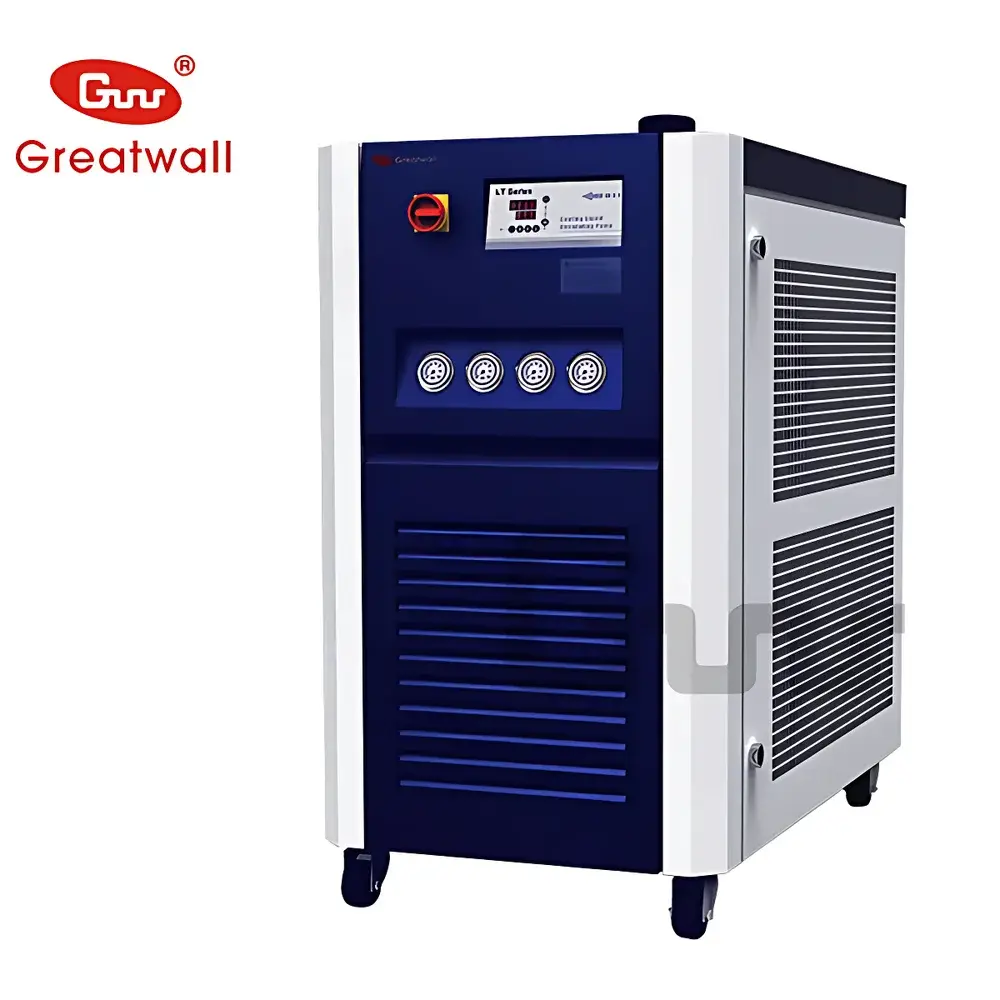
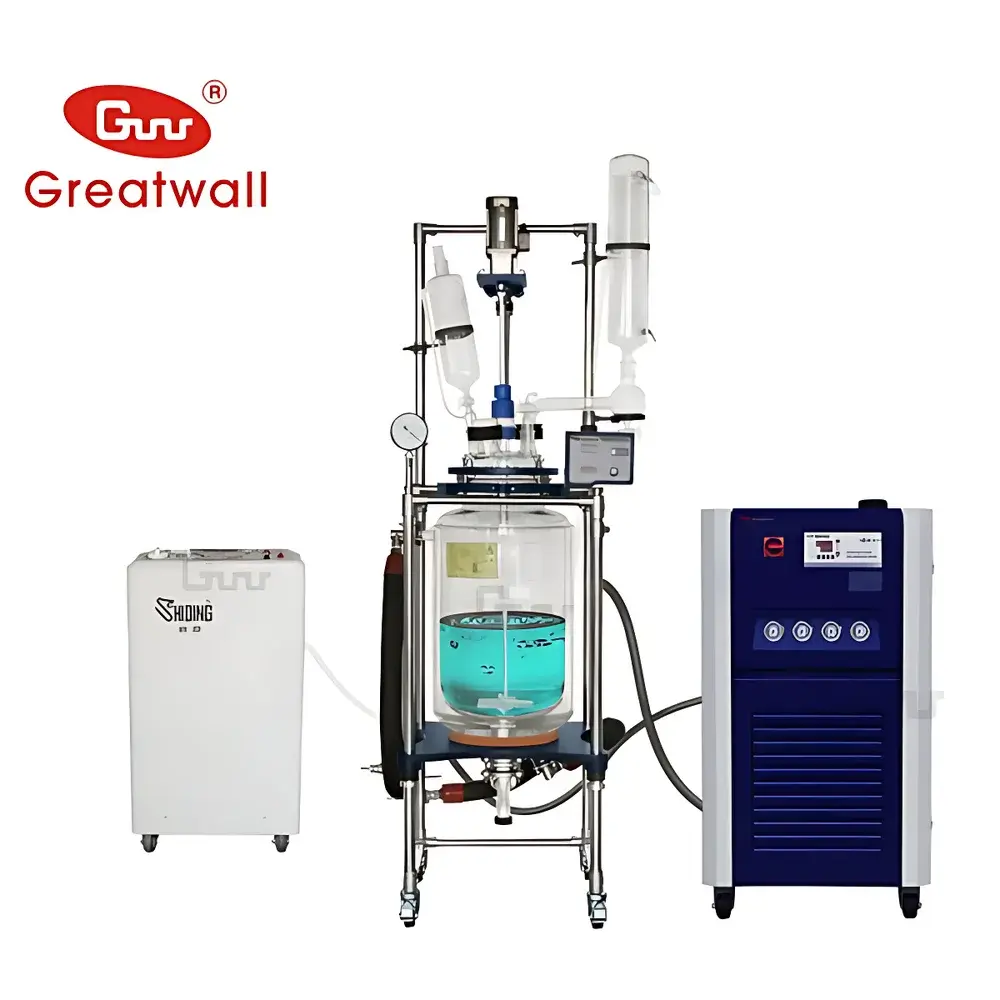
The Great Wall LT-100-80 Ultra-Low Temperature Circulating Chiller
| Brand | The Great Wall |
|---|---|
| Origin | Henan, China |
| Manufacturer Type | Direct Manufacturer |
| Product Category | Domestic |
| Model | LT-100-110 |
| Instrument Type | Integrated Unit |
| Cooling Method | Air-Cooled |
| Temperature Range | –80 °C to –40 °C |
| Refrigeration Capacity | 2500–10000 W |
| Temperature Stability | ±2 °C |
| Circulation Pump Pressure | 1 bar |
| Circulation Flow Rate | 30 L/min |
| Operation Mode | Continuous |
Overview
The Great Wall LT-100-80 is an integrated ultra-low temperature circulating chiller engineered for precise thermal management in demanding laboratory and pilot-scale industrial applications. It operates on a closed-loop vapor-compression refrigeration cycle with cascade dual-stage compressors, enabling stable and continuous delivery of sub-zero coolant—down to –80 °C—at flow rates up to 30 L/min. Unlike single-stage chillers limited to –40 °C or higher, the LT-100-80 employs a two-refrigerant cascade architecture (typically R23/R404A or R508B-based) to overcome thermodynamic constraints at cryogenic setpoints. This design ensures consistent heat extraction from exothermic chemical reactions, low-temperature material characterization systems (e.g., DSC, rheometry, tensile testing), and controlled process simulation environments where thermal inertia and stability are critical.
Key Features
- Integrated air-cooled architecture eliminates dependency on external cooling water infrastructure, reducing installation complexity and operational overhead.
- Closed-loop circulation system minimizes exposure of heat-transfer fluid (e.g., ethanol/water or specialized low-temperature silicone oils) to ambient moisture and oxygen—preventing viscosity drift, oxidation, and freezing-point elevation over extended operation.
- Comprehensive safety suite includes high-pressure cut-off switches, phase-sequence monitoring, compressor thermal overload protection, delayed restart logic (≥3 min), and overcurrent interruption—compliant with IEC 61000-6-2/6-4 electromagnetic compatibility requirements.
- Automatic overfill protection mechanism activates when expansion tank level exceeds threshold, routing excess fluid to a dedicated overflow reservoir to prevent pump cavitation or seal damage.
- Stainless steel fluid reservoir and corrosion-resistant wetted parts ensure long-term compatibility with aggressive solvents and low-temperature brines commonly used in pharmaceutical crystallization and polymer synthesis workflows.
Sample Compatibility & Compliance
The LT-100-80 is compatible with standard laboratory heat-exchange interfaces—including 1/2″ and 3/4″ NPT threaded ports—and supports integration with jacketed reactors (1–100 L), calorimeters, spectroscopic cryostats, and environmental test chambers. Its temperature stability of ±2 °C across the full –80 °C to –40 °C range meets ASTM E747 (Standard Practice for Calibration of Cryogenic Thermometers) traceability requirements when paired with certified Pt100 sensors. While not intrinsically rated for Class I Division 1 hazardous locations, its electrical enclosure conforms to IP54 ingress protection standards and supports optional ATEX-compliant control module upgrades for solvent-handling environments. Documentation packages include Factory Acceptance Test (FAT) reports and material compliance declarations per RoHS 2011/65/EU and REACH Regulation (EC) No. 1907/2006.
Software & Data Management
The chiller features a programmable digital controller with real-time display of setpoint, actual bath temperature, refrigeration load (%), pump status, and fault codes. Optional RS485 Modbus RTU or Ethernet TCP/IP communication enables bidirectional integration into centralized LabVantage, DeltaV, or Siemens Desigo CCMS platforms. Audit-trail-capable firmware (v3.2+) logs all parameter changes, alarm events, and runtime hours with timestamping—supporting GLP/GMP-aligned data integrity practices per FDA 21 CFR Part 11 when deployed with validated user access controls and electronic signature modules. Data export is supported via CSV over USB or network transfer for trend analysis in MATLAB, Python Pandas, or JMP.
Applications
- Controlled low-temperature synthesis in API manufacturing (e.g., lithiation, Grignard, and asymmetric hydrogenation reactions requiring –70 °C stability).
- Thermal conditioning of elastomers, composites, and battery electrode slurries during DMA, TMA, or mechanical fatigue testing per ISO 6721 and ASTM D6991.
- Simulating arctic or aerospace thermal profiles in environmental stress screening per MIL-STD-810H Method 502.7.
- Coolant supply for high-power laser diodes, superconducting magnet cryocoolers, and FTIR interferometer beam path stabilization.
- Process validation support for freeze-drying cycle development, including shelf-cooling ramp rate control and condenser temperature mapping.
FAQ
What heat-transfer fluids are recommended for operation at –80 °C?
Low-viscosity, low-pour-point silicone oils (e.g., DC-704, pour point –90 °C) or ethanol/water mixtures (30/70 v/v, pour point –85 °C) are validated for sustained use. Glycol-based fluids are not recommended below –40 °C due to solidification risk.
Can the LT-100-80 be operated continuously for 72+ hours at –80 °C?
Yes—designed for uninterrupted duty under nominal load conditions. Compressor duty cycle, oil return efficiency, and condenser airflow are optimized for >10,000-hour MTBF per ISO 13374-1 condition monitoring guidelines.
Is remote monitoring possible without third-party SCADA?
Yes. Native Modbus TCP support allows direct polling of temperature, pressure, and status registers using open-source tools like Node-RED or commercial HMI software without proprietary middleware.
Does the unit meet noise emission limits for ISO Class 5 cleanroom-adjacent labs?
Air-cooled operation generates ≤72 dB(A) at 1 m distance—within acceptable limits for non-classified lab corridors but requires acoustic shielding if installed adjacent to vibration-sensitive optical tables.
How is calibration traceability maintained over time?
Front-panel Pt100 sensor is factory-calibrated against NIST-traceable dry-block calibrators. Users may perform field verification using calibrated reference thermometers per ISO/IEC 17025:2017 Clause 6.5.3 procedures.



