
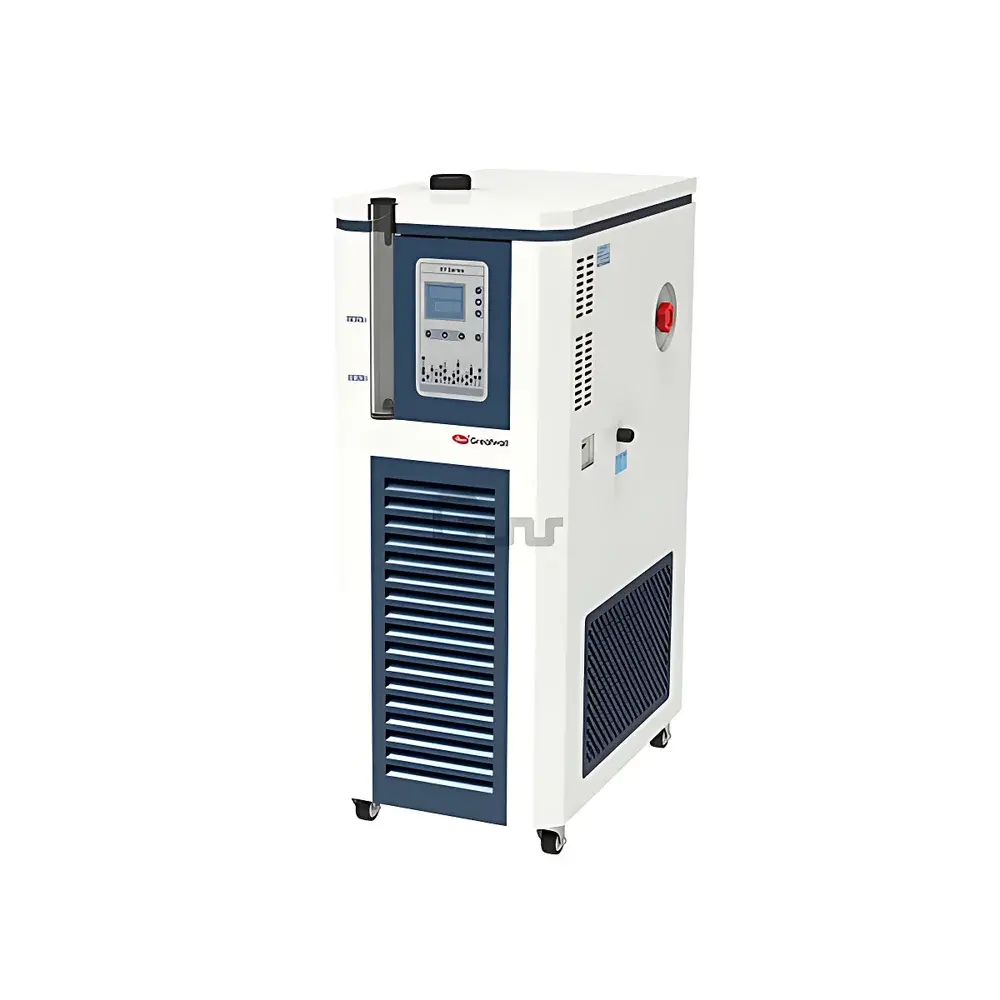
The Great Wall SY-20-250 High-Temperature Circulating Bath
| Brand | The Great Wall |
|---|---|
| Origin | Henan, China |
| Manufacturer Type | Direct Manufacturer |
| Product Category | Domestic |
| Model | SY-20-250 |
| Instrument Type | Water/Oil Bath |
| Circulation Mode | Internal & External |
| Temperature Control | Heating-Only |
| Bath Volume | 20 L |
| Temperature Range | RT + 5 °C to 250 °C |
| Temperature Stability | ±0.5 °C |
| Max Flow Rate | 42 L/min |
| Max Pressure | 2.8 bar |
| Circulation Port Size | 3/4" |
| Heat Transfer Fluid Capacity | 9 L |
| Heating Power | 3 kW |
| Circulation Pump Power | 370 W |
| Ambient Temp Range | 5–40 °C |
| Ambient Humidity | ≤60% RH |
| Power Supply | 220–240 V~, 50 Hz |
| Dimensions (W×D×H) | 430 × 690 × 1075 mm |
| Weight | 60 kg |
Overview
The Great Wall SY-20-250 High-Temperature Circulating Bath is a precision-engineered thermal management system designed for stable, continuous delivery of heated heat transfer fluids—such as silicone oil, glycerol, or high-temperature synthetic oils—to external process equipment. Operating on resistive electric heating and PID-controlled feedback regulation, the unit maintains temperature setpoints within ±0.5 °C across its full operational range (RT + 5 °C to 250 °C), making it suitable for demanding applications requiring sustained thermal input under controlled conditions. Its sealed, corrosion-resistant stainless-steel circulation loop minimizes fluid degradation and oxidation, extending service life of expensive heat transfer media while ensuring long-term reproducibility in process-critical environments.
Key Features
- Stainless-steel fluid path and reservoir engineered for chemical resistance, high-temperature stability, and low maintenance in aggressive thermal environments.
- Dual-mode circulation architecture supporting both internal recirculation (for bath temperature uniformity) and external loop delivery (to jacketed reactors, condensers, or analytical instrumentation).
- PID-based digital temperature controller with intuitive interface, real-time display, and programmable ramp/soak profiles for process integration.
- Integrated safety system including over-temperature cut-off, dry-run protection, and audible/visual alarm activation upon fault detection.
- High-capacity circulation pump (370 W, 42 L/min at 2.8 bar) optimized for low-pressure drop in extended external loops—compatible with standard 3/4″ NPT or ISO-KF fittings.
- Hermetically sealed heat transfer fluid circuit that reduces evaporation, oxidation, and contamination—critical for maintaining viscosity stability and thermal conductivity over extended operation.
- Robust mechanical construction (60 kg frame, reinforced chassis) ensures vibration damping and positional stability during continuous 24/7 operation.
Sample Compatibility & Compliance
The SY-20-250 is compatible with a wide range of thermally stable heat transfer fluids meeting ASTM D4652 (silicone oils), ISO 6743-12 (synthetic heat transfer fluids), or manufacturer-specified specifications for flash point (>280 °C), autoignition temperature (>350 °C), and thermal oxidative stability. It supports GLP/GMP-aligned workflows through traceable temperature logging (via optional RS485/Modbus interface), audit-ready event history, and configurable alarm thresholds. While not certified to UL/CE for hazardous locations, the unit complies with IEC 61010-1 for laboratory electrical safety and meets IP20 ingress protection requirements for indoor laboratory use.
Software & Data Management
The built-in microprocessor controller provides local setpoint adjustment, real-time temperature monitoring, and alarm status indication. For enhanced data integrity and regulatory compliance, optional communication modules enable connection to SCADA systems or LIMS via Modbus RTU or ASCII protocol. Logged temperature data—including timestamps, setpoints, deviations, and fault events—can be exported in CSV format for trending analysis, deviation investigation, and 21 CFR Part 11–compliant electronic record retention when paired with validated third-party software platforms.
Applications
- Heating and temperature control of jacketed glass reactors and pilot-scale stirred tank reactors in pharmaceutical API synthesis and fine chemical manufacturing.
- Thermal conditioning of chromatography columns, viscometers, and calorimeters requiring stable external heat source integration.
- Material testing setups involving elevated-temperature tensile, creep, or thermal expansion measurements per ASTM E228 or ISO 11359.
- Calibration laboratories performing temperature sensor validation across extended ranges using reference-grade thermocouples or PRTs.
- Process development labs requiring repeatable thermal profiles for catalyst screening, polymerization kinetics, or solvent recovery optimization.
FAQ
What types of heat transfer fluids are compatible with the SY-20-250?
Silicone oils (e.g., Dow Corning 200 Fluid), polyalkylene glycols (PAGs), and high-stability synthetic aromatics meeting minimum flash point (≥280 °C) and thermal stability specifications are recommended. Mineral oils are not advised above 180 °C due to coking risk.
Can the unit operate continuously for 72+ hours?
Yes—the SY-20-250 is rated for uninterrupted operation under nominal load when ambient conditions remain within 5–40 °C and relative humidity ≤60% RH, with periodic visual inspection of fluid level and pump performance.
Is external temperature feedback supported for cascade control?
The standard configuration uses internal PT100 sensing only; however, optional external sensor input (0–10 V or 4–20 mA) can be enabled for process temperature feedback in closed-loop reactor control schemes.
What maintenance intervals are recommended?
Inspect fluid level and clarity monthly; replace heat transfer fluid every 12–24 months depending on operating temperature profile and usage frequency. Clean circulation filter quarterly and verify pump seal integrity annually.
Does the unit include documentation for IQ/OQ qualification?
Factory test reports (including temperature uniformity mapping, stability verification, and safety interlock validation) are provided. Full GMP-compliant IQ/OQ protocols require site-specific execution by qualified personnel using calibrated metrology standards.



