
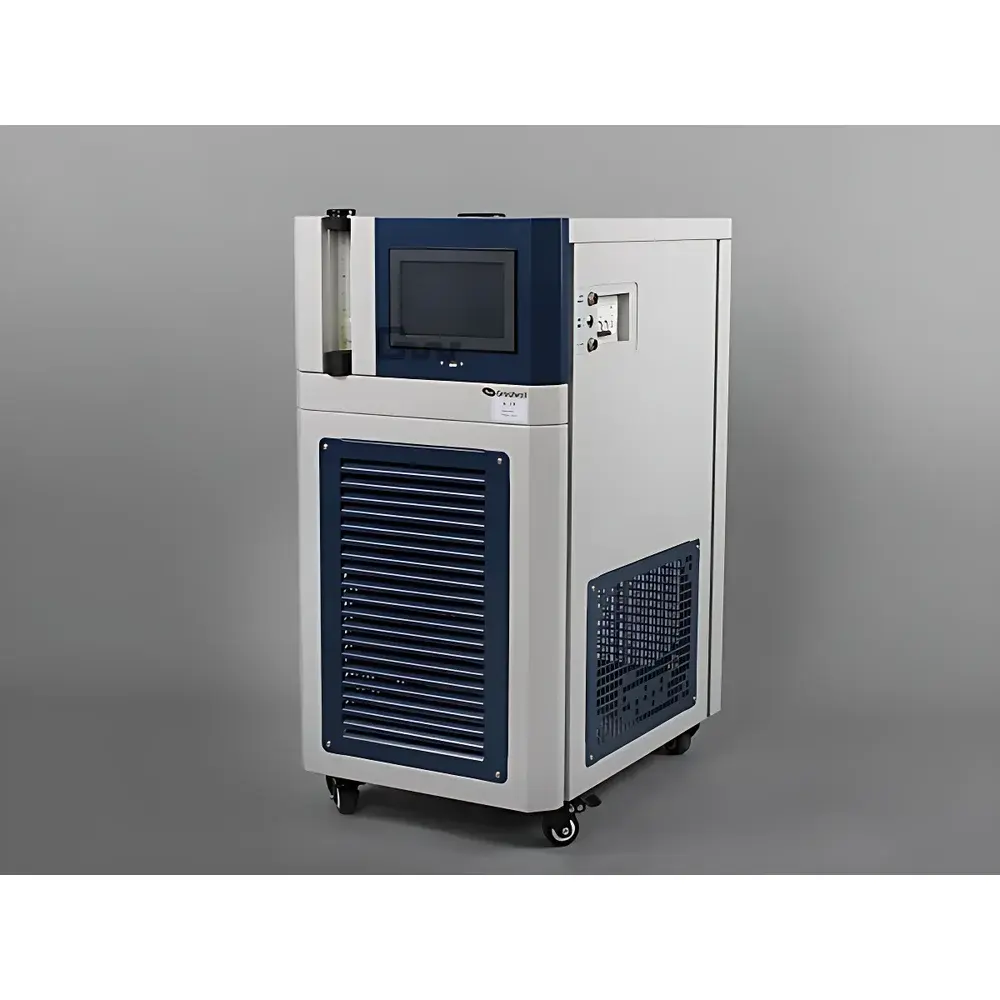
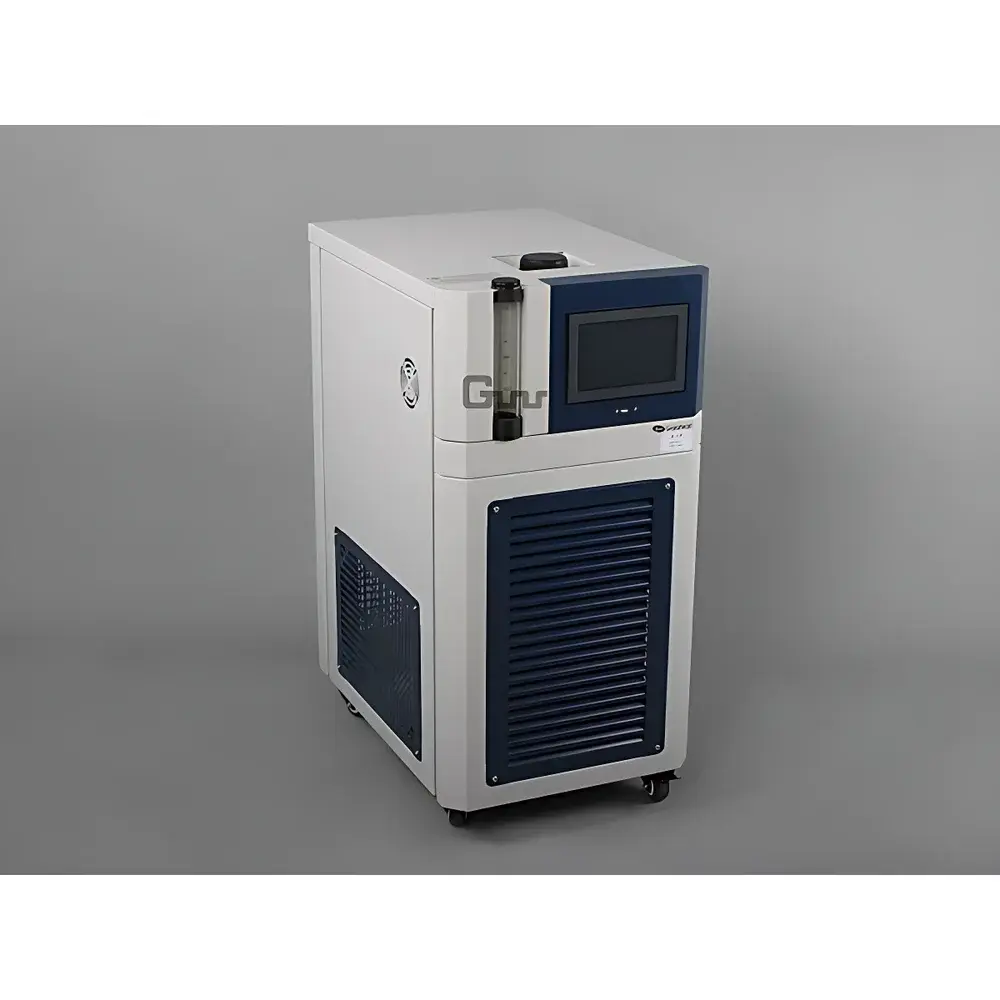
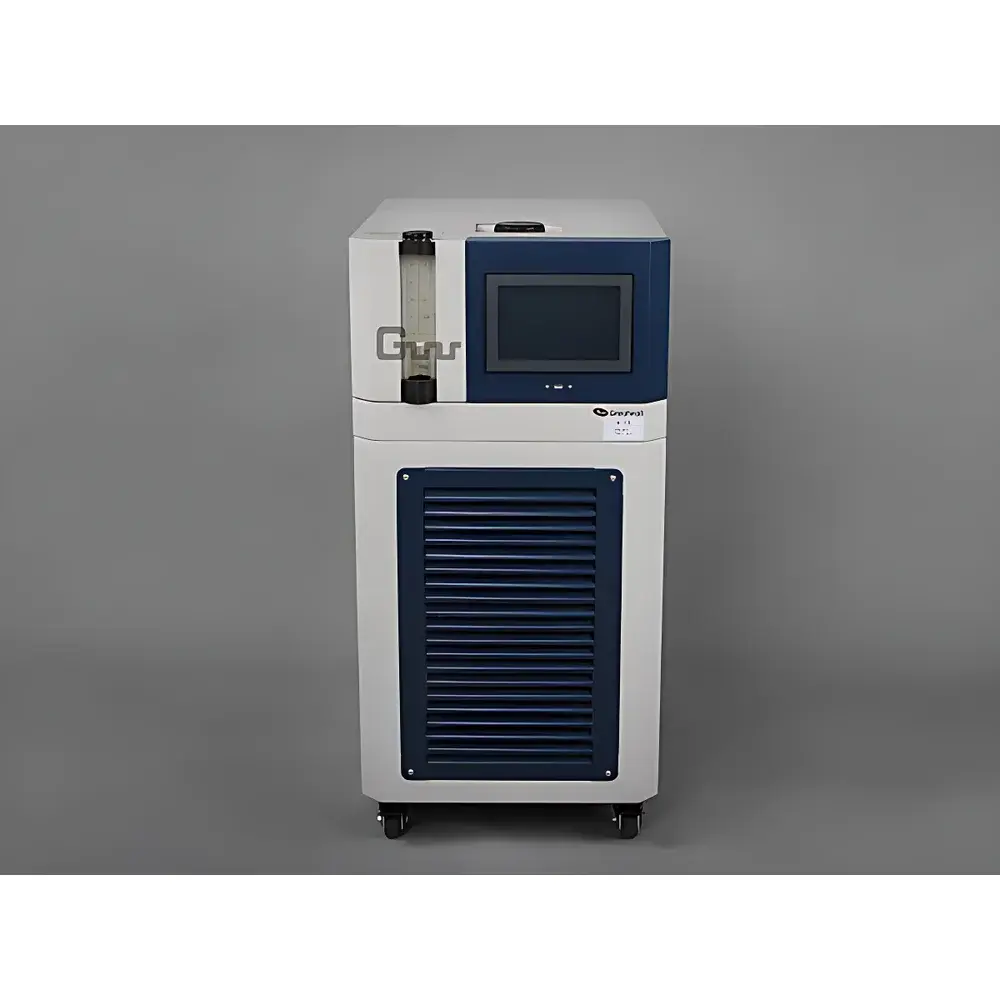
The Great Wall ZT-5-200-30H Closed-Loop Refrigerated Heating Circulator (Air-Cooled)
| Brand | The Great Wall |
|---|---|
| Origin | Henan, China |
| Manufacturer Type | Direct Manufacturer |
| Country of Origin | China |
| Model | ZT-5-200-30H (Air-Cooled) |
| Temperature Stability | ±0.5 °C |
| Operating Temperature Range | −30 °C to +200 °C |
| Ambient Temperature Range | 5 °C to 35 °C |
| Ambient Humidity | ≤70% RH |
| Power Supply | 220–240 V~, 50 Hz |
| Total Power Consumption | 3 kW |
| Heating Power | 2 kW |
| Refrigerant | R404A |
| Cooling Capacity | 0.6 kW at 200 °C / 0.6 kW at 20 °C / 0.5 kW at 0 °C / 0.4 kW at −10 °C / 0.3 kW at −20 °C / 0.2 kW at −30 °C |
| Circulation Pump Power | 180 W |
| Flow Rate | 25 L/min |
| Maximum Pressure | 1.5 bar |
| External Port Size | 1/2″ BSP |
| Expansion Tank Material | SUS304 |
| Tubing & Valve Material | SUS304 |
| Dimensions (W×D×H) | 420 mm × 650 mm × 860 mm |
| Net Weight | 106 kg |
| Safety Protections | Delayed startup, overcurrent, overtemperature, and high-temperature cutoff |
| Display | LCD touchscreen interface |
Overview
The Great Wall ZT-5-200-30H is a closed-loop refrigerated heating circulator engineered for precise, stable thermal control in laboratory-scale chemical synthesis, pharmaceutical process development, and biotechnology applications. Utilizing a dual-mode thermodynamic architecture—combining resistive heating elements with a cascade-capable R404A vapor-compression refrigeration system—the unit delivers continuous, bidirectional temperature regulation across an exceptionally wide operational range of −30 °C to +200 °C. Its closed-loop design prevents solvent evaporation, minimizes contamination risk, and eliminates atmospheric moisture ingress—critical for moisture-sensitive reactions (e.g., Grignard, organolithium, or anhydrous catalysis). Unlike open-bath systems, the ZT-5-200-30H maintains consistent fluid volume and composition over extended operation, ensuring long-term thermal reproducibility in reaction calorimetry, crystallization studies, and controlled polymerization.
Key Features
- High-precision temperature stability of ±0.5 °C across the full operating range—validated under dynamic load conditions with external reactors up to 50 L capacity
- Air-cooled condenser design eliminates dependency on facility cooling water, simplifying installation in standard laboratory environments (ambient 5–35 °C, ≤70% RH)
- Stainless steel (SUS304) wetted components—including expansion tank, circulation tubing, and isolation valves—ensure corrosion resistance against common organic solvents (e.g., THF, acetone, DMF, ethyl acetate) and aqueous buffers
- Touchscreen LCD interface with real-time display of setpoint, actual bath temperature, pump status, system pressure, and active safety flags
- Integrated safety suite compliant with IEC 61010-1:2010 requirements: delayed compressor restart, electronic overcurrent protection, dual-stage thermal cutoff (process and refrigerant loop), and dry-run detection
- Modular pump head rated for continuous duty at 25 L/min flow and 1.5 bar maximum backpressure—compatible with jacketed reactors, rotary evaporators, and inline heat exchangers
Sample Compatibility & Compliance
The ZT-5-200-30H supports thermal conditioning of diverse sample matrices via external circulation. It interfaces seamlessly with glass-jacketed reactors (1–50 L), falling-film evaporators, and analytical instrumentation requiring stabilized thermal input (e.g., FTIR cells, DSC autosamplers). All fluid-contact materials meet ASTM A240/A240M standards for 304 stainless steel. The system adheres to CE marking requirements (2014/30/EU EMC Directive and 2014/35/EU LVD Directive) and incorporates design features aligned with ISO/IEC 17025:2017 clause 6.4.7 (environmental monitoring equipment qualification). Optional ATEX-certified variants (II 2G Ex db IIB T4 Gb) are available for use in Zone 1 hazardous areas—subject to site-specific risk assessment per IEC 60079-10-1.
Software & Data Management
While the base model operates via standalone touchscreen control, optional RS485 Modbus RTU or Ethernet TCP/IP connectivity enables integration into centralized lab infrastructure. When paired with third-party SCADA or LIMS platforms (e.g., LabWare, Thermo Fisher SampleManager), the unit logs timestamped temperature, flow, and alarm events with audit-trail capability—supporting GLP/GMP documentation requirements. Data export is supported in CSV format; no proprietary software license is required. Firmware updates are performed via USB flash drive, maintaining full traceability per FDA 21 CFR Part 11 Annex 11 principles for electronic records.
Applications
- Exothermic/endothermic reaction control in organic synthesis (e.g., nitration, hydrogenation, lithiation)
- Temperature-programmed crystallization of APIs under cGMP-relevant conditions
- Thermal stabilization of rotary evaporation systems during low-boiling-point solvent removal
- Calibration validation of temperature sensors (PT100, thermocouples) across extended ranges
- Material testing under thermal cycling (−30 °C ↔ +200 °C) per ASTM D696 and ISO 11359-2 protocols
- Bioreactor jacket temperature control in microbial fermentation studies
FAQ
What is the recommended heat transfer fluid for operation at −30 °C?
A silicone oil blend (e.g., Dow Corning DC-200 or equivalent) with pour point ≤ −45 °C and viscosity < 50 cSt at 20 °C is strongly recommended. Ethylene glycol/water mixtures are unsuitable below −15 °C due to increased viscosity and reduced heat transfer efficiency.
Can this unit be used with explosion-proof reactors?
Yes—when configured with the optional ATEX-certified electrical package (including intrinsically safe pump driver and sealed touchscreen), it meets Zone 1 installation requirements for Group IIB gases. Full certification documentation is provided upon request.
Is remote monitoring possible without additional hardware?
No—standard configuration includes only local HMI control. Remote access requires optional communication module installation and network configuration by qualified personnel.
How often should the refrigerant charge be verified?
Under normal operation, refrigerant integrity is monitored continuously via discharge temperature and pressure sensors. Annual verification using calibrated manifold gauges and leak detection (per ISO 5149-2) is recommended as part of preventive maintenance.
Does the system support ramp-and-soak temperature profiles?
Yes—the touchscreen interface allows programming of multi-segment temperature ramps with user-defined rates (0.1–10 °C/min) and dwell times (1 min to 99 h 59 min), stored in non-volatile memory.



