
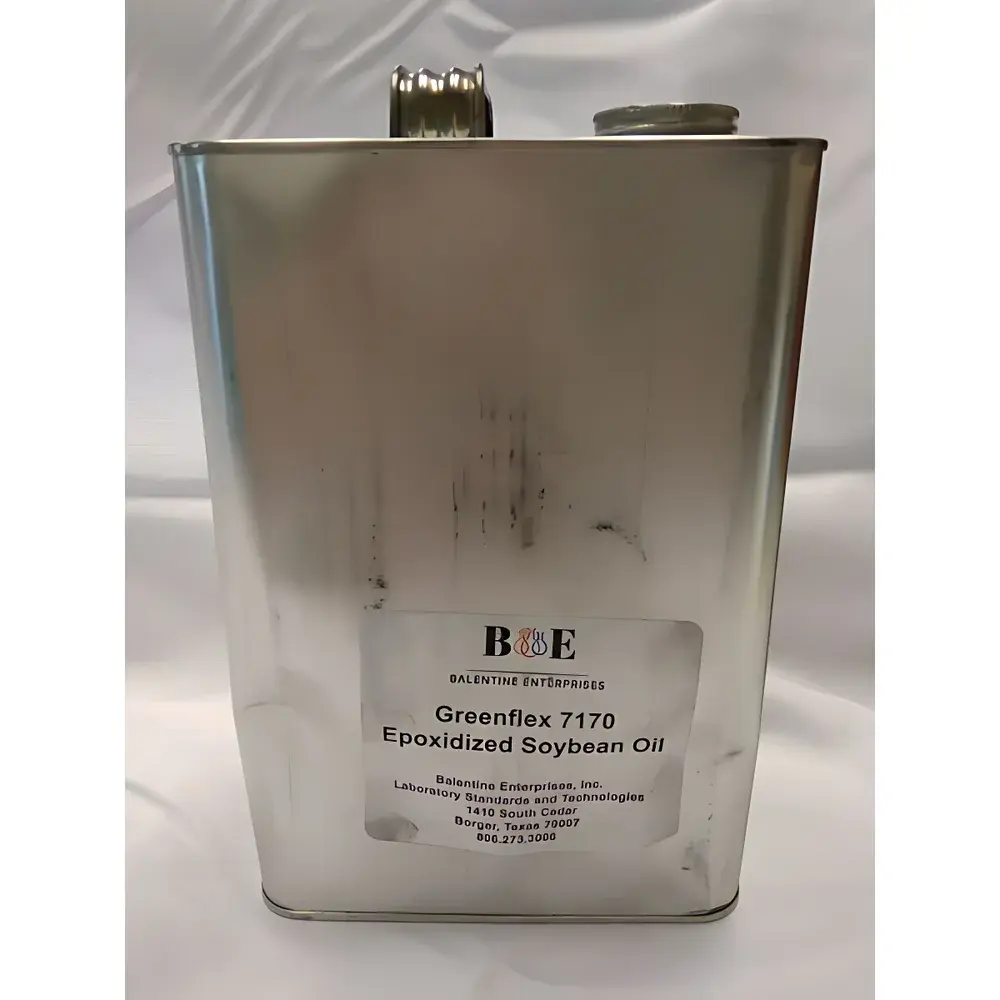
GreenChem Paralex G-62 Soybean Oil Epoxide (ASTM D3265 Reference Standard for Carbon Black Tinting Strength)
| Brand | GreenChem |
|---|---|
| Origin | USA |
| Compliance | ASTM D3265 |
| Chemical Identity | Epoxidized Soybean Oil (ESBO), CAS 8013-07-8 |
| Form | Clear, pale-yellow liquid |
| Purity | ≥95% (by epoxide content) |
| Packaging | Sealed amber glass bottle, nitrogen-purged |
| Storage | 2–8 °C, protected from light and moisture |
Overview
GreenChem Paralex G-62 Soybean Oil Epoxide is a certified reference material specifically formulated and validated for use in ASTM D3265 – Standard Test Method for Tinting Strength of Carbon Black. This method quantifies the ability of carbon black to reduce the reflectance of a white pigment matrix when dispersed with a standardized diluent—namely, epoxidized soybean oil. Paralex G-62 serves as the designated dispersing medium in the ASTM D3265 protocol, enabling reproducible preparation of carbon black–titanium dioxide–oil pastes for optical evaluation. Its consistent epoxide value (typically 6.0–6.5% w/w), low volatility, and controlled viscosity ensure minimal batch-to-batch variation in paste rheology and dispersion stability—critical parameters influencing the uniformity of film formation during drawdown and subsequent reflectance measurement.
Key Features
- Manufactured under strict quality control in an ISO 9001-certified facility in the United States, with full traceability to raw material lots and analytical certificates of analysis (CoA) provided per batch.
- Validated against ASTM D3265 requirements: meets specifications for epoxide oxygen content, acid number (<0.5 mg KOH/g), iodine value (<5 g I₂/100 g), and Gardner color (<3).
- Supplied in nitrogen-flushed, light-blocking amber glass bottles to prevent oxidative degradation and epoxide ring hydrolysis—ensuring shelf-life stability for ≥24 months when stored refrigerated (2–8 °C).
- Compatible with standard laboratory drawdown bars (e.g., 100 µm or 150 µm gap) and precision three-roll mills used in carbon black paste preparation per ASTM D3265 Section 7.
- No added plasticizers, solvents, or stabilizers—guaranteeing absence of interferents that could skew reflectance readings or alter dispersion kinetics.
Sample Compatibility & Compliance
Paralex G-62 is exclusively intended for use in ASTM D3265-compliant tinting strength assays involving dry carbon black powders and rutile titanium dioxide (TiO₂) pigments. It is not suitable for general-purpose plasticizer applications or non-standardized dispersion protocols. Each production lot undergoes independent verification by an accredited third-party lab for conformance to ASTM D3265 Annex A1 specifications. The material supports GLP-compliant testing environments and is referenced in multiple FDA-regulated colorant validation protocols where carbon black performance must be benchmarked under auditable conditions. While not a pharmaceutical excipient, its purity profile aligns with USP residual solvent limits and meets heavy metal thresholds per ICH Q3D.
Software & Data Management
As a physical reference standard—not an instrument—Paralex G-62 does not interface with software. However, its use is fully integrated into LIMS (Laboratory Information Management Systems) workflows supporting ASTM D3265. Batch-specific CoAs include QR-coded metadata linking to digital records of GC-FID epoxide quantification, FTIR spectral fingerprints, and Karl Fischer water content. These data elements are structured to support 21 CFR Part 11-compliant electronic record retention when imported into validated LIMS platforms. Laboratories performing routine D3265 testing are advised to log Paralex G-62 lot numbers alongside instrument calibration dates, operator IDs, and reflectance measurement timestamps to satisfy internal audit and external accreditation (e.g., ISO/IEC 17025) traceability requirements.
Applications
- Primary reference dispersant in ASTM D3265 tinting strength determinations for furnace, channel, and thermal carbon blacks.
- Calibration verification tool for spectrophotometers and photoelectric reflectometers used in ITRB (Index of Tinting Strength Based on Reflectance) calculations.
- Benchmark material in interlaboratory round-robin studies assessing method reproducibility across global carbon black producers and pigment users.
- Control standard in R&D settings evaluating novel carbon black surface treatments or alternative dispersants—where deviation from Paralex G-62 baseline performance indicates formulation impact.
- Support material in regulatory submissions to EPA, ECHA, or Health Canada requiring documented adherence to standardized carbon black characterization methods.
FAQ
Is Paralex G-62 identical to “oxidized soybean oil”?
No. Paralex G-62 is epoxidized—not oxidized—soybean oil. Epoxidation introduces oxirane rings via peracid reaction; oxidation implies uncontrolled radical degradation. ASTM D3265 explicitly requires epoxidized soybean oil.
Can I substitute another ESBO brand for ASTM D3265 testing?
Only if the alternative is formally qualified per ASTM D3265 Annex A2, including side-by-side testing against Paralex G-62 and demonstration of ≤±1.5% ITRB deviation across ≥5 carbon black grades.
What is the shelf life after opening?
Once opened, use within 30 days under inert gas blanket and refrigerated storage. Repeated exposure to ambient humidity degrades epoxide functionality and increases acid number.
Does this material require special shipping conditions?
Yes. Shipped on cold packs with temperature monitoring loggers. Ambient transit exceeding 25 °C for >48 hours voids ASTM conformance warranty.
Is Paralex G-62 compliant with REACH or Proposition 65?
Yes. Fully registered under REACH (EC No. 279-917-7). Does not contain substances listed under California Prop 65; SDS confirms absence of carcinogens, mutagens, or reproductive toxins at detectable levels.





