
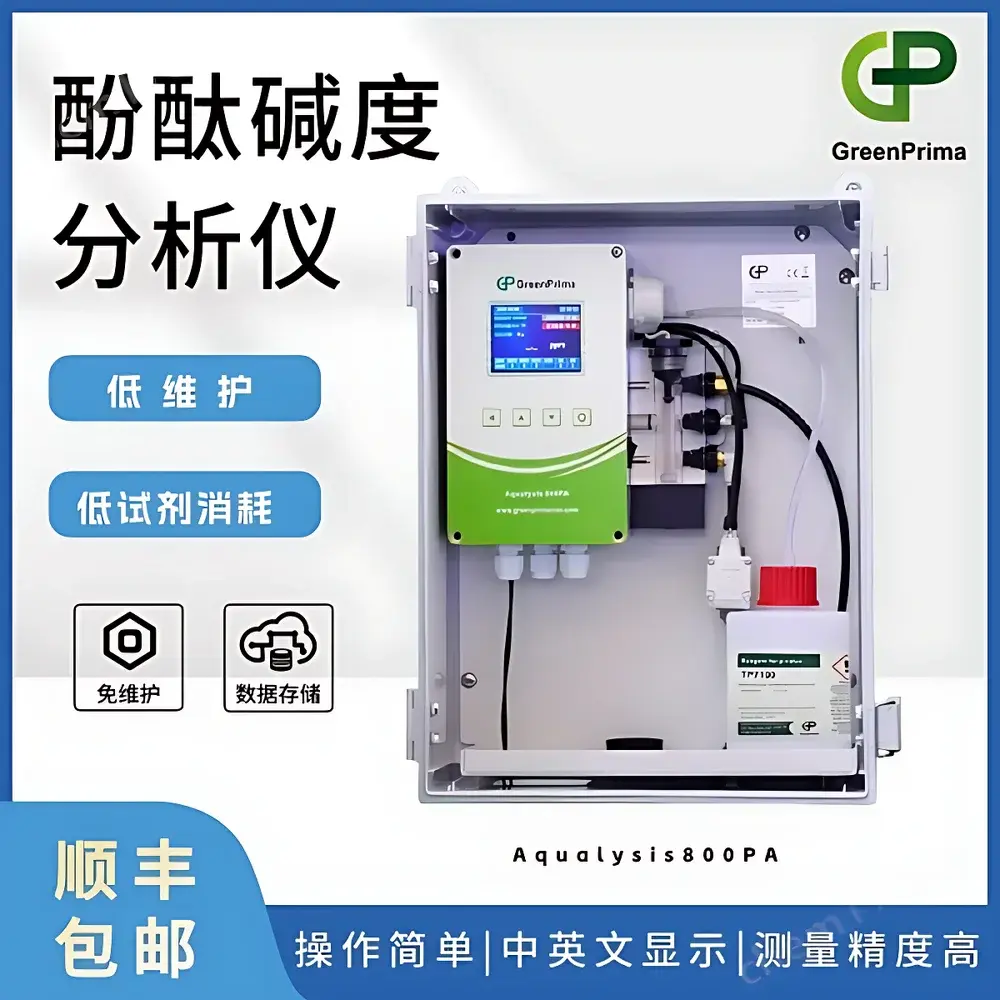
GreenPrima Aqualysis 800PA Phenolphthalein Alkalinity Analyzer
| Brand | GreenPrima |
|---|---|
| Origin | United Kingdom |
| Manufacturer Type | Manufacturer |
| Origin Category | Imported |
| Model | Aqualysis 800PA |
| Price | Upon Request |
Overview
The GreenPrima Aqualysis 800PA Phenolphthalein Alkalinity Analyzer is a fully automated, benchtop-to-industrial inline analyzer engineered for continuous or periodic determination of phenolphthalein alkalinity (P-alkalinity) in process and environmental water streams. It operates on the principle of potentiometrically guided acid–base titration coupled with photometric endpoint detection: a precise volume of standardized hydrochloric acid is dispensed into the sample; upon reaching the pH transition zone (~8.3), phenolphthalein indicator is introduced, inducing a distinct color shift from pink to colorless. This optical change is quantified via a calibrated photodiode-based spectrophotometric sensor operating at a fixed wavelength optimized for phenolphthalein’s absorbance peak. The microprocessor-controlled system calculates alkalinity concentration—expressed as mg/L CaCO₃, mmol/L, °dH, or °f—based on stoichiometric equivalence and reagent concentration. Designed for unattended operation in demanding industrial environments, the Aqualysis 800PA complies with foundational principles outlined in ISO 9963-1 (water quality — determination of alkalinity — part 1: titrimetric methods) and supports method validation under GLP and GMP-aligned operational frameworks.
Key Features
- Automated titration–photometry hybrid measurement with endpoint detection repeatability ±1% of selected reagent upper limit and accuracy within ±2%
- Integrated touchscreen control unit (color LCD, bilingual English/Chinese UI) enabling intuitive local configuration, real-time trend visualization, and diagnostic access
- Compact footprint (400 × 300 × 180 mm; 4 kg) with IP65-rated enclosure suitable for semi-outdoor or utility room deployment
- Low-maintenance architecture: corrosion-resistant fluidic path (PP, PTFE, borosilicate glass), precision peristaltic metering pumps, and modular valve manifold minimizing downtime
- Flexible operation modes: continuous analysis, timed intervals (1–360 min), or external trigger (flow pulse, digital input)
- Configurable rinse cycle (15–1800 s) to mitigate carryover in high-suspended-solid or high-iron applications
- Four programmable relay outputs (250 VAC / 4 A max) for alarm signaling, pump control, or interlock with upstream/downstream treatment units
- Dual digital inputs supporting start/stop commands or synchronization with PLC-driven process logic
- Embedded data logging with timestamped fault records, calibration history, and measurement archives (retention configurable)
Sample Compatibility & Compliance
The Aqualysis 800PA is validated for use with clarified or low-turbidity aqueous matrices meeting defined physicochemical constraints: pH 4–10, Fe < 3 ppm, Cu < 0.2 ppm, Al < 0.1 ppm, Mn < 0.2 ppm. Sample temperature must remain between 5°C and 40°C; inlet pressure should be maintained at 1–2 bar (max. 5 bar). It is routinely deployed in metallurgical cooling circuits—including basic oxygen furnace (BOF) gas scrubber water, turbid recirculating systems, closed-loop cooling towers, and low-pressure boiler feedwater—where rapid alkalinity shifts indicate scaling risk or chemical dosing inefficiency. While not certified to EN 14181 or US EPA Method 310.1 out-of-the-box, its measurement protocol aligns with the theoretical basis of ASTM D1067 (Standard Test Methods for Acidity or Alkalinity of Water) and supports internal method verification per ISO/IEC 17025 requirements when operated with traceable standards and documented SOPs.
Software & Data Management
The embedded firmware provides full local control without dependency on external PCs. All configuration parameters—including titrant concentration, reporting units, alarm thresholds, and communication protocols—are stored in non-volatile memory. Analog output (4–20 mA, load ≤750 Ω) enables direct integration into DCS or SCADA systems; RS485 Modbus RTU interface allows bidirectional data exchange for remote parameter adjustment and batch retrieval of historical datasets. Audit trails include operator-initiated actions (e.g., manual calibration, zero check), error codes with timestamps, and automatic event logging (e.g., reagent depletion warning, sensor timeout). The system supports 21 CFR Part 11–compliant operation when paired with external identity management and electronic signature modules—though native digital signature functionality is not implemented onboard.
Applications
- Real-time monitoring of phenolphthalein alkalinity in steel plant wet scrubber effluents to prevent CaCO₃ precipitation and nozzle fouling
- Process optimization in HVAC cooling tower water treatment, where P-alkalinity correlates with carbonate buffer capacity and corrosion inhibitor efficacy
- Boiler feedwater quality assurance in low-pressure steam generation, ensuring compliance with ASME B31.1 water chemistry guidelines
- Wastewater neutralization control prior to discharge, particularly in metal finishing or electroplating facilities
- Validation support for lime softening or CO₂ stripping unit performance in municipal water reclamation plants
FAQ
What is the difference between total alkalinity and phenolphthalein alkalinity?
Phenolphthalein alkalinity (P-alkalinity) measures hydroxide (OH⁻) and one-half of carbonate (CO₃²⁻) alkalinity, detected at pH ≈ 8.3. Total alkalinity includes OH⁻, CO₃²⁻, and bicarbonate (HCO₃⁻), titrated to pH ≈ 4.5.
Can the Aqualysis 800PA measure both P- and M-alkalinity (methyl orange)?
No—the instrument is dedicated to phenolphthalein endpoint detection only. M-alkalinity requires a second titration step to pH 4.5 and is not supported by this model.
Is field calibration required before installation?
Yes—initial calibration using certified alkalinity standard solutions (e.g., 100 mg/L and 500 mg/L CaCO₃) is mandatory. Subsequent automatic calibration can be scheduled at user-defined intervals.
What maintenance intervals are recommended?
Reagent replacement every 3–6 months (depending on usage frequency), tubing inspection quarterly, and optical window cleaning biweekly in high-dust environments.
Does the analyzer support connection to cloud-based monitoring platforms?
Native MQTT or OPC UA is not supported; however, third-party gateways can translate Modbus RTU or 4–20 mA signals to cloud protocols via edge computing devices.
Related Products







