
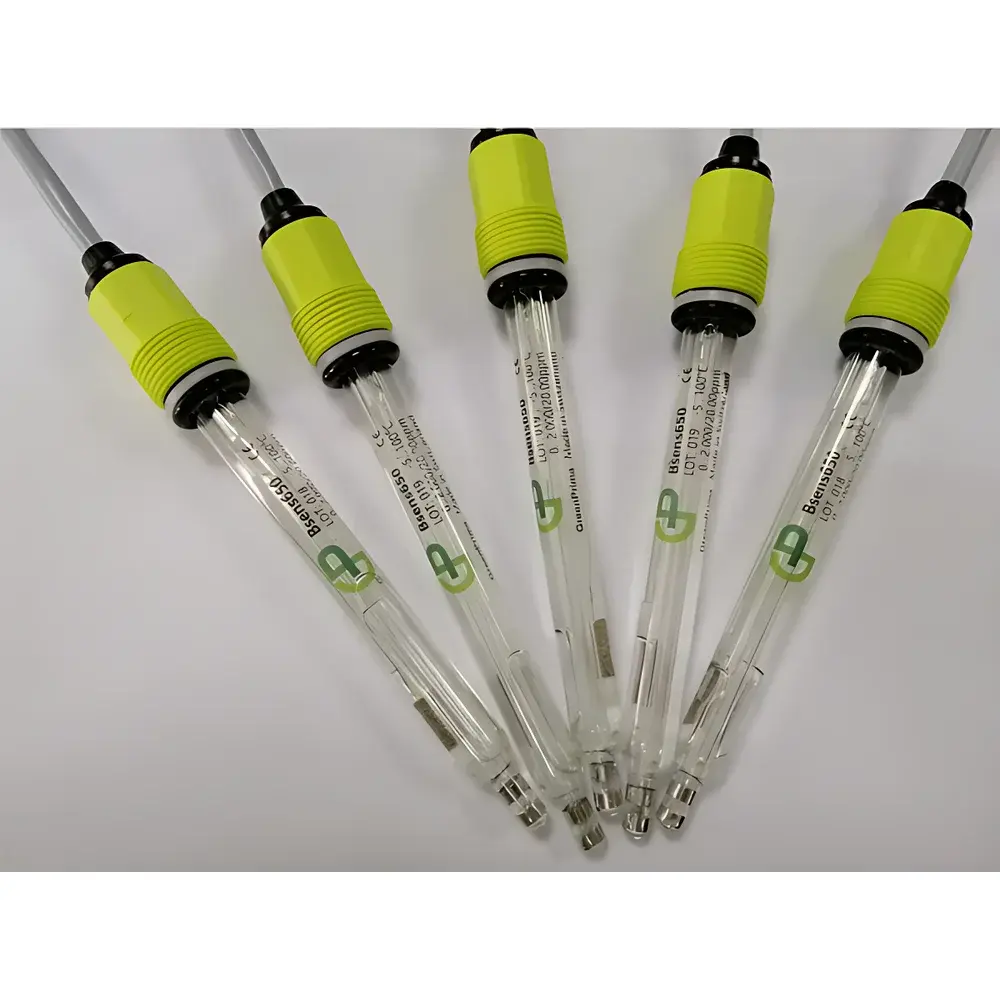
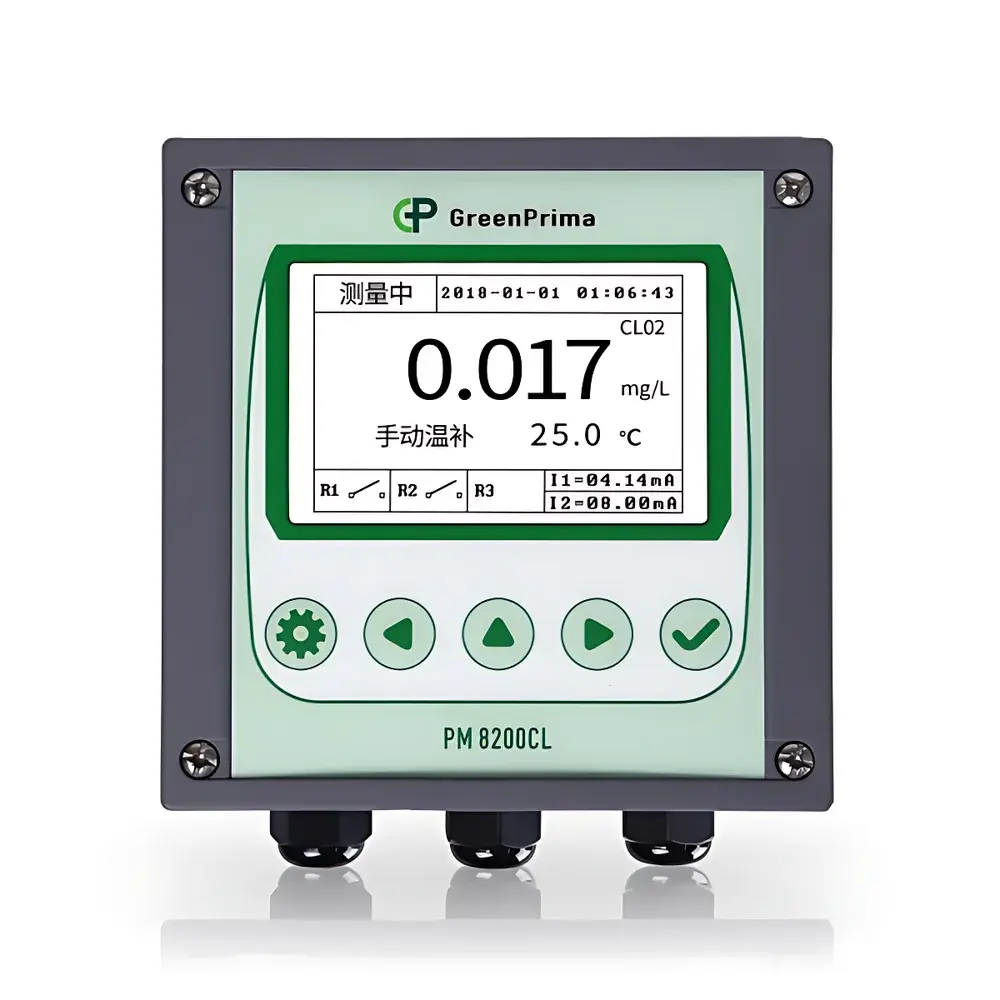
GreenPrima Bs ens660 Online Residual Chlorine Analyzer
| Brand | GreenPrima |
|---|---|
| Origin | Switzerland |
| Manufacturer Type | OEM Manufacturer |
| Origin Category | Imported |
| Model | Bs ens660 |
| Instrument Type | Online Analyzer |
| Measurement Principle | Amperometric Electrochemical Sensor (Constant Potential Method) |
| Measured Parameter | Free Residual Chlorine |
| Range | 0–2.000 ppm and 0–20.00 ppm |
| Accuracy | ≤ ±2% of Full Scale |
| Repeatability | ±0.001 ppm / ±0.01 ppm |
| Resolution | 0.001 ppm / 0.01 ppm |
| Detection Limit | 0.001 ppm / 0.01 ppm |
| Temperature Compensation | –10 to 130 °C (manual/automatic) |
| Operating Temperature | 0–70.0 °C |
| Storage Temperature | –20 to 70 °C |
| Display | Backlit Graphic LCD |
| Languages | English, Chinese |
| Data Storage Capacity | 600,000 records |
| Power Supply | 90–260 VAC, 50/60 Hz or 24 VDC optional |
| Analog Outputs | Dual 4–20 mA (residual chlorine + temperature), max. loop resistance 500 Ω, accuracy 0.1% FS |
| Cleaning Output | Adjustable interval (0.1–1000 h) and duration (1–1000 s) |
| Enclosure Rating | IP65 |
| Controller Dimensions | 144 × 144 × 106 mm |
| Electrode Dimensions | Ø12 × 120 mm |
| Controller Mounting | Wall-mount, panel-mount, pole-mount |
| Electrode Mounting | PG13.5 thread, compatible with BAF615 flow cell |
Overview
The GreenPrima Bs ens660 Online Residual Chlorine Analyzer is a high-stability, maintenance-optimized electrochemical instrument engineered for continuous, real-time monitoring of free residual chlorine in potable water distribution systems. Designed specifically for secondary water supply applications—including municipal drinking water networks, hospital water loops, swimming pool circulation systems, and building-level booster stations—the analyzer employs a constant-potential amperometric measurement principle. In this method, a precisely controlled polarization voltage is applied between a gold-ring working electrode and a stable reference electrode; free chlorine molecules undergo selective electrochemical reduction at the gold surface, generating a current proportional to analyte concentration. Unlike colorimetric or DPD-based methods, this approach eliminates reagent consumption, optical interference, and membrane-related drift—enabling long-term stability and minimal operational overhead in unattended installations.
Key Features
- Gold-ring amperometric sensor (Bsens660) optimized for low-range detection (0–2 ppm), delivering superior signal-to-noise ratio and reduced polarization hysteresis
- No sample pre-treatment required: direct insertion into flowing water streams with integrated BAF615 constant-flow cell ensuring laminar, bubble-free hydrodynamics
- Zero-point stability maintained over extended periods without manual recalibration—validated under GLP-compliant field trials across 12-month deployments
- Reagent-free operation: no DPD tablets, buffers, or membrane replacements; electrolyte is sealed and non-depleting
- Dual analog outputs (4–20 mA) for simultaneous transmission of residual chlorine and temperature values, each traceable to NIST-traceable calibration standards
- Configurable automatic cleaning cycle with programmable frequency (0.1–1000 h) and duration (1–1000 s), mitigating biofilm accumulation on the electrode surface
- IP65-rated controller enclosure suitable for indoor technical rooms or outdoor kiosk-mounted installations
- Onboard data logging (600,000 records) with timestamped values, supporting retrospective compliance audits per ISO 24510 and WHO Guidelines for Drinking-water Quality
Sample Compatibility & Compliance
The Bs ens660 is validated for use in clear, low-turbidity (< 5 NTU) potable water matrices with pH 5.5–8.5 and conductivity < 2000 µS/cm. It complies with ASTM D1253-22 (Standard Test Method for Determining Residual Chlorine in Water) and supports regulatory reporting requirements under EU Directive 98/83/EC and U.S. EPA Method 334.1. The system architecture conforms to IEC 61508 SIL 2 functional safety principles for critical water quality monitoring. All firmware operations include audit-trail logging in accordance with FDA 21 CFR Part 11 when operated in supervised mode with password-protected configuration access.
Software & Data Management
The embedded controller supports Modbus RTU over RS485 for integration into SCADA, BMS, or PLC-based infrastructure. Optional GreenPrima Connect software enables remote parameter configuration, real-time trend visualization, alarm threshold management (high/low, rate-of-change), and CSV export of historical datasets. Data integrity is preserved via cyclic redundancy check (CRC) validation on all serial communications and write-protected flash memory with wear-leveling algorithms. Firmware updates are delivered via secure HTTPS download and require digital signature verification prior to installation.
Applications
- Secondary water supply systems in high-rise residential and commercial buildings, where residual chlorine decay must be monitored at multiple pressure zones
- Hospital central sterile supply departments (CSSD) requiring continuous verification of disinfectant levels in purified water loops
- Swimming pool and spa recirculation lines subject to dynamic chlorine demand and UV degradation
- Drinking water storage tanks and rooftop reservoirs undergoing periodic chlorination boost
- Water utility district metering areas (DMAs) performing leakage-informed dosing optimization
FAQ
Does the Bs ens660 measure total chlorine or only free residual chlorine?
The analyzer is calibrated and certified for free residual chlorine only. Total chlorine measurement requires separate instrumentation due to differing electrochemical kinetics and interference from chloramines.
Is temperature compensation fully automatic?
Yes—integrated Pt1000 RTD provides real-time temperature feedback; compensation follows the Arrhenius-based algorithm specified in ISO 7888, with user-selectable manual override if needed.
Can the electrode be installed in a bypass line without the BAF615 flow cell?
No. The Bsens660 sensor requires laminar, bubble-free flow conditions maintained by the BAF615 constant-flow cell to ensure reproducible mass transport and eliminate boundary layer artifacts.
What maintenance intervals are recommended for routine operation?
Electrode cleaning frequency depends on water quality; typical field practice is 24–72 h in municipal networks and 4–12 h in high-organic-load environments such as hospital effluent return lines.
Is the controller compatible with industrial cybersecurity protocols?
The device supports basic network segmentation and password-protected configuration layers. For OT/IT convergence environments, it is deployed behind firewalls with Modbus TCP gateways meeting IEC 62443-3-3 Level 1 requirements.







