
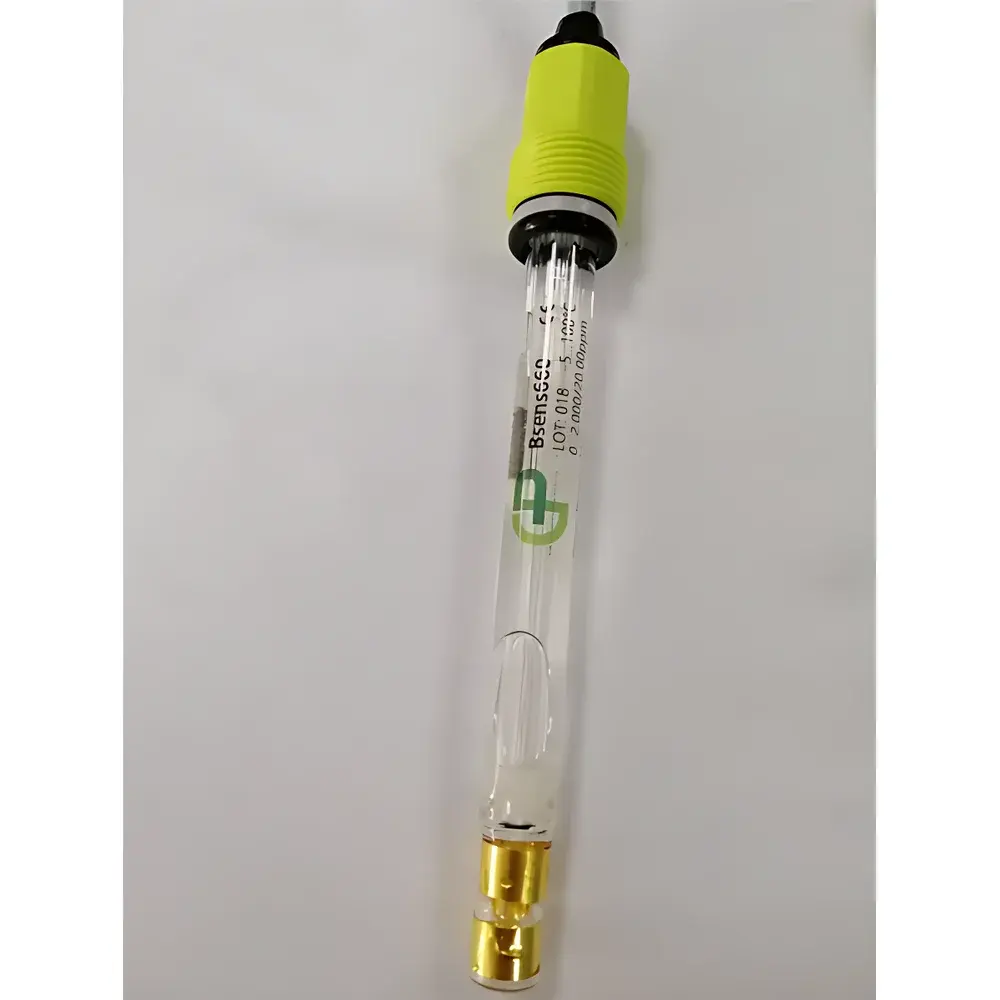
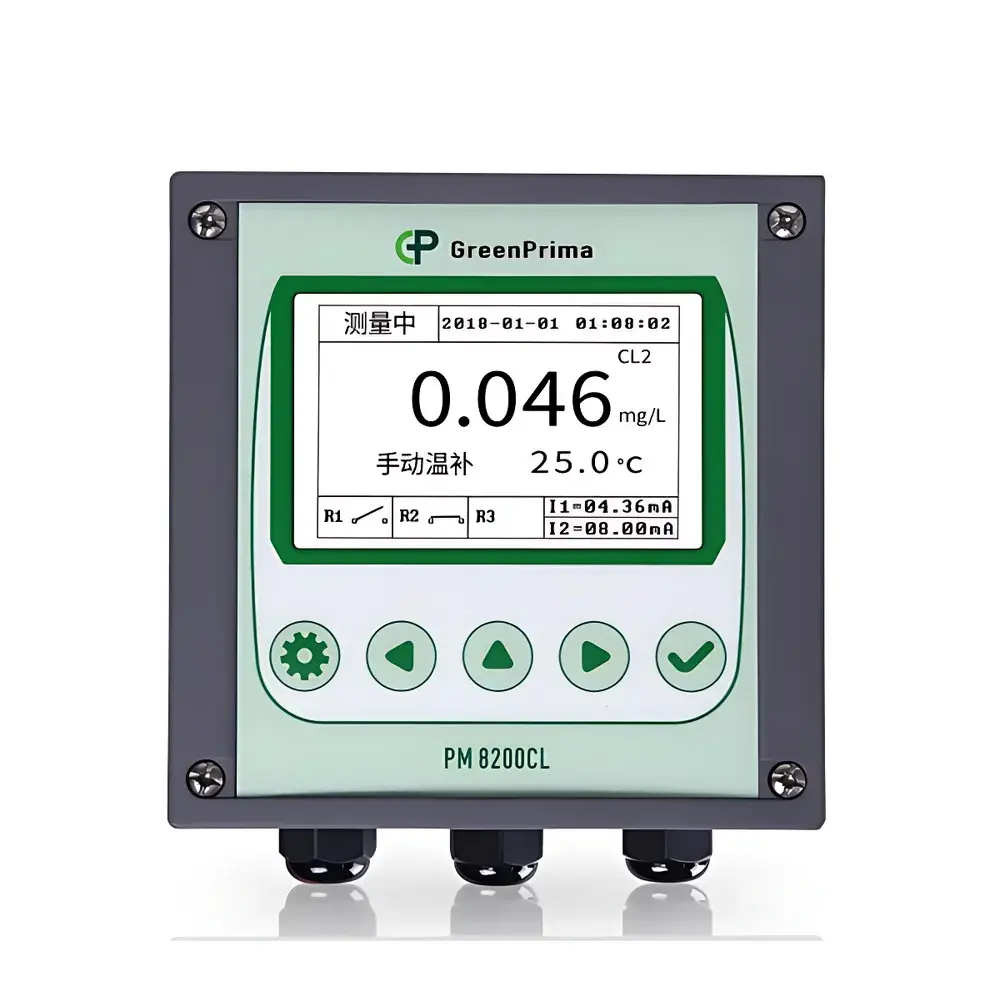
GreenPrima Bsens660 Online Residual Chlorine Analyzer for Hospital Wastewater Monitoring
| Brand | GreenPrima |
|---|---|
| Origin | Switzerland |
| Manufacturer | GreenPrima AG |
| Product Type | Imported |
| Model | Bsens660 |
| Instrument Category | Online Analyzer |
| Measurement Principle | Amperometric Electrochemical Sensor (Constant Voltage Method) |
| Measured Parameter | Free Residual Chlorine |
| Range | 0–2 ppm and 0–20 ppm |
| Accuracy | ≤ ±2% of Full Scale |
| Repeatability | ±0.001 ppm / ±0.01 ppm |
| Resolution | 0.001 ppm / 0.01 ppm |
| Detection Limit | 0.001 ppm / 0.01 ppm |
| Temperature Compensation | –10 to 130 °C (manual/automatic) |
| Operating Temp. | 0–70.0 °C |
| Storage Temp. | –20 to 70 °C |
| Display | Backlit Graphic LCD |
| Languages | English, Chinese |
| Data Storage | 600,000 records |
| Power Supply | 90–260 VAC, 50/60 Hz or 24 VDC optional |
| Analog Outputs | Dual 4–20 mA (residual chlorine & temperature), max. loop resistance 500 Ω, accuracy 0.1% FS |
| Cleaning Output | Adjustable interval (0.1–1000 h) and duration (1–1000 s) |
| Enclosure Rating | IP65 |
| Controller Dimensions | 144 × 144 × 106 mm |
| Electrode Dimensions | Ø12 × 120 mm |
| Controller Mounting | Wall-mount, panel-mount, pole-mount |
| Electrode Mounting | PG13.5 thread with BAF615 flow cell |
Overview
The GreenPrima Bsens660 Online Residual Chlorine Analyzer is an industrial-grade electrochemical monitoring system engineered for continuous, real-time measurement of free residual chlorine in hospital wastewater effluent streams. Designed to meet stringent discharge compliance requirements—including those outlined in WHO Guidelines for Safe Discharge of Healthcare Wastewater and EU Directive 91/271/EEC—the analyzer employs a constant-voltage amperometric detection principle. In this method, a stable polarizing potential is applied between a gold-ring working electrode and a silver/silver chloride reference electrode. Free chlorine species (HOCl/OCl⁻) undergo selective reduction at the gold surface, generating a diffusion-controlled current linearly proportional to concentration. The integrated BAF615 precision flow cell ensures laminar, pressure-stabilized sample delivery—critical for minimizing flow-induced signal drift and maintaining long-term baseline stability. Unlike colorimetric or DPD-based methods, the Bsens660 requires no reagents, membranes, or electrolyte refills, eliminating consumable dependency and reducing total cost of ownership over multi-year deployment.
Key Features
- Gold-ring amperometric sensor (Bsens660) optimized for low-range detection (0–2 ppm), delivering high sensitivity and minimal polarization drift
- Self-contained flow management via BAF615 constant-flow cell—no external pumps or pressure regulators required
- Dual-range auto-scaling capability (0–2 ppm / 0–20 ppm) with automatic range-switching logic based on dynamic signal thresholds
- Integrated temperature compensation using Pt1000 RTD sensor; supports both manual setpoint and automatic real-time correction
- Zero-point stability maintained over 30-day intervals without recalibration under steady-state conditions
- Robust IP65-rated controller housing with dual 4–20 mA analog outputs (chlorine + temperature), RS485 Modbus RTU interface, and programmable cleaning cycle control
- Onboard data logging (600,000 timestamped records) compliant with GLP audit trail requirements, including operator ID, calibration events, and alarm logs
Sample Compatibility & Compliance
The Bsens660 is validated for use in complex, variable-composition hospital effluents containing organic load, suspended solids (up to 50 mg/L TSS), and intermittent disinfectant surges. Its gold-ring electrode exhibits minimal fouling in chlorinated organic matrices and resists interference from nitrite (<5 mg/L), bromide (<10 mg/L), and oxidized manganese (<0.5 mg/L) per ASTM D6508-22 Annex A3. System compliance includes adherence to IEC 61508 SIL2 for safety-related instrumentation, EN 50178 for electrical safety in industrial environments, and ISO 7027 for optical equivalence in validation protocols. When deployed with documented SOPs, the analyzer satisfies data integrity expectations under FDA 21 CFR Part 11 for electronic records and signatures in regulated healthcare facilities.
Software & Data Management
The embedded firmware supports configuration, diagnostics, and historical review via local keypad/LCD or remote access through Modbus TCP (optional gateway). All calibration actions—span, zero, and slope verification—are digitally signed and time-stamped with user authentication. Data export is available in CSV format via USB port or scheduled FTP push. Optional GreenPrima CloudLink software enables centralized fleet monitoring across multiple hospital sites, with configurable threshold alerts (SMS/email), predictive maintenance scheduling based on electrode polarization trends, and automated report generation aligned with ISO/IEC 17025 internal audit templates.
Applications
- Real-time monitoring of chlorine residuals prior to municipal sewer discharge from hospital central sterilization units and dialysis centers
- Feedback control of sodium hypochlorite dosing systems in on-site wastewater treatment plants (WWTPs)
- Compliance verification for local environmental authority reporting (e.g., US EPA NPDES permits, China MEP HJ 505-2009)
- Process optimization in tertiary disinfection stages where chlorine demand fluctuates due to seasonal pathogen load variations
- Validation support during commissioning of new dechlorination systems (e.g., sulfur dioxide or activated carbon contactors)
FAQ
Does the Bsens660 require routine membrane replacement or electrolyte replenishment?
No. The gold-ring amperometric design eliminates the need for permeable membranes, internal electrolytes, or gel-filled reference junctions—reducing maintenance frequency and operational risk.
Can the analyzer operate reliably in wastewater with high turbidity or biofilm potential?
Yes. When installed with the BAF615 flow cell and configured with periodic automated cleaning cycles (programmable 1–1000 s duration), the system maintains stable output in effluents with up to 100 NTU turbidity and moderate biofilm formation rates.
Is temperature compensation mandatory for accurate readings?
Temperature compensation is enabled by default and strongly recommended. The built-in Pt1000 sensor corrects for kinetic and solubility effects across –10 to 130 °C, ensuring <±0.5% deviation from true concentration at 25 °C reference.
How is calibration traceability established?
Calibration is performed using NIST-traceable DPD standard solutions (e.g., AccuStandard CL-1000 series) following ISO 8467:2021 procedures. Certificate of Calibration includes uncertainty budget per GUM guidelines.
What cybersecurity provisions are included for network-connected deployments?
Firmware v3.2+ supports TLS 1.2 encrypted Modbus TCP communication, role-based access control (admin/operator/viewer), and secure firmware update signing via X.509 certificate validation.
Related Products







