
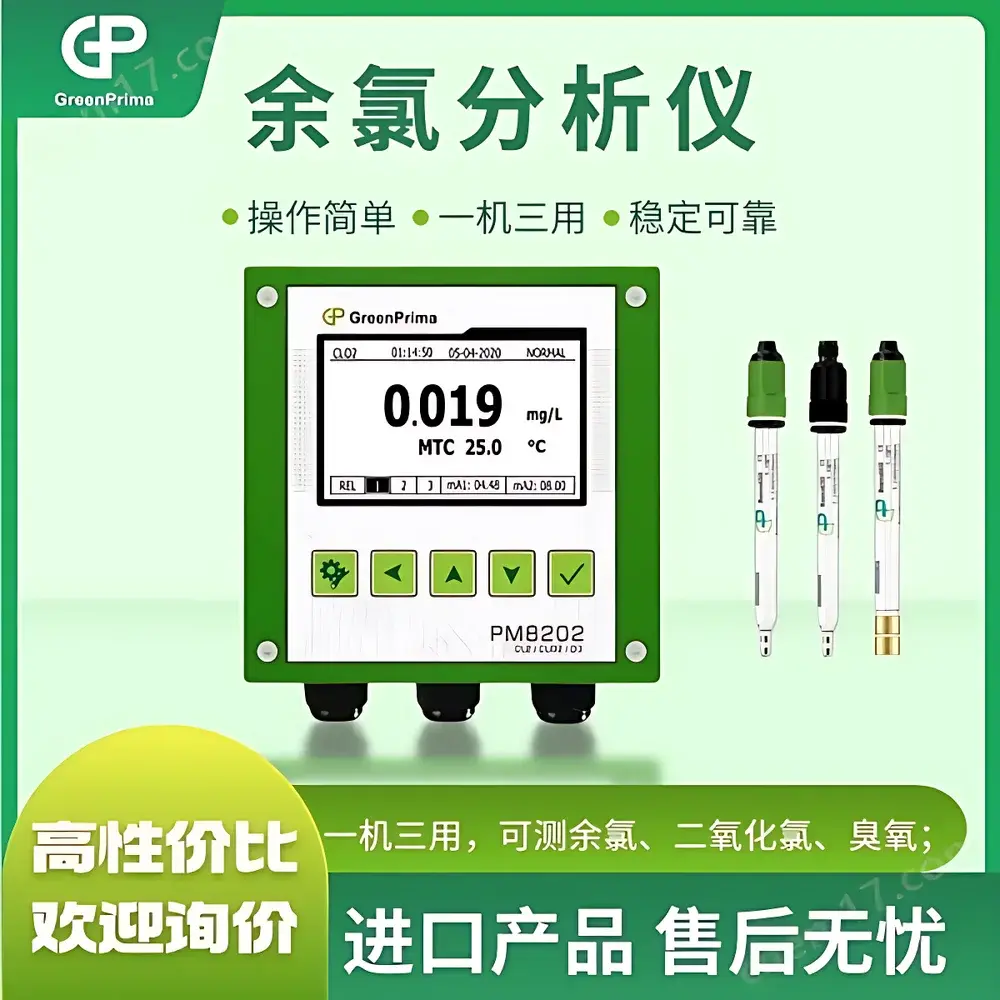
GreenPrima PM 8202C L Residual Chlorine, Chlorine Dioxide and Ozone Analyzer
| Brand | GreenPrima |
|---|---|
| Origin | United Kingdom |
| Manufacturer Type | Original Equipment Manufacturer (OEM) |
| Product Category | Imported Instrument |
| Model | PM 8202C L |
| Instrument Type | Online Analyzer |
| Measurement Principle | Amperometric Constant-Voltage Electrochemistry |
| Measured Parameters | Free Chlorine, Total Chlorine, Chlorine Dioxide, Ozone |
| Range | 0.00–20.00 ppm / 0.00–200.00 ppb |
| Accuracy | ±2% of Full Scale (F.S.) |
| Resolution | 0.001 ppm / 0.01 ppm |
| Temperature Compensation | –10 to +130 °C (NTC10K or PT1000 sensor compatible) |
| Operating Temperature | –10 to +70.0 °C |
| Storage Temperature | –20 to +70.0 °C |
| Display | Backlit Graphic LCD (Chinese/English Switchable) |
| Data Storage | 600,000 records |
| Power Supply | 90–260 VAC, 50/60 Hz or 24 VDC optional |
| Output | Dual isolated 4–20 mA (0.1% F.S., max. loop resistance 500 Ω) |
| Enclosure Rating | IP65 |
| Dimensions (W×H×D) | 144 × 144 × 108 mm |
| Panel Cutout | 138 × 138 mm |
| Weight | 0.87 kg |
Overview
The GreenPrima PM 8202C L is an online amperometric analyzer engineered for continuous, real-time monitoring of residual oxidants in potable water distribution systems and process streams. It operates on a constant-voltage electrochemical principle using dual platinum or gold working electrodes—configured as Bsens650 (Pt) or Bsens660 (Au)—paired with a dedicated BAF615 flow-controlled cell. This architecture enables selective, stable detection of free chlorine, total chlorine, chlorine dioxide, and ozone without chemical reagents or membrane replacement. Unlike colorimetric or DPD-based methods, the PM 8202C L eliminates sample pretreatment, reagent consumption, and optical path fouling, making it suitable for unattended operation in municipal water plants, hospital utility systems, secondary water supply stations, and industrial process water loops where regulatory compliance and measurement continuity are critical.
Key Features
- Reagent-free, membrane-free amperometric sensing with dual platinum or gold electrodes for high selectivity and long-term stability
- Integrated BAF615 constant-flow cell ensures consistent hydrodynamic conditions across varying inlet pressures, minimizing flow-induced drift
- Triple-analyte capability: simultaneous configuration for residual chlorine (free/total), chlorine dioxide, and ozone via electrode selection and calibration protocols
- Full temperature compensation from –10 °C to +130 °C using NTC10K or PT1000 sensors—supports both manual and automatic compensation modes
- Dual isolated 4–20 mA analog outputs with configurable scaling for measured parameter and temperature; RS485 Modbus RTU interface for SCADA integration
- Two independent programmable relays with hysteresis control for alarm signaling, pump interlock, or dosing system activation
- Configurable cleaning cycle (0.1–1000 hours interval; 1–1000 seconds duration) triggered via dedicated output to external solenoid valves or ultrasonic cleaners
- IP65-rated enclosure with wall-mount, panel-mount, and inline pipe-mount options; compact 144 × 144 × 108 mm footprint for space-constrained installations
- Secure access control with password-protected setup menu and parameter lockout to prevent unauthorized configuration changes
- Onboard data logging of 600,000 timestamped records—including measurement values, temperature, calibration events, and system diagnostics
Sample Compatibility & Compliance
The PM 8202C L is validated for use in potable water per WHO Guidelines for Drinking-water Quality and EPA Method 334.0 (amperometric chlorine determination). Its electrode-based detection meets ISO 7888:2019 (water quality — determination of residual chlorine) and supports GLP/GMP-aligned operational documentation through audit-trail-capable event logging. The analyzer complies with electromagnetic compatibility requirements per EN 61326-1:2013 and safety standards per IEC 61010-1:2010. No sample filtration or pH adjustment is required for typical drinking water matrices (pH 6.0–8.5, turbidity < 5 NTU, chloride < 1000 mg/L), though optional pre-filtration is recommended for high-sediment applications such as raw water intake monitoring.
Software & Data Management
Configuration and diagnostics are performed via the built-in graphic LCD with bilingual (English/Chinese) menu navigation. All calibration parameters—including zero offset, slope, temperature coefficient, and electrode sensitivity—are stored non-volatilely. The device supports two-point calibration using certified standard solutions traceable to NIST SRM 2801 (chlorine) or USP-grade ClO₂ reference materials. Logged data can be exported via USB or retrieved remotely via Modbus register polling. While the unit does not include embedded FDA 21 CFR Part 11-compliant electronic signature functionality, its event log structure—recording operator ID (if entered), timestamp, action type, and pre/post-value—is compatible with third-party LIMS or MES systems implementing full Part 11 compliance at the enterprise level.
Applications
- Municipal drinking water treatment: post-disinfection monitoring at clearwells, booster stations, and distribution network endpoints
- Hospital central sterile supply departments (CSSD) and dialysis units requiring strict oxidant control in rinse water
- Secondary water supply systems in high-rise buildings, where stagnation-induced chlorine decay must be continuously tracked
- Pharmaceutical purified water (PW) and water-for-injection (WFI) distribution loops subject to EU GMP Annex 1 and USP requirements
- Food & beverage production lines using chlorine dioxide for CIP sanitization validation
- Swimming pool and spa recirculation systems operating under EN 15288-1:2018 guidelines
FAQ
What electrochemical principle does the PM 8202C L employ?
It uses constant-voltage amperometry with dual working electrodes to generate current proportional to oxidant concentration at a fixed applied potential.
Can the same sensor measure chlorine, chlorine dioxide, and ozone simultaneously?
No—electrode selection (Bsens650 for chlorine/ozone or Bsens660 for chlorine dioxide) and calibration must be configured per target analyte; switching requires hardware change and recalibration.
Is temperature compensation mandatory for accurate readings?
Yes—oxidation kinetics and diffusion rates are temperature-dependent; the instrument requires either NTC10K or PT1000 input for valid compensation across its full operating range.
Does the analyzer support automatic zero calibration?
No—zero calibration requires manual introduction of dechlorinated water or sodium thiosulfate-treated blank; no internal reagent delivery system is included.
How often should the flow cell be cleaned in high-fouling environments?
Cleaning frequency is application-specific; typical intervals range from 24 to 168 hours, adjustable via the cleaning timer function based on observed signal drift or pressure drop.
Related Products







