
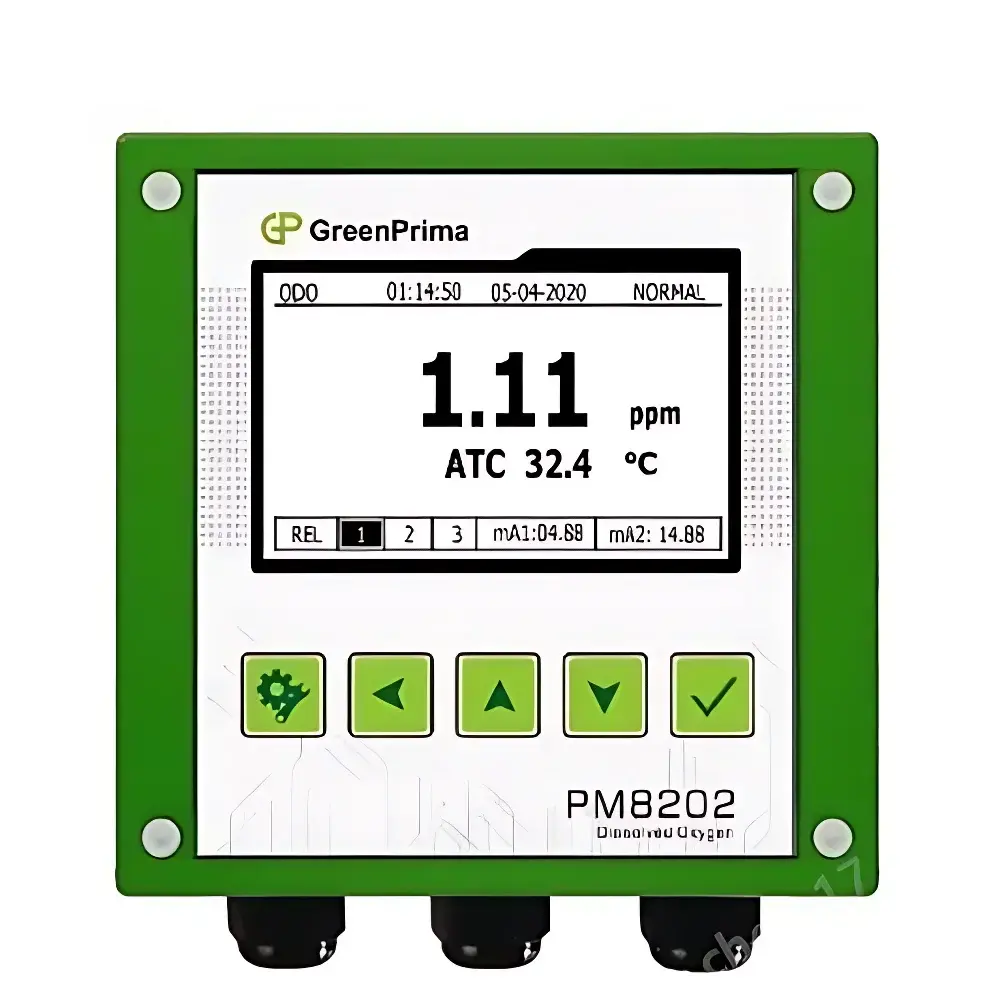
GreenPrima PM 8202D Online Polarographic Dissolved Oxygen Analyzer
| Brand | GreenPrima |
|---|---|
| Origin | United Kingdom |
| Manufacturer Type | Original Equipment Manufacturer (OEM) |
| Product Category | Imported Instrument |
| Model | PM 8202D |
| Instrument Type | Online Analyzer |
| Measurement Principle | Polarographic Electrochemical Sensor (Clark-type) |
| Measurement Range | 0.00–20.00 ppm / 0.00–200.00 ppb |
| Resolution | 0.001 ppm / 0.01 ppb |
| Accuracy | ±0.02 ppm / ±0.02 ppb |
| Temperature Compensation | –10 to 130 °C (manual or automatic |
| Operating Temperature | –10 to 70.0 °C |
| Storage Temperature | –20 to 70.0 °C |
| Display | Backlit large-dot-matrix LCD (Chinese/English bilingual) |
| Data Storage | 600,000 records |
| Power Supply | 90–260 VAC, 50/60 Hz or optional 24 VDC |
| Analog Outputs | Two isolated 4–20 mA outputs (max. loop resistance 500 Ω, accuracy 0.1% F.S., configurable for DO or temperature) |
| Communication | RS485 Modbus RTU |
| Cleaning Control Output | Adjustable cleaning interval (0.1–1000 h) and duration (1–1000 s) |
| Alarm Outputs | Two independent Hi/Lo relay alarms (5 A / 250 VAC / 30 VDC, hysteresis adjustable) |
| Enclosure Rating | IP65 |
| Mounting Options | Wall-mount, panel-mount, pipe-mount |
| Dimensions (W×H×D) | 144 × 144 × 108 mm |
| Cut-out Size | 138 × 138 mm |
| Weight | 0.87 kg |
Overview
The GreenPrima PM 8202D Online Polarographic Dissolved Oxygen Analyzer is a field-deployable, continuous-monitoring instrument engineered for high-reliability dissolved oxygen (DO) measurement in aqueous process streams and environmental water systems. It operates on the Clark-type polarographic principle: a noble metal cathode (typically gold or platinum) and a silver/silver chloride anode are immersed in an electrolyte-filled chamber separated from the sample by an oxygen-permeable polytetrafluoroethylene (PTFE) membrane. When a fixed polarizing voltage (~–0.7 V vs. Ag/AgCl) is applied, molecular oxygen diffusing through the membrane undergoes electrochemical reduction at the cathode, generating a current linearly proportional to the partial pressure of dissolved O₂. This current is converted into concentration units (ppm or ppb) with integrated temperature compensation—critical for maintaining accuracy across variable thermal conditions encountered in wastewater treatment, pharmaceutical bioreactors, power plant condensate loops, and aquaculture recirculation systems.
Key Features
- Robust IP65-rated enclosure with fully sealed, gas-tight housing—designed for long-term operation in humid, corrosive, or splash-prone industrial environments.
- Large backlit dot-matrix LCD display showing real-time DO concentration, temperature, system time, and relay status—supporting both English and Chinese interface languages.
- Modular electrode compatibility: supports interchangeable polarographic sensors (e.g., Bsens420, Bsens430, Bsens440), enabling optimization for flow velocity, fouling resistance, or response time per application requirements.
- Dual isolated 4–20 mA analog outputs configurable for DO value, temperature, or diagnostic signals—compliant with standard PLC and DCS input specifications.
- RS485 serial interface with Modbus RTU protocol for integration into SCADA, MES, or centralized data acquisition platforms—enabling remote configuration, calibration logging, and alarm event retrieval.
- User-accessible password protection for parameter modification, calibration access, and system reset—ensuring operational integrity in unattended or multi-operator facilities.
- Programmable automatic cleaning control output—supports external solenoid valves or ultrasonic cleaners with independently adjustable cycle intervals (0.1–1000 hours) and durations (1–1000 seconds).
Sample Compatibility & Compliance
The PM 8202D is validated for continuous use in municipal and industrial wastewater, potable water distribution networks, aquaculture tanks, fermentation broth, boiler feedwater, and cooling tower circuits. Its Clark-type sensor design meets performance expectations outlined in ASTM D888 (Standard Test Methods for Dissolved Oxygen in Water) and ISO 5814:2012 (Water quality — Determination of dissolved oxygen — Electrochemical probe method). While not intrinsically safe, its 24 VDC option facilitates deployment in classified areas when paired with appropriate barrier systems. The device supports GLP-compliant data management via timestamped internal storage (600,000 records) and optional audit-trail-enabled software—suitable for regulated environments requiring traceability under FDA 21 CFR Part 11 or EU Annex 11 guidelines.
Software & Data Management
Data logging occurs autonomously at user-defined intervals (1 second to 24 hours), with each record containing DO value, temperature, timestamp, and sensor status flags (e.g., membrane saturation, electrolyte depletion warning). Stored data may be retrieved via Modbus register polling or exported in CSV format using GreenPrima’s PC-based configuration utility. The firmware implements cyclic redundancy check (CRC) validation for all stored entries and includes write-protection mechanisms to prevent accidental overwrites. Calibration history—including zero/span points, date/time stamps, operator ID (if entered), and verification results—is retained separately and exportable for quality assurance review.
Applications
- Municipal wastewater treatment plants: monitoring aeration basin DO setpoints to optimize energy consumption and nitrification efficiency.
- Pharmaceutical bioreactors: ensuring consistent dissolved oxygen tension during upstream processing of monoclonal antibodies or vaccines.
- Power generation: safeguarding steam-cycle condensate purity by detecting low-level oxygen ingress that accelerates corrosion in feedwater systems.
- Aquaculture operations: maintaining species-specific DO thresholds (e.g., >5 ppm for salmonids) in RAS (Recirculating Aquaculture Systems) to support metabolic demand and reduce stress-related mortality.
- Chemical and fermentation processes: closed-loop control of oxygen supplementation in aerobic batch or fed-batch reactors where stoichiometric oxygen demand must be precisely matched.
FAQ
What maintenance does the polarographic sensor require?
Regular maintenance includes periodic replacement of the oxygen-permeable membrane and replenishment of the internal electrolyte solution—typically every 3–6 months depending on operating conditions and fouling exposure. Sensor calibration (zero and span) is recommended before each membrane change and at least weekly in critical applications.
Can the PM 8202D operate without temperature compensation?
No—the instrument mandates temperature input (via built-in NTC10K or external PT1000 sensor) for accurate DO calculation. Both manual and automatic compensation modes are supported, but omission invalidates concentration reporting per thermodynamic solubility models.
Is the 4–20 mA output intrinsically safe?
The analog outputs are isolated and compliant with IEC 61000-4 immunity standards, but intrinsic safety requires additional barrier certification. For hazardous locations, pairing with a certified Zener or galvanic isolator is required.
How is sensor drift detected and corrected?
The controller monitors cathode current stability and electrolyte conductivity trends. A progressive decline in zero-current baseline or reduced span response triggers a “sensor health warning” flag—prompting scheduled verification against air-saturated water or certified standard solutions.
Does the device support HART communication?
No—communication is limited to RS485 Modbus RTU. HART functionality is not implemented; users requiring HART must deploy a separate protocol converter or select alternative instrumentation.
Related Products







