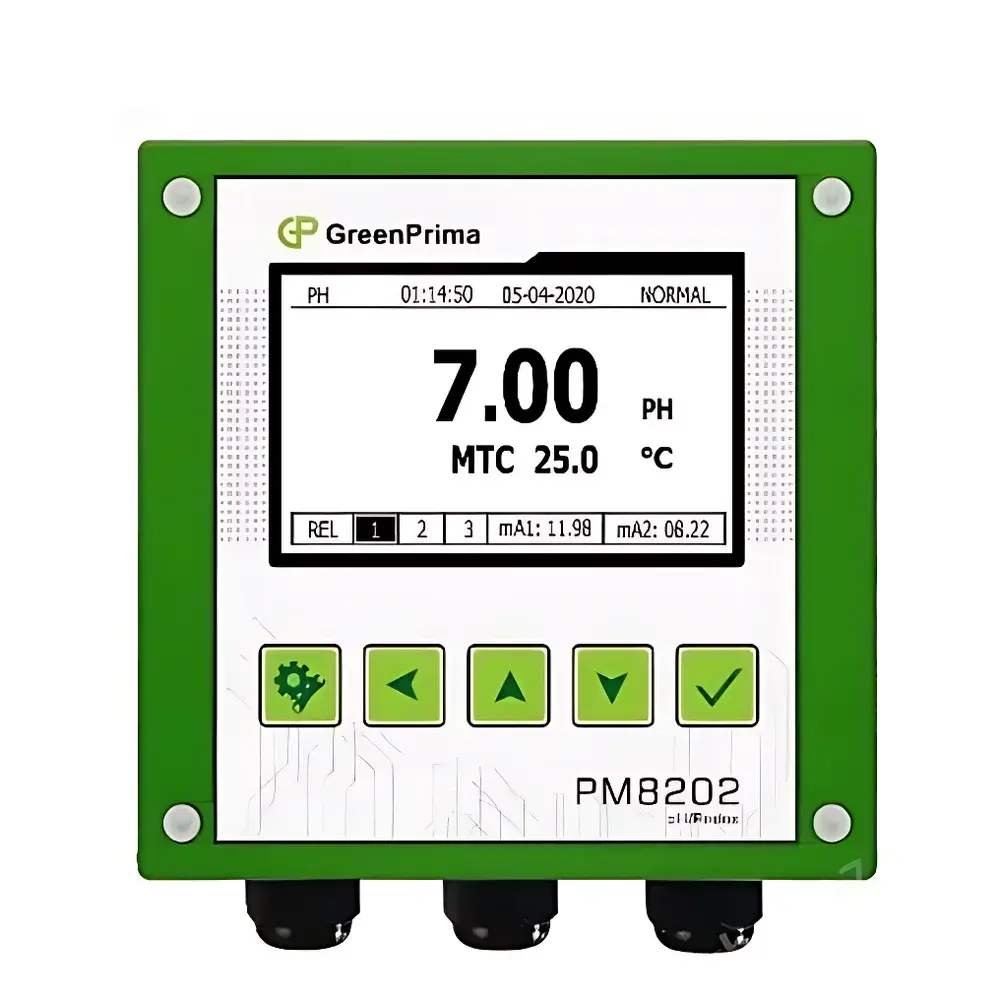
GreenPrima PM820 2P High-Temperature Online pH Analyzer
| Brand | GreenPrima |
|---|---|
| Origin | United Kingdom |
| Manufacturer Type | Original Equipment Manufacturer (OEM) |
| Product Category | Imported Industrial Process Instrument |
| Model | PM820 2P |
| Measurement Range | -2 to 16 pH, -2000 to +2000 mV, 0 to 130 °C |
| Resolution | 0.01 pH, 1 mV, 0.1 °C |
| Accuracy | ±0.01 pH, ±0.1 mV, ±0.1 °C |
| Temperature Compensation Range | -10 to 130 °C (manual/automatic |
| Dimensions | 144 × 144 × 108 mm |
| Weight | 0.87 kg |
Overview
The GreenPrima PM820 2P High-Temperature Online pH Analyzer is an industrial-grade process monitoring instrument engineered for continuous, real-time measurement of pH, redox potential (ORP), and temperature in demanding aqueous environments. Designed around a modular architecture, the analyzer integrates seamlessly with GreenPrima’s Bsens series of high-temperature pH electrodes—including models Bsens110T, Bsens210, Bsens120T, Bsens130, Bsens140T, Bsens150T, and Bsens180T—each rated for sustained operation up to 130 °C. Its core measurement principle relies on potentiometric detection via glass electrode technology, calibrated against NIST-traceable buffer standards, and incorporates dual-sensor temperature compensation to ensure thermodynamic accuracy across wide thermal gradients. The device complies with fundamental requirements for process analytical technology (PAT) deployment in regulated industries, supporting stable operation under variable pressure and flow conditions typical of boiler feedwater, sterilization loops, chemical reactor effluents, and high-temperature wastewater streams.
Key Features
- IP65-rated fully sealed enclosure with corrosion-resistant polycarbonate housing, suitable for humid, dusty, or splash-prone industrial zones
- Backlit high-contrast dot-matrix LCD display showing simultaneous pH/ORP value, temperature, timestamp, relay status, and system diagnostics
- Dual isolated 4–20 mA analog outputs (0.1% FS accuracy, max. 500 Ω loop resistance), configurable for pH, ORP, or temperature signals independently
- RS485 Modbus RTU interface for integration into SCADA, DCS, or PLC-based control systems (addressable from 1 to 247)
- Configurable cleaning cycle output: cleaning interval adjustable from 0.1 to 1000 hours; duration from 1 to 1000 seconds
- Two independent programmable alarm relays (5 A / 250 VAC / 30 VDC), each with user-defined setpoints, hysteresis, and fail-safe logic
- Onboard data logging capacity of 600,000 records with time-stamped entries, retained during power loss via non-volatile memory
- Multi-language UI (English and Chinese) with intuitive menu navigation, password-protected configuration access, and one-button factory reset
- Flexible mounting options: panel-mount (138 × 138 mm cutout), wall-mount, or inline pipe-mount with optional bracket kits
Sample Compatibility & Compliance
The PM820 2P is validated for use with conductive aqueous media having conductivity ≥50 µS/cm, including potable water, municipal and industrial wastewater, cooling tower blowdown, pharmaceutical purified water (PW) and water-for-injection (WFI) distribution loops, food & beverage processing streams, and chemical synthesis effluents. It supports automatic temperature compensation using either NTC10K or PT1000 probe inputs—enabling traceable calibration per ISO 17025 laboratory practices when paired with certified reference electrodes. While not intrinsically safe, the unit meets CE marking requirements under the EMC Directive 2014/30/EU and Low Voltage Directive 2014/35/EU. Its firmware architecture accommodates audit trail generation and user-access logging—facilitating alignment with FDA 21 CFR Part 11 expectations where electronic records are subject to review during GMP/GLP audits.
Software & Data Management
Data export is supported via USB mass storage mode (using standard FAT32-formatted drives) or through Modbus-polling scripts deployed on supervisory systems. Logged datasets include pH, mV, temperature, timestamp, and event flags (e.g., calibration, cleaning, alarm activation). Internal clock synchronization supports NTP-compatible time servers when integrated via gateway hardware. Firmware updates are performed offline using signed .bin files to prevent unauthorized modification. Configuration backups can be saved and restored across units, ensuring consistency in multi-node deployments. No cloud connectivity or proprietary software is required—operation remains fully functional without external dependencies.
Applications
- Continuous pH monitoring in steam boiler feedwater and condensate return lines
- Real-time acidity control in high-temperature CIP (Clean-in-Place) systems for dairy and biopharma facilities
- Effluent quality assurance in chemical manufacturing reactors operating above 100 °C
- Regulatory compliance monitoring for EPA NPDES discharge permits in municipal treatment plants
- Process validation support for sterilization cycles (e.g., autoclave drain monitoring, SIP verification)
- Corrosion mitigation control in geothermal brine and oilfield produced water handling
FAQ
What temperature range is supported for continuous electrode immersion?
The Bsens-series high-temperature pH sensors compatible with the PM820 2P are rated for continuous operation at 0–130 °C; short-term excursions up to 140 °C are permissible with appropriate dwell-time limits defined in electrode datasheets.
Does the analyzer support automatic calibration?
No—calibration is manual and requires two-point (or three-point) buffer standardization using certified pH 4.01, 7.00, and 10.01 solutions; however, slope and offset values are stored and applied automatically during measurement.
Can the unit operate on DC power?
Yes—primary power is 90–260 VAC, 50/60 Hz, but optional 24 VDC operation is available upon configuration at order stage.
Is the data logger compliant with 21 CFR Part 11?
The device provides foundational elements (user authentication, audit-ready timestamps, immutable logs), but full Part 11 compliance requires supplementary procedural controls, electronic signature policies, and system validation conducted by the end-user per their quality management system.
How often should the pH sensor be cleaned or replaced?
Cleaning frequency depends on fouling rate—typically every 24–72 hours in aggressive wastewater; replacement intervals range from 6–24 months based on electrode drift, response time degradation, and calibration stability as verified per ASTM D1293 or ISO 10523 protocols.
Related Products