
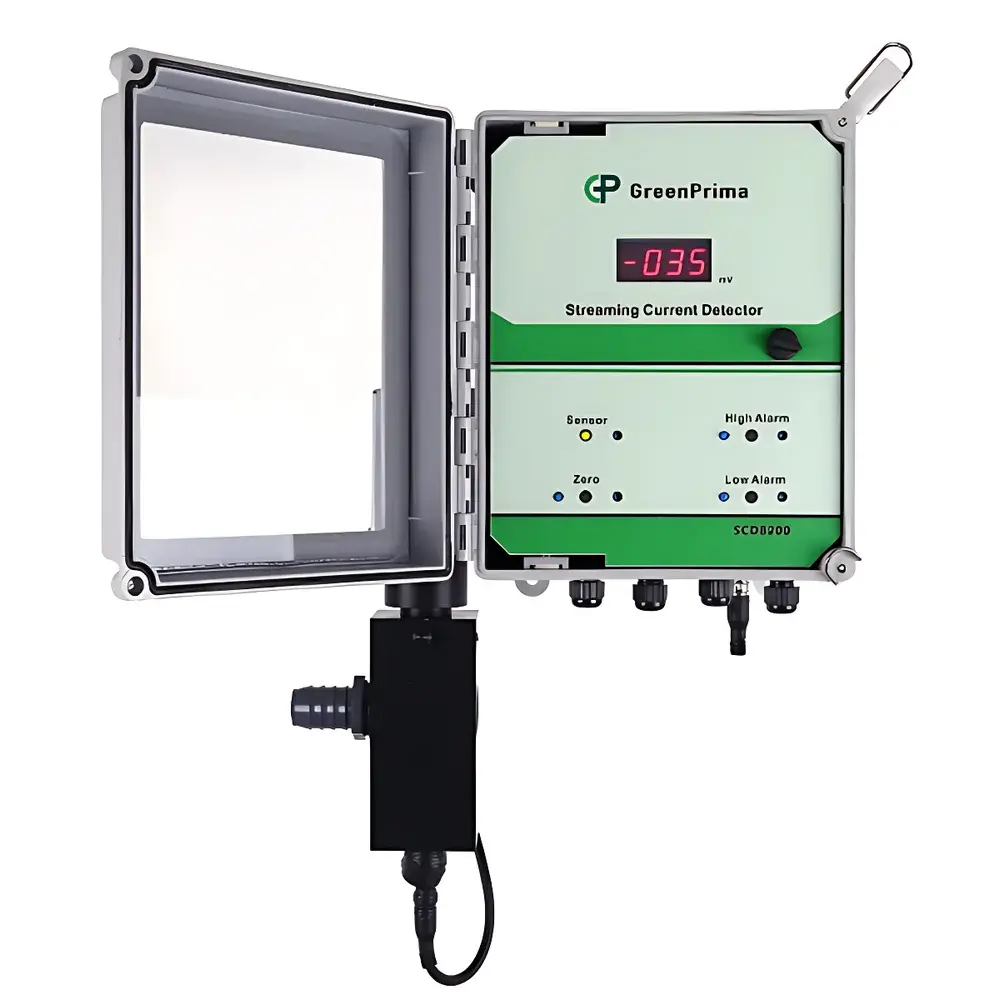
GreenPrima SCD8200 Streaming Current Detector for Municipal Water Treatment
| Brand | GreenPrima |
|---|---|
| Origin | USA |
| Manufacturer Type | Manufacturer |
| Origin Category | Imported |
| Model | SCD 8200 |
| Price Range | USD 6,800 – 13,600 |
| Power Supply | 100–240 VAC, 50/60 Hz |
| Measurement Range | −1000 to +1000 mV |
| Accuracy | ±0.1% of full scale |
| Response Time | 1 second |
| Sample Flow Rate | 1 US gallon per minute (3.785 L/min) |
| Inlet Connection | 1/2″ barbed quick-connect |
| Outlet Connection | 3/4″ barbed quick-connect |
| Enclosure Rating | NEMA 4X / IP65 |
| Output Signals | 4–20 mA, −10 to +10 V, 0–10 V |
| Communication Protocol | MODBUS RTU (optional) |
| Alarm Outputs | Dual SPDT relays (high/low) |
| Sensor Materials | Delrin®, 316 stainless steel, PTFE |
| Weight | 9 kg |
| Dimensions | 11.0″ × 6.0″ × 5.5″ (W × H × D) |
Overview
The GreenPrima SCD8200 Streaming Current Detector is an industrial-grade, online electrokinetic analyzer engineered for real-time monitoring and control of coagulation efficacy in municipal drinking water treatment plants, wastewater reclamation facilities, and industrial pretreatment systems. Based on the principle of streaming current measurement—a well-established electrophoretic technique—the SCD8200 quantifies the net surface charge density of colloidal particles and dissolved ionic species in flowing water. As a piston-driven flow cell subjects the sample to controlled shear, counter-ions within the electrical double layer are mobilized, generating a measurable alternating current between two parallel platinum or stainless-steel electrodes. This streaming current signal (in mV) correlates directly with the residual zeta potential of the suspension post-coagulant dosing, providing a robust, physics-based proxy for optimal coagulant dosage. Unlike offline jar testing or turbidity-based feedback, the SCD8200 delivers continuous, process-representative data with sub-second response—enabling closed-loop control of polyaluminum chloride (PACl), ferric chloride, or cationic polymer feed rates.
Key Features
- True online streaming current measurement with 1-second dynamic response, eliminating lag inherent in lab-based titration or offline particle counting
- Self-contained, NEMA 4X-rated non-metallic enclosure with integrated power supply and signal conditioning—designed for permanent outdoor installation in humid, chlorinated, or UV-exposed environments
- Zero-point auto-calibration function that compensates for electrode drift without manual intervention or chemical standards
- Robust sensor wetted materials: Delrin® body for dimensional stability, 316 stainless steel fasteners, and PTFE-sealed flow path—resistant to oxidation, scaling, and chlorine degradation
- Dual analog outputs (4–20 mA and ±10 V) plus optional MODBUS RTU serial communication for integration into PLCs, SCADA systems, or DCS platforms
- Configurable high/low alarm relays for automatic shutdown, pump modulation, or operator notification during under-dosing or over-dosing events
- No consumables, no reagents, and no optical components—ensuring >5 years of maintenance-free operation under typical municipal service conditions
Sample Compatibility & Compliance
The SCD8200 is validated for use with raw surface water, clarified effluent, filtered backwash water, and low-turbidity finished water (0.1–100 NTU). It accommodates pH ranges from 5.5 to 9.0 and total suspended solids up to 50 mg/L without clogging or signal attenuation. The instrument complies with key regulatory frameworks governing automated process control in public water systems, including EPA Guidance Manual for Optimization of Coagulation (2012), ISO 5667-3:2018 (water sampling — preservation and handling), and ASTM D3693-17 (standard practice for determining coagulant dose). Its audit-ready data logging supports GLP-compliant record retention and satisfies traceability requirements under 21 CFR Part 11 when paired with compliant SCADA historian software.
Software & Data Management
While the SCD8200 operates as a standalone transmitter, its analog and MODBUS outputs interface seamlessly with industry-standard automation infrastructure. When integrated with programmable logic controllers (e.g., Siemens S7, Rockwell ControlLogix), it enables proportional-integral (PI) or model-predictive control (MPC) algorithms to dynamically adjust coagulant metering pump speed based on real-time streaming current deviation from setpoint. Optional web-enabled gateways allow remote configuration, trend visualization, and alarm history export in CSV or PDF format. All measurements include embedded timestamps and diagnostic flags (e.g., “flow fault”, “electrode saturation”), supporting root-cause analysis during QA/QC audits or regulatory reviews.
Applications
- Municipal potable water treatment: Real-time optimization of primary coagulation in conventional rapid sand or dissolved air flotation (DAF) plants
- Membrane pre-treatment: Preventing fouling in ultrafiltration (UF) and reverse osmosis (RO) systems by maintaining optimal coagulant residual prior to cartridge filtration
- Wastewater tertiary treatment: Enhancing phosphorus removal efficiency and improving settleability in biological nutrient removal (BNR) trains
- Sludge dewatering conditioning: Quantifying charge neutralization prior to centrifuge or belt press feed to maximize dry solids content and reduce polymer consumption
- Industrial process water recycling: Monitoring coagulant demand variability caused by seasonal changes in influent organic loading or algal blooms
FAQ
How does streaming current differ from zeta potential measurement?
Streaming current is a bulk-flow electrokinetic phenomenon directly proportional to the average surface charge of colloids in motion; it requires no dilution or electrophoretic cell setup and is inherently suited for online deployment. Zeta potential, while more fundamental, demands static suspension, laser Doppler velocimetry, and offline laboratory instrumentation.
Can the SCD8200 be installed on existing pipelines without process interruption?
Yes—its compact flow cell design allows T-fitting installation with minimal head loss (<2 psi at 1 gpm). No bypass loop or isolation valves are required; standard 1/2″ and 3/4″ barbed connectors enable rapid field commissioning.
Is calibration traceable to NIST standards?
The SCD8200 does not require periodic span calibration. Its zero-reference is maintained via internal electronic compensation, and linearity is factory-verified against certified voltage sources traceable to NIST SRM 2702. Field verification uses known charge-neutralization standards (e.g., potassium chloride solutions).
What maintenance intervals are recommended?
Sensor cleaning is advised every 6–12 months depending on raw water quality; typically performed with diluted citric acid (5%) followed by deionized water rinse. No recalibration is needed post-cleaning.
Does the instrument support Modbus TCP or only RTU?
MODBUS RTU over RS-485 is standard; MODBUS TCP requires an external protocol gateway and is not natively supported by the embedded transmitter firmware.







