
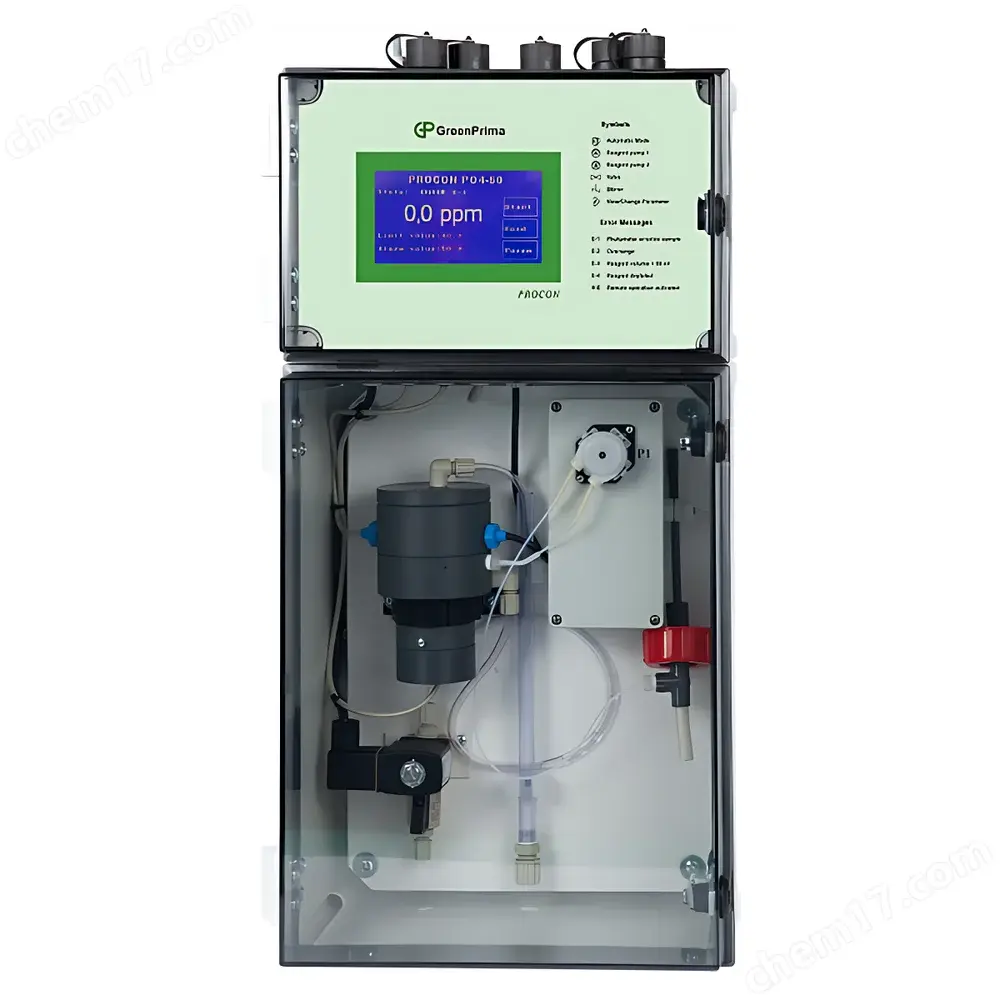
GreenPrima PROCON 4000 Online Silicate Analyzer
| Brand | GreenPrima |
|---|---|
| Origin | United Kingdom |
| Manufacturer Type | Original Equipment Manufacturer (OEM) |
| Product Category | Imported Instrument |
| Model | PROCON 4000 |
| Instrument Type | Online Analyzer |
| Measurement Principle | Photometric Determination of Soluble Silica via Molybdenum Blue Reduction Method |
| Compliance | Designed for ISO/IEC 17025-aligned operation and compatible with GLP/GMP data integrity requirements |
Overview
The GreenPrima PROCON 4000 Online Silicate Analyzer is a fully automated, microprocessor-controlled photometric instrument engineered for continuous, real-time monitoring of soluble silica (SiO₂) in ultra-pure water streams. It operates on the classical molybdenum blue method: orthosilicic acid reacts with ammonium molybdate under acidic conditions to form heteropoly-molybdosilicic acid, which is subsequently reduced to the intensely colored β-silicomolybdenum blue complex. Absorbance at 815 nm is measured using a high-stability LED–photodiode optical system, enabling trace-level quantification with minimal reagent consumption and negligible interferences from common anions (e.g., phosphate, sulfate) when properly conditioned. The analyzer is purpose-built for critical applications where silica-induced scaling or deposition threatens thermal efficiency and equipment integrity—particularly in high-pressure boiler feedwater, turbine condensate, and nuclear steam generator systems.
Key Features
- Fully autonomous operation: integrated sequence control for sampling, line flushing, reagent dosing, reaction timing, colorimetric measurement, and waste disposal
- Self-calibrating zero-point compensation with adaptive drift correction algorithm—eliminates routine manual zero adjustment
- Three selectable measurement ranges: 1–100 ppb, 4–999 ppb, and 0.02–3 ppm SiO₂—optimized for varying process demands without hardware modification
- High-resolution capacitive touchscreen (240 × 128 pixels) with intuitive menu navigation and multilingual interface support (English, German, French, Spanish)
- Programmable analysis cycle: fixed interval (13 min standard, adjustable 1–99 min) or externally triggered via dry-contact input
- Configurable 0/4–20 mA analog outputs (max. load 500 Ω) with user-defined scaling and fault signaling (e.g., sensor error, low reagent)
- IP65-rated enclosure (640 × 315 × 190 mm H×W×D) suitable for industrial control room or near-process mounting
- Modular wet-end design: corrosion-resistant PFA/PVDF fluidic path, peristaltic metering pumps, and low-volume reaction chamber minimizing carryover and reagent use
Sample Compatibility & Compliance
The PROCON 4000 accepts samples with conductivity < 1 µS/cm and temperature between 5–45 °C. It is validated for use with deionized water, mixed-bed polishers’ effluent, condensate polishing loop returns, and once-through HRSG feedwater. All wetted materials comply with ASTM F2238 (fluoropolymer biocompatibility) and USP Class VI standards. Electrical safety conforms to IEC 61010-1:2010; EMC compliance meets EN 61326-1:2013. Data handling supports audit-trail functionality per FDA 21 CFR Part 11 when paired with optional secure logging software—enabling electronic signatures, user access levels, and immutable event records for regulated environments.
Software & Data Management
The embedded firmware provides local data storage (≥10,000 measurement records with timestamps), configurable alarm thresholds (high/low limit, maintenance alert), and relay activation logic (1 × alarm, 1 × limit, 1 × analysis trigger). USB port enables periodic data export in CSV format; optional Ethernet module adds Modbus TCP/IP or OPC UA connectivity for integration into DCS/SCADA platforms. Firmware updates are performed via USB stick with cryptographic signature verification to ensure integrity. No cloud dependency or vendor-hosted services required—data sovereignty remains fully under end-user control.
Applications
- Power generation: monitoring silica breakthrough in condensate polisher effluent and boiler feedwater to prevent turbine blade fouling
- Pharmaceutical manufacturing: verifying silica compliance in Water for Injection (WFI) distribution loops per USP
- Semiconductor fab ultrapure water (UPW) systems: detecting sub-ppb silica excursions that risk wafer surface defects during cleaning
- Chemical process water: safeguarding catalyst integrity in high-purity synthesis streams
- Nuclear utility secondary side chemistry control: ensuring adherence to EPRI TR-102327 silica action limits
FAQ
What is the minimum detectable silica concentration?
The detection limit is 0.5 ppb SiO₂ (at 1–100 ppb range) based on signal-to-noise ratio ≥3 under typical operating conditions.
Does the analyzer require daily calibration?
No—zero-point auto-compensation and factory-established calibration curves eliminate routine calibration; annual verification against NIST-traceable standards is recommended.
Can it measure both orthosilicic acid and silicates?
Yes—the acid hydrolysis step in the reagent protocol ensures total reactive silica (monomeric + oligomeric forms) is converted to orthosilicic acid prior to detection.
Is remote diagnostics supported?
Basic status telemetry (error codes, pump cycles, reagent level) is available via analog output or USB; advanced remote access requires optional Ethernet gateway and site-specific firewall configuration.
What maintenance intervals are specified?
Peristaltic pump tubing replacement every 6 months; optical window cleaning every 3 months; full wet-end inspection annually per GreenPrima Maintenance Protocol MP-PROCON-4000 Rev. 3.
Related Products







