
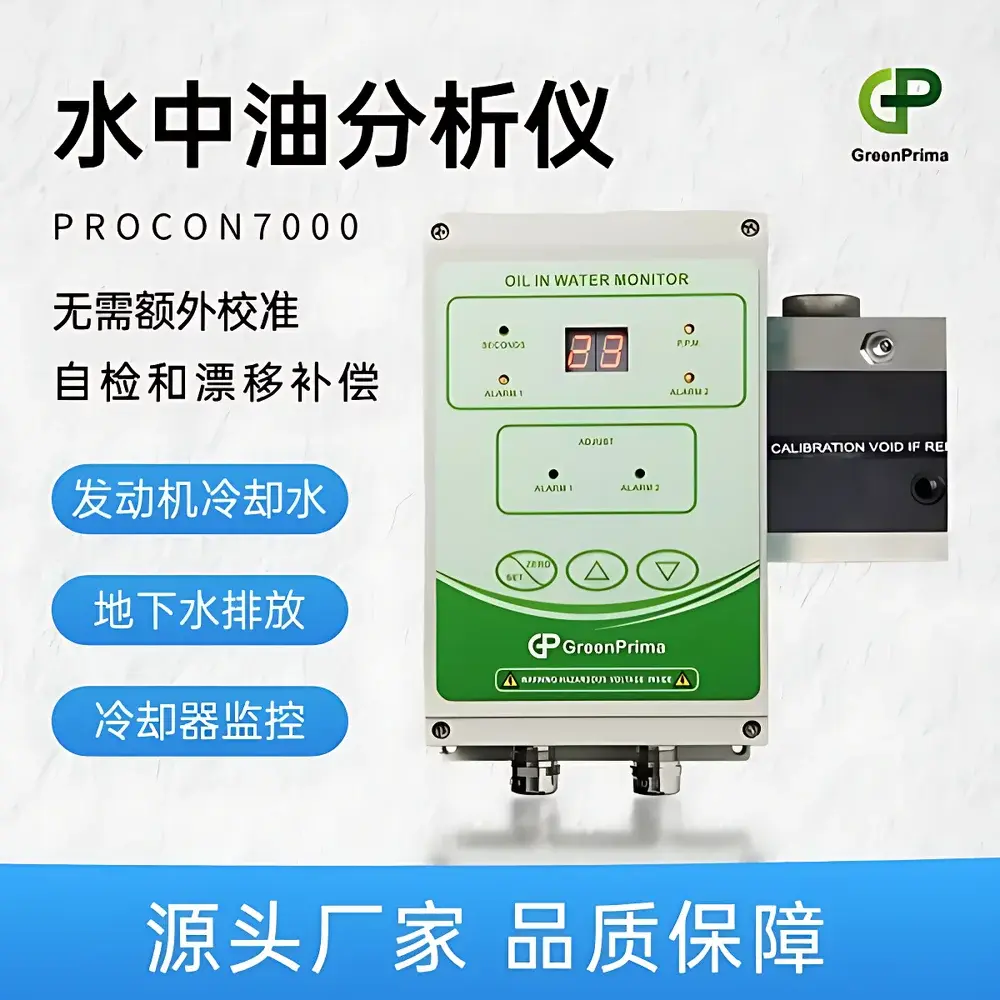
GreenPrima PROCON 7000 Online Hydrocarbon-in-Water Analyzer for Groundwater Discharge Monitoring
| Brand | GreenPrima |
|---|---|
| Origin | United Kingdom |
| Manufacturer Type | Original Equipment Manufacturer (OEM) |
| Product Origin | Imported |
| Model | PROCON 7000 |
| Instrument Type | Online Analyzer |
| Measurement Principle | Fluorescence-based Hydrocarbon Detection (UV-Excited Emission) |
| Measurement Range | 0–99 ppm (as hydrocarbon equivalent) |
| Accuracy | ±2 ppm |
| Alarm Setpoint Range | 1–98 ppm (adjustable) |
| Alarm Delay 1 | 0–60 s (adjustable) |
| Alarm Delay 2 | 10–240 s (adjustable) |
| Display | 240 × 128 pixel TFT touchscreen |
| Output Signals | 0/4–20 mA (min. load 820 Ω), 0–5 V / 1–5 V DC (min. load 50 kΩ) |
| Sample Flow Rate | 0.1–2 L/min |
| Sample Temperature | 1–40 °C |
| Sample Pressure | 0.1–10 bar |
| Ambient Operating Temperature | 1–60 °C |
| Relative Humidity | ≤90% RH at 55 °C |
| Enclosure Rating | IP55 |
| Electrical Safety | EN 61010-1, IEC 664 Category II |
| Power Supply | 230 V / 115 V AC or 24 V AC |
| Max. Power Consumption | 10 VA |
| Dimensions (H×W×D) | 215 × 242 × 73 mm |
| Weight | 2.25 kg |
Overview
The GreenPrima PROCON 7000 is a dedicated online hydrocarbon-in-water analyzer engineered for continuous, real-time monitoring of total petroleum hydrocarbons (TPH) in aqueous effluents—specifically designed for groundwater discharge compliance verification and industrial cooling water surveillance. Unlike generic optical turbidity or conductivity sensors, the PROCON 7000 employs UV-excited fluorescence detection, a selective and interference-resistant method widely accepted for hydrocarbon quantification in low-concentration aqueous matrices. Its measurement principle relies on the intrinsic fluorescence response of aromatic and aliphatic hydrocarbons when exposed to ultraviolet light (typically 254–280 nm), with signal intensity linearly correlated to concentration across the 0–99 ppm range. This approach delivers high specificity for mineral oils, diesel, lubricants, and other common hydrocarbon contaminants while minimizing cross-sensitivity to suspended solids, dissolved organic matter, or chlorinated compounds—critical for regulatory-grade reporting in sensitive environmental discharge streams.
Key Features
- Automated self-diagnostic routine with built-in drift compensation, ensuring long-term stability without manual recalibration.
- Adjustable measurement interval (1–60 minutes), enabling optimization between data granularity and reagent-free operational economy.
- Full-touchscreen interface (240 × 128 pixel TFT) with intuitive menu navigation, multilingual support, and real-time trend visualization.
- Dual independently configurable alarm outputs (Alarm 1 & Alarm 2), each with programmable setpoints (1–98 ppm) and adjustable delay timers (0–60 s and 10–240 s respectively).
- Industrial-grade analog output suite: isolated 0/4–20 mA (820 Ω min. load) and voltage outputs (0–5 V / 1–5 V DC, 50 kΩ min. load) compliant with PLC/DCS integration standards.
- Robust mechanical design with IP55-rated enclosure and IP65-rated external terminal block for relay and auxiliary I/O connections—suitable for semi-outdoor installation near discharge points or pump stations.
- No consumables or reagents required; maintenance limited to periodic optical window inspection and flow-path validation per ISO 15839:2012 guidelines.
Sample Compatibility & Compliance
The PROCON 7000 is validated for use with clarified or filtered groundwater, boiler condensate (when pre-cooled to ≤40 °C), engine cooling water, and treated industrial wastewater streams. It accommodates sample temperatures from 1 °C to 40 °C and pressures up to 10 bar, supporting direct inline installation or sidestream sampling via optional flow cell. The instrument meets EN 61010-1 safety requirements for measurement and control equipment in industrial environments and conforms to IEC 61326-1 for electromagnetic compatibility. While not certified to EPA Method 1664 or ISO 9377-2 for laboratory-grade TPH quantification, its ±2 ppm accuracy and documented repeatability (CV < 3.5% at 10 ppm) align with performance criteria outlined in EU Water Framework Directive Annex V monitoring protocols and UK Environment Agency’s “Monitoring Strategy for Hydrocarbon Discharges.” Data integrity is supported through timestamped event logging and non-volatile memory retention for ≥30 days of 15-minute interval records.
Software & Data Management
Data acquisition is facilitated via standard USB 2.0 port (optional module), enabling export of CSV-formatted time-series logs—including concentration values, alarm states, system diagnostics, and flow validation flags—for post-processing in LIMS or statistical process control platforms. The embedded firmware supports Modbus RTU over RS-485 (optional add-on) for SCADA integration. All configuration changes, alarm triggers, and power-cycle events are recorded with ISO 8601 timestamps and retained locally with audit-trail capability. Though not FDA 21 CFR Part 11-compliant out-of-the-box, the unit can be deployed within GLP/GMP-aligned workflows when paired with validated third-party data acquisition software that enforces electronic signature, role-based access, and change history tracking.
Applications
- Continuous monitoring of groundwater discharge points at brownfield remediation sites to verify compliance with local regulatory thresholds (e.g., UK EA’s 10 ppm TPH limit for controlled waters).
- Early leak detection in lubricating oil cooler circuits within power generation facilities, preventing hydrocarbon ingress into closed-loop cooling systems.
- Real-time verification of oil-water separator efficiency in petrochemical wastewater treatment trains prior to final discharge.
- Boiler feedwater protection—when used downstream of condensate coolers—to detect trace hydrocarbon carryover from turbine lube oil systems.
- Regulatory reporting support for ISO 14001-certified environmental management systems, providing auditable, timestamped concentration records aligned with PD ISO/IEC 17025 documentation practices.
FAQ
Does the PROCON 7000 require periodic calibration with certified reference standards?
No. The analyzer uses factory-calibrated fluorescence optics and internal reference photodiodes for automatic zero tracking and gain stabilization. Field verification using a traceable 10 ppm mineral oil standard is recommended every 6 months per ISO 15839:2012 Annex B.
Can it measure emulsified oil or only free-phase hydrocarbons?
It detects dissolved and finely dispersed hydrocarbons (including stable micro-emulsions) due to the molecular-level fluorescence response, but does not distinguish between free, dispersed, or dissolved fractions—reporting total extractable hydrocarbons as ppm equivalents.
Is the unit suitable for seawater applications?
Not without pretreatment. High salinity (>35,000 ppm Cl⁻) causes quenching of fluorescence signal and potential crystallization on optical surfaces. Use requires desalination or dilution to ≤5,000 ppm TDS, validated per application-specific testing.
What is the minimum detectable concentration (MDC) under routine operating conditions?
The practical MDC is 1.2 ppm (3σ of blank noise), verified per ISO 11929:2019 for measurement uncertainty estimation.
How is sample integrity maintained during transport to the analyzer?
A dedicated stainless-steel flow cell with PTFE-wetted parts and temperature-stabilized path ensures minimal adsorption or phase separation. Sample line length should not exceed 15 m, and insulated tracing is advised below 5 °C to prevent viscosity-induced laminar flow artifacts.







