
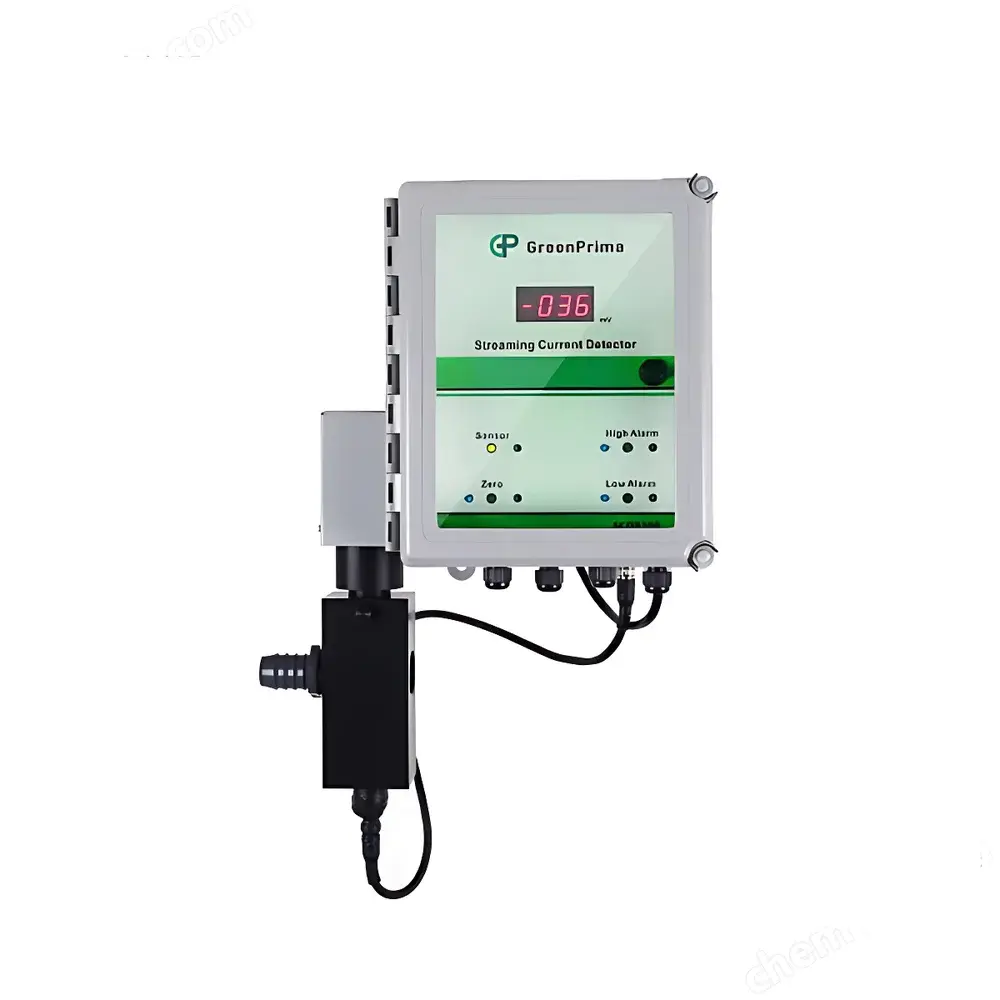
GreenPrima SCD8200 Streaming Current Detector
| Brand | GreenPrima |
|---|---|
| Origin | United Kingdom |
| Manufacturer Type | Manufacturer |
| Origin Category | Imported |
| Model | SCD8200 |
| Price | Upon Request |
| Power Supply | 230 VAC, 50 Hz |
| Measurement Range | −1000 to +1000 mV |
| Accuracy | ±0.1% of full scale |
| Display | LED |
| Flow Rate | 1 L/min |
| Inlet Connection | 1/2" NPT |
| Outlet Connection | 3/4" NPT |
| Response Time | 1 second |
| Sensor Materials | Delrin housing / 316 stainless steel electrodes / PTFE wetted parts |
| Output Signals | 4–20 mA, −10 to +10 V, 0–10 V |
| Communication Protocol | MODBUS RTU (RS-485, optional) |
| Alarm Outputs | Two programmable SPDT relays (high/low) |
| Enclosure Rating | IP65 |
| Dimensions | 279 mm × 152 mm (11.0" × 6.00") |
| Weight | 9 kg |
Overview
The GreenPrima SCD8200 Streaming Current Detector is an industrial-grade online electrokinetic sensor engineered for real-time monitoring and optimization of coagulation and flocculation processes in water and wastewater treatment systems. It operates on the principle of streaming current measurement—a well-established electrokinetic technique that quantifies the net surface charge density of suspended colloidal particles in aqueous solution. As process water flows through a precision-machined cylindrical cell, a motor-driven piston induces controlled laminar shear, displacing the diffuse double layer surrounding colloids and generating a measurable alternating current between two embedded electrodes. This streaming current (in millivolts) correlates directly with the residual ionic charge imbalance post-coagulant dosing—providing a rapid, non-invasive, and chemically agnostic indicator of coagulant demand and floc stability.
Key Features
- Real-time streaming current measurement from −1000 to +1000 mV with ±0.1% full-scale accuracy, enabling precise endpoint detection during coagulant titration
- Self-contained flow cell with integrated piston-driven recirculation system maintaining consistent 1 L/min sample throughput without external pumps
- Zero-point auto-calibration routine executed at user-defined intervals or upon power-up, ensuring long-term baseline stability
- Robust sensor construction using Delrin polymer housing, 316 stainless steel electrodes, and PTFE-sealed wetted surfaces for corrosion resistance in aggressive chemical environments
- Dual analog outputs (4–20 mA and ±10 V) plus optional MODBUS RTU over RS-485 for seamless integration into PLC-based SCADA and DCS platforms
- Two independently configurable SPDT relay outputs for high/low alarm triggering, feed-forward control logic, or emergency shutdown signaling
- IP65-rated NEMA 4X enclosure suitable for wall- or panel-mount installation in humid, chemically exposed utility rooms and process galleries
Sample Compatibility & Compliance
The SCD8200 is validated for continuous operation in raw surface water, clarified effluent, membrane pre-filtration streams, and thickened sludge filtrate—covering pH ranges from 4.5 to 9.5 and turbidity up to 500 NTU. Its electrode geometry and shear profile are optimized to minimize fouling in high-solids applications while retaining sensitivity to sub-micron colloidal charge shifts. The instrument complies with IEC 61000-6-2 (immunity) and IEC 61000-6-4 (emissions) for industrial electromagnetic compatibility. While not certified for SIL or ATEX use, its design supports integration into GMP-compliant water systems under FDA 21 CFR Part 11 when paired with audit-trail-enabled control software. Routine verification may be performed per ASTM D5897–22 (Standard Test Method for Streaming Current Detection of Colloidal Charge in Water).
Software & Data Management
Local configuration and diagnostics are accessible via front-panel LED display and tactile keypad. For centralized supervision, GreenPrima provides optional PC-based configuration software supporting parameter logging, trend visualization, and export to CSV or OPC UA-compatible historians. All analog output signals carry timestamped metadata; MODBUS registers include diagnostic flags for sensor status, flow interruption, electrode contamination, and calibration validity. Data integrity is preserved through non-volatile memory retention across power cycles. When deployed in regulated facilities, the SCD8200’s deterministic response time (<1 s), traceable calibration protocol, and relay event logging meet core requirements for process analytical technology (PAT) frameworks outlined in USP and ISO 17025-accredited laboratory workflows.
Applications
- Dynamic coagulant dosing control in municipal drinking water plants—reducing alum or ferric chloride consumption by 15–30% while maintaining turbidity <0.1 NTU
- Optimization of cationic polymer dosing in anaerobic digester dewatering lines to improve cake solids content and reduce polymer cost per ton of dry solids
- Pre-treatment monitoring upstream of low-pressure reverse osmosis (RO) and nanofiltration (NF) membranes to prevent organic fouling and extend element service life
- Real-time feedback control in dissolved air flotation (DAF) units where rapid charge neutralization is critical to bubble–floc adhesion efficiency
- Commissioning support and ongoing performance validation for jar test–derived coagulant setpoints in new or retrofitted treatment trains
FAQ
How does streaming current differ from zeta potential measurement?
Streaming current reflects bulk colloidal charge balance under dynamic flow conditions and is more robust for online process control; zeta potential requires static electrophoretic mobility analysis and is typically lab-based.
Can the SCD8200 be used with non-ionic or anionic polymers?
Yes—the sensor responds to net surface charge regardless of coagulant chemistry, though optimal calibration curves must be established for each polymer type and dosage range.
Is field recalibration required after installation?
No; zero-point auto-calibration eliminates manual offset adjustment. Full span verification with certified reference solutions is recommended quarterly.
What maintenance intervals are recommended for the flow cell?
Visual inspection every 2 weeks; mechanical cleaning of electrodes with dilute citric acid (5%) every 3–6 months depending on feedwater hardness and iron/manganese content.
Does the unit support Modbus TCP or only RTU?
MODBUS RTU over RS-485 is standard; MODBUS TCP requires an external protocol converter and is not natively supported.







