
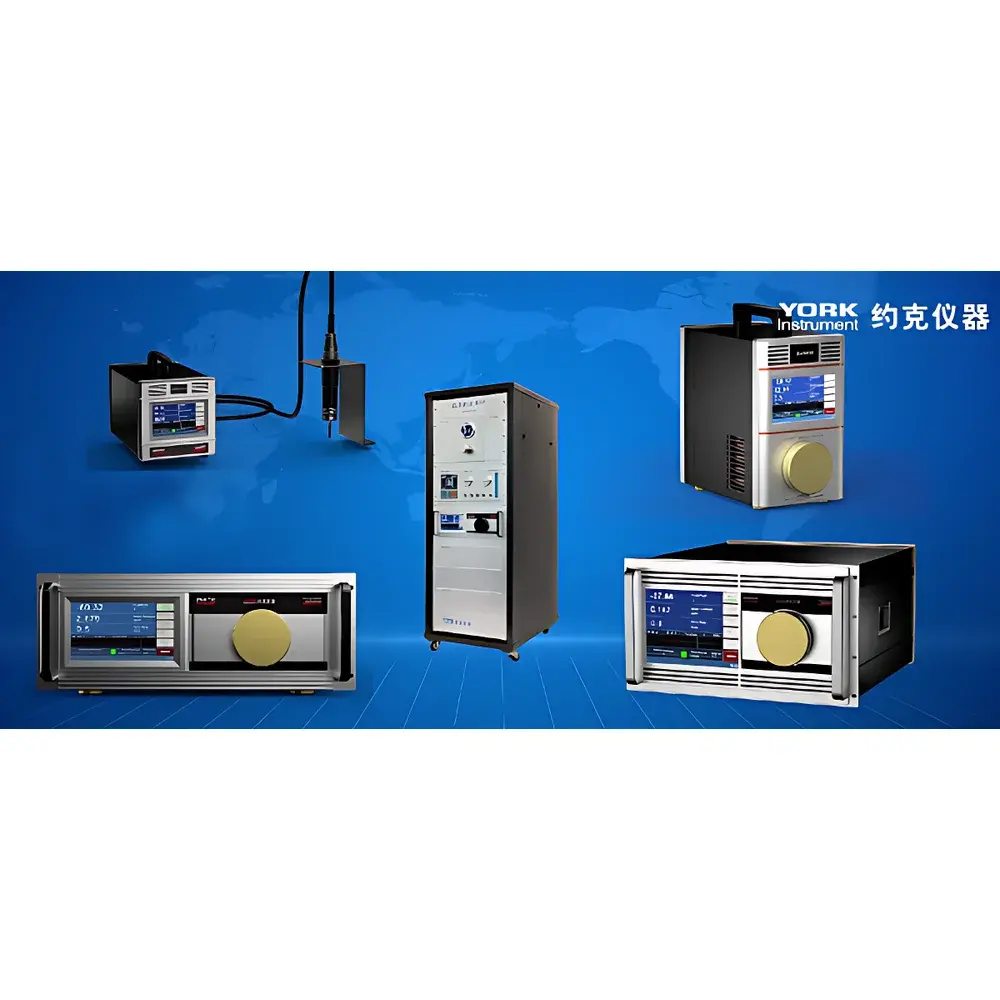
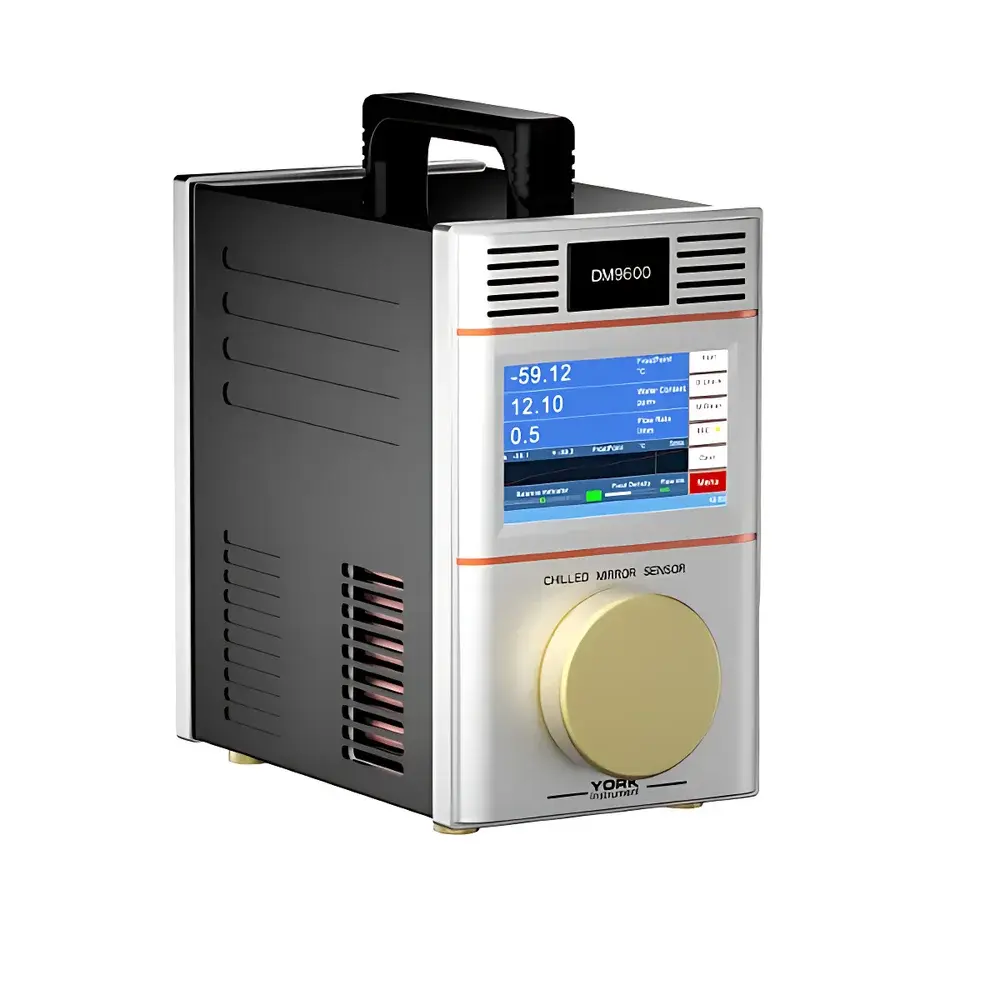
York Instruments DM9600 Chilled-Mirror Precision Dew Point Meter
| Brand | York Instruments |
|---|---|
| Origin | Beijing, China |
| Manufacturer Type | Manufacturer |
| Product Type | Portable Dew Point Meter |
| Measurement Principle | Chilled-Mirror Condensation |
| Operating Temperature | -20 °C to +40 °C |
| Accuracy | ±0.1 °C (dew point) |
| Repeatability | ±0.05 °C (dew point) |
| Display | High-Resolution Capacitive Touch LCD |
| User Interface | Graphical, Multilingual (English/Chinese), Step-by-Step Guidance |
| Mirror Control | Digital Fuzzy Logic with Auto-Balance Algorithm |
| Mirror Maintenance | Integrated Mirror Inspection and Automated Cleaning Sequence |
| Diagnostics | Real-Time Self-Diagnostic Engine with Fault Classification |
| Communication Interfaces | RS-485, USB 2.0 |
Overview
The York Instruments DM9600 Chilled-Mirror Precision Dew Point Meter is an optoelectronic analytical instrument engineered for trace-level moisture quantification in compressed gases, process streams, and ambient air. Unlike electrochemical or capacitive sensor-based dew point meters, the DM9600 implements the fundamental thermodynamic principle of chilled-mirror condensation: a polished, temperature-controlled mirror surface is cooled until dew (or frost) forms under controlled laminar flow conditions; the corresponding mirror temperature—measured via calibrated platinum resistance thermometry—is reported as the thermodynamically defined dew point temperature. This primary measurement method ensures traceability to SI units and eliminates sensor drift associated with polymer or metal-oxide sensing elements. Designed for field-deployable operation without compromising metrological integrity, the DM9600 delivers laboratory-grade accuracy in a ruggedized portable enclosure compliant with IP54 ingress protection. Its performance meets the requirements for ISO 8573-1 Class 1–4 compressed air purity verification, ASTM D1193 Type I–IV water specification validation, and routine calibration transfer in GLP-regulated environments.
Key Features
- Chilled-mirror optical detection system with sapphire-coated stainless-steel mirror and high-stability Peltier thermal actuation
- Digital fuzzy logic temperature control enabling sub-millidegree mirror stabilization and automatic dew/frost equilibrium detection
- Capacitive touch LCD interface with adaptive backlighting and configurable data overlay (dew point, ppmv, relative humidity, pressure-corrected values)
- Embedded mirror inspection protocol: real-time reflectance monitoring and scheduled ultrasonic-assisted cleaning cycles to prevent contamination-induced hysteresis
- Comprehensive self-diagnostics including mirror contamination index, thermistor linearity verification, flow-path pressure drop assessment, and cooling efficiency benchmarking
- Dual communication architecture supporting Modbus RTU over RS-485 for SCADA integration and USB CDC class for direct PC connection and firmware updates
Sample Compatibility & Compliance
The DM9600 accommodates non-corrosive, particle-free gas streams with nominal flow rates between 0.5–2.0 L/min at ambient pressure. Compatible sample matrices include nitrogen, argon, oxygen, synthetic air, natural gas (dry), SF6, and helium. It is not intended for use with condensable hydrocarbons, aggressive halogenated compounds, or aerosol-laden streams without upstream filtration (e.g., 0.1 µm particulate filter and coalescing trap). The instrument conforms to IEC 61000-6-2 (immunity) and IEC 61000-6-3 (emissions), carries CE marking under the EU Measuring Instruments Directive (MID) Annex MI-005 for humidity measuring instruments, and supports audit-ready data logging compliant with FDA 21 CFR Part 11 when paired with York’s validated DewTrack™ software suite.
Software & Data Management
DewTrack™ desktop application (Windows 10/11, 64-bit) provides full instrument configuration, real-time trending, statistical process monitoring (X̄/R charts), and automated report generation per ISO/IEC 17025 clause 7.8.2. All measurements are timestamped with NTP-synchronized UTC and tagged with operator ID, sample ID, and environmental metadata (ambient T/P). Raw mirror temperature traces, condensation onset detection events, and diagnostic logs are stored in open-format CSV and SQLite databases. Audit trail functionality records all parameter changes, calibration actions, and user logins with immutable hash signatures—enabling full traceability during regulatory inspections.
Applications
- Verification of desiccant dryer and membrane dryer performance in industrial compressed air systems (ISO 8573-1:2010)
- Moisture monitoring in SF6 insulated switchgear per IEEE C37.122.1 and IEC 62271-1
- Validation of purge gas dryness in semiconductor fab nitrogen manifolds (SEMI F57)
- Calibration reference for lower-cost hygrometers in pharmaceutical lyophilizer chamber monitoring
- Field verification of natural gas water content prior to pipeline injection (AGA Report No. 10)
- Research-grade dew point characterization in atmospheric chemistry and climate simulation chambers
FAQ
What is the difference between chilled-mirror and capacitance-based dew point measurement?
Chilled-mirror methods rely on direct physical phase change observation and are primary standards; capacitance sensors infer moisture from dielectric shift and require periodic recalibration against traceable references.
Can the DM9600 measure below -60 °C dew point?
Yes—the standard configuration achieves -70 °C DP with optional low-temperature Peltier module and enhanced thermal isolation; extended range requires factory configuration and certified calibration.
Is mirror cleaning performed manually or automatically?
The DM9600 features fully automated mirror inspection and cleaning sequences triggered by reflectance decay thresholds; no disassembly or consumables are required.
Does the instrument support pressure compensation for non-atmospheric sampling?
Yes—integrated absolute pressure transducer enables real-time dew point correction using Magnus–Tetens equations per ISO 6329; user-configurable reference pressure settings are supported.
How often does the DM9600 require calibration verification?
York Instruments recommends annual calibration against NIST-traceable chilled-mirror standards; internal diagnostics provide continuous performance verification between formal calibrations.



