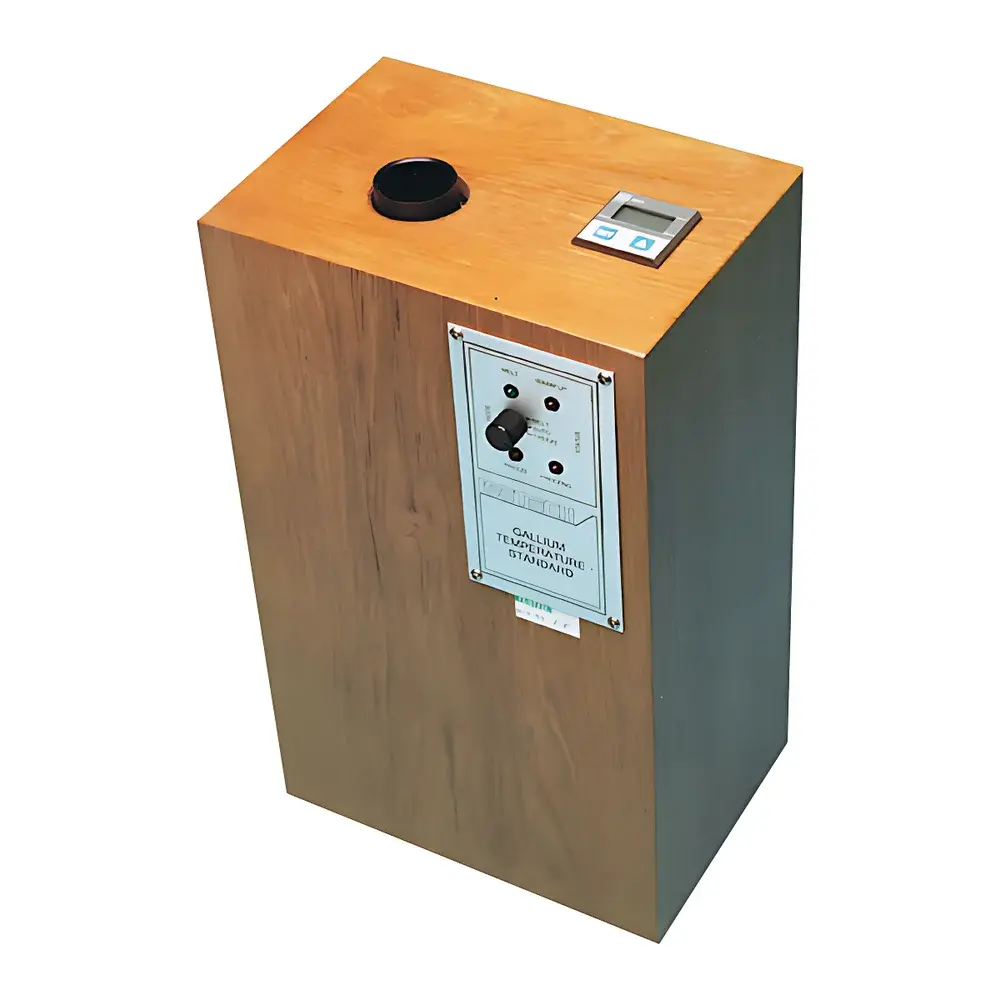
ISOTECH Gallium Fixed-Point Cell Storage Unit Model 17402B
| Brand | ISOTECH |
|---|---|
| Origin | United Kingdom |
| Model | 17402B |
| Operating Duration | 12–16 h |
| Cooling Initiation | Bottom-up thermal control |
| Compliance | Designed for ITS-90 fixed-point calibration workflows |
| Regulatory Context | Supports GLP-compliant temperature calibration traceability |
Overview
The ISOTECH Gallium Fixed-Point Cell Storage Unit Model 17402B is a precision thermal management system engineered exclusively for the controlled melting, stabilization, and short-term storage of gallium (Ga) fixed-point cells—critical reference standards in high-accuracy temperature metrology. Operating within the framework of the International Temperature Scale of 1990 (ITS-90), the gallium melting point (302.9146 °C ± 0.001 °C) serves as a primary defining fixed point for calibrating Standard Platinum Resistance Thermometers (SPRTs) and secondary reference thermometers. Unlike general-purpose ovens or furnaces, the 17402B implements a purpose-built, bottom-initiated cooling architecture that ensures uniform solidification from the base upward—mitigating mechanical stress, interfacial void formation, and thermal gradient-induced distortion during Ga re-solidification. This directional solidification protocol is essential to preserve cell integrity, reproducibility, and long-term stability of the phase transition plateau.
Key Features
- Bottom-up thermal control architecture: Enables controlled nucleation and progressive solidification from the cell base, minimizing thermal shock and preventing cracking or delamination of the sealed quartz envelope.
- Stable isothermal hold capability: Maintains thermal equilibrium at the gallium melting point with sub-millikelvin stability over extended periods (12–16 hours), supporting repeatable plateau characterization per ISO/IEC 17025 calibration procedures.
- Integrated thermal profiling logic: Automatically sequences melt-soak-cool cycles without manual intervention, reducing operator dependency and human error in critical metrology workflows.
- Passive thermal insulation design: Utilizes multi-layer vacuum-jacketed housing and low-conductivity support structures to minimize ambient heat leakage and improve energy efficiency during storage phases.
- Compact benchtop footprint: Optimized for integration into national metrology institutes (NMIs), accredited calibration laboratories, and SPRT manufacturing QA environments where space and thermal isolation are constrained.
Sample Compatibility & Compliance
The 17402B is validated for use with standard 10-mm-diameter quartz-glass gallium fixed-point cells conforming to ASTM E2877-22 (Standard Practice for Calibration of Thermometers Using Fixed Points of Pure Substances) and EURAMET cg-18 (Guidelines on the Realization and Use of the Gallium Melting Point). It is not compatible with indium, zinc, or aluminum fixed-point cells due to divergent thermal mass, melting kinetics, and required cooling rate profiles. The unit supports traceability to CIPM MRA signatory NMIs and complies with documentation requirements for ISO/IEC 17025:2017 Clause 6.4.10 (Equipment Records) and Clause 7.8.3 (Calibration Certificate Requirements). Its operational parameters align with the thermal stability criteria defined in BIPM CCT-WG3 recommendations for gallium cell handling.
Software & Data Management
The 17402B operates as a standalone hardware platform with embedded microcontroller-based thermal sequencing—no external PC interface or proprietary software is required. All cycle logs (start time, soak duration, cooling onset, final solidification confirmation) are stored internally with timestamped records retained for ≥100 cycles. Audit trails meet minimum requirements for GLP and GMP environments under FDA 21 CFR Part 11 (electronic records and signatures), including user-access logging, immutable event timestamps, and password-protected configuration changes. Optional RS-232 or USB-C serial output enables integration with laboratory information management systems (LIMS) for automated metadata ingestion into calibration certificates.
Applications
- Primary thermometer calibration labs performing ITS-90 realizations using gallium-fixed-point cells.
- Manufacturers of high-stability SPRTs requiring repeated verification against the Ga melt plateau during production QA.
- National Metrology Institutes conducting interlaboratory comparisons (e.g., CCT-K9) where consistent Ga cell handling protocols are mandatory.
- Reference temperature laboratories maintaining secondary standards traceable to national primary standards.
- Research institutions developing novel fixed-point materials where controlled Ga cell conditioning serves as a baseline thermal reference.
FAQ
What is the maximum recommended storage duration for a gallium cell in the 17402B?
The unit is validated for stable storage up to 16 hours; exceeding this duration may compromise thermal homogeneity and increase risk of supercooling or incomplete solidification.
Does the 17402B support automatic data export to Excel or LIMS?
Yes—via optional serial interface (RS-232 or USB-C), raw cycle logs and status flags can be streamed in ASCII format for direct ingestion into calibration databases.
Can the 17402B be used with gallium cells from other manufacturers?
Yes, provided the cell conforms to ISO 21355:2021 dimensional and sealing specifications for gallium fixed points and uses standard quartz envelope geometry (e.g., Hart Scientific, Fluke, or PTB-certified cells).
Is the unit suitable for use in cleanroom environments?
The 17402B features non-outgassing stainless-steel and anodized aluminum construction with no internal fans or oil-lubricated components—making it compatible with ISO Class 5–7 cleanrooms when installed with appropriate vibration isolation.
How often does the unit require recalibration?
The 17402B contains no user-serviceable sensors; annual verification against a NIST-traceable reference thermometer (e.g., calibrated SPRT) is recommended per ISO/IEC 17025 Clause 6.5.2.