
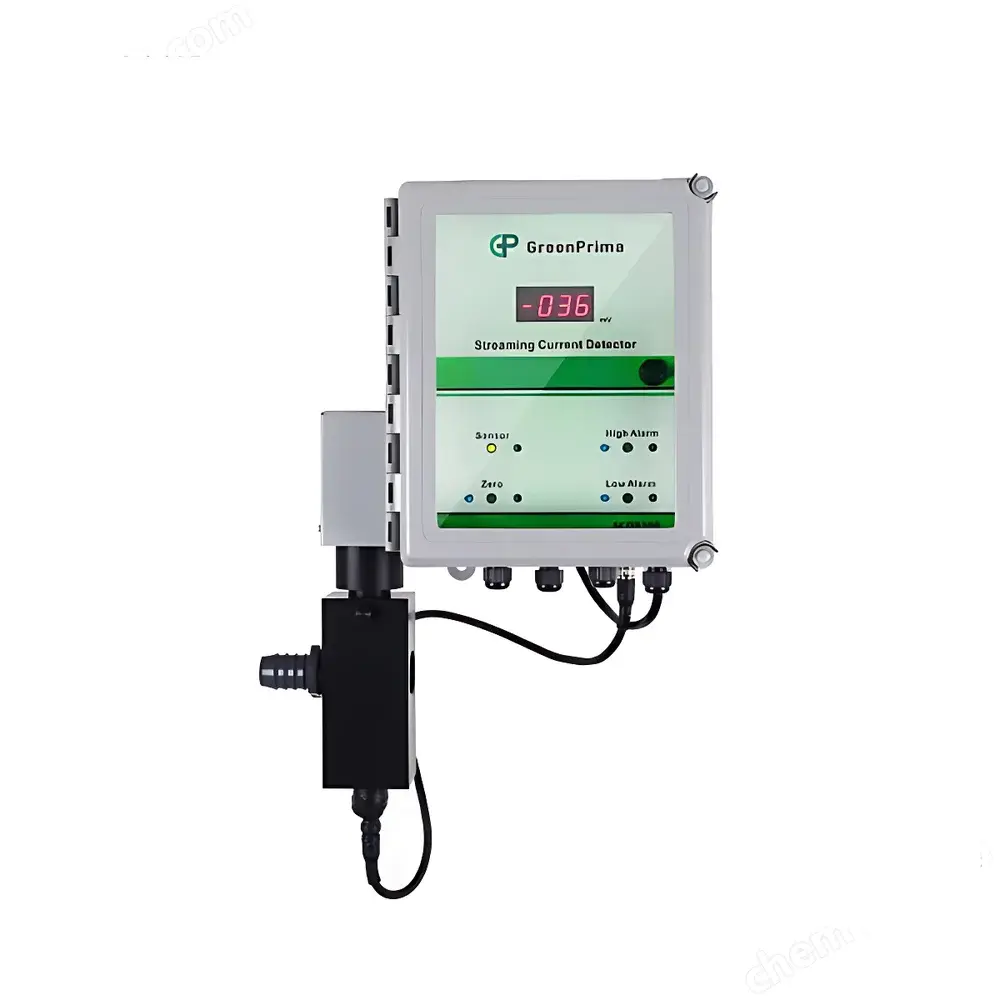
GreenPrima SCD8200 Streaming Current Detector
| Brand | GreenPrima |
|---|---|
| Origin | United Kingdom |
| Manufacturer Type | Original Equipment Manufacturer (OEM) |
| Product Category | Imported Instrument |
| Model | SCD8200 |
| Price | Upon Request |
| Power Supply | 100–240 VAC, 50/60 Hz |
| Measurement Range | –1000 to +1000 mV |
| Accuracy | ±0.1% of full scale |
| Display | LED |
| Sample Flow Rate | 1 L/min |
| Inlet Connection | 1/2" NPT |
| Outlet Connection | 3/4" NPT |
| Response Time | ≤1 second |
| Sensor Housing Material | Delrin®, 316 Stainless Steel, PTFE |
| Output Signals | 4–20 mA, –10 to +10 V, 0–10 V |
| Communication Protocol | MODBUS RTU (RS-485, optional) |
| Alarm Outputs | Two SPDT relays (High/Low) |
| Enclosure Rating | IP65 |
| Dimensions (W×H×D) | 279 × 152 × 229 mm (11.0" × 6.0" × 9.0") |
| Weight | 9 kg |
| Auto-Zero Calibration | Yes |
| Self-Diagnostic Function | LED status indicators on sensor head |
Overview
The GreenPrima SCD8200 Streaming Current Detector is an industrial-grade online electrokinetic analyzer engineered for real-time monitoring and control of coagulation efficiency in water and wastewater treatment processes. It operates on the principle of streaming current measurement—a well-established electrokinetic phenomenon where mechanical shear induces charge displacement in colloidal suspensions. As a piston-driven reciprocating pump forces sample water through a precision-machined detection cell, hydrodynamic shear disrupts the electrical double layer surrounding suspended particles, liberating counter-ions that migrate under the applied electric field between two parallel electrodes. This ion migration generates a measurable alternating current—termed streaming current—whose magnitude and polarity directly correlate with the net surface charge density of residual colloids post-coagulant dosing. Unlike offline jar testing or zeta potential analyzers, the SCD8200 delivers continuous, process-integrated feedback with sub-second response, enabling closed-loop control of coagulant feed systems without operator intervention.
Key Features
- Real-time streaming current measurement from –1000 to +1000 mV with ±0.1% full-scale accuracy and <1-second dynamic response time
- Robust sensor architecture combining Delrin® polymer, 316 stainless steel wetted parts, and PTFE seals for chemical resistance across pH 4–11 and common coagulants (e.g., Al2(SO4)3, FeCl3, polyaluminum chloride)
- Integrated auto-zero calibration routine eliminating manual offset drift correction; validated per ASTM D6977-17 (Standard Practice for Streaming Current Detection)
- Dual analog outputs (4–20 mA and ±10 V) plus optional MODBUS RTU (RS-485) for seamless integration into PLC-based SCADA and DCS platforms
- Two programmable SPDT relay outputs for high/low alarm triggering, compatible with plant-wide event logging and safety interlock protocols
- IP65-rated NEMA 4X enclosure suitable for indoor/outdoor mounting in humid, chemically aggressive environments typical of water treatment plants
- Self-diagnostic LED indicators on the sensor head provide immediate visual confirmation of flow presence, electrode integrity, and signal stability
Sample Compatibility & Compliance
The SCD8200 is validated for continuous operation with raw surface water, clarified effluent, filtered process streams, and sludge dewatering filtrates. Its flow path design accommodates turbidities up to 500 NTU and suspended solids concentrations ≤150 mg/L without clogging. The instrument complies with EN 61326-1 (EMC for industrial environments), IEC 61000-4-2/4/5/6 (electrostatic discharge and surge immunity), and meets functional safety requirements aligned with IEC 61508 SIL 2 for critical process monitoring. Data integrity supports GLP/GMP-aligned operations through traceable calibration logs and audit-ready output records. While not FDA 21 CFR Part 11-certified out-of-the-box, its digital outputs are compatible with validated data acquisition systems meeting Part 11 requirements when deployed with appropriate system-level controls.
Software & Data Management
The SCD8200 operates as a standalone field instrument but is fully interoperable with industry-standard automation infrastructure. Its MODBUS RTU interface enables bidirectional communication for remote configuration of alarm thresholds, zero calibration initiation, and diagnostic status retrieval. When integrated with supervisory control software (e.g., Ignition SCADA, Siemens Desigo CC, or ABB Ability™), streaming current trends can be correlated with coagulant dosage, turbidity, pH, and UV254 absorbance to build multivariate predictive models for optimal dosing. All analog outputs include galvanic isolation and are factory-calibrated with NIST-traceable reference standards. Raw signal data is timestamped and retained locally via external PLC historian or cloud-based IIoT platforms compliant with ISO/IEC 27001 information security frameworks.
Applications
- Real-time optimization of coagulant dosing in municipal drinking water treatment plants, reducing alum or ferric chloride consumption by 15–30% while maintaining turbidity <0.1 NTU at filter effluent
- Control of polymer dosing in anaerobic digester supernatant treatment and belt press dewatering lines to stabilize cake solids content and minimize polymer waste
- Pre-treatment monitoring for reverse osmosis (RO) and nanofiltration (NF) systems, preventing fouling by detecting insufficient coagulation before membrane scaling occurs
- Performance verification during commissioning of new coagulation basins or retrofit of existing chemical feed systems
- Compliance support for regulatory reporting under EU Drinking Water Directive (2020/2184) and U.S. EPA Long Term 2 Enhanced Surface Water Treatment Rule (LT2ESWTR)
FAQ
How does streaming current differ from zeta potential?
Streaming current measures bulk charge mobility under controlled shear in flowing systems, making it ideal for real-time process control. Zeta potential requires static, dilute samples and is primarily used for colloidal stability research—not online dosing control.
Can the SCD8200 operate with seawater or brackish influent?
Yes—its electrode design and material selection accommodate conductivity ranges from 50 µS/cm to 5,000 µS/cm. However, frequent zero calibration is recommended in high-salinity applications due to baseline drift from ionic strength effects.
Is field calibration required after installation?
No. The auto-zero function eliminates routine manual calibration. Periodic verification using certified reference solutions (e.g., KCl standards) is recommended every 6 months per ISO/IEC 17025 laboratory practice guidelines.
What maintenance intervals are specified for the piston pump and sensor cell?
The brushless DC piston pump is rated for >20,000 hours MTBF. Sensor cell cleaning is only necessary if fouling occurs—typically every 3–6 months depending on feed water quality—and involves simple disassembly and ultrasonic cleaning in mild detergent.
Related Products







