
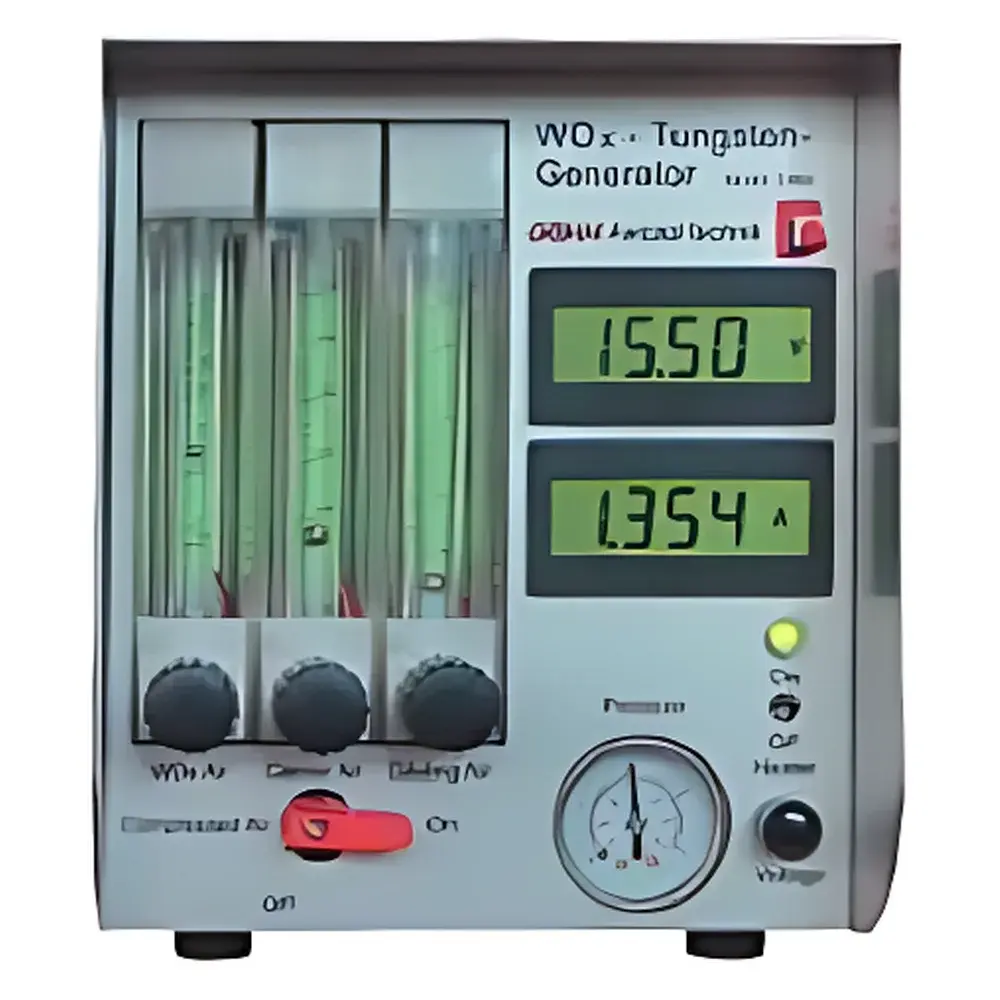
GRIMM 7860 NANO WOx Tungsten Oxide Nanoparticle Aerosol Generator
| Brand | GRIMM |
|---|---|
| Origin | Germany |
| Model | 7860 NANO WOx |
| Particle Size Range | 1.2–20 nm |
| Generation Principle | Thermal Vaporization & Controlled Oxidation of Tungsten Filament |
| Gas Supply Requirement | External, Triple-Stream Mass Flow Controlled |
| Compliance | Designed for ISO 14644-3, ISO 27498, and EU GMP Annex 1 aerosol challenge testing |
Overview
The GRIMM 7860 NANO WOx is a precision-engineered thermal nanoparticle aerosol generator designed for the reproducible, on-demand production of tungsten oxide (WOx) nanoparticles in the sub-20 nm size range. It operates on the principle of resistive heating of a high-purity tungsten filament under controlled oxidizing atmosphere, inducing rapid vaporization followed by homogeneous nucleation and controlled growth of WOx clusters. Unlike spray-based or nebulization methods, this thermophoretic generation mechanism yields monodisperse, chemically stable, non-volatile nanoparticles with minimal agglomeration—critical for filter penetration testing, condensation nucleus counter (CNC) calibration, and nanofiltration efficiency validation. The system is engineered for integration into cleanroom qualification protocols, HEPA/ULPA filter certification workflows, and laboratory-based inhalation toxicology exposure chambers where traceable, metrologically sound nanoparticle sources are required.
Key Features
- Thermally stable tungsten filament with precise current regulation enabling repeatable particle nucleation at temperatures exceeding 2,500 °C
- Triple independent mass flow controllers (MFCs) for carrier gas (e.g., N2), oxidation gas (e.g., O2 or air), and dilution gas—enabling fine-tuned control over particle size distribution (PSD) and number concentration
- Real-time monitoring of filament resistance and temperature via integrated feedback loop to maintain stable vaporization kinetics
- Modular design compatible with standard 1/4″ Swagelok® fittings and ISO-KF vacuum interfaces for seamless integration into aerosol test benches
- No consumables beyond the tungsten filament; typical filament lifetime exceeds 200 operational hours under nominal conditions
- CE-marked and compliant with IEC 61000-6-3 (EMC) and IEC 61000-6-2 (immunity) for use in regulated laboratory environments
Sample Compatibility & Compliance
The 7860 NANO WOx generates chemically inert, crystalline WO3-dominant nanoparticles with negligible organic residue—making it suitable for applications requiring low-background interference, such as scanning mobility particle sizer (SMPS) calibration and electrical aerosol detector (EAD) response characterization. Its output meets the particle size and stability criteria outlined in ISO 14644-3 Annex B for nanoparticle challenge aerosols and aligns with the technical requirements of EU GMP Annex 1 (2022) for filter integrity verification in aseptic manufacturing. While not intrinsically certified to ISO/IEC 17025, the generator supports GLP-compliant documentation when paired with traceable flow meters, calibrated CPCs (e.g., TSI 3776), and time-synchronized data acquisition systems.
Software & Data Management
The device operates via front-panel controls with analog outputs (0–10 V) for filament current, MFC setpoints, and status signals—designed for integration into programmable logic controller (PLC) or LabVIEW-based test automation platforms. GRIMM provides optional configuration software (AeroControl v2.1) for remote parameter scripting, batch-mode sequence definition, and audit-trail-enabled operation logging. All operational parameters—including gas flow ratios, ramp profiles, and runtime duration—are exportable in CSV format. When deployed within FDA-regulated environments, the system supports 21 CFR Part 11 compliance through third-party electronic lab notebook (ELN) integration, provided user-defined role-based access controls and electronic signature workflows are implemented at the host system level.
Applications
- Calibration and performance verification of nanoparticle sizers (e.g., SMPS, nano-DMA systems)
- Penetration testing of ULPA filters (ISO Class 1–3 cleanrooms) and membrane filters used in pharmaceutical isolators
- Generation of reference aerosols for aerosol filtration efficiency studies per ISO 16890 and EN 1822
- Controlled exposure studies in inhalation toxicology using well-characterized metal oxide nanoparticles
- Validation of real-time airborne nanoparticle monitors (e.g., condensation particle counters, diffusion chargers)
- Research into nanoparticle coagulation dynamics and surface charging behavior under laminar flow conditions
FAQ
What gases are required for operation?
The 7860 NANO WOx requires three externally supplied, pressure-regulated gas streams: an inert carrier gas (e.g., nitrogen or argon), an oxidizing gas (e.g., dry air or oxygen), and a dilution gas (typically filtered compressed air or nitrogen). All gases must be oil-free and particle-free (≤10 nm).
Is the particle size distribution adjustable in real time?
Yes—by independently modulating the carrier-to-oxidant flow ratio and total volumetric flow, users can shift the modal diameter across the 1.2–20 nm range while maintaining stable number concentration; typical adjustment resolution is ±0.3 nm under closed-loop control.
Does the system include particle concentration measurement?
No—the 7860 NANO WOx is a pure generator. Concentration quantification requires external instrumentation such as a calibrated condensation particle counter (CPC) or scanning mobility particle sizer (SMPS) system.
Can the tungsten filament be replaced by the user?
Yes—filament replacement is a field-serviceable procedure requiring only standard hex tools and adherence to the torque specifications in the technical manual; GRIMM supplies certified replacement filaments with individual calibration certificates.
Is the output suitable for biological exposure studies?
WOx nanoparticles generated by this system have been used in peer-reviewed inhalation studies (e.g., published in Particle and Fibre Toxicology), but end-users must conduct their own hazard assessment and obtain institutional biosafety committee approval prior to in vivo application.







