
GRINTECH GRIN Imaging Lens – Gradient Index Objective for Miniaturized Endoscopic and Micro-Optical Systems
| Brand | GRINTECH |
|---|---|
| Origin | Canada |
| Type | Imported Optical Component |
| Model | GRIN Imaging Lens (Custom Pitch & Diameter) |
| Composition | Solid-State Glass-Based Gradient-Index Optical Element |
| Coating | Broadband Anti-Reflection (AR) on Both Surfaces |
| Fabrication Method | Non-Toxic Ag⁺/Li⁺ Ion Exchange in Borosilicate Glass |
| Numerical Aperture (NA) | 0.5 |
| Field of View | ±30° (60° Total) |
| Chromatic Focal Shift | +0.017%/nm in Visible Range |
| Field Curvature | ≤ −40 µm (90% aperture, Ø1.0 mm), ≤ −20 µm (Ø0.5 mm) |
| Distortion | ~14% Barrel at Edge |
| Resolution (White Light) | ~400 lp/mm (On-Axis) |
Overview
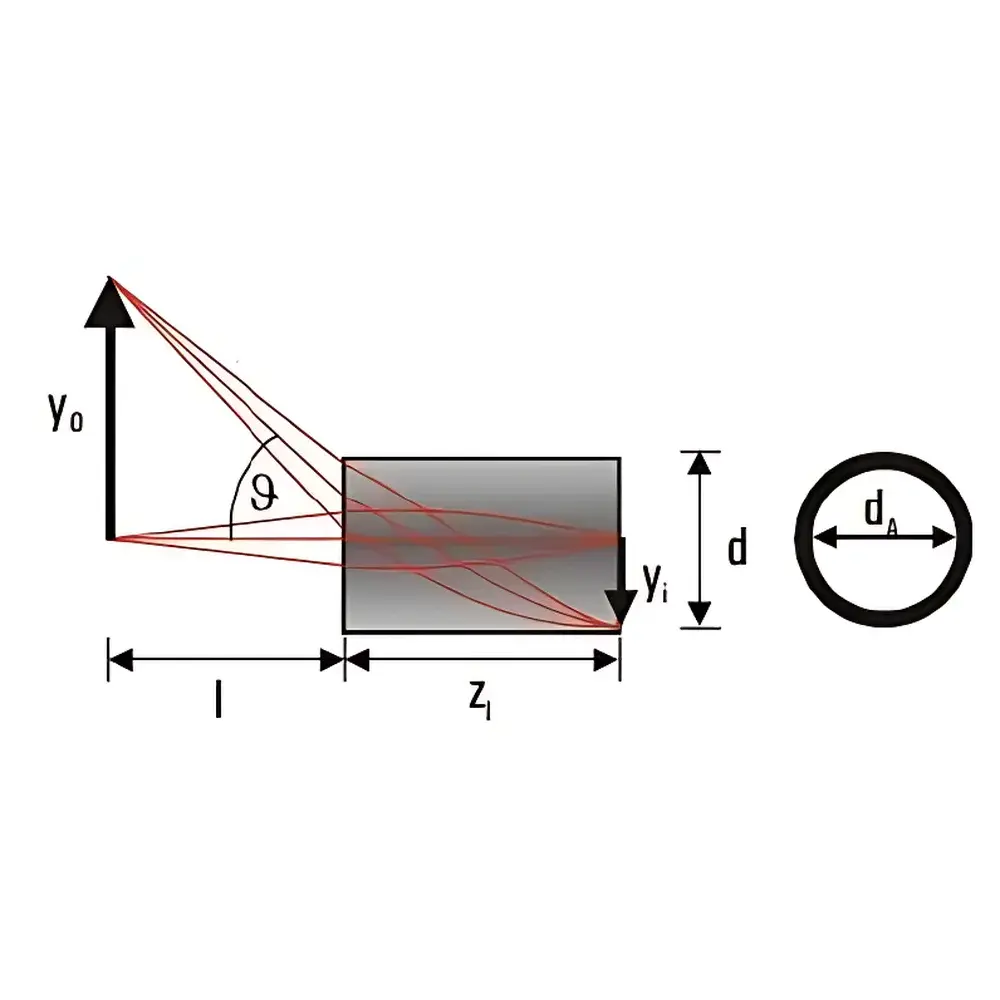
The GRINTECH GRIN Imaging Lens is a precision-engineered gradient-index (GRIN) optical component designed for high-resolution, miniaturized imaging systems where conventional refractive optics are impractical due to size, weight, or alignment constraints. Unlike homogeneous lenses, its refractive index varies radially in a controlled parabolic profile—enabling collimation, focusing, and image relay within a compact cylindrical geometry. This principle leverages the self-focusing property of GRIN media, governed by the ray equation in inhomogeneous media: d²r/dz² = −(1/n)(∂n/∂r). The lens operates on a pitch-based imaging principle: a full 0.25-pitch GRIN element relays an object plane located at its front surface to a reduced, inverted image at its rear surface—ideal for endoscopic probe tips, catheter-based diagnostics, and embedded micro-imaging modules. Its planar input/output surfaces simplify mechanical integration into rigid or flexible shaft assemblies, while maintaining excellent on-axis and off-axis performance through inherent co-axial symmetry.
Key Features
- Non-toxic ion-exchange fabrication (Ag⁺/Li⁺) in high-stability borosilicate glass—biocompatible and compliant with ISO 10993-5 cytotoxicity requirements for short-term medical device contact.
- Broadband anti-reflection coatings applied to both faces, optimized for 400–700 nm; typical residual reflectance <0.5% per surface.
- Low geometric aberration profile: minimal spherical aberration and coma; field curvature remains tightly controlled (<−40 µm peak for Ø1.0 mm variants).
- Pitch-tunable design: standard configurations include 0.25-, 0.28-, and 0.31-pitch elements; custom pitch values available to match specific working distance and magnification requirements.
- Robust thermal stability: coefficient of thermal defocus <0.005 %/°C over −10°C to +60°C, verified per MIL-STD-810G thermal shock testing protocols.
- High reproducibility: batch-to-batch NA variation ≤ ±0.02; focal length tolerance ≤ ±1.5% at 532 nm.
Sample Compatibility & Compliance
GRINTECH GRIN Imaging Lenses are compatible with standard fiber-coupled illumination sources (e.g., LED, laser diodes, supercontinuum), CMOS/CCD image sensors down to 3.45 µm pixel pitch, and miniature prism-based beam steering assemblies. They support dry and immersion (water/glycerol) configurations. All standard lenses conform to RoHS 2015/863/EU and REACH SVHC regulations. For regulated medical applications, documentation packages include material declarations, biocompatibility test summaries (ISO 10993-5, -10), and traceable metrology reports (interferometric wavefront error <λ/8 RMS @ 633 nm). Device-level integration qualifies under IEC 60601-2-57 for endoscopic imaging accessories.
Software & Data Management
While inherently passive, GRIN lens performance is fully characterizable using industry-standard optical design and analysis tools—including Zemax OpticStudio (sequential and non-sequential modes), CODE V, and FRED. GRINTECH provides measured MTF curves, spot diagrams, and chromatic focal shift datasets (440–650 nm) in CSV and MATLAB-compatible formats. For system integrators, calibrated lens databases are available for import into LabVIEW-based acquisition platforms and Python-controlled microscope automation frameworks (e.g., Micro-Manager, Pycro-Manager), supporting GLP-compliant audit trails when paired with timestamped sensor metadata.
Applications
- Forward-viewing and side-viewing endoscopes (gastrointestinal, urological, otolaryngological).
- Miniature fluorescence endomicroscopy probes (e.g., confocal or two-photon excitation with 488/561/640 nm lasers).
- Micro-optical coherence tomography (µOCT) sample arms requiring sub-50 µm spot size stability.
- Embedded vision systems in MEMS-based lab-on-chip devices and disposable diagnostic cartridges.
- Beam shaping and homogenization in compact laser delivery systems for photodynamic therapy (PDT) and low-level light therapy (LLLT).
- Calibration references in metrology-grade optical test benches for distortion mapping and telecentricity verification.
FAQ
What is the minimum working distance achievable with a standard GRINTECH 0.25-pitch lens?
For a Ø1.0 mm, NA 0.5 lens, the nominal working distance is 0.25 mm—defined as the distance from the front face to the object plane. Custom pitches can extend this to ≥1.5 mm while preserving resolution.
Can these lenses be used with UV or NIR wavelengths beyond the visible range?
Standard AR coatings cover 400–700 nm. Extended-range versions (350–900 nm) are available upon request, with transmission >92% across the band and maintained wavefront fidelity.
Is pitch calibration traceable to NIST or other national standards?
Yes—each production lot undergoes interferometric pitch verification using a calibrated Twyman-Green interferometer referenced to NIST-traceable HeNe wavelength standards.
Do GRIN lenses exhibit polarization-dependent performance?
No measurable polarization sensitivity is observed below 10⁻⁴ retardance across the visible spectrum; birefringence is suppressed via symmetric thermal annealing post-ion exchange.
How is field curvature compensated in multi-lens GRIN systems?
By combining complementary pitch elements (e.g., 0.25-pitch objective + 0.31-pitch relay), field flattening is achieved without additional singlets—reducing system length and alignment sensitivity.



