
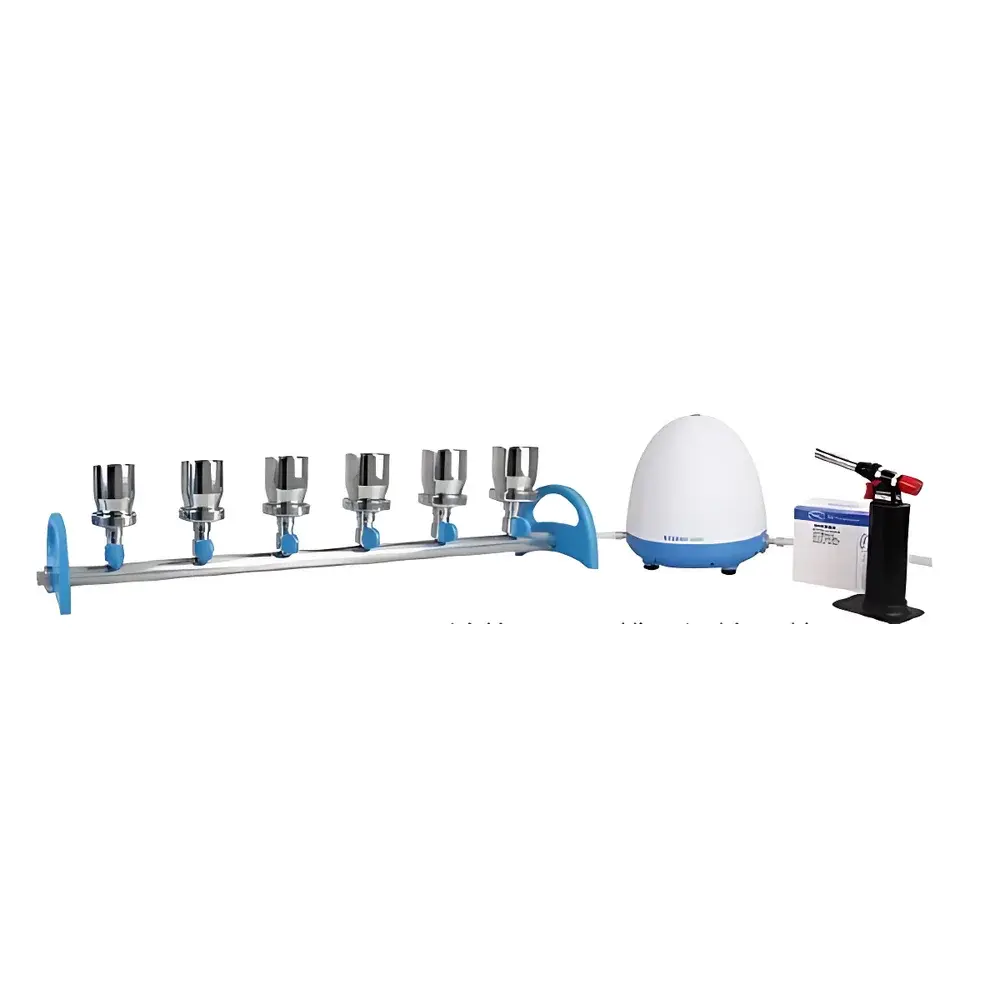
ROCKER MultiVac 600-MB-A Direct-Drain Multi-Position Vacuum Filtration System
| Brand | ROCKER |
|---|---|
| Origin | Taiwan |
| Model | MultiVac 600-MB-A |
| Pump Flow Rate | 4.5 L/min |
| Ultimate Vacuum | –525 mmHg |
| Number of Filtration Positions | 6 (individually controllable) |
| Membrane Diameter | 47 mm / 50 mm |
| Funnel Capacity | 100 mL (36 cm² filtration area) |
| Tubing ID | 8 mm (5/16 inch) |
| Main Body Material | SUS316 stainless steel |
| Control Valves | Anodized aluminum |
| Filtration Base & Gasket | SUS316 stainless steel |
| Handle & Fittings | SUS316 stainless steel or anodized aluminum |
Overview
The ROCKER MultiVac 600-MB-A is a precision-engineered, direct-drain, six-position vacuum filtration system designed for high-throughput, contamination-sensitive applications in life science laboratories. Unlike conventional vacuum filtration setups requiring intermediate waste bottles and manual tubing reconfiguration, this system integrates a dedicated drain port directly into the filtration base—enabling continuous, hands-free liquid discharge into a laboratory sink or centralized drainage line. It operates on the principle of controlled negative pressure generated by a diaphragm vacuum pump (not included), drawing sample through membrane filters seated on independently actuated stainless-steel funnels. The system is optimized for sterile or low-bioburden workflows including microbiological analysis, cell harvesting, buffer clarification, and particulate recovery—where reproducibility, material compatibility, and spatial efficiency are critical.
Key Features
- Direct-drain architecture eliminates need for waste collection flasks, reducing setup time, risk of overflow, and potential cross-contamination between runs.
- Six individually controllable filtration positions with dual Quick-Fit™ rapid-connect fittings at each funnel base—allowing tool-free installation or removal of filter assemblies in under 5 seconds.
- Full-SUS316 stainless-steel wetted path (including base, gaskets, funnels, and fittings) ensures corrosion resistance against organic solvents, acidic/basic buffers, and sterilizing agents such as sodium hypochlorite or hydrogen peroxide.
- Anodized aluminum control valves provide precise, tactile flow regulation with long-term mechanical stability and resistance to oxidation in humid environments.
- Compact footprint (290 × 210 × 270 mm) reduces benchtop occupancy by up to 40% compared to bottle-dependent multi-funnel systems—ideal for ISO Class 5–7 clean benches and shared core facilities.
- Interchangeable filtration bases support multiple configurations: standard 6-position, 4-position, or custom adapter plates for specialized funnels (e.g., 25-mm or 90-mm formats) without hardware modification.
Sample Compatibility & Compliance
The MultiVac 600-MB-A accommodates standard 47-mm and 50-mm diameter membranes—including mixed cellulose ester (MCE), polyethersulfone (PES), nylon, PVDF, and track-etched polycarbonate—across a broad pH range (1–14) and temperatures up to 60 °C during continuous operation. Its all-metal construction meets USP Class VI biocompatibility requirements for non-pyrogenic contact surfaces and complies with ISO 13485 design controls for medical device manufacturing support environments. When used with validated sterilization protocols (e.g., autoclaving at 121 °C for 20 min), the system supports GLP and GMP-aligned workflows for environmental monitoring, raw material testing, and process validation in pharmaceutical QC labs.
Software & Data Management
As a manually operated, valve-controlled hardware platform, the MultiVac 600-MB-A does not incorporate embedded electronics or digital interfaces. However, its modular architecture enables seamless integration into electronically monitored workflows: vacuum source pumps with analog/digital output signals (e.g., 0–10 V or 4–20 mA) can be logged via external data acquisition systems compliant with FDA 21 CFR Part 11. ROCKER provides traceable calibration documentation for vacuum gauge reference points and recommends periodic verification of valve seal integrity per ASTM F2663-20 (Standard Guide for Validation of Sterile Filtration Processes). Audit trails for maintenance and usage may be maintained using laboratory information management systems (LIMS) compatible with SOP-driven recordkeeping.
Applications
- Microbiological membrane filtration for total viable count (TVC), coliform, and E. coli enumeration per ISO 9308-1 and USP .
- Clarification of cell culture supernatants prior to downstream chromatography or ultrafiltration steps.
- Particulate analysis in injectables and ophthalmic solutions following USP and EP 2.9.19.
- Routine filtration of HPLC mobile phases, buffers, and reagents in analytical chemistry labs.
- Environmental water testing for suspended solids, algae, or microplastics using standardized gravimetric or microscopy-based methods.
- Pre-filtration of samples prior to ICP-MS or AAS analysis to prevent nebulizer clogging.
FAQ
Is the MultiVac 600-MB-A compatible with aggressive solvents such as acetone or chloroform?
Yes—the SUS316 stainless-steel wetted components and anodized aluminum valves exhibit excellent resistance to common organic solvents; however, prolonged exposure to halogenated hydrocarbons above 40 °C is not recommended without prior compatibility verification.
Can the system be autoclaved?
All stainless-steel and anodized aluminum components are autoclavable at 121 °C for 20 minutes; gaskets must be inspected for deformation after repeated cycles.
Does ROCKER supply vacuum pumps certified for use with this system?
ROCKER offers optional diaphragm vacuum pumps (e.g., RV 600 series) with oil-free operation, chemical-resistant membranes, and CE/UL certification—designed specifically for integration with MultiVac platforms.
What is the maximum operating pressure differential across the filter membrane?
The system is rated for continuous operation at ≤ –525 mmHg (≈ –70 kPa); transient peaks up to –600 mmHg are permissible but should be avoided during sensitive biological filtrations to prevent cell lysis or membrane rupture.
How often should the Quick-Fit seals be replaced?
Under normal use (≤50 cycles/week), fluorosilicone O-rings in the Quick-Fit interface retain sealing performance for ≥12 months; visual inspection for compression set or cracking is advised quarterly.





