
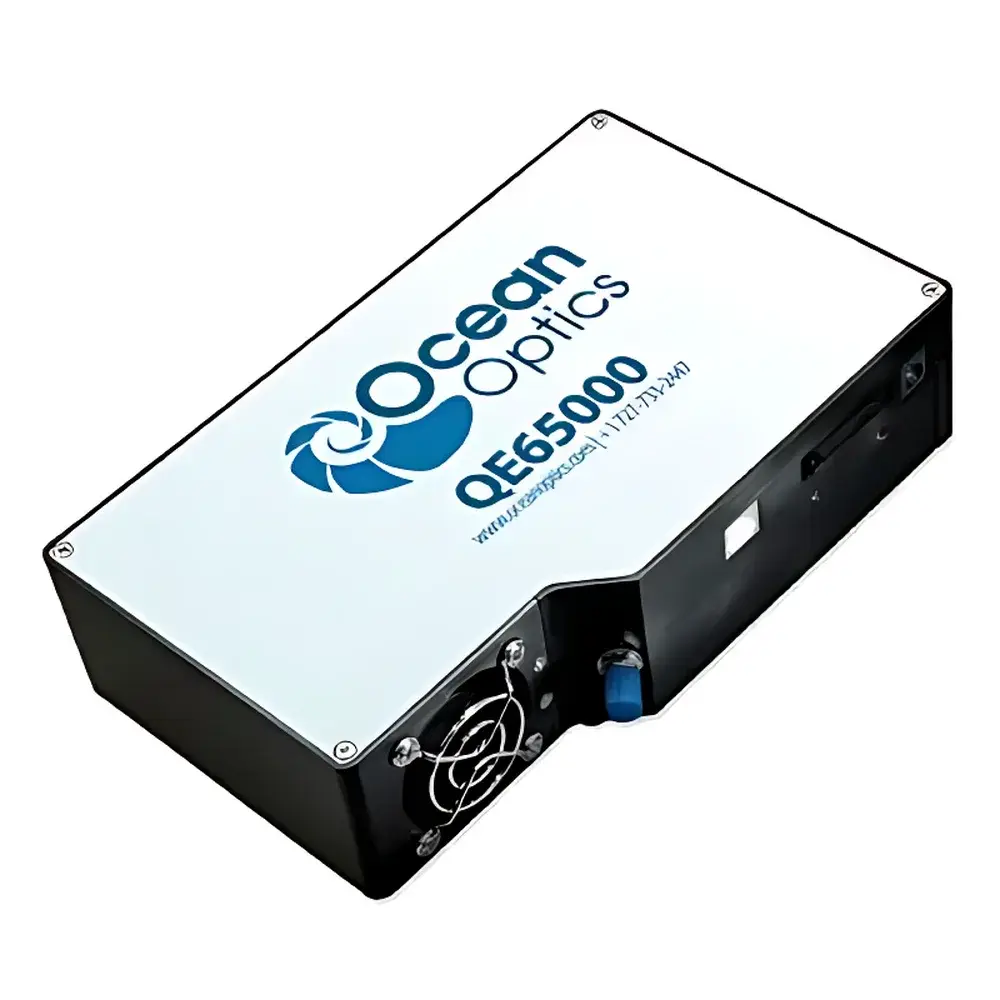
Ocean Optics QE65000 Scientific-Grade Fiber Optic Spectrometer
| Brand | Ocean Optics |
|---|---|
| Origin | USA |
| Model | QE65000 |
| Detector Type | Back-Thinned FFT-CCD |
| Wavelength Range | 200–1100 nm |
| Optical Resolution (FWHM) | 0.14–7.7 nm |
| Quantum Efficiency | up to 90% (peak), 65% @ 250 nm |
| Signal-to-Noise Ratio | 1000:1 (full signal) |
| A/D Resolution | 16-bit |
| Integration Time | 8 ms – 15 min |
| Stray Light | <0.08% @ 600 nm |
| Dark Noise | 3 RMS counts |
| Thermoelectric Cooling | down to −15 °C |
| Dimensions | 182 × 110 × 47 mm |
| Weight | 1.18 kg (excl. power supply) |
| Interface | USB 2.0, RS-232, Ethernet (via Remora adapter) |
| GPIO | 10 programmable digital I/O ports |
| Software | SpectraSuite (Windows, macOS, Linux) |
Overview
The Ocean Optics QE65000 is a scientific-grade fiber optic spectrometer engineered for ultra-low-light spectral measurement across demanding research and industrial applications. Built around a Hamamatsu S7031-1006 back-thinned, frame-transfer CCD detector, the QE65000 leverages true two-dimensional pixel architecture—not linear array geometry—to maximize photon collection efficiency from the full height of the entrance slit. This design fundamentally improves system sensitivity compared to conventional linear-CCD spectrometers, where only slit width governs light throughput. The instrument employs a f/4 Czerny-Turner optical layout with 101.6 mm focal length optics, optimized for high throughput and minimal aberration. Its quantum efficiency peaks at 90% in the visible range and maintains 65% at 250 nm—enabling robust UV performance without supplemental coatings. Thermoelectric cooling (down to −15 °C) suppresses dark current and enables integration times from 8 milliseconds to 15 minutes, making the QE65000 suitable for fluorescence lifetime analysis, Raman spectroscopy, astronomical photometry, DNA sequencing assays, and thin-film reflectance characterization—all under low-photon-flux conditions.
Key Features
- Back-thinned, frame-transfer CCD detector (Hamamatsu S7031-1006) with 1024 × 58 active pixels and 24.576 µm² pixel size
- Peak quantum efficiency of 90% and >65% at 250 nm—optimized for UV–NIR spectral coverage (200–1100 nm)
- Enhanced optical platform featuring HC-1 holographic gratings and low-BRDF internal coatings to reduce stray light (<0.08% @ 600 nm) and improve photometric reproducibility
- Onboard programmable microcontroller with 10 digital GPIO ports and pulse generation capability for synchronized external device control (e.g., shutter triggering, source modulation, process sequencing)
- Thermoelectric cooling system with software-controlled setpoint stability within ±0.1 °C of target temperature
- Multiple interface options: USB 2.0 (480 Mbps), RS-232 (115.2 kbaud), and optional Ethernet/WiFi connectivity via Remora network adapter
- Configurable optical path: selectable slit widths (5–200 µm), 14 grating options, OFLV long-pass filters (OFLV-QE series), and SMA905 fiber coupling
Sample Compatibility & Compliance
The QE65000 supports direct fiber-coupled measurements from liquid samples (cuvettes, flow cells), solid surfaces (reflectance probes), gas-phase absorption cells, and vacuum-compatible optical setups. Its modular optical platform permits customization for compliance with application-specific regulatory frameworks: when integrated into validated analytical workflows, the system supports traceable wavelength calibration (NIST-traceable standards available), linearity verification (>99.8% corrected linearity), and stable thermal management—key prerequisites for GLP and GMP environments. While the spectrometer itself does not carry FDA 21 CFR Part 11 certification, its data acquisition and metadata logging capabilities (via SpectraSuite’s audit-ready export formats) align with requirements for electronic record integrity in regulated laboratories. The instrument meets IEC 61326-1 for electromagnetic compatibility and operates within Class I laser product safety limits when used with compliant excitation sources.
Software & Data Management
SpectraSuite—a cross-platform application (Windows, macOS, Linux)—provides full instrument control, real-time spectral visualization, batch acquisition, and export in CSV, TXT, and HDF5 formats. Each QE65000 unit stores factory-calibrated coefficients (wavelength, intensity, nonlinearity correction) in onboard memory, ensuring consistent spectral fidelity across instruments and software versions. The embedded microcontroller enables hardware-level synchronization: users can trigger external events during integration windows using programmable GPIO logic or TTL pulses—critical for time-resolved spectroscopy and pump-probe experiments. Raw 16-bit A/D data is preserved throughout processing; dark subtraction, smoothing, and baseline correction are applied non-destructively. SpectraSuite supports automated calibration routines—including intensity and wavelength validation using certified reference lamps—and generates timestamped, metadata-embedded reports suitable for lab notebook integration.
Applications
- Fluorescence spectroscopy: High-sensitivity detection of weak emitters (e.g., single-molecule fluorescence, quantum dot emissions) enabled by low-noise TE-cooled detection and extended integration windows
- Raman spectroscopy: Paired with notch or edge filters (e.g., OFLV-QE series), the QE65000 resolves Stokes-shifted bands with high SNR, especially in near-infrared excitation configurations
- Astronomical instrumentation: Used in small-telescope spectrographs and exoplanet transit spectrometers due to its UV response, thermal stability, and low-stray-light optical design
- DNA sequencing and bioassays: Supports capillary electrophoresis detection and microplate reader integration via fiber-optic probes
- Thin-film and coating analysis: Measures reflectance/transmittance spectra for thickness and refractive index modeling (e.g., Cauchy or Tauc analysis)
- Environmental monitoring: Deployed in field-portable UV-Vis analyzers for water quality (nitrate, DOC) and atmospheric trace-gas sensing when coupled with multipass cells
FAQ
What cooling performance does the QE65000 achieve?
The thermoelectric cooler stabilizes the detector at temperatures as low as −15 °C (dependent on ambient conditions), reducing dark current to ~200 e⁻/pixel/sec at 0 °C and enabling integration times up to 15 minutes with minimal noise accumulation.
Can the QE65000 be used in a regulated pharmaceutical QC lab?
Yes—when configured with NIST-traceable calibration standards and operated under documented SOPs, the QE65000 supports data integrity requirements for USP , ASTM E275, and ISO/IEC 17025-compliant testing. SpectraSuite’s export logs include timestamps, instrument ID, and calibration metadata.
How is wavelength calibration maintained across units?
Each QE65000 stores unique polynomial coefficients in non-volatile memory. These are loaded automatically by SpectraSuite, eliminating manual recalibration and ensuring inter-unit comparability for multi-instrument studies.
Is real-time triggering supported for time-resolved measurements?
Yes—the onboard microcontroller supports four hardware trigger modes (edge, level, synchronous, asynchronous) and allows user-defined GPIO actions during integration, enabling precise synchronization with pulsed lasers or mechanical choppers.
What optical resolution options are available?
Resolution ranges from 0.14 nm to 7.7 nm FWHM, determined by selected grating groove density and entrance slit width. For example, a 25 µm slit with a 2400 g/mm grating yields ~0.14 nm resolution in the UV, while a 200 µm slit with a 300 g/mm grating delivers broader-band NIR coverage at ~7.7 nm resolution.




