
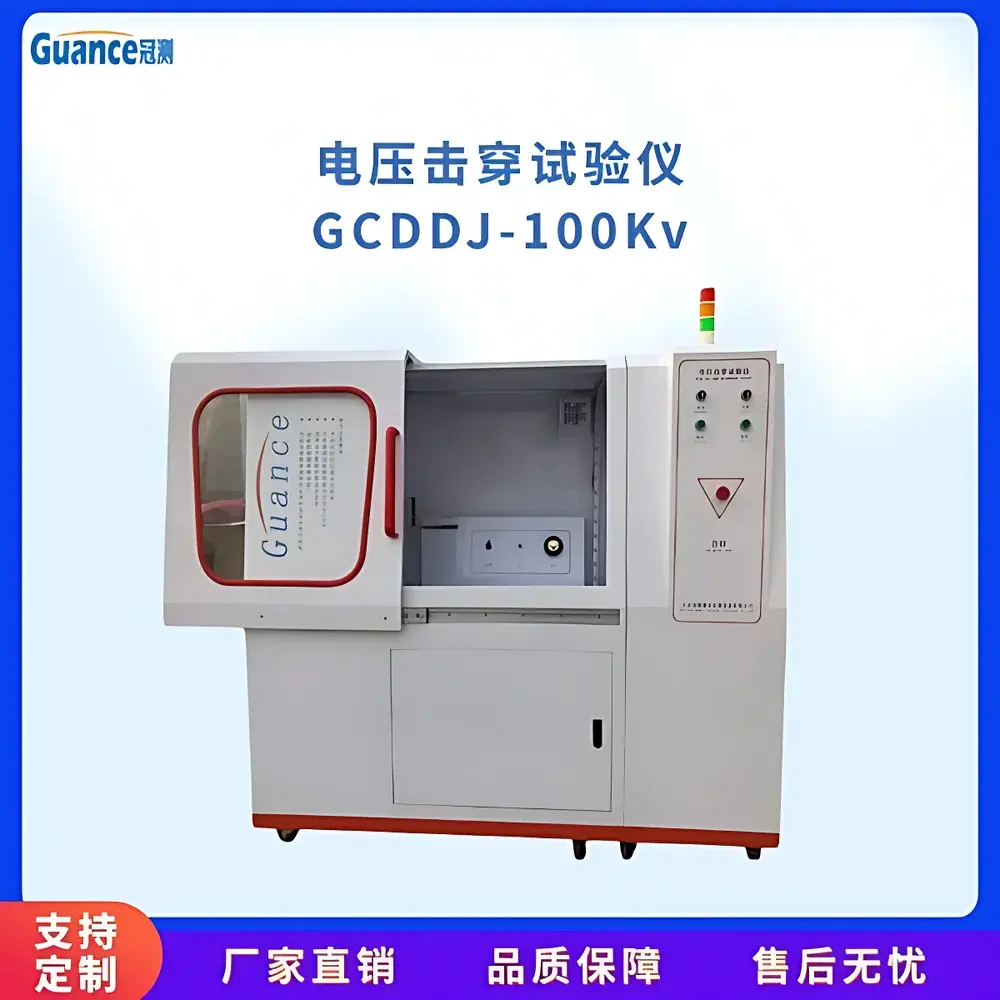
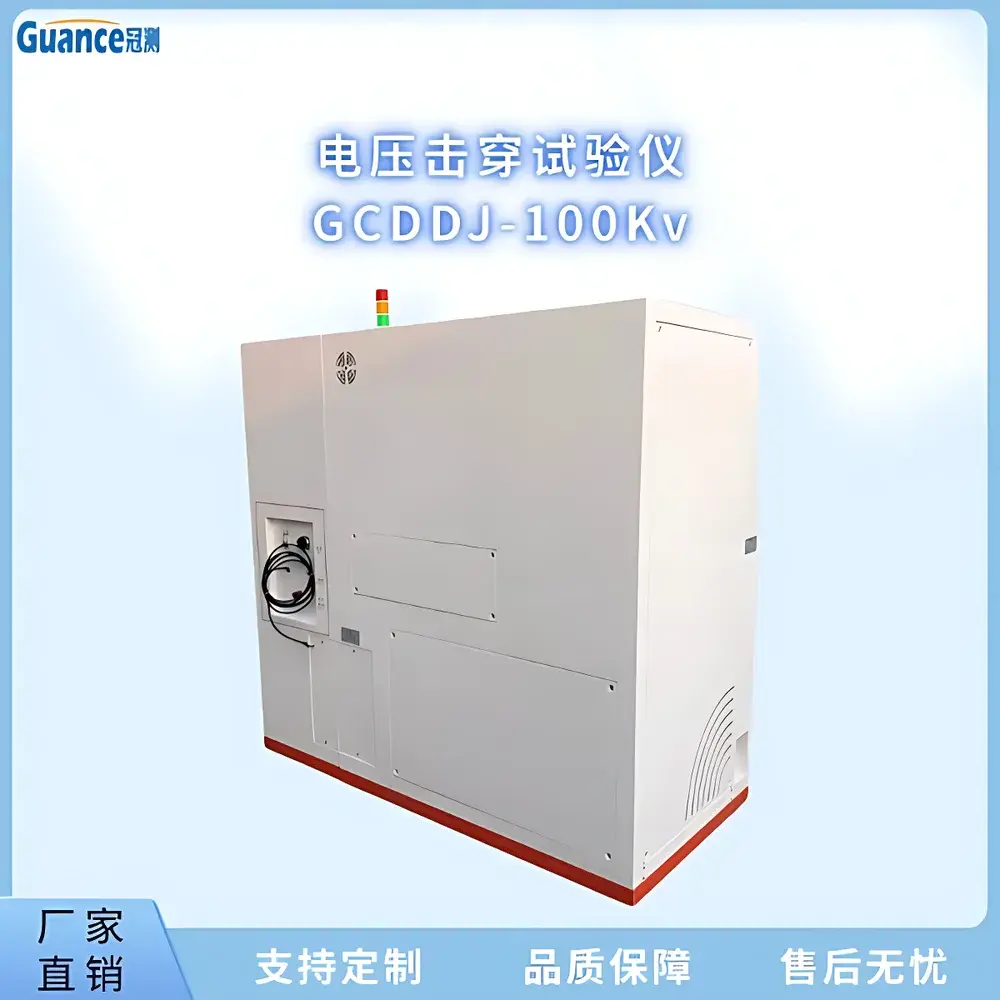
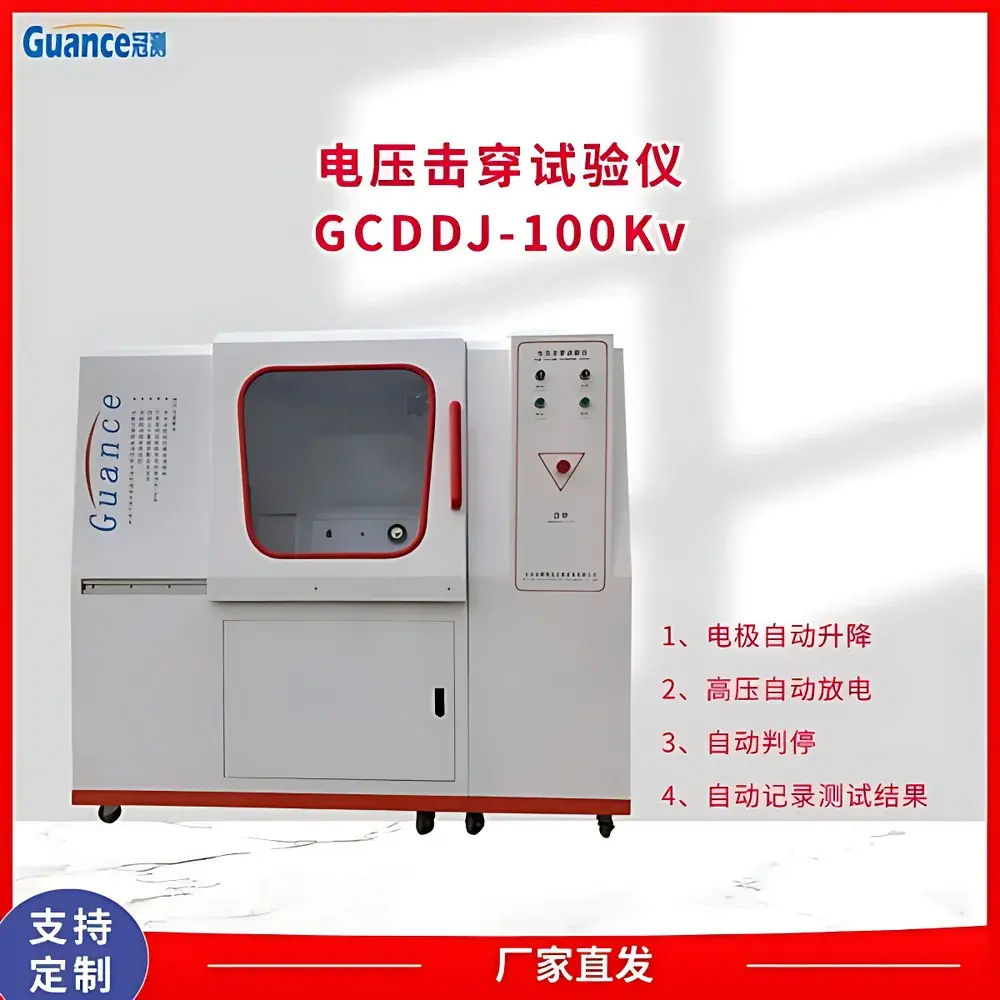
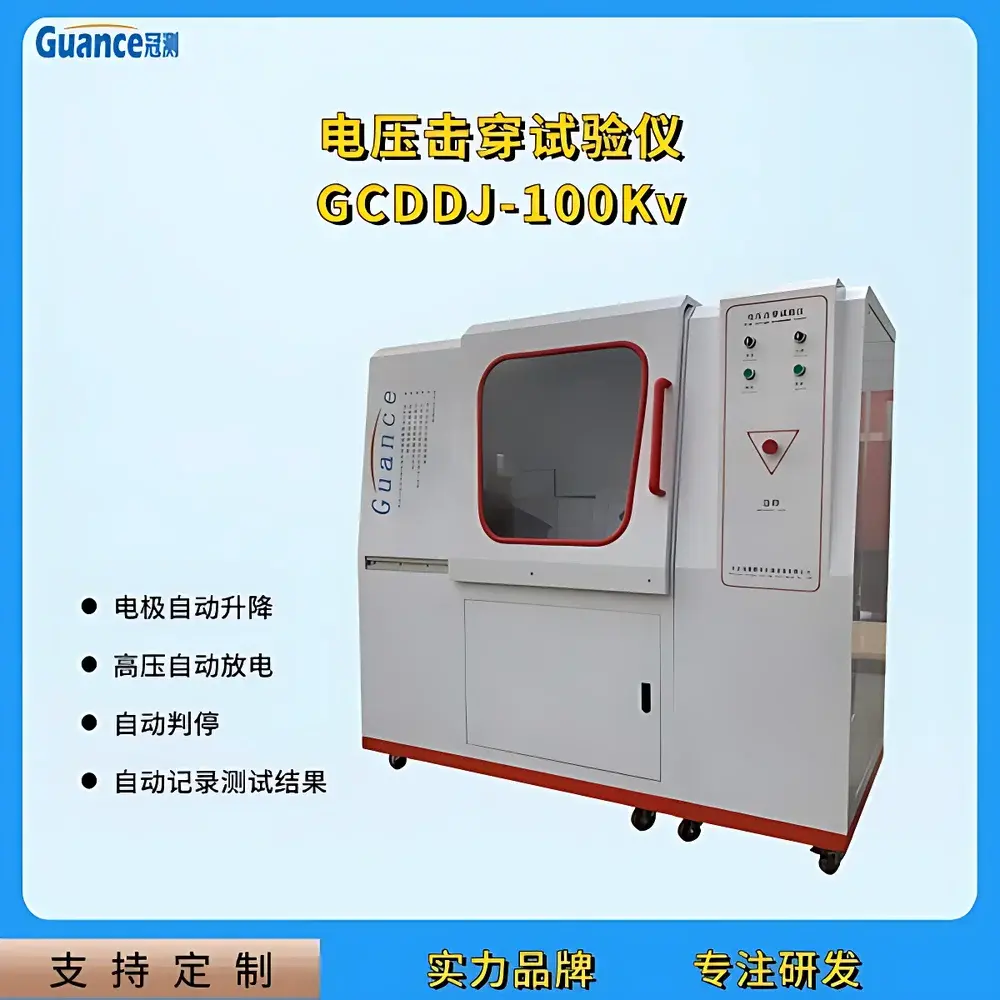
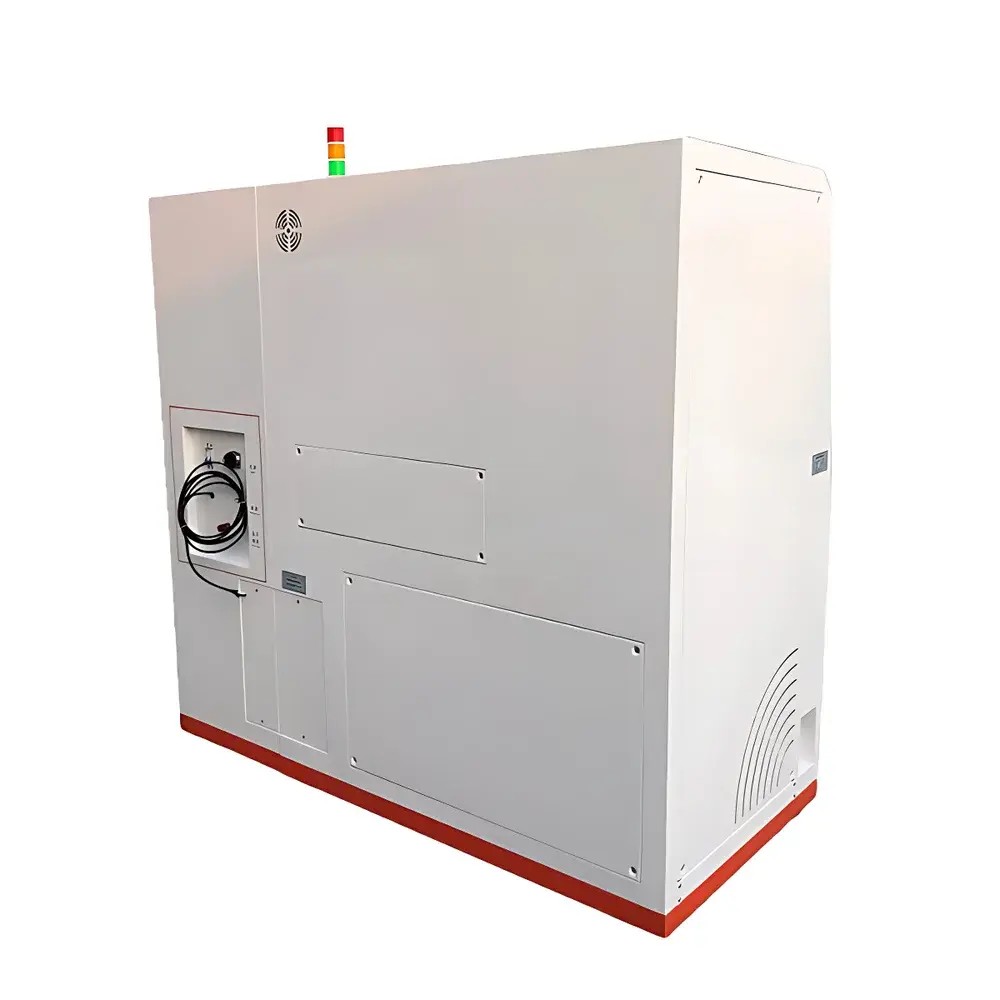
GuanCe GCDDJ-100kV Fully Automated Voltage Breakdown Tester
| Brand | GuanCe |
|---|---|
| Origin | Beijing, China |
| Model | GCDDJ-100kV |
| Dielectric Withstand Voltage | 100 kV AC/DC |
| Electrical Capacity | 5 kVA |
| Input Voltage | AC 220 V / 50 Hz |
| Voltage Ramp Rate | 0.1–5 kV/s (adjustable) |
| Voltage Accuracy | ≤ ±1.5% |
| Leakage Current Range | 0–100 mA |
| Voltage Sensor Range | 0–100 V |
| Electrode Options | φ25 mm (×2), φ75 mm (×1) |
| Test Chamber Dimensions | 750 × 600 × 800 mm |
| Overall Dimensions | 1500 × 850 × 1700 mm |
| Weight | ~250 kg |
| Safety Protections | Overvoltage, Overcurrent, Short-Circuit, Ground-Fault |
| Test Media | Air, Oil Bath (standard), High-Temperature Environment (optional) |
| Data Acquisition | Optically Isolated Digital I/O via Siemens PLC |
| Software Platform | Windows-based GUI with Real-Time Curve Plotting, ASTM/IEC Compliant Reporting |
Overview
The GuanCe GCDDJ-100kV Fully Automated Voltage Breakdown Tester is an industrial-grade dielectric strength measurement system engineered for precision, repeatability, and regulatory compliance in high-voltage insulation evaluation. It operates on the principle of controlled voltage ramping—either AC or DC—to determine the electric field threshold at which solid insulating materials undergo catastrophic dielectric failure (i.e., electrical breakdown). Designed in accordance with core requirements of IEC 60243-1, ASTM D149, GB/T 1408.1, and ISO 60243, the instrument supports standardized testing of polymers, elastomers, laminates, ceramics, glass, varnishes, and molded insulating components under reproducible environmental conditions. Its architecture integrates a Siemens S7-series PLC for deterministic real-time control, optically isolated data acquisition to eliminate electromagnetic interference from high-voltage transients, and dual-mode voltage generation capable of delivering up to 100 kV with programmable ramp profiles.
Key Features
- Fully automated test execution with pre-configured protocols for dielectric breakdown, withstand voltage, and stepwise (gradient) voltage testing
- Siemens PLC-based control system ensuring deterministic timing, fault response <10 ms, and deterministic sequence logic per IEC 61508 SIL-2 principles
- Optically isolated digital I/O interface between high-voltage module and PC host—eliminates ground-loop coupling and ensures signal integrity during 100 kV transients
- Adjustable voltage ramp rate from 0.1 kV/s to 5 kV/s, selectable in 0.1 kV/s increments; supports linear, stepped, and hold-and-rise profiles
- Multi-criteria breakdown detection: simultaneous voltage collapse and leakage current surge (>10 mA threshold configurable) with auto-hold and trip confirmation
- Dual-mode output: AC (50 Hz sine wave, RMS-regulated) and DC (ripple <3%, polarity reversible) up to 100 kV
- Integrated safety subsystem including overvoltage cut-off, overcurrent limiting (5 A fast-acting fuse + electronic crowbar), short-circuit protection, and ground-fault monitoring
- Motorized electrode lift mechanism (optional) with position feedback for repeatable sample alignment; manual placement mode standard
- Oil bath test chamber (300 × 150 × 200 mm) with suspended sample rack, built-in LED illumination, and forced-air exhaust for fume management
- Large observation window (550 × 600 mm tempered glass) with integrated multi-color tower light indicating test status (Ready, Running, Tripped, Fault)
Sample Compatibility & Compliance
The GCDDJ-100kV accommodates flat-sheet and molded specimens conforming to standard electrode configurations defined in ASTM D149 and IEC 60243-1. Standard electrodes include two 25 mm diameter disc electrodes (for volume resistivity and breakdown across thickness) and one 75 mm diameter electrode (for surface tracking assessment). Custom electrode geometries—including needle-plane, rod-plane, and multi-point arrays—are supported upon request. Testing media options include ambient air (IEC 60270-compliant partial discharge screening), transformer oil immersion (ASTM D877/D1816), and elevated-temperature environments (up to 200 °C, optional heated chamber add-on). All hardware and software functions comply with GLP documentation requirements, including audit-trail-enabled user login, parameter change logging, and timestamped result archiving—fully traceable for FDA 21 CFR Part 11 readiness when paired with validated Windows OS configuration.
Software & Data Management
The proprietary Windows-based control suite provides a validated, intuitive GUI supporting full test lifecycle management. Real-time dual-channel plotting displays applied voltage (kV) and leakage current (mA) synchronously with millisecond resolution. Users may define test templates per material class (e.g., “Epoxy Resin – ASTM D149 AC Mode”), assign operator IDs, set pass/fail criteria (e.g., “Breakdown > 60 kV required”), and configure report metadata (lab ID, sample lot, environmental conditions). Export functionality includes CSV and native Excel (.xlsx) formats with embedded metadata; reports embed raw curves, statistical summaries (mean, SD, min/max), and compliance annotations. The software maintains a local encrypted database with automatic daily backup, supports networked deployment in LAN environments, and logs all critical events—including door interlock state, HV enable/disable cycles, and calibration verification timestamps—for internal QA audits.
Applications
This tester serves quality assurance laboratories in cable manufacturing, aerospace composites, automotive EV battery pack insulation validation, medical device polymer certification, and power electronics encapsulant R&D. Typical use cases include: qualification of silicone rubber housings for outdoor insulators; comparative analysis of nanofilled polyimide films for flexible printed circuits; verification of epoxy-mica tape integrity in high-voltage motor windings; and accelerated aging studies correlating thermal stress with dielectric degradation. Its ability to execute sequential multi-sample tests with automated reset—combined with deterministic breakdown detection—enables statistically robust Weibull analysis of breakdown voltage distributions per IEC 60243-2 Annex B.
FAQ
What standards does the GCDDJ-100kV support out-of-the-box?
It natively implements test sequences and reporting templates aligned with ASTM D149, IEC 60243-1, GB/T 1408.1, and ISO 60243. Custom protocol scripting is available for proprietary or regional standards.
Is the system suitable for production-line QC testing?
Yes—the PLC-based architecture enables unattended batch operation, integrated barcode scanning (via optional USB scanner), and direct export to MES/SPC systems via CSV or OPC UA (add-on module).
How is calibration traceability maintained?
Voltage and current sensors are calibrated annually against NIST-traceable references; calibration certificates include uncertainty budgets per ISO/IEC 17025. Internal self-test routines verify sensor linearity and isolation integrity prior to each test session.
Can the system perform partial discharge (PD) measurement?
No—this instrument measures macroscopic breakdown and leakage current only. PD detection requires dedicated high-frequency coupling and RF-spectrum analysis hardware (e.g., IEC 60270-compliant PD analyzers).
What maintenance is required for long-term reliability?
Annual inspection of HV bushings, oil bath cleanliness verification, electrode surface polishing, and verification of interlock switch timing. No consumables beyond standard transformer oil (if used) and replacement fuses.



