
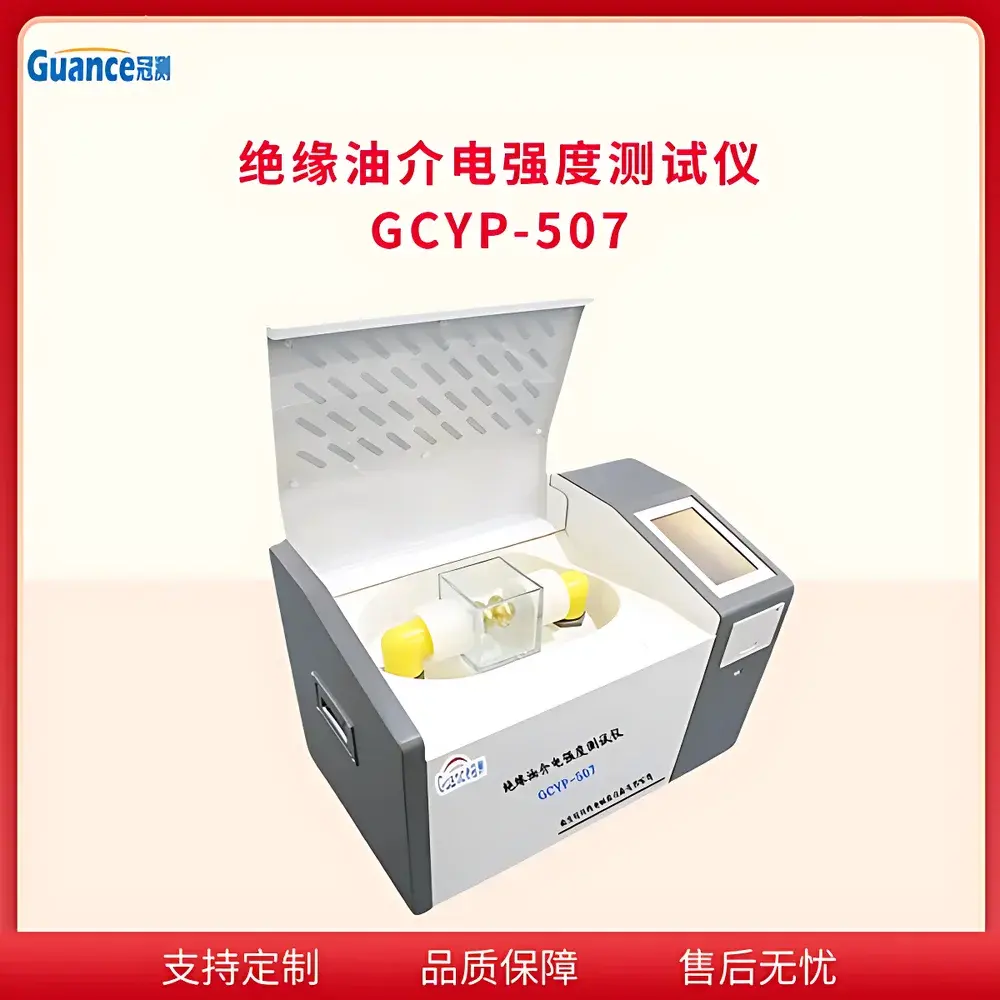
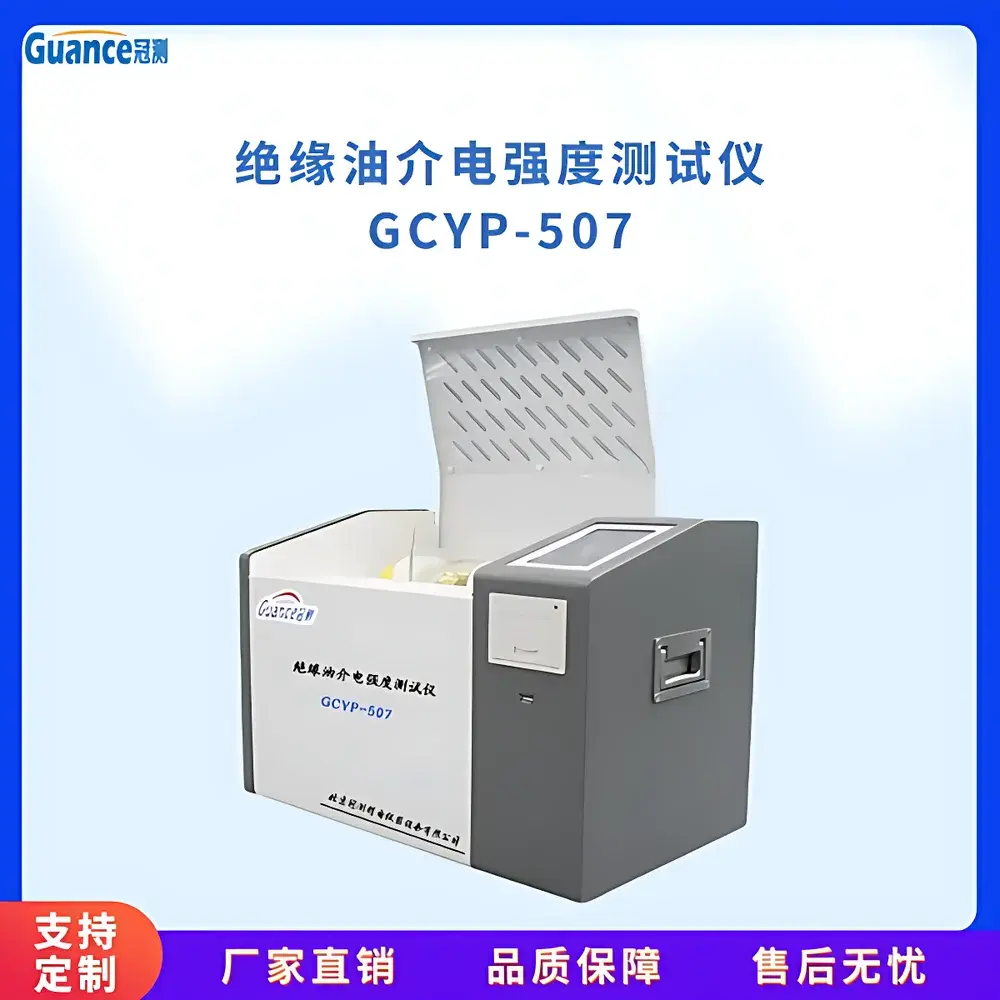
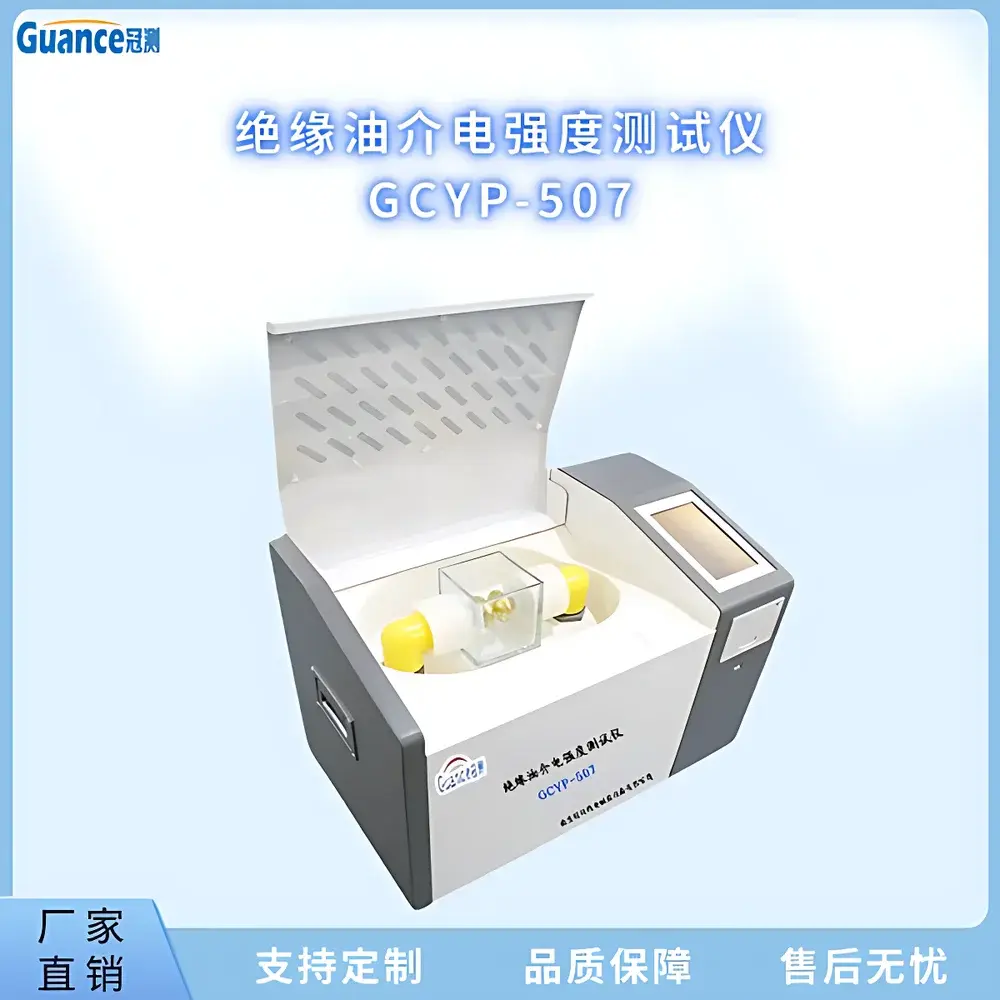
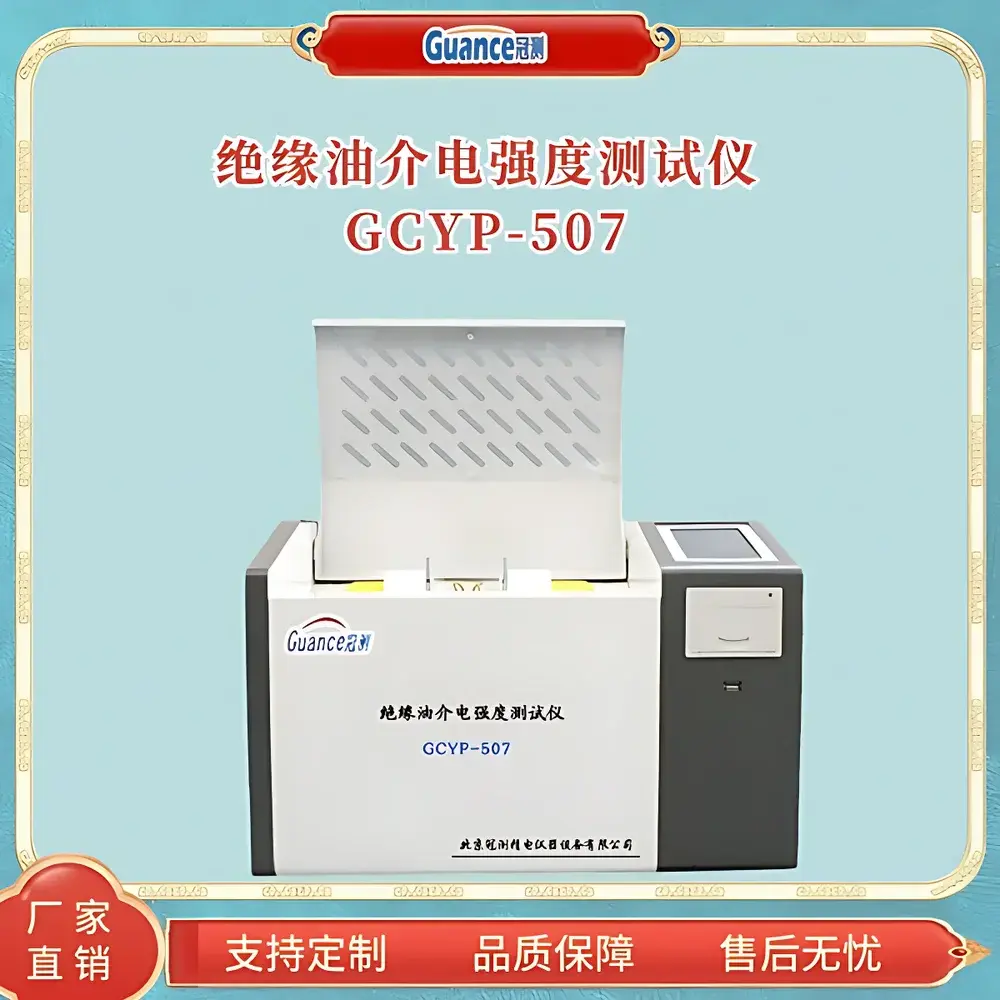
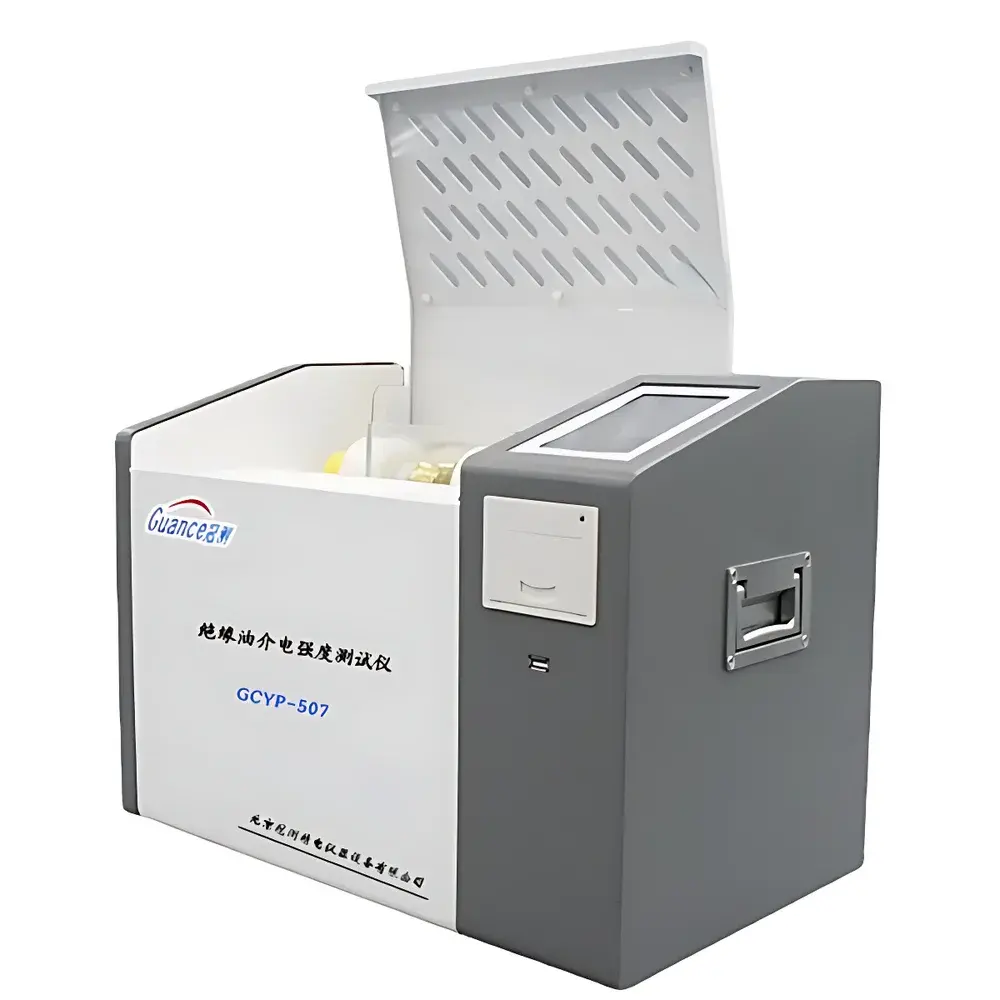
GuanCe GCYP-507.2 Insulating Oil Dielectric Strength Tester
| Brand | GuanCe Instruments |
|---|---|
| Origin | Beijing, China |
| Manufacturer Type | Authorized Distributor |
| Country of Origin | China |
| Model | GCYP-507.2 |
| Breakdown Voltage Range | 0–50 kV |
| Compliance Standards | GB/T 507–1986, GB/T 507–2002, DL 429.9, IEC 60156 |
| Communication Interface | RS-232 |
| Display | Dual-language (English/Chinese) LCD with real-time temperature & humidity monitoring |
| Safety Features | Overcurrent, overvoltage, short-circuit, and watchdog circuit protection |
| Electrode Cup Material | High-purity borosilicate glass + chemical-resistant polymer |
| Data Acquisition | Direct high-voltage end sampling into 16-bit A/D converter |
Overview
The GuanCe GCYP-507.2 Insulating Oil Dielectric Strength Tester is a fully digital, microprocessor-controlled instrument engineered for precise measurement of the dielectric breakdown voltage of transformer oils, turbine oils, and other insulating liquids used in high-voltage electrical equipment. Based on the principle of stepwise voltage ramping under standardized electrode geometry (typically spherical or disk-type electrodes per IEC 60156), the system applies an AC voltage (50 Hz or 60 Hz) across a defined oil gap until electrical breakdown occurs—marked by a rapid current surge and arc formation. The measured breakdown voltage reflects the oil’s ability to resist electrical conduction under stress and serves as a critical indicator of contamination (e.g., water, particulates, fibers) or oxidation degradation. Designed for routine quality control in substation maintenance labs, power generation facilities, and transformer manufacturing QA environments, the GCYP-507.2 delivers repeatable, traceable results aligned with international test protocols.
Key Features
- Microcontroller-based architecture with embedded watchdog circuitry ensures continuous operational integrity and eliminates system lockup under electromagnetic interference.
- Direct high-voltage terminal sampling architecture feeds breakdown signals directly into a 16-bit analog-to-digital converter—bypassing analog signal conditioning stages that introduce drift or gain error.
- Integrated environmental monitoring displays real-time ambient temperature and relative humidity; optional infrared oil temperature probe enables compliance with ASTM D877 and IEC 60156 temperature correction requirements.
- Preloaded test standards include GB/T 507–1986, GB/T 507–2002, DL 429.9 (China’s electric utility standard), and IEC 60156—each with configurable ramp rate, dwell time, and pass/fail logic.
- Electrode cup constructed from borosilicate glass and chemically inert polymer materials resists hydrolysis and acid corrosion, ensuring long-term dimensional stability and minimizing cross-contamination between samples.
- Dual-language interface (English/Chinese) supports multilingual lab personnel without requiring firmware reconfiguration.
- Comprehensive hardware-level safety: automatic shutdown on overcurrent (>5 mA), overvoltage (>5% setpoint deviation), and short-circuit detection; reinforced insulation barrier between HV section and operator interface.
Sample Compatibility & Compliance
The GCYP-507.2 accommodates standard 40 mL insulating oil specimens in accordance with IEC 60156 and GB/T 507 specifications. It supports mineral-based, synthetic ester, and silicone-based dielectric fluids—provided viscosity remains below 100 cSt at 40 °C to ensure adequate particle settling prior to testing. All test sequences comply with GLP documentation requirements: each test record includes timestamp, operator ID (via optional login module), electrode gap setting (2.5 mm default), ambient conditions, and raw breakdown voltage waveform capture (stored locally). The instrument meets EN 61000-4-3 (radiated immunity) and EN 61000-4-4 (electrical fast transient) standards for electromagnetic compatibility in industrial laboratories.
Software & Data Management
Data export is supported via RS-232 serial interface to external PCs running Windows-based laboratory information management systems (LIMS) or custom CSV loggers. Each test generates a structured ASCII record containing: test ID, date/time, breakdown voltage (kV), number of strokes, average value across six consecutive tests, pass/fail status per selected standard, and environmental metadata. Audit-trail functionality (when paired with compliant host software) satisfies FDA 21 CFR Part 11 requirements for electronic records—enabling secure user authentication, immutable result logging, and change history tracking. Firmware updates are performed via UART bootloader using vendor-provided configuration utilities.
Applications
- Routine dielectric strength verification of transformer oil prior to commissioning and after maintenance (per IEEE C57.106).
- Condition monitoring of insulating oil in service-aged power transformers and circuit breakers.
- Quality assurance testing of new oil batches supplied to grid operators and OEMs.
- Research evaluation of antioxidant additive performance and oxidation stability under accelerated aging protocols.
- Third-party certification labs performing accredited testing to ISO/IEC 17025 scope requirements.
FAQ
What electrode configuration does the GCYP-507.2 use?
It employs a standard 2.5 mm spherical electrode gap conforming to IEC 60156 and GB/T 507–2002. Electrodes are precision-polished stainless steel with calibrated alignment fixtures.
Is calibration traceable to national standards?
Yes—factory calibration is performed using NIST-traceable high-voltage dividers; users may perform field verification with certified reference voltage sources up to 50 kV.
Can the instrument store test results internally?
No internal non-volatile memory is provided; all data must be transmitted in real time via RS-232 or recorded externally during testing.
Does it support automatic stirring or degassing?
Stirring and vacuum degassing are manual pre-test procedures per standard methodology; the instrument itself does not integrate fluid handling subsystems.
What maintenance is required for long-term accuracy?
Annual verification of electrode surface finish, gap distance, and HV divider linearity is recommended; cleaning with anhydrous ethanol and lint-free wipes after each sample is mandatory.



