
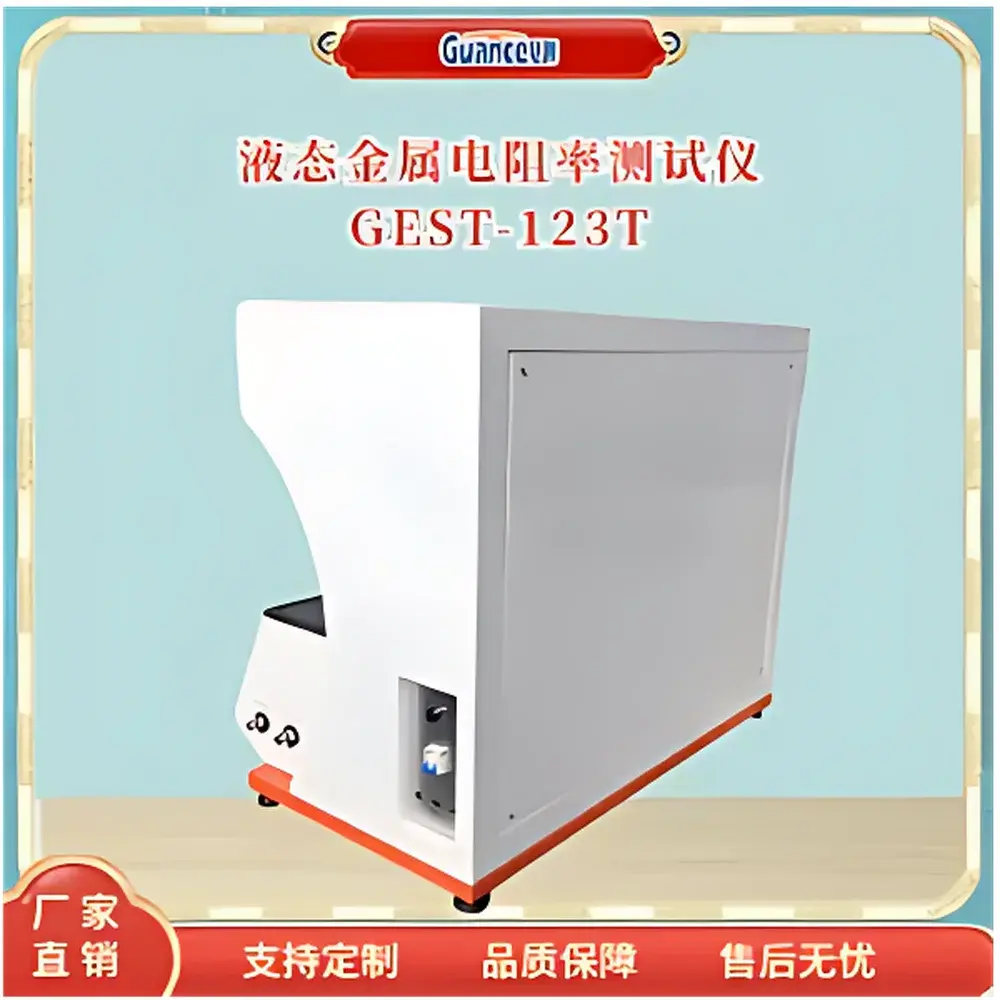
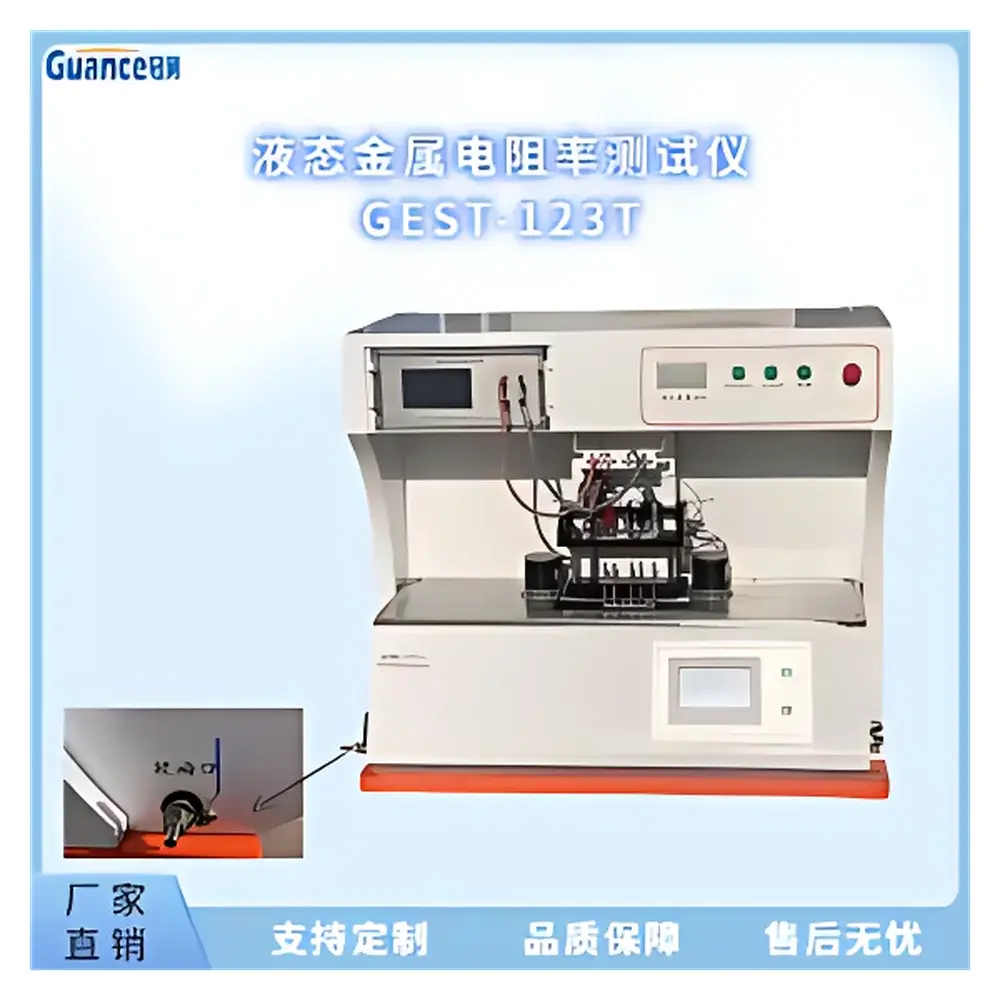
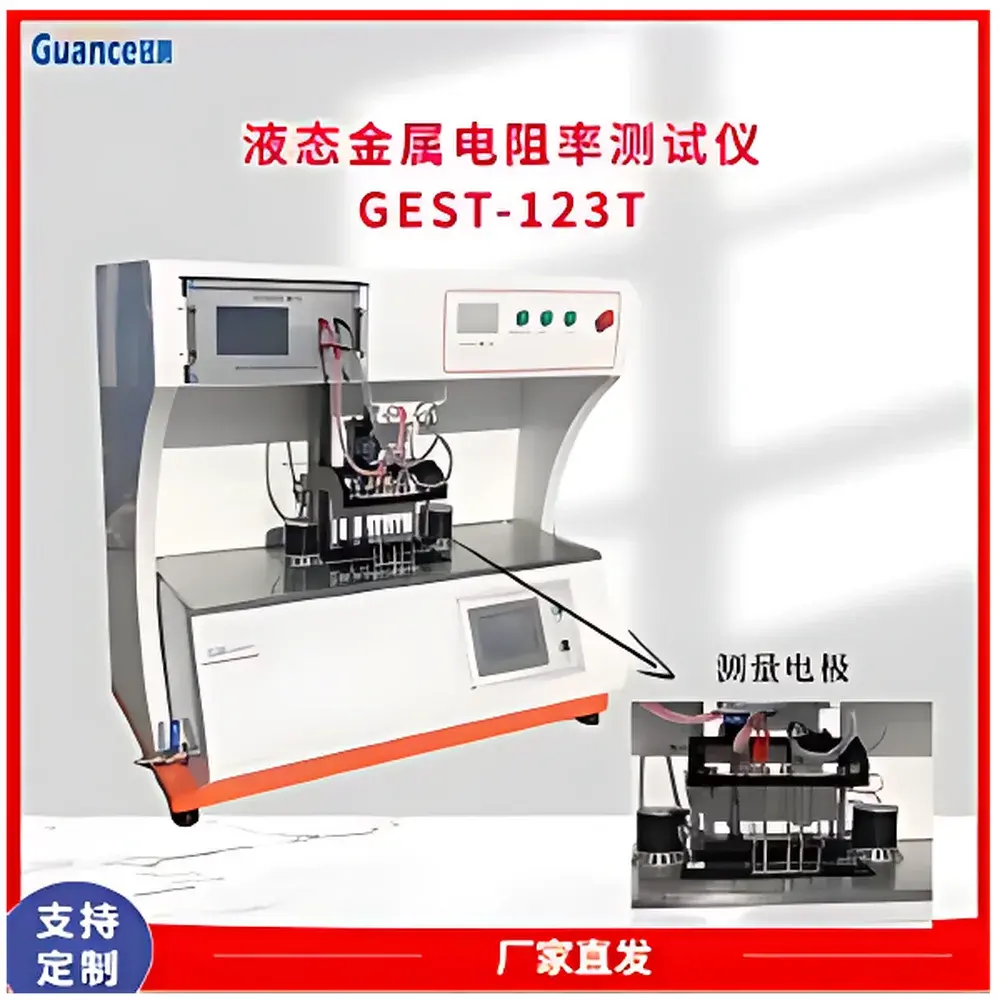
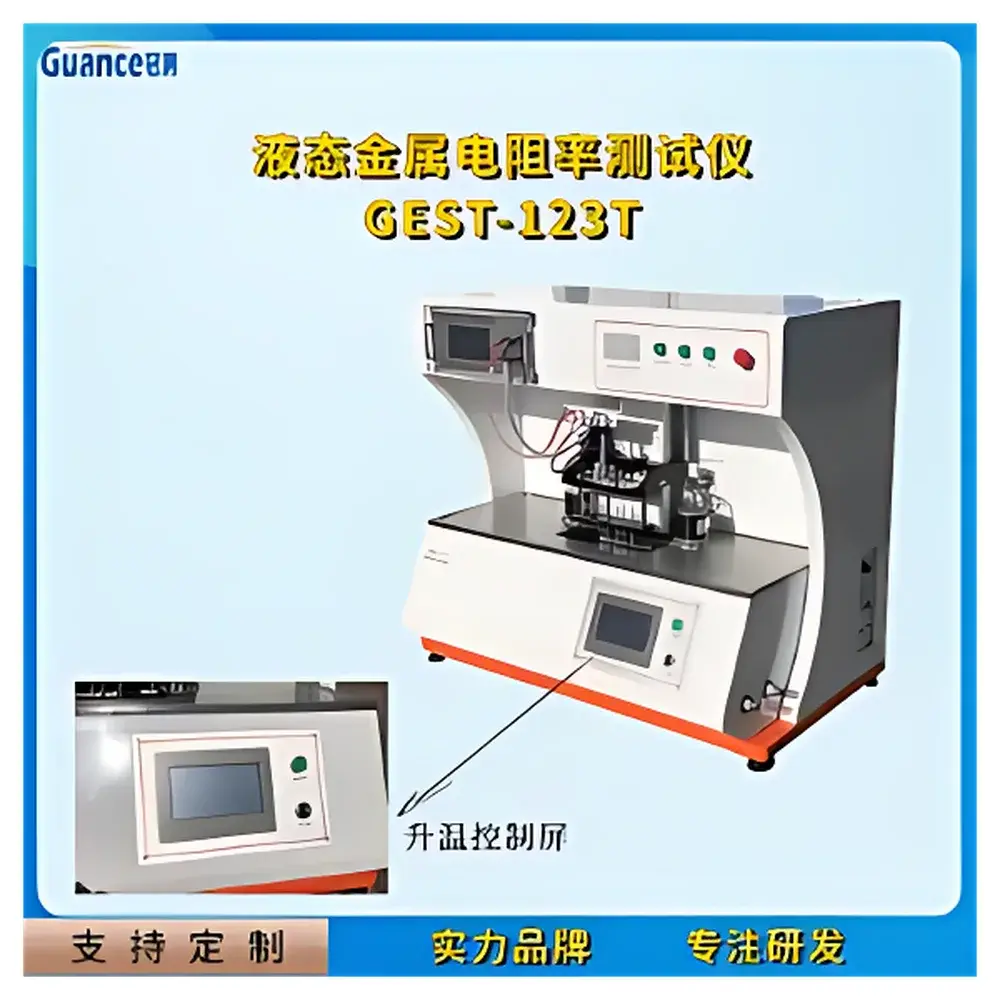
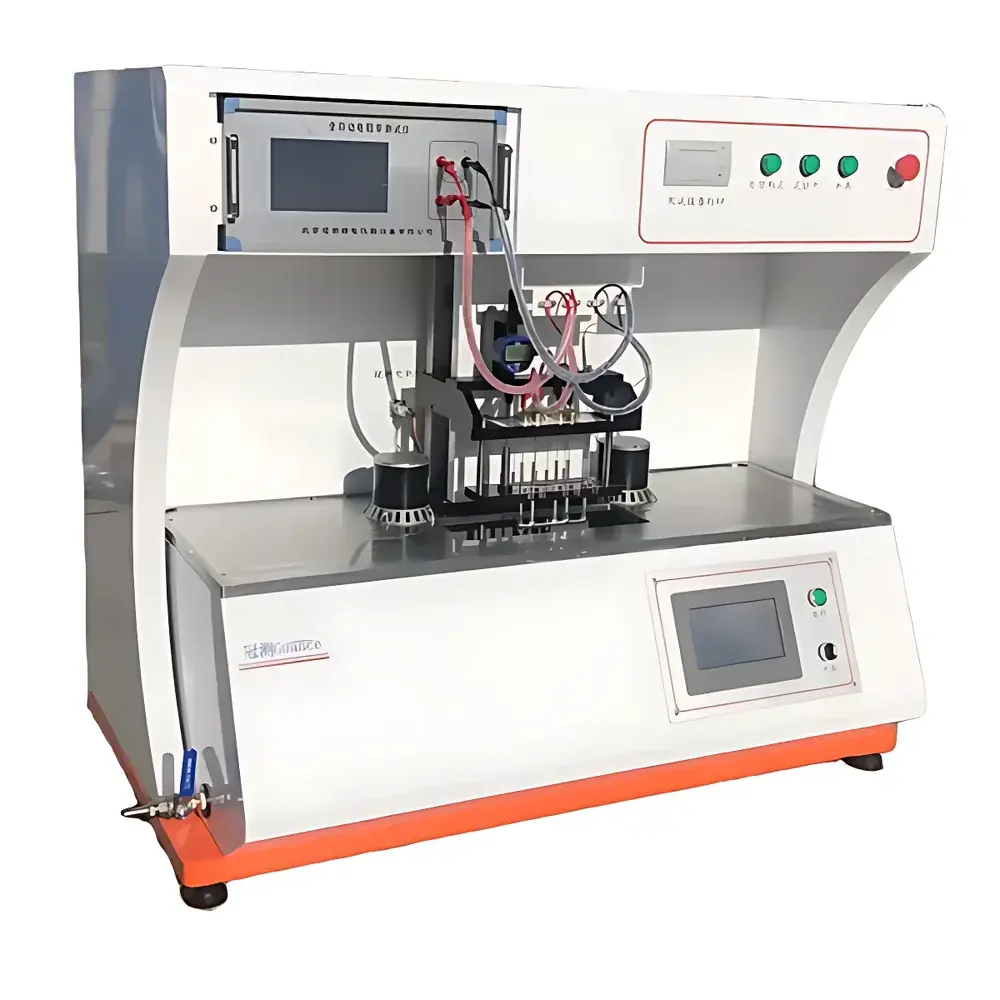
GuanCe GEST-123T3 High-Temperature Liquid Metal Resistivity Measurement System
| Brand | GuanCe Instruments |
|---|---|
| Origin | Beijing, China |
| Manufacturer Type | Authorized Distributor |
| Country of Origin | China |
| Model | GEST-123T3 |
| Price | USD 1,700 (approx.) |
| Temperature Range | Ambient to 300 °C |
| Max Heating Rate | ≤30 min from ambient to 300 °C |
| Electrode Travel Speed | 0–300 mm/min |
| Resistivity Measurement Range | 10⁻⁴ – 10⁵ Ω·cm |
| Resolution | 10⁻⁶ Ω·cm |
| Current Sources | 10 μA, 100 μA, 1 mA, 10 mA, 100 mA, 1 A |
| Current Accuracy | ±(0.5% of reading + 2 digits) |
| Electrode Material | Tungsten Carbide |
| Cell Material | Fused Quartz |
| Measurement Method | Four-Terminal (Kelvin) |
| Temperature Control Algorithm | AI-enhanced PID |
| Compliance Standard | GB/T 41079.2–2022 |
Overview
The GuanCe GEST-123T3 High-Temperature Liquid Metal Resistivity Measurement System is an engineered solution for precise, in-situ determination of electrical resistivity in molten metallic samples across a controlled thermal range (ambient to 300 °C). It operates on the fundamental principle of four-terminal (Kelvin) resistance measurement, eliminating lead and contact resistance errors to ensure traceable accuracy in resistivity calculation (ρ = R × A / L), where R is measured resistance, A is electrode cross-sectional area, and L is inter-electrode spacing. The system employs oil-bath heating with dual-motor forced circulation to maintain spatial temperature uniformity within ±1.5 °C across the quartz electrochemical cell—critical for reproducible thermoelectric property characterization. Temperature regulation leverages AI-optimized PID algorithms interfaced with industrial-grade PLCs, enabling multi-segment programmable ramping and dwell control. Designed specifically for research and development in metallurgy, nuclear materials science, and liquid metal battery technology, the GEST-123T3 supports quantitative evaluation of electronic structure evolution under thermal excitation, consistent with the metrological framework defined in GB/T 41079.2–2022.
Key Features
- Four-terminal resistivity measurement architecture with selectable precision current sources (10 μA to 1 A), minimizing parasitic voltage drop effects.
- Fused quartz electrochemical cell rated for continuous operation up to 300 °C, chemically inert toward reactive liquid metals including Ga-based alloys, NaK, and Zn-Sn eutectics.
- Tungsten carbide electrodes with sub-micrometer positional repeatability (0.001 mm resolution via calibrated digital dial indicator linked to PLC).
- Programmable thermal profiling: up to 8 independent temperature segments with user-defined ramp rates (0.1–10 °C/min) and soak durations.
- Integrated servo-driven vertical actuation system (750 W motor, ball screw transmission) enabling automated electrode immersion depth control and repeatable sample contact geometry.
- Real-time synchronized acquisition of temperature, voltage, current, calculated resistance, and derived resistivity—with automatic unit conversion (Ω·cm, μΩ·m, %IACS).
- Onboard calibration routines for temperature sensor offset correction and current source verification using certified reference resistors (traceable to national standards).
Sample Compatibility & Compliance
The GEST-123T3 accommodates low-volatility liquid metals and alloys with melting points below 300 °C, including but not limited to gallium, indium, bismuth-tin eutectics, magnesium alloys, and sodium-potassium (NaK) coolants. Sample volume requirements are optimized for 15–30 mL capacity within the quartz cell. All wetted components meet ISO 8502-3 cleanliness specifications for non-contaminating surfaces. The system conforms to GB/T 41079.2–2022 for liquid metal conductivity testing methodology, and its data acquisition architecture supports audit-ready logging compatible with GLP-compliant laboratories. While not FDA-certified, the hardware design principles align with IEC 61000-6-2 (EMC immunity) and IEC 61010-1 (electrical safety for laboratory equipment).
Software & Data Management
Control and analysis are performed via a Windows-based HMI application communicating with a Siemens S7-1200 PLC over PROFINET. The software provides real-time graphical overlays of ρ(T) and σ(T) (conductivity) curves, with export capability to CSV, Excel, and PDF formats. Statistical post-processing includes moving-average filtering, standard deviation per temperature bin, linear/nonlinear regression of dρ/dT, and derivative-based inflection point detection. All measurement sessions are timestamped and stored with metadata (operator ID, sample ID, calibration status, environmental conditions). Audit trails record parameter changes, manual overrides, and calibration events—supporting basic 21 CFR Part 11 readiness when deployed with domain-authenticated Windows accounts and file-level encryption.
Applications
- Thermoelectric coefficient derivation via combined resistivity and Seebeck coefficient measurements (when integrated with differential thermopile setups).
- Phase transition detection in metastable liquid alloys through abrupt resistivity anomalies during controlled cooling ramps.
- Quality assurance of high-purity liquid metal coolants for Generation IV nuclear reactor designs (e.g., sodium fast reactors).
- Electrodeposition process optimization by correlating melt resistivity with impurity concentration (e.g., oxygen, carbon).
- Fundamental studies of electron scattering mechanisms in disordered metallic liquids, supporting density functional theory validation.
- Development and qualification of liquid metal anodes for next-generation rechargeable batteries.
FAQ
What temperature uniformity can be achieved within the oil bath during steady-state operation?
Typical radial and axial gradients remain within ±1.2 °C at 250 °C, verified by three-point NIST-traceable PT100 probe mapping.
Is the quartz cell replaceable, and what is its expected service life under continuous 280 °C operation?
Yes—the cell is field-replaceable; typical lifetime exceeds 1,200 operational hours with proper thermal cycling protocols (≤5 °C/min ramp rate recommended).
Can the system interface with third-party data acquisition platforms such as LabVIEW or Python via TCP/IP or Modbus RTU?
Yes—PLC exposes Modbus TCP registers for real-time variable access; SDK documentation and register maps are provided upon request.
Does the resistivity calculation automatically compensate for thermal expansion of the electrode spacing?
No—users must input nominal L₀ and A₀ values; however, the software allows post-hoc correction using literature-based thermal expansion coefficients for common liquid metals.
What maintenance intervals are recommended for the tungsten carbide electrodes?
Visual inspection and surface profilometry every 200 test cycles; polishing with 0.25 µm diamond paste restores original geometry if wear depth remains <5 µm.



