
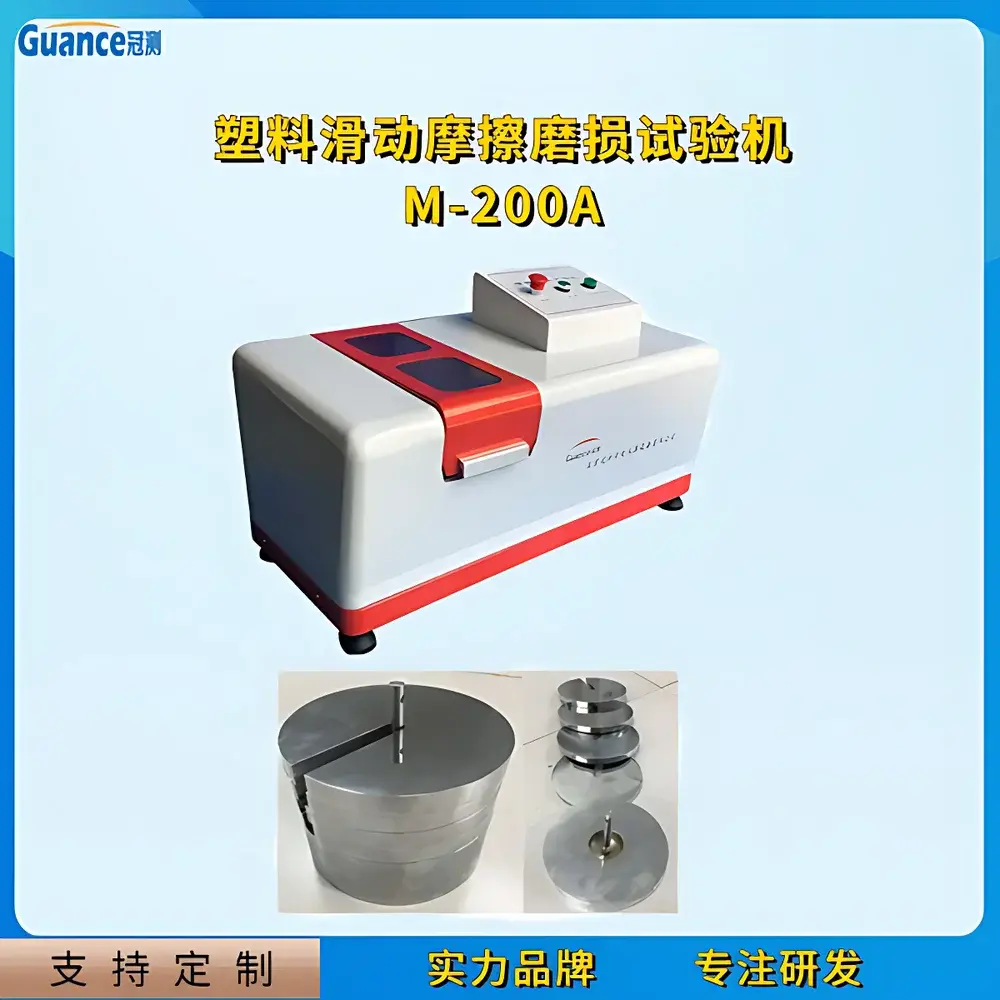
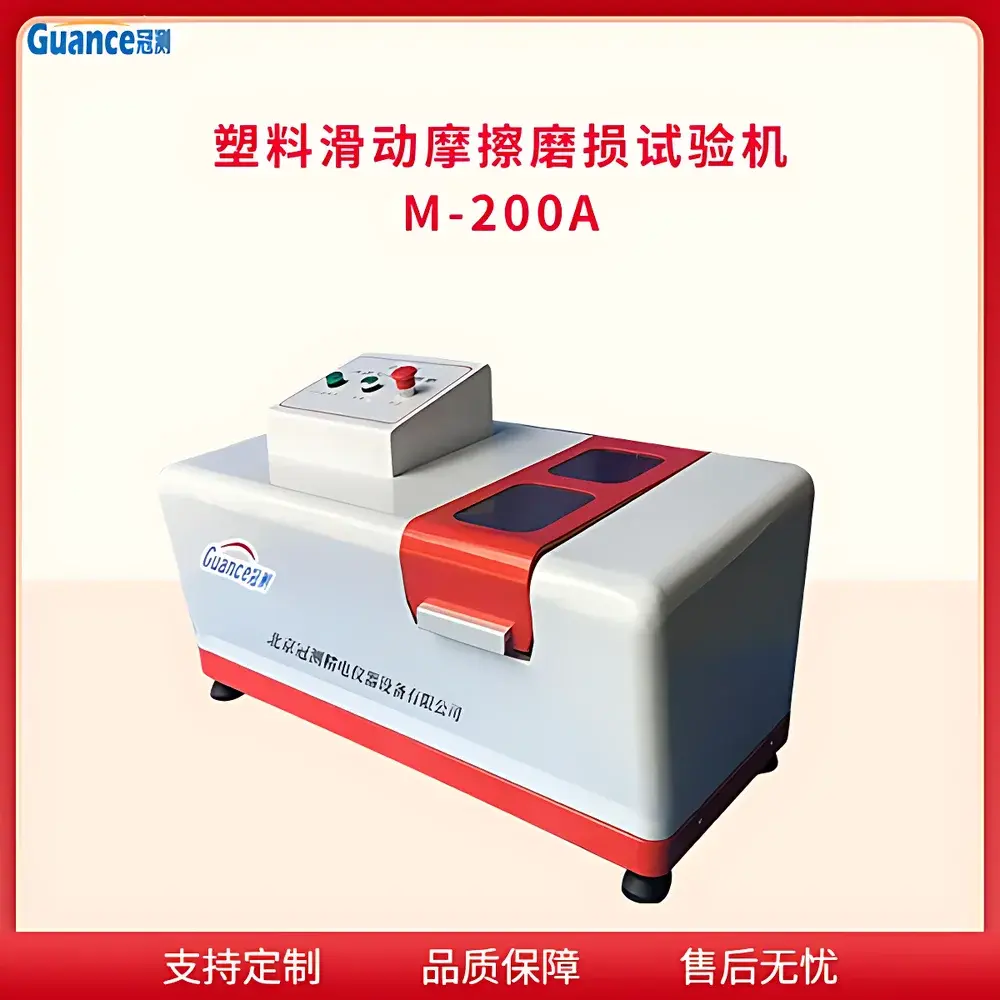
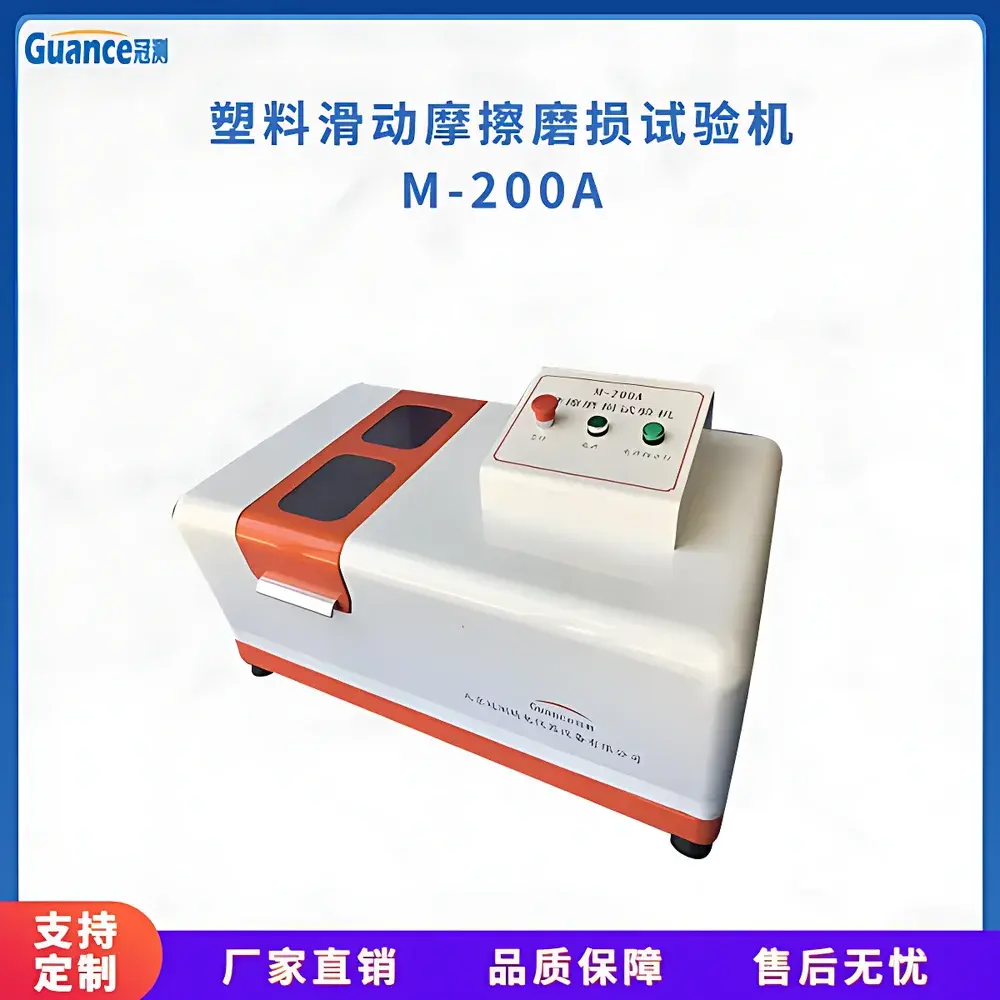
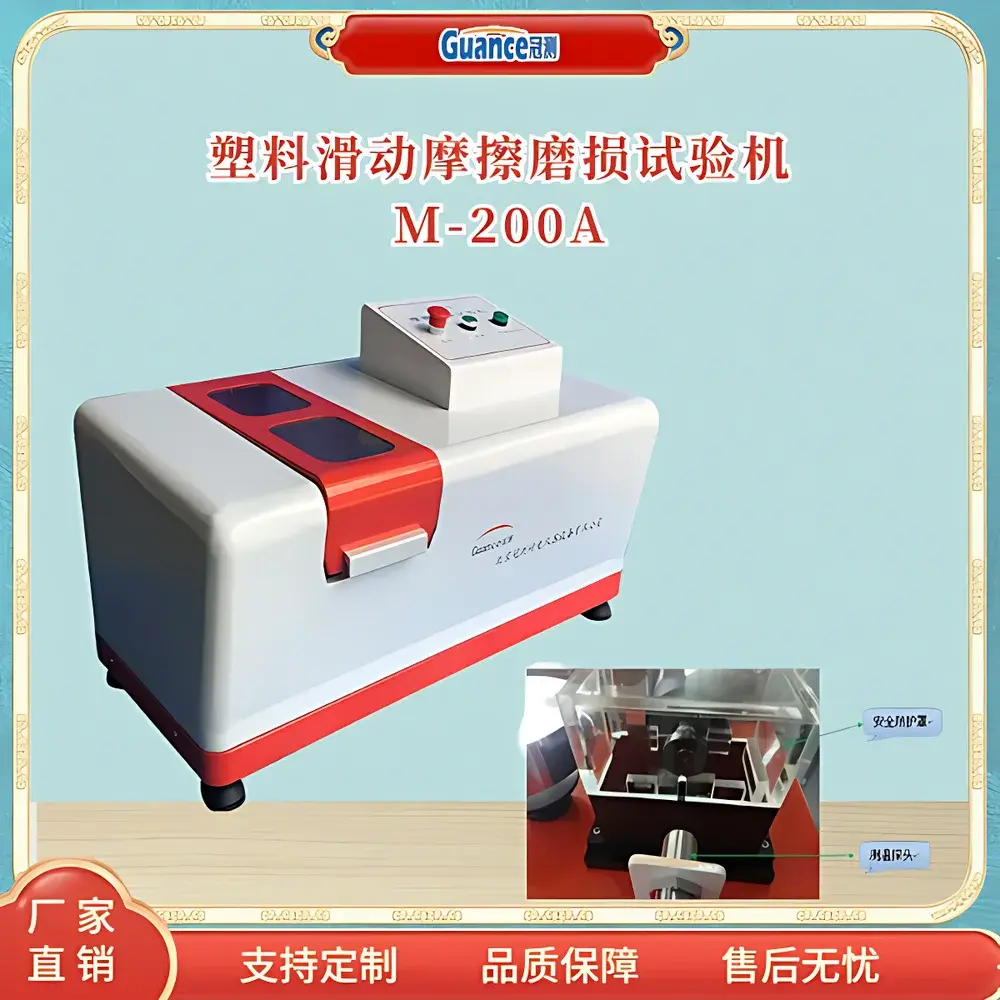
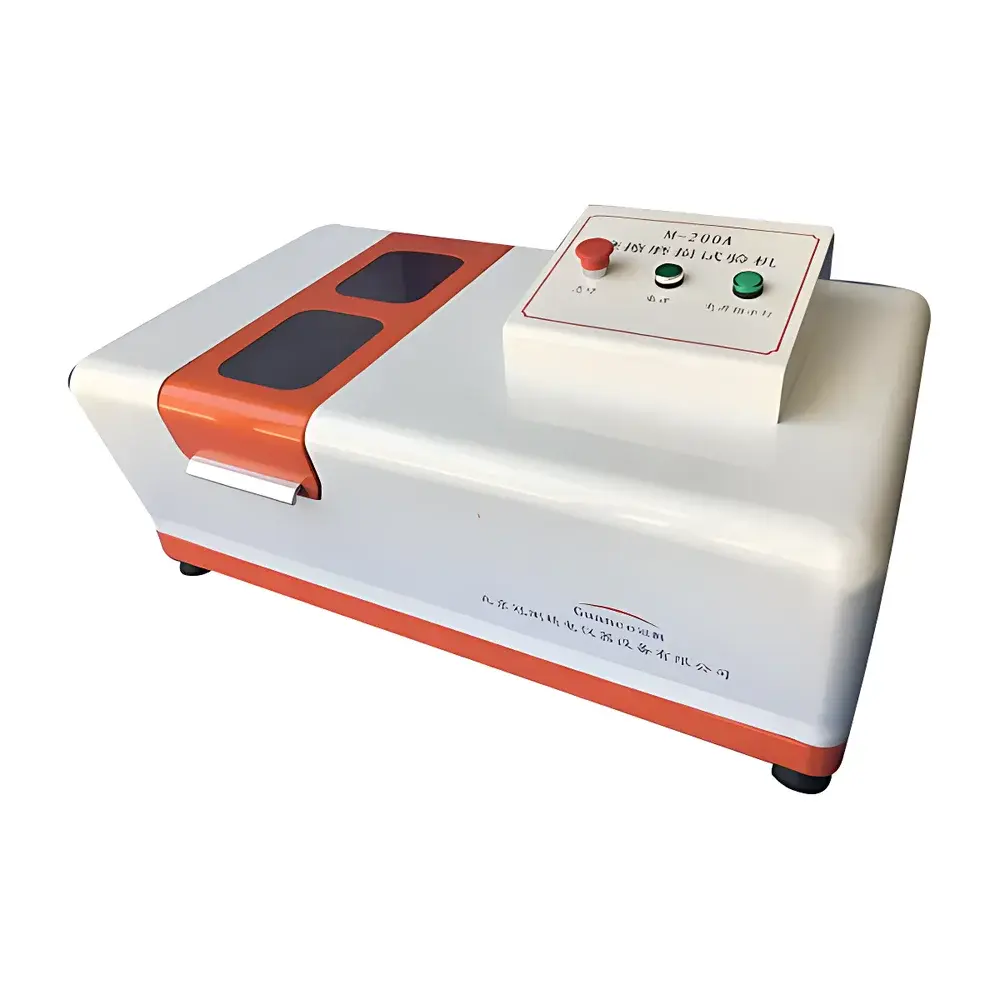
GuanCe Instruments M-200A.2 Plastic Sliding Friction and Wear Tester
| Brand | GuanCe Instruments |
|---|---|
| Origin | Beijing, China |
| Model | M-200A.2 |
| Maximum Friction Force | 300 N |
| Friction Force Resolution | 1% of full scale |
| Maximum Operating Temperature | 800 °C |
| Specimen Dimensions | 30 mm × 7 mm × 6 mm |
| Rotational Speed Range | 0–200 rpm (adjustable) |
| Applied Load | 196 N ± 0.1% (extendable to 392 N) |
| Friction Torque Range | 0–4 N·m |
| Load Accuracy | ±0.5% FS |
| Speed Accuracy | ±1% |
| Torque Measurement Accuracy | ±1% FS |
| Counter Timing Resolution | 1 s |
| Sensor Accuracy | ±1% FS |
| Friction Ring | Ø40 mm × 10 mm, 45# steel, hardened to HRC 40–45, surface roughness Ra ≤ 3.2 µm, concentricity < 0.01 mm |
Overview
The GuanCe Instruments M-200A.2 Plastic Sliding Friction and Wear Tester is a precision-engineered tribological testing system designed for quantitative evaluation of sliding friction behavior and wear resistance in polymeric, elastomeric, graphite-based, and composite materials under controlled load, speed, and thermal conditions. It operates on the pin-on-disk configuration principle—where a stationary rectangular specimen (pin) is pressed against a rotating annular ring (disk) under axial load—enabling direct measurement of dynamic friction force, real-time coefficient of friction (COF), and cumulative wear volume via mass loss or dimensional analysis. The instrument complies with key international and national standards including GB/T 3960–1983 (Plastic Sliding Friction and Wear Test Method) and GB/T 9141.8–1999 (Sliding Friction Coefficient Test for Flexible Graphite Sheets), and its mechanical and control architecture supports method development aligned with ASTM D3702, ISO 7148-1, and ISO 6892-1 for comparative tribological assessment.
Key Features
- Microcomputer-controlled closed-loop operation with integrated data acquisition, enabling programmable test sequences—including variable rotational speed, stepwise loading, and timed duration protocols.
- Dual-axis high-stability load application system with calibrated dead-weight loading (standard 4 kg + four 1 kg weights), supporting precise static loads from 196 N (±0.1%) up to 392 N via modular weight stacking.
- High-fidelity torque transduction using a calibrated strain-gauge-based sensor (0–4 N·m range, ±1% FS accuracy), synchronized with real-time angular position tracking for continuous COF derivation (µ = T / (r × FN)).
- Thermally robust test chamber capable of ambient-to-800 °C operation, accommodating high-temperature tribology studies of thermally stabilized polymers, carbon composites, and ceramic-filled matrices.
- Integrated color thermal printer delivering ASTM/ISO-compliant reports with time-stamped friction force vs. time curves, cumulative torque traces, and tabulated statistical outputs (mean COF, standard deviation, wear rate in mm³/N·m).
- Friction counter with 1-second resolution timing and automatic cycle termination logic, ensuring repeatability across multi-stage wear tests per GLP-aligned experimental workflows.
Sample Compatibility & Compliance
The M-200A.2 accommodates standardized specimens measuring 30 mm × 7 mm × 6 mm—optimized for rigid plastics (e.g., PTFE, UHMWPE, PEEK), vulcanized rubbers, flexible graphite sheets, and fiber-reinforced laminates. Its interchangeable 45# steel friction ring (Ø40 mm × 10 mm, HRC 40–45, Ra ≤ 3.2 µm) meets geometric tolerances specified in GB/T 3960 (concentricity < 0.01 mm; 0.5 × 45° chamfer). The system supports method validation per ISO/IEC 17025 requirements and facilitates audit-ready documentation for QA/QC laboratories operating under GMP or ISO 9001 frameworks. While not inherently 21 CFR Part 11 compliant, its raw data export (CSV, TXT) and timestamped report generation support integration into validated LIMS environments with supplementary electronic signature controls.
Software & Data Management
The embedded Windows-based control software provides intuitive GUI navigation for test setup, real-time monitoring (dual-channel analog display of friction force and rotational speed), and post-test analysis. All acquired parameters—including instantaneous torque, elapsed time, load status, and temperature—are logged at user-defined intervals (default: 100 ms) and stored in structured ASCII format for third-party statistical processing (e.g., MATLAB, JMP, or Python pandas). Exported datasets include metadata headers specifying calibration dates, operator ID, environmental conditions, and instrument serial number—essential for traceability in regulatory submissions. Firmware updates are delivered via USB interface with version-controlled changelogs and integrity checksum verification.
Applications
- Quantitative screening of solid lubricant additives in engineering thermoplastics under dry sliding conditions.
- Accelerated wear life prediction of polymer bushings and seals used in automotive transmission systems.
- Comparative COF mapping of flame-retardant composites across temperature gradients (25–300 °C).
- Validation of surface-modified graphite electrodes for battery separator tribology.
- Method development for ASTM D1894–22 (Coefficient of Friction of Plastic Film) adaptations on rigid substrates.
- Academic research on third-body wear mechanisms in nanofilled polymer nanocomposites.
FAQ
What standards does the M-200A.2 directly support?
It is configured to execute GB/T 3960–1983 and GB/T 9141.8–1999 test protocols out-of-the-box; method templates for ASTM D3702 and ISO 7148-1 are available upon request.
Can the system operate above ambient temperature without external furnace integration?
Yes—the integrated heating module enables stable operation up to 800 °C within the test zone, with PID-controlled thermal regulation and Class A thermocouple feedback.
Is torque zeroing and calibration traceable to national metrology institutes?
Each unit ships with a factory calibration certificate referencing CNAS-accredited standards; optional annual recalibration services include NIST-traceable torque verification.
Does the software support automated wear rate calculation?
Yes—wear volume (mm³) is derived from pre- and post-test specimen mass measurements (via external analytical balance input) and automatically normalized to applied normal load and sliding distance to yield specific wear rate (mm³/N·m).
Are replacement friction rings supplied with certification of material hardness and surface finish?
All consumable friction rings are supplied with individual QC reports listing measured HRC value, surface roughness (Ra), and concentricity verification per ISO 1101.



