
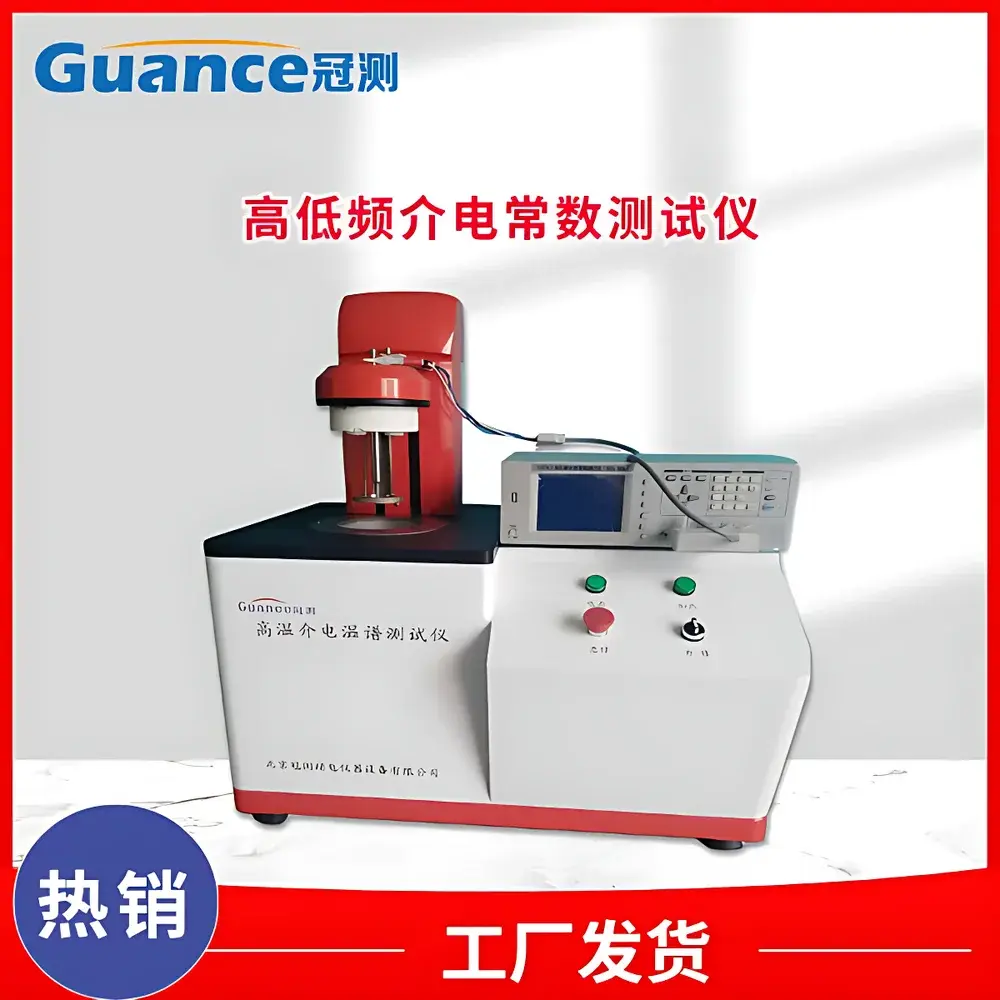
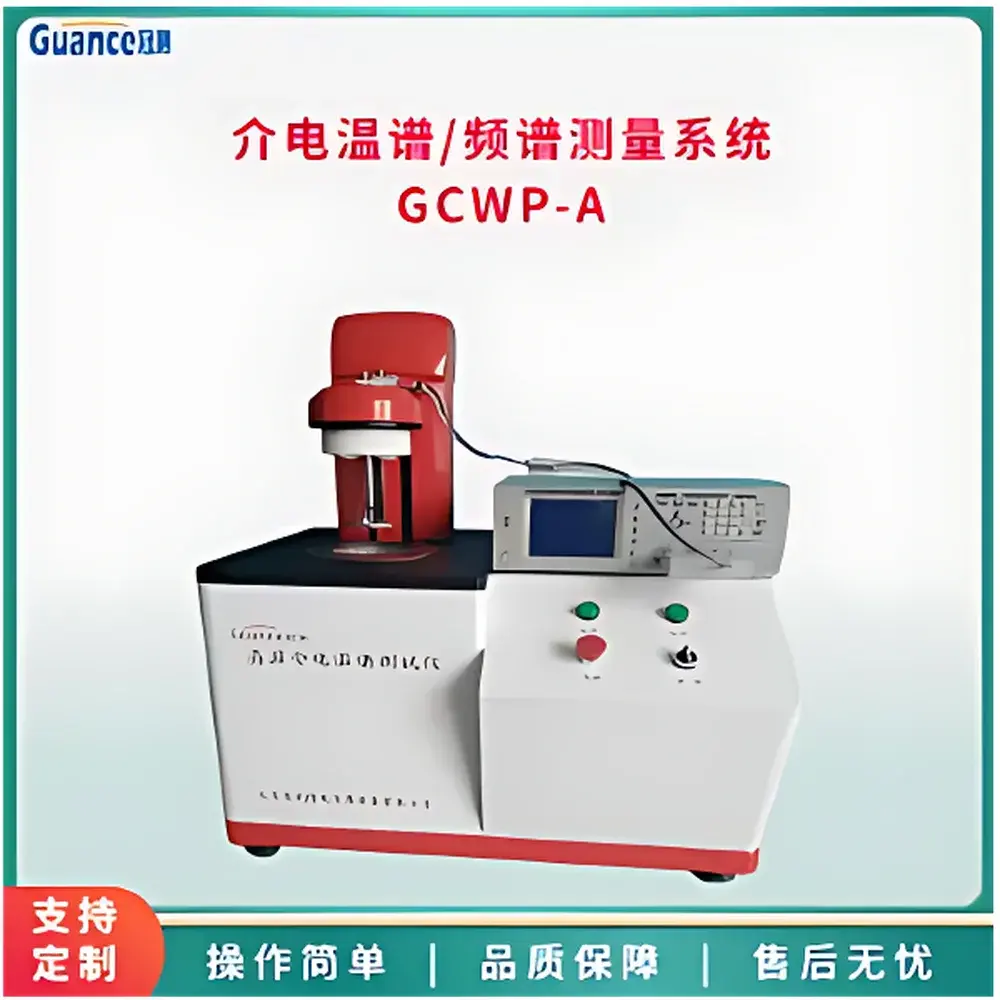
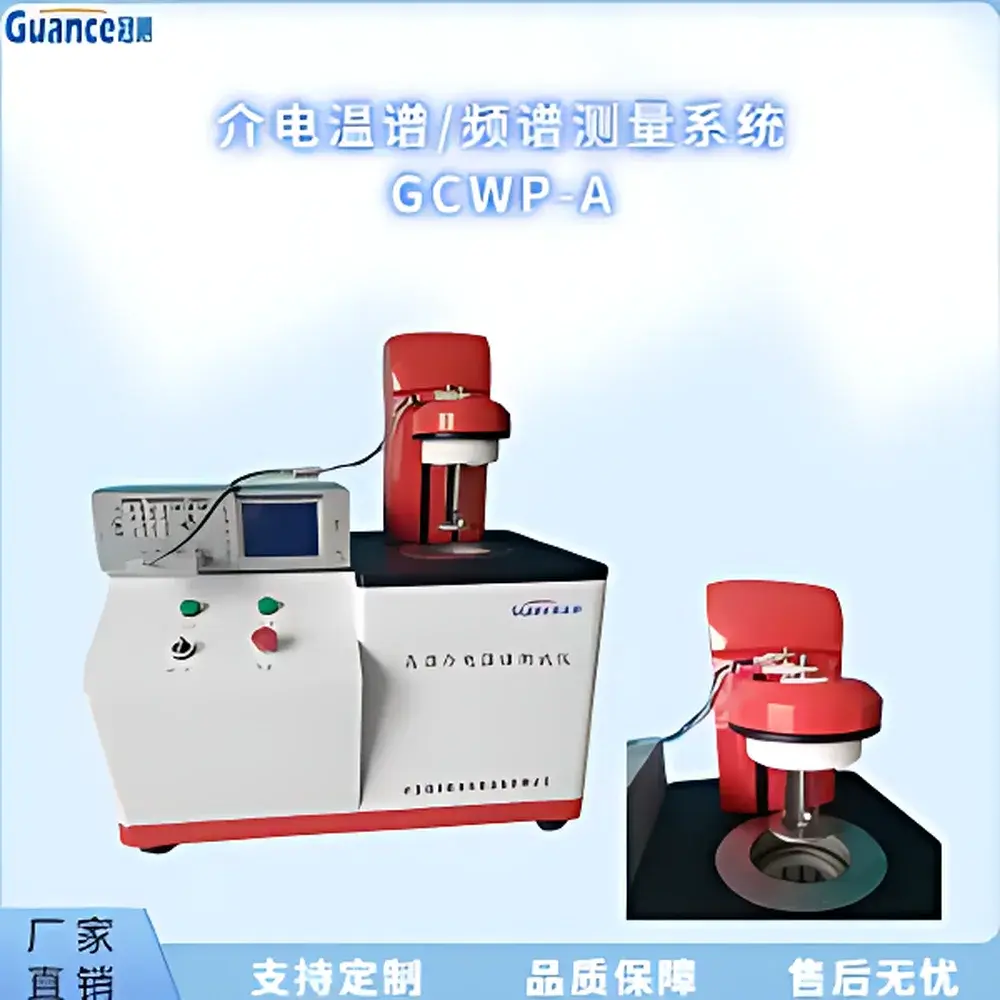
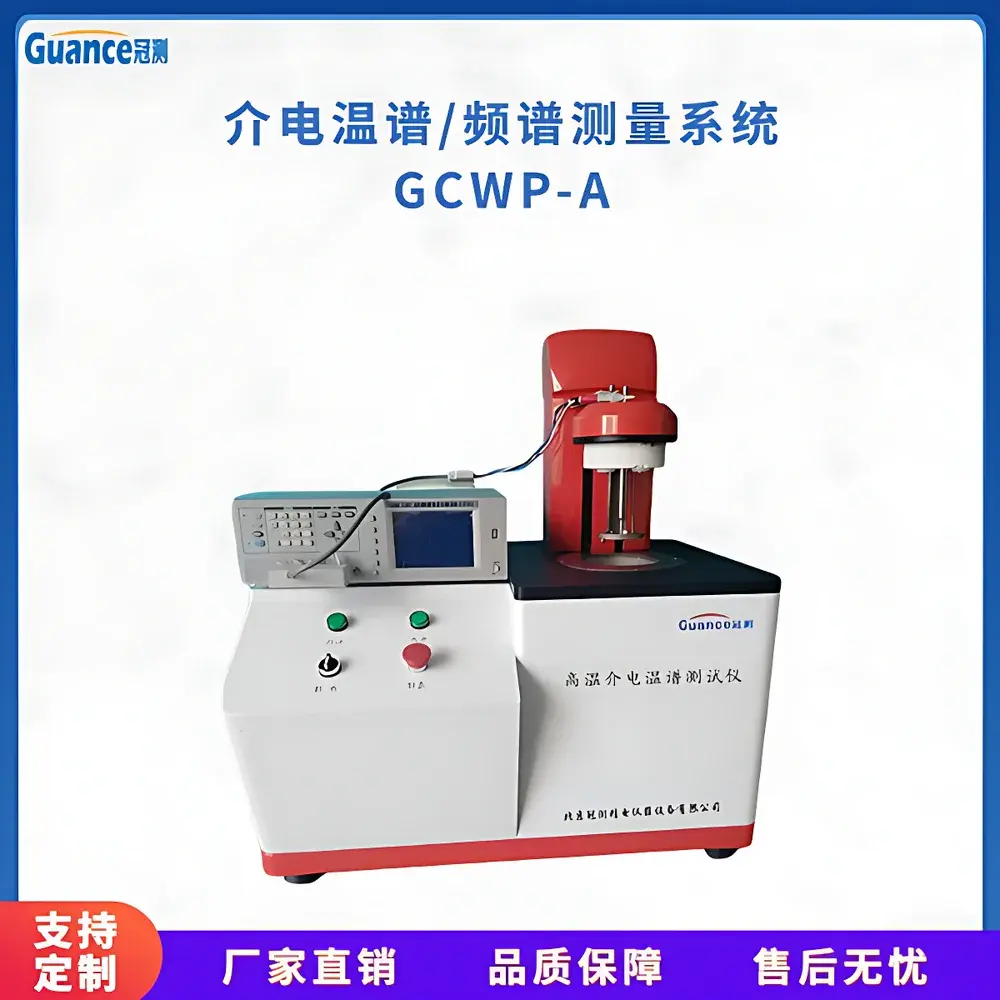
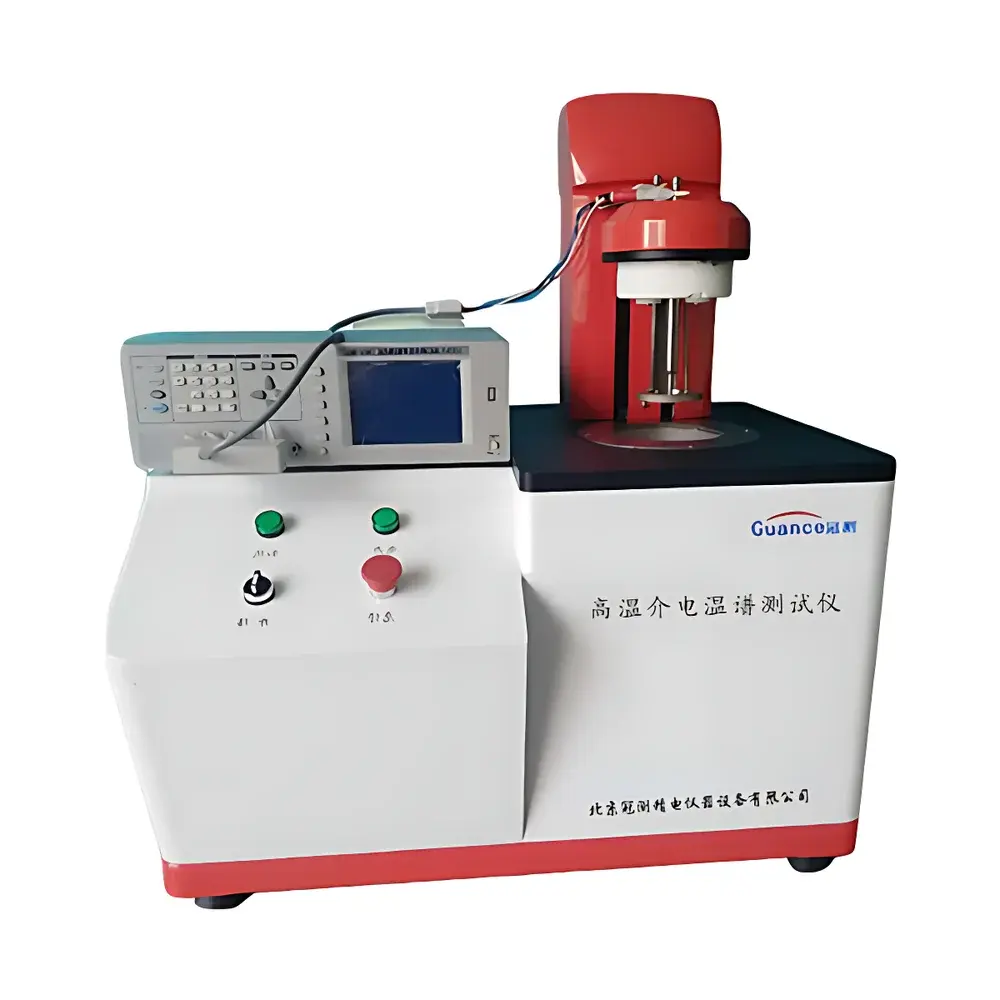
GuanCe Instruments GCWP-A5 High-Temperature Dielectric Constant Analyzer for Composite Materials
| Brand | GuanCe Instruments |
|---|---|
| Model | GCWP-A5 |
| Measurement Principle | Precision Impedance Bridge (Agilent 4294A-based) |
| Electrode Configuration | Quadruple 6-mm Diameter Electrodes |
| Temperature Range | −180 °C to +500 °C |
| Heating Rate | 0.5–2.5 °C/min |
| Frequency Range | Dependent on Integrated Agilent 4294A Impedance Analyzer |
| Electrode Shielding | 304 Stainless Steel Inner Sleeve / PTFE Outer Jacket |
| Data Interface | Silver-Plated Copper Low-Temperature Shielded Cables |
| Compliance | ASTM D150, IEC 60250, ISO 17025 (when operated in accredited lab environment) |
| Power Supply | AC 220 V, 50 Hz, 2 kW |
| Enclosure | Q235 Steel with High-Temperature Powder Coating |
| Operating Environment | Dust-Free, Low-Vibration, EMI-Shielded Laboratory |
| Data Output | Raw CSV Export, Real-Time Lissajous & Bode Plots, PDF Report Generation |
Overview
The GuanCe Instruments GCWP-A5 High-Temperature Dielectric Constant Analyzer is a purpose-engineered system for the precise, temperature-resolved characterization of complex permittivity (ε′ and ε″) and dielectric loss tangent (tan δ) in advanced composite materials. It integrates a calibrated Agilent 4294A precision impedance analyzer as its core measurement engine—ensuring traceable, high-stability impedance spectroscopy across frequencies determined by the connected bridge unit. The system employs a four-channel electrode manifold with thermally matched 6 mm diameter parallel-plate electrodes, enabling simultaneous, comparative dielectric analysis of up to four specimens under identical thermal and electrical boundary conditions. Designed for rigorous materials science research and quality control in aerospace, electronics encapsulation, and high-performance polymer development, the GCWP-A5 operates over an exceptional thermal range from cryogenic (−180 °C) to elevated temperatures (+500 °C), with programmable heating rates from 0.5 to 2.5 °C/min. Its dual-layer electrode shielding—comprising an inner 304 stainless steel conductive sleeve and outer PTFE insulating jacket—minimizes stray capacitance and thermal EMF drift, while silver-plated copper low-temperature shielded cables preserve signal integrity across the full operational envelope.
Key Features
- Quadruple independent electrode channels with 6 mm diameter precision-machined plates for concurrent multi-sample dielectric evaluation
- Integrated Agilent 4294A impedance analyzer interface—supporting frequency-dependent permittivity extraction per ASTM D150 Annex A3
- Programmable thermal ramping (0.5–2.5 °C/min) and isothermal hold capability within −180 °C to +500 °C range
- Electrode assembly featuring coaxial 304 stainless steel inner shielding and chemically inert PTFE outer insulation
- Low-noise signal path utilizing silver-plated copper cryo-rated shielded cables with <10 pF/m capacitance
- Dual-mode operation: fully automated sequence-controlled testing or manual stepwise parameter adjustment
- Real-time visualization of complex impedance (Z*, θ), permittivity (ε′, ε″), and loss tangent (tan δ) via synchronized Bode and Cole-Cole plots
Sample Compatibility & Compliance
The GCWP-A5 accommodates solid flat-sheet composites (e.g., CFRP, GFRP, ceramic-polymer laminates), thin-film dielectrics, and cured resin systems with thicknesses between 0.1 mm and 5 mm. Specimen mounting requires planar parallelism ≤ ±2 µm and surface roughness Ra < 0.8 µm to ensure uniform electric field distribution. All measurements conform to the test methodology stipulated in ASTM D150 (“Standard Test Methods for Dielectric and Resistivity Properties of Solid Electrical Insulating Materials”) and IEC 60250 (“Methods of Test for Determination of the Permittivity and Dielectric Dissipation Factor of Electrical Insulating Materials”). When deployed in GLP-compliant laboratories, the system supports audit-ready data logging—including timestamped raw impedance sweeps, operator ID, environmental chamber status, and calibration certificate traceability—to satisfy ISO/IEC 17025 documentation requirements.
Software & Data Management
The proprietary GCWP Control Suite (v3.2+) provides native integration with the Agilent 4294A via GPIB or LAN. It enables full script-based test sequencing—including automatic electrode channel switching at user-defined time intervals—and enforces metadata tagging (sample ID, batch number, thermal profile ID). All acquired data are stored in vendor-neutral CSV format with column headers compliant with IEEE Std 1158. Real-time curve fitting (Debye, Cole-Cole, Havriliak-Negami models) is supported offline via optional MATLAB® or Python-based post-processing modules. Audit trails record every parameter change, report generation event, and user login—meeting FDA 21 CFR Part 11 electronic record requirements when configured with digital signature and role-based access controls.
Applications
- Temperature-dependent permittivity mapping of carbon-fiber-reinforced polymer matrices during cure cycle validation
- Interfacial polarization analysis in nanocomposite dielectrics (e.g., BaTiO₃/epoxy) across glass transition regimes
- Quality assurance screening of microwave-absorbing radar-absorbing materials (RAM) at elevated service temperatures
- Reliability assessment of high-k gate dielectrics in flexible electronics substrates under thermal cycling stress
- Correlation of dielectric dispersion behavior with DMA-derived viscoelastic transitions in thermoset composites
FAQ
What impedance analyzer models are compatible with the GCWP-A5?
The system is factory-integrated and validated exclusively with the Agilent 4294A precision impedance analyzer. Use of alternative bridges requires revalidation per IEC 61000-4-30 and may void calibration certification.
Can the GCWP-A5 perform real-time dielectric monitoring during in-situ curing?
Yes—when paired with a programmable thermal controller and appropriate sample holder design, the system supports continuous impedance acquisition at fixed frequency points during dynamic thermal ramps.
Is NIST-traceable calibration provided with the instrument?
A full calibration certificate (including electrode capacitance, thermal sensor accuracy, and bridge linearity verification) is supplied at shipment, traceable to NIST SRM 1828 (low-loss dielectric standard) and NIST SRM 1922 (high-temperature reference material).
What safety interlocks are implemented for high-temperature operation?
The enclosure incorporates dual redundant thermal cutoffs (mechanical bimetallic + solid-state PID limit), door-open sensing, and ground-fault circuit interruption (GFCI) on the 2 kW heating supply.
Does the software support automated compliance reporting for ISO 17025 audits?
Yes—the GCWP Control Suite generates structured XML audit logs containing all raw data, processing parameters, calibration history, and user authentication events, exportable for third-party LIMS ingestion.
Related Products



