
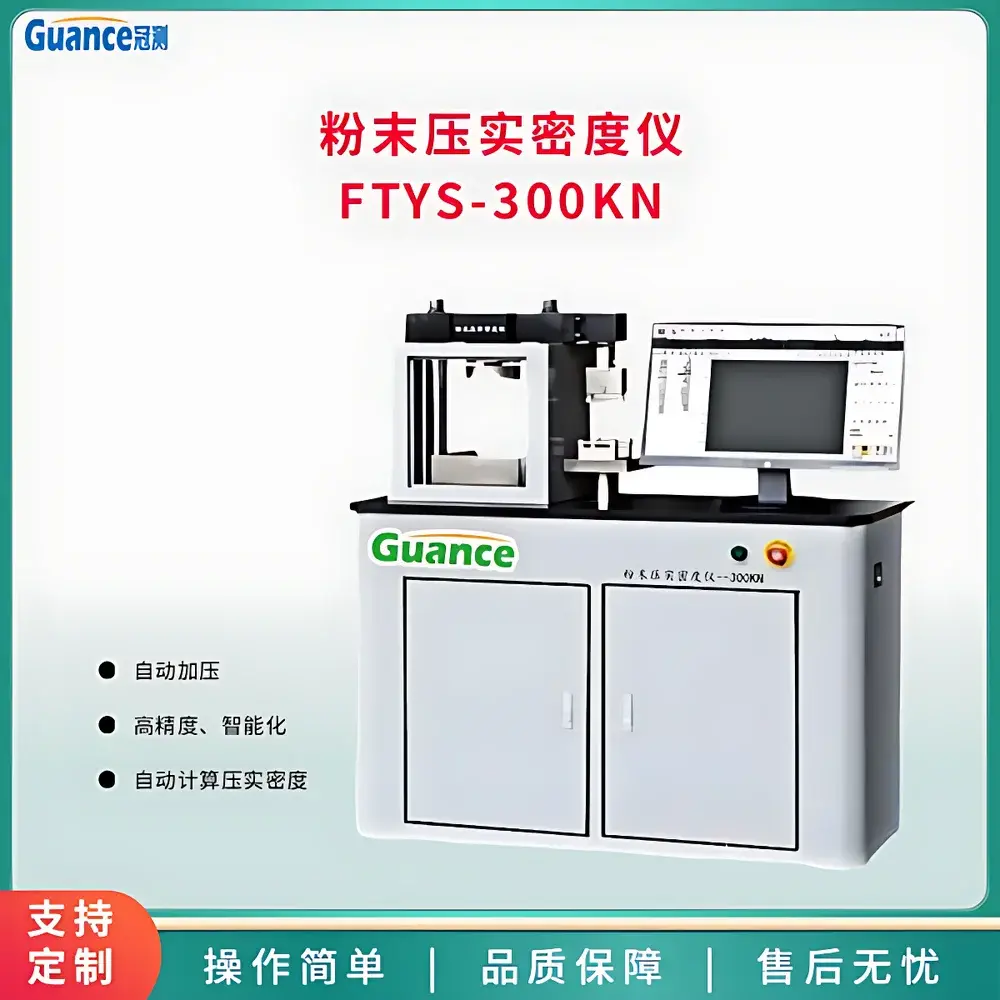
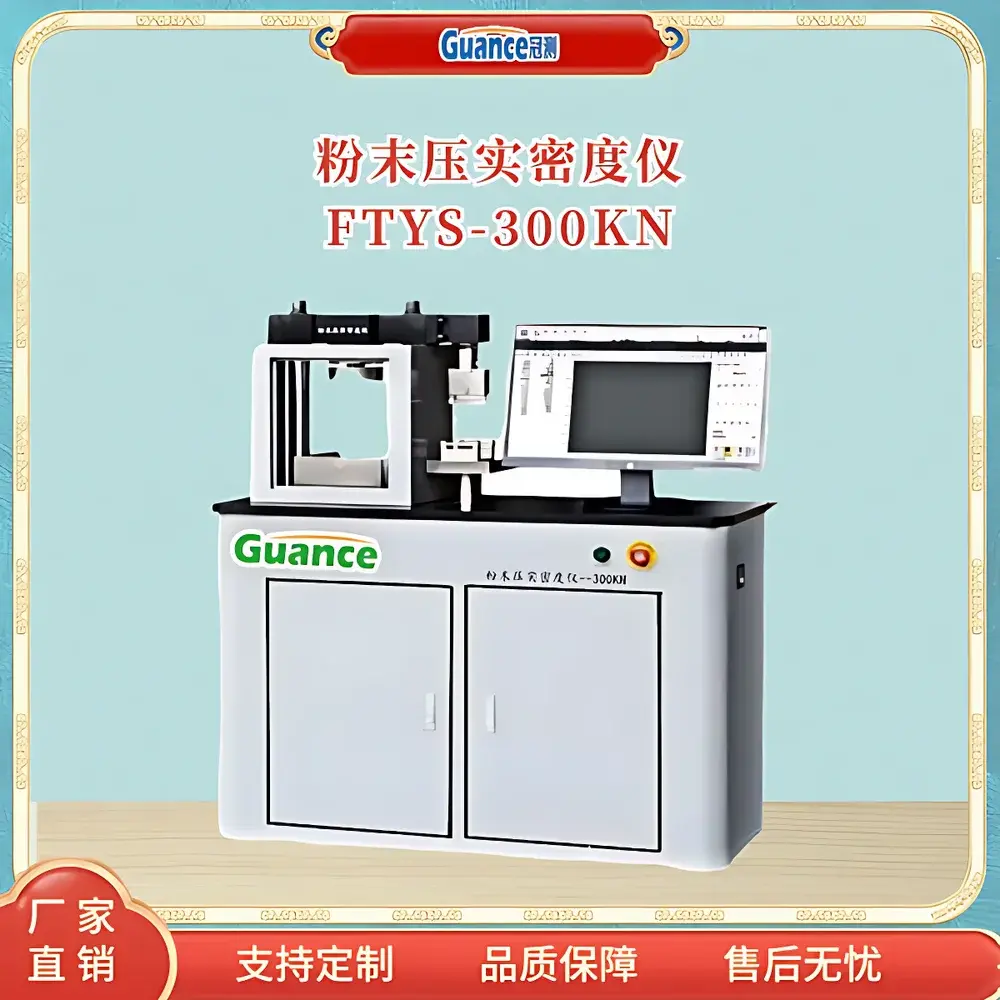
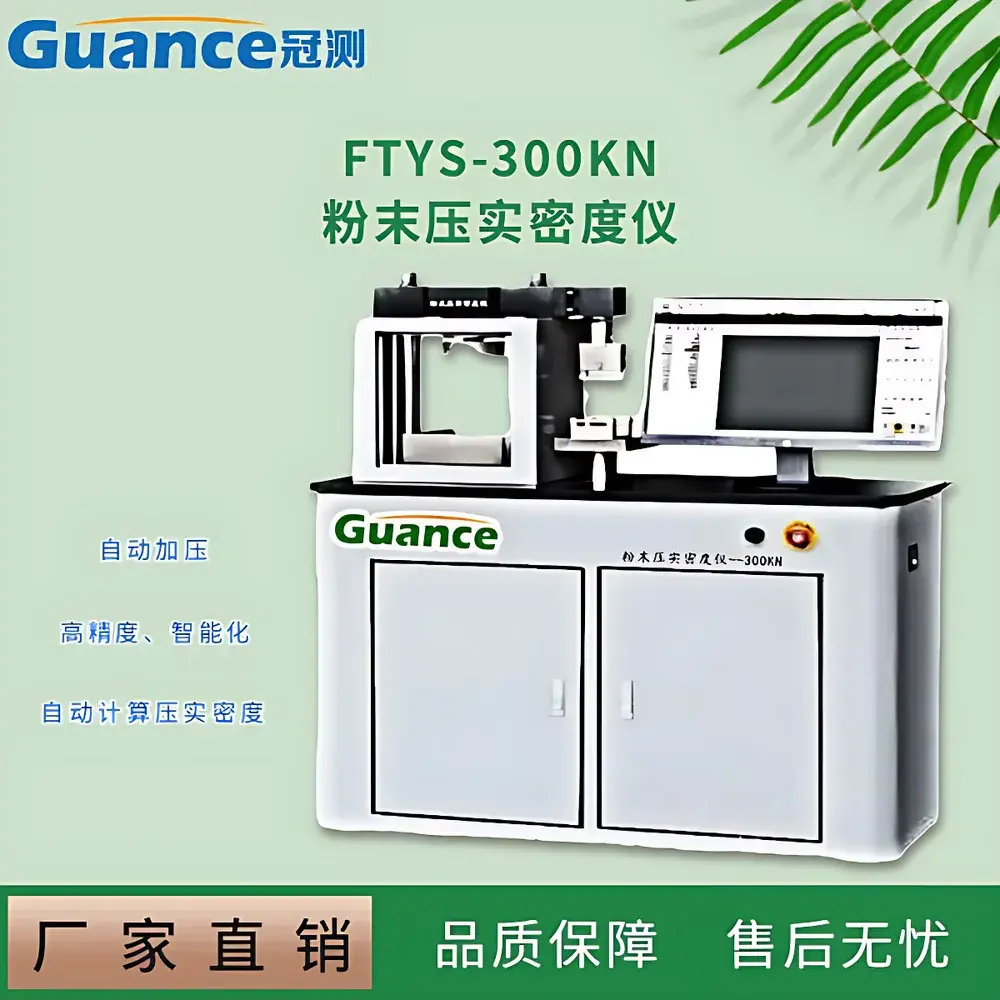
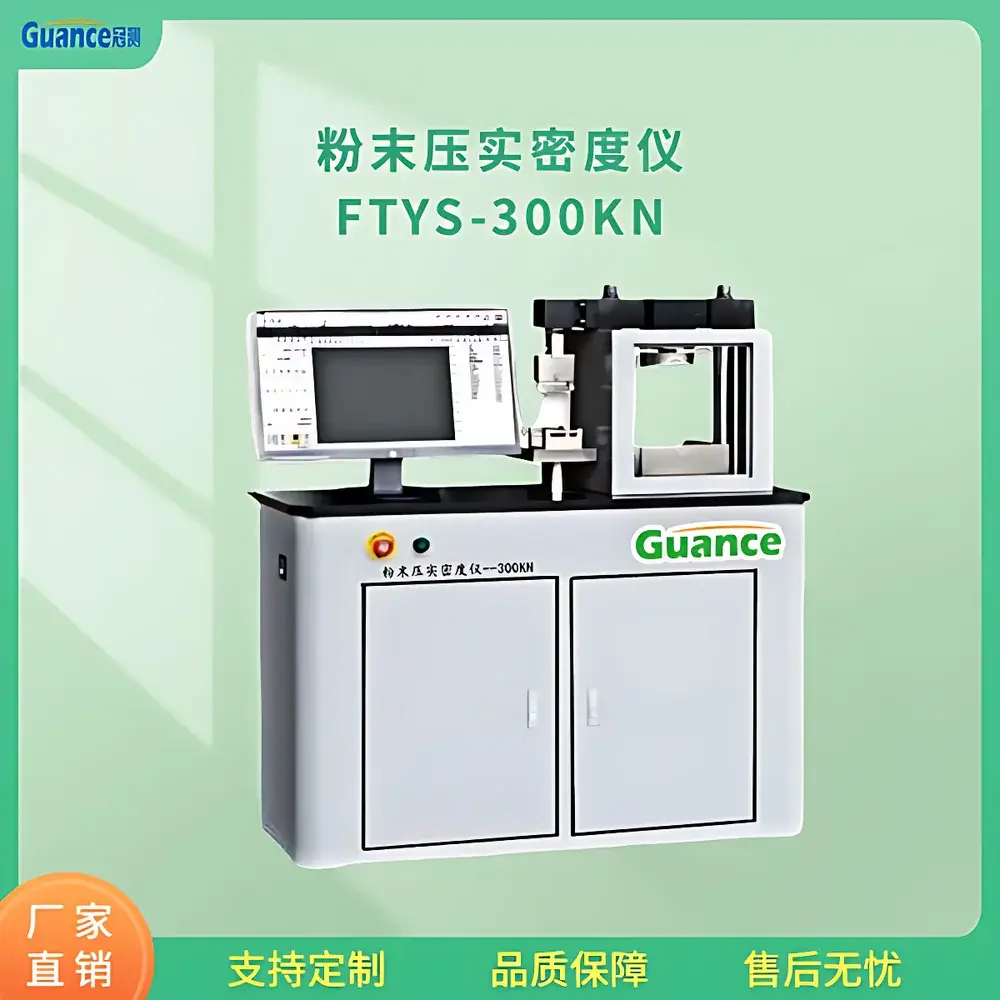
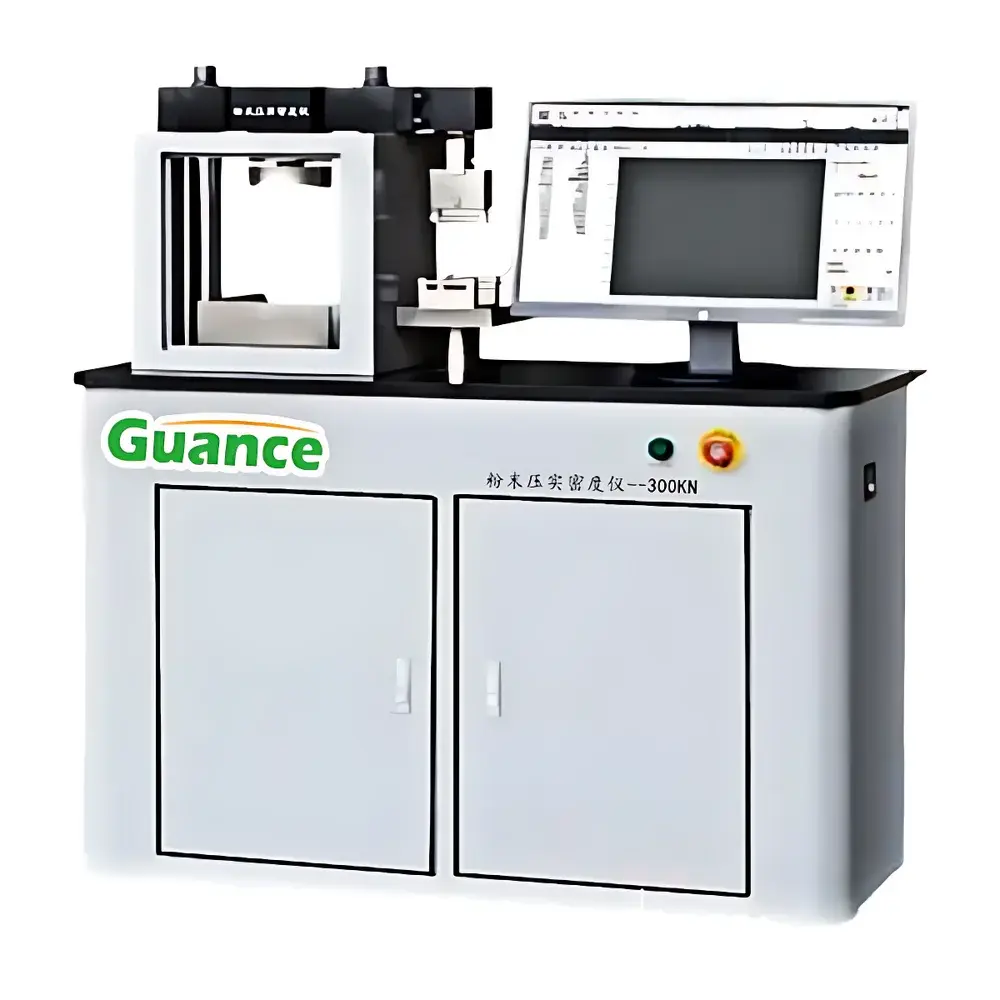
Guance Instruments FTYS-300KN Powder Compaction Density Tester for Lithium Iron Phosphate Cathode Materials
| Key | Brand: Guance Instruments |
|---|---|
| Model | FTYS-300KN |
| Origin | Beijing, China |
| Instrument Type | Laboratory Benchtop True Density Tester |
| Application | Solid–Liquid Dual-Mode Density Measurement |
| Density Range | 0–2 g/cm³ |
| Maximum Load Capacity | 20 kN |
| Density Resolution | 0.01 g/cm³ |
| Repeatability | ±0.001 g/cm³ |
| Minimum Sample Mass | 0.02 g |
| Temperature Operating Range | 0–40 °C |
| Display | Digital LCD |
| Compliance Standard | GB/T 24533–2009 |
Overview
The Guance Instruments FTYS-300KN Powder Compaction Density Tester is a precision laboratory benchtop system engineered for the quantitative determination of compaction density in electrode active materials—specifically optimized for lithium iron phosphate (LiFePO₄) cathodes and graphite anodes used in lithium-ion battery manufacturing. Unlike conventional pycnometric or buoyancy-based true density analyzers, this instrument implements a controlled uniaxial compression methodology grounded in ASTM D5762 and GB/T 24533–2009 standards. It measures the volumetric density of a powder sample after subjecting it to a defined compressive load (up to 20 kN), simulating the calendering process employed in electrode production. The resulting compaction density—expressed in g/cm³—is calculated as the ratio of areal mass loading (g/cm²) to the compressed thickness of the coated electrode layer (excluding current collector thickness). This parameter directly correlates with electrode porosity, ionic conductivity, electrolyte wettability, and long-term cycling stability.
Key Features
- High-force electro-mechanical actuation: Equipped with a high-torque AC servo motor driving a precision-ground ball screw assembly, enabling stable, programmable load application from 0.1 kN to 20 kN at rates adjustable between 0.01–5 mm/min.
- Robust mechanical architecture: Lower-mounted frame design with full-steel construction ensures structural rigidity, minimal deflection under load, and extended fatigue life—critical for repeated compression cycles in QC environments.
- Real-time force–displacement synchronization: Integrated wheel-spoke load cell (±0.05% FS accuracy) and linear displacement transducer deliver synchronized data acquisition at 100 Hz sampling rate, supporting compliance curve analysis and yield point identification.
- Standardized compaction tooling: Includes calibrated cylindrical punches and dies conforming to GB/T 24533–2009 geometry specifications (e.g., 13 mm diameter die cavity), ensuring inter-laboratory reproducibility.
- Thermal-stable operation: Designed for ambient temperature control (0–40 °C), minimizing thermal drift during multi-hour testing sequences; optional environmental enclosure available for humidity-controlled workflows.
- Integrated safety systems: Overload cut-off, emergency stop circuitry, and transparent polycarbonate dust shield comply with IEC 61000-6-2 EMC and ISO 13857 machine guarding requirements.
Sample Compatibility & Compliance
The FTYS-300KN supports dry, free-flowing powders with particle size distributions typical of battery-grade cathode materials (D₅₀ ≈ 0.5–5 µm). It accommodates both single-component powders (e.g., LiFePO₄, NMC, LCO) and pre-mixed slurry-dried electrodes containing conductive carbon and binder. Sample masses as low as 0.02 g enable high-throughput screening while maintaining statistical validity per ISO 13320 laser diffraction correlation protocols. All test procedures adhere to GB/T 24533–2009, with traceable calibration performed using certified reference loads (NIST-traceable 10 kN and 20 kN standards). Optional audit-ready configuration supports 21 CFR Part 11-compliant electronic signatures, ALCOA+ data integrity principles, and GLP-aligned metadata logging—including operator ID, environmental conditions, and instrument firmware version.
Software & Data Management
The included MaxTest 800 software (Windows 10/11 compatible) provides deterministic test sequencing, real-time stress–strain visualization, and automated compaction density calculation per Equation 1 of GB/T 24533–2009. Raw force–displacement datasets are exported in CSV and XML formats with embedded metadata tags (e.g., , , ). Software modules support batch reporting with customizable templates aligned with internal QC dashboards or external regulatory submissions. Audit trail functionality logs all user actions—including method edits, result overrides, and calibration events—with immutable timestamps and operator authentication. Data backups are configurable to network drives or encrypted USB storage, satisfying ISO/IEC 17025 Clause 7.5.2 retention requirements.
Applications
- Electrode formulation development: Correlating binder content, solvent selection, and drying profiles with final compaction density and pore structure.
- Process validation: Verifying consistency of roll-press parameters (line speed, nip pressure, gap setting) via reference powder compaction benchmarks.
- Material qualification: Screening incoming LiFePO₄ batches for deviations in particle morphology or agglomeration behavior that affect densification kinetics.
- Failure analysis: Diagnosing capacity fade mechanisms by comparing compaction density trends across cycle-aged electrodes versus pristine controls.
- Regulatory documentation: Generating test reports compliant with UN Manual of Tests and Criteria Section III, Subsection 38.3 for lithium battery transport certification.
FAQ
What standards does the FTYS-300KN comply with?
GB/T 24533–2009 is the primary standard; supplementary alignment with ASTM D5762 (for coal and coke) and ISO 3953 (for metallic powders) is achievable via custom method configuration.
Can the system measure true density (helium pycnometry) in addition to compaction density?
No—the FTYS-300KN is purpose-built for mechanical compaction density only. True density requires separate helium pycnometry instrumentation (e.g., Micromeritics AccuPyc series).
Is calibration verification traceable to national metrology institutes?
Yes—load cell calibration certificates include NIST-traceable uncertainty statements (k = 2) and are renewed annually per ISO/IEC 17025 requirements.
Does the software support multi-user role-based access control?
Yes—administrator, technician, and reviewer roles enforce separation of duties for method setup, test execution, and result approval.
What maintenance intervals are recommended for sustained accuracy?
Bi-weekly visual inspection of die/punch surfaces, quarterly lubrication of screw threads, and annual full-system recalibration including displacement transducer linearity verification.
Related Products



