
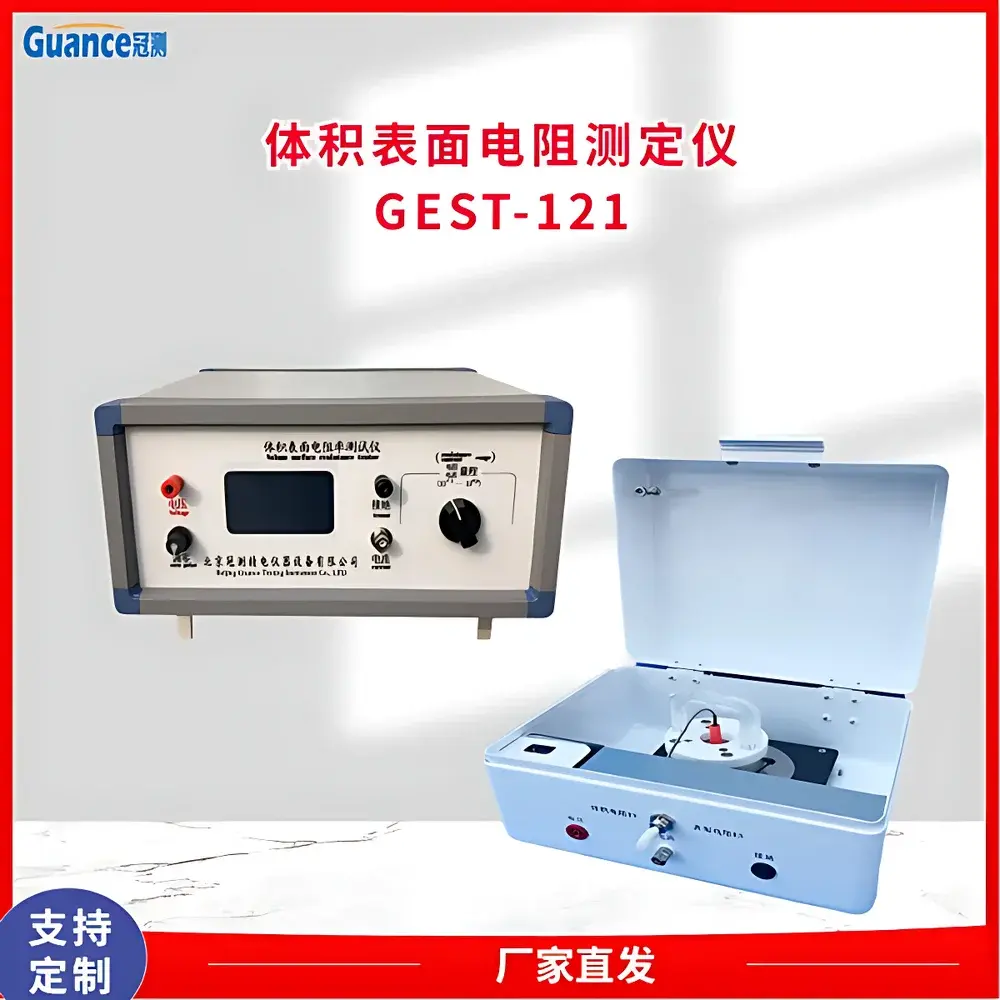
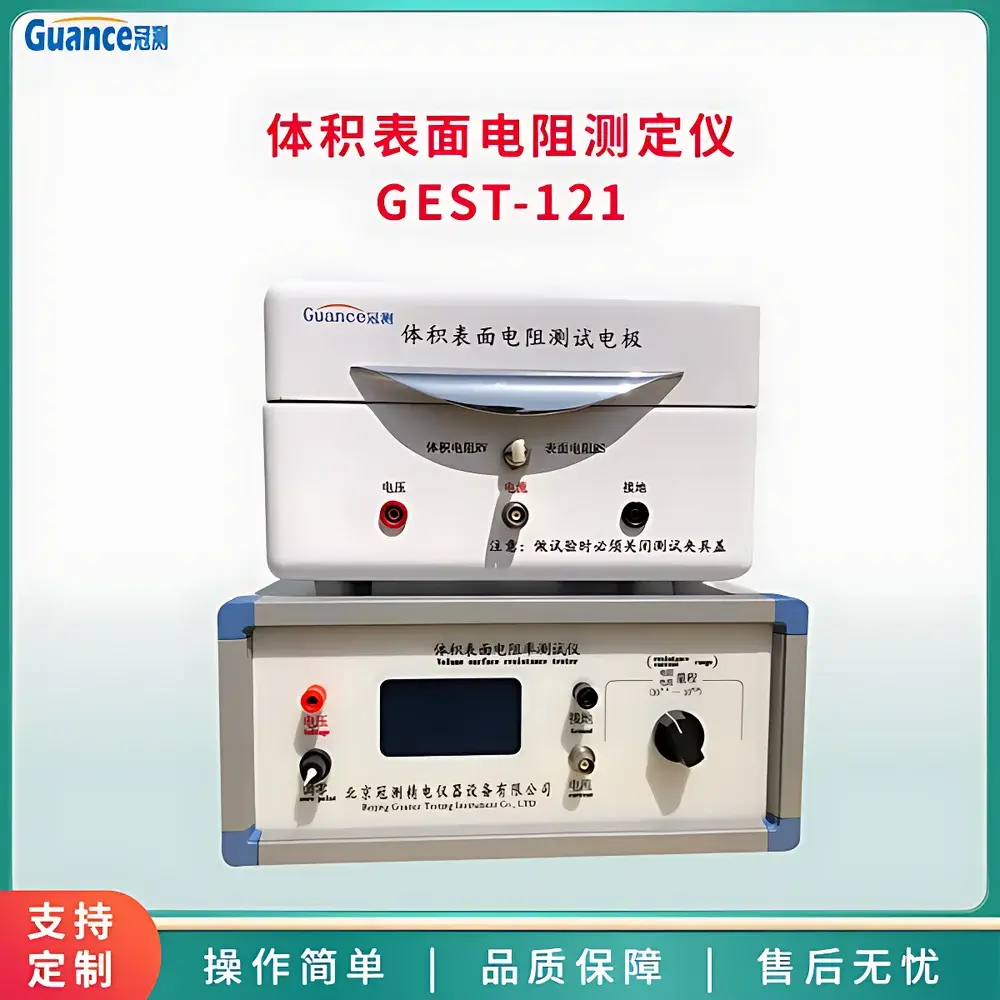
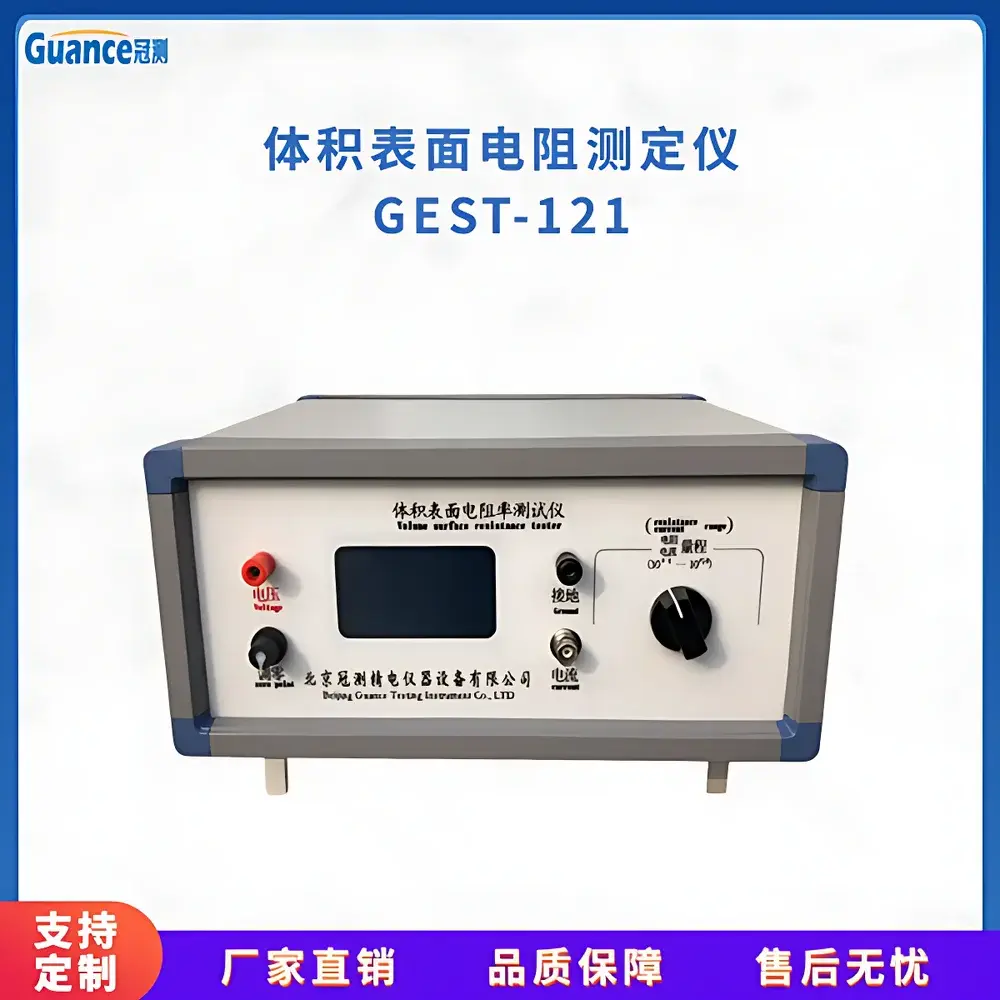
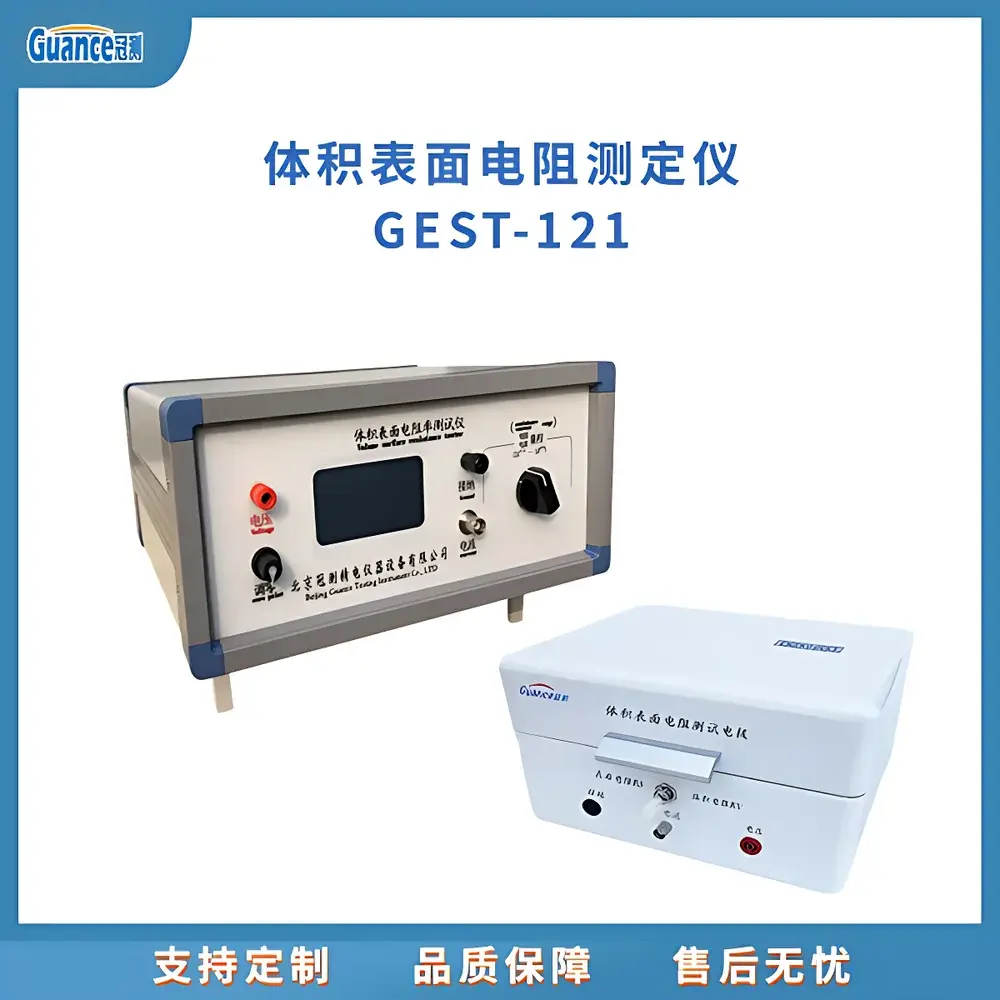
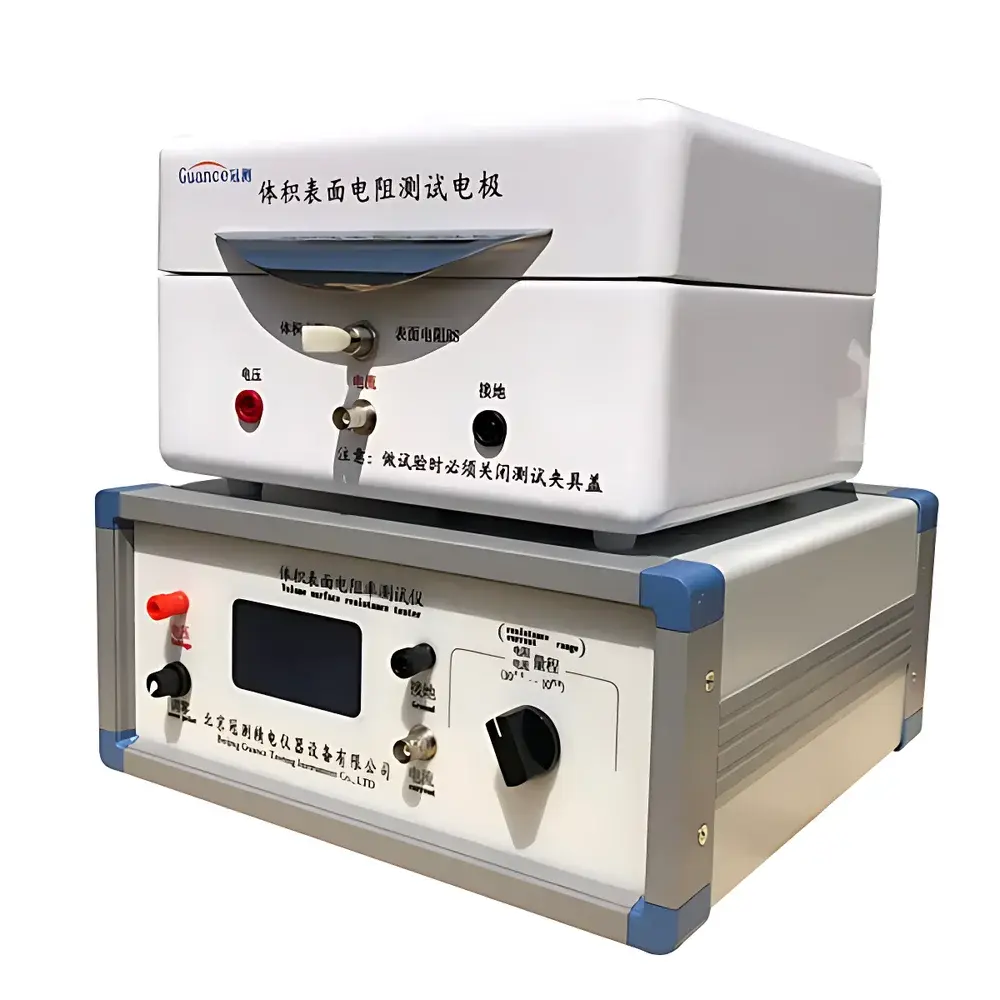
GuanCe Instruments GEST-121Ad Volume & Surface Resistivity Tester
| Brand | GuanCe Instruments |
|---|---|
| Origin | Beijing, China |
| Manufacturer Type | Authorized Distributor |
| Country of Origin | China |
| Model | GEST-121Ad |
| Price | USD 2,000 (approx.) |
| Resistance Range | 1×10⁴ Ω to 1×10¹⁸ Ω |
| Current Range | 1×10⁻¹⁶ A to 2×10⁻⁴ A |
| Test Voltages | 10 V, 50 V, 100 V, 250 V, 500 V, 1000 V |
| Accuracy | ±1% (≤1×10¹⁰ Ω), ±5–10% (>1×10¹⁰ Ω) |
| Display | Digital LCD |
| Power Supply | 220 V AC / 50 Hz |
| Power Consumption | 100 W |
| Dimensions (L×W×H) | 300 mm × 300 mm × 150 mm |
| Weight | ~5 kg |
| Standard Electrode | Three-terminal solid-state electrode set (for discs/films ≥80 mm diameter) |
Overview
The GuanCe Instruments GEST-121Ad Volume & Surface Resistivity Tester is a precision electrometric instrument engineered for the quantitative determination of electrical insulation properties in solid, liquid, and powdered dielectric materials. It operates on the principle of constant-voltage direct-current (DC) resistivity measurement, conforming to standardized test methodologies including ASTM D257, IEC 60093, and GB/T 1410. The system applies calibrated DC test voltages—ranging from 10 V to 1000 V—to generate stable electric fields across sample geometries, enabling simultaneous calculation of volume resistivity (ρᵥ, in Ω·m) and surface resistivity (ρₛ, in Ω/sq) via Ohm’s law and geometric correction factors. Its extended resistance range up to 1×10¹⁸ Ω supports characterization of ultra-high-resistivity polymers, ceramic coatings, antistatic additives, and advanced insulating composites used in aerospace, semiconductor packaging, and high-voltage equipment manufacturing.
Key Features
- Wide dynamic resistance range: 1×10⁴ Ω to 1×10¹⁸ Ω with dual-range current sensing (1×10⁻¹⁶ A to 2×10⁻⁴ A), optimized for low-conductivity materials requiring high-impedance measurement integrity.
- Programmable DC test voltage selection (10 V, 50 V, 100 V, 250 V, 500 V, 1000 V) compliant with material-specific test standards and safety requirements.
- Digital LCD interface with real-time display of resistance value, applied voltage, measured current, and elapsed test time—no external software required for basic operation.
- Modular electrode architecture: ships with a standardized three-terminal guarded electrode assembly for flat solid samples ≥80 mm in diameter; supports optional electrode configurations for powders (powder cell), liquids (liquid cell), thin films (ring electrodes), and irregular solids (spring-loaded probes).
- Robust industrial-grade enclosure (300 × 300 × 150 mm, ~5 kg), EMI-shielded internal circuitry, and thermal-stabilized high-voltage source ensure repeatability under laboratory and production QA environments.
- Compliant with Class II electrical safety standards; includes overvoltage protection, automatic discharge circuitry, and interlocked guard terminals to minimize stray leakage paths during high-resistance measurements.
Sample Compatibility & Compliance
The GEST-121Ad accommodates diverse physical forms without modification to core electronics: rigid or flexible polymer sheets, elastomeric gaskets, ceramic substrates, conductive/antistatic flooring tiles, electrostatic dissipative (ESD) footwear, nanoparticle suspensions, conductive pastes, and cured resin composites. All measurements adhere to internationally recognized protocols—ASTM D257 for volume/surface resistivity of solid insulating materials, IEC 61340-2-3 for ESD control applications, and ISO 3915 for resistivity of conductive plastics. For regulated environments (e.g., medical device component validation or aerospace material qualification), the instrument supports GLP-compliant documentation when paired with external data loggers or validated LIMS interfaces. While not natively 21 CFR Part 11 certified, its deterministic analog signal path and non-volatile parameter storage enable audit-ready traceability when integrated into validated workflows.
Software & Data Management
The GEST-121Ad operates as a standalone benchtop unit with no embedded operating system or network stack. All measurement parameters—including selected voltage, integration time, electrode configuration, and environmental notes—are manually recorded or exported via RS-232 serial output (optional cable). Users may interface the device with third-party data acquisition platforms (e.g., LabVIEW, MATLAB, or custom Python scripts) using ASCII-based command-response protocol for automated batch testing. Calibration certificates are provided per unit, traceable to CNAS-accredited national metrology institutes. Firmware updates are not field-upgradable; recalibration is recommended annually or after 500 operational hours per ISO/IEC 17025 guidelines.
Applications
- Quality assurance of insulating layers in printed circuit board (PCB) laminates and conformal coatings.
- Development and screening of antistatic additives in polyolefin films and injection-molded housings.
- Verification of surface resistivity compliance for cleanroom garments, ESD-safe workbenches, and grounded flooring systems (per ANSI/ESD S20.20).
- Research on charge transport mechanisms in organic semiconductors, ferroelectric ceramics, and ion-conducting solid electrolytes.
- Regulatory testing of medical device packaging materials per ISO 11607 for electrostatic shielding performance.
- Characterization of carbon-black-filled elastomers used in automotive fuel hoses and grounding straps.
FAQ
What standards does the GEST-121Ad support for resistivity testing?
It complies with ASTM D257, IEC 60093, GB/T 1410, and IEC 61340-2-3 for volume/surface resistivity and ESD material evaluation.
Can the instrument measure liquids and powders?
Yes—when equipped with optional liquid cells or powder compression electrodes, both sold separately.
Is the 1×10¹⁸ Ω upper limit achievable under standard lab conditions?
Achieving full-scale accuracy requires strict environmental control (RH <30%, temperature stability ±1°C) and proper guarding to suppress surface leakage.
Does it include calibration documentation?
Each unit ships with a factory calibration certificate traceable to CNAS-accredited reference standards.
How often should recalibration be performed?
Annually or after 500 hours of cumulative use, per ISO/IEC 17025 recommendations for metrological assurance.



