
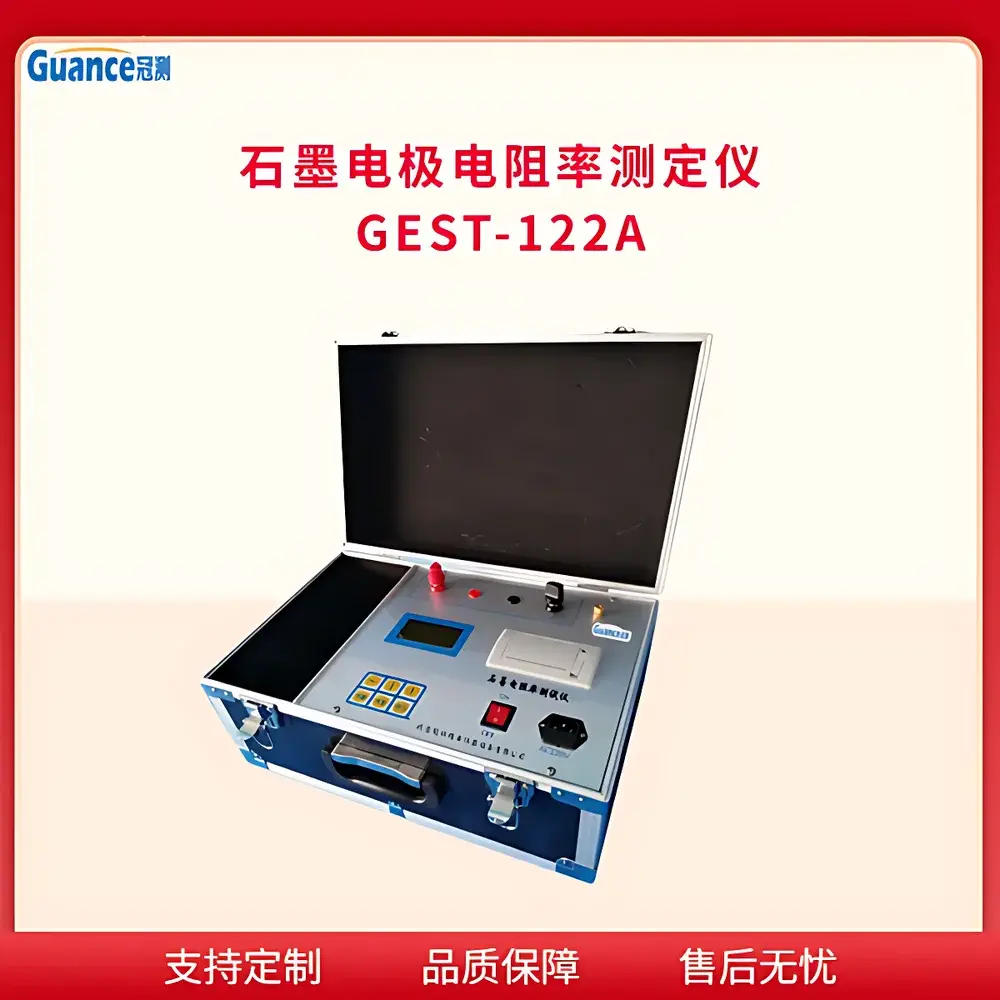
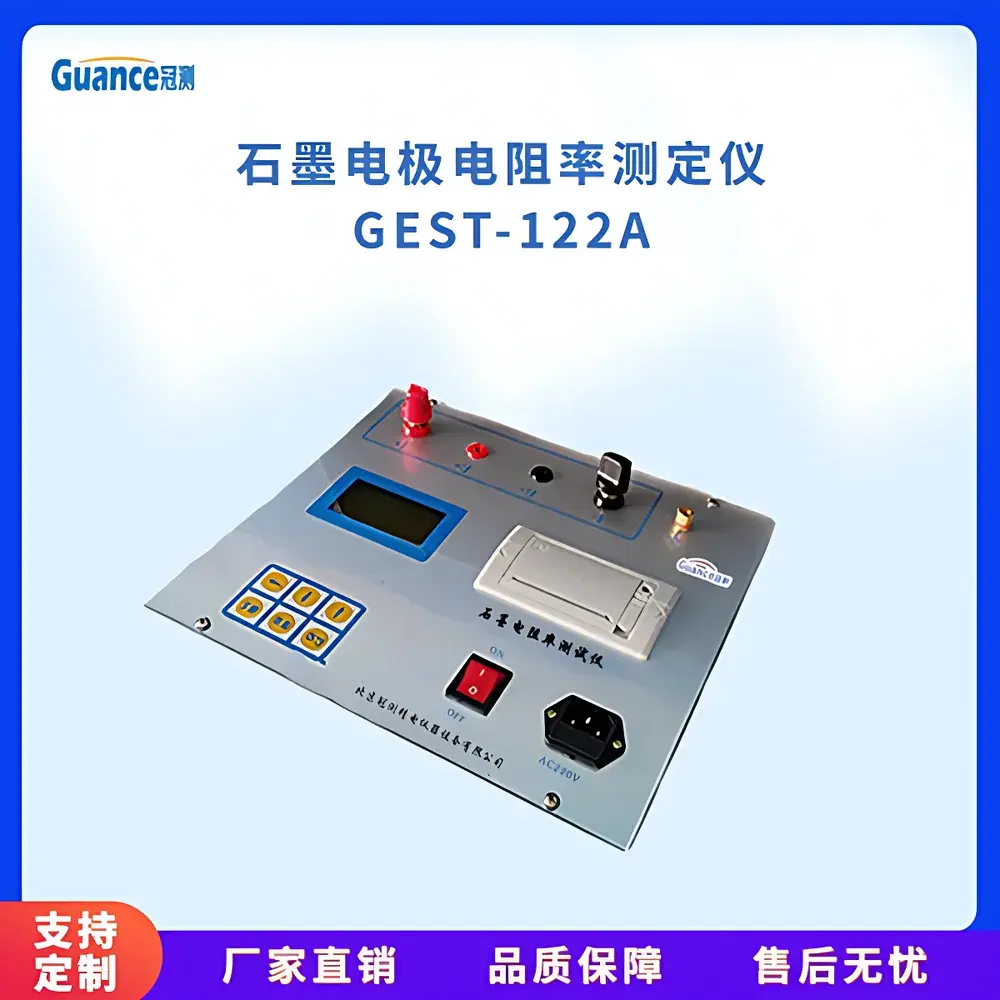
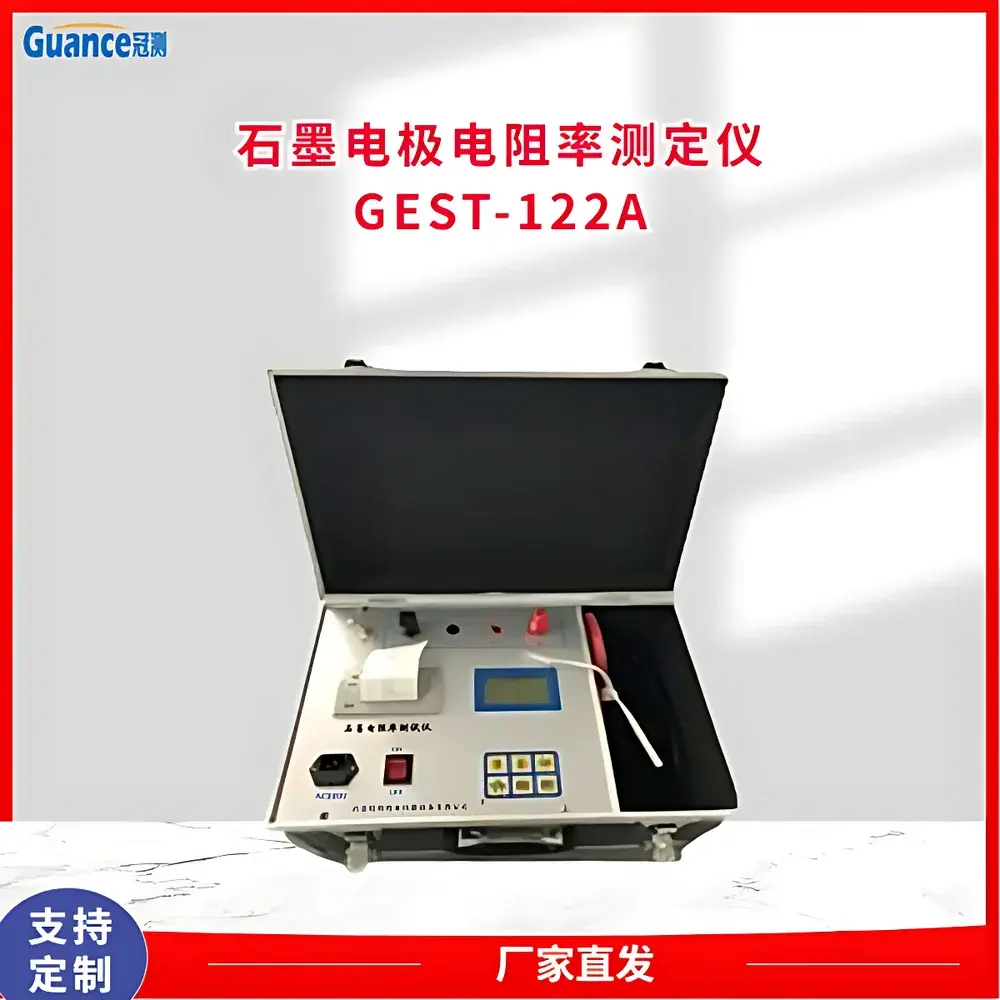
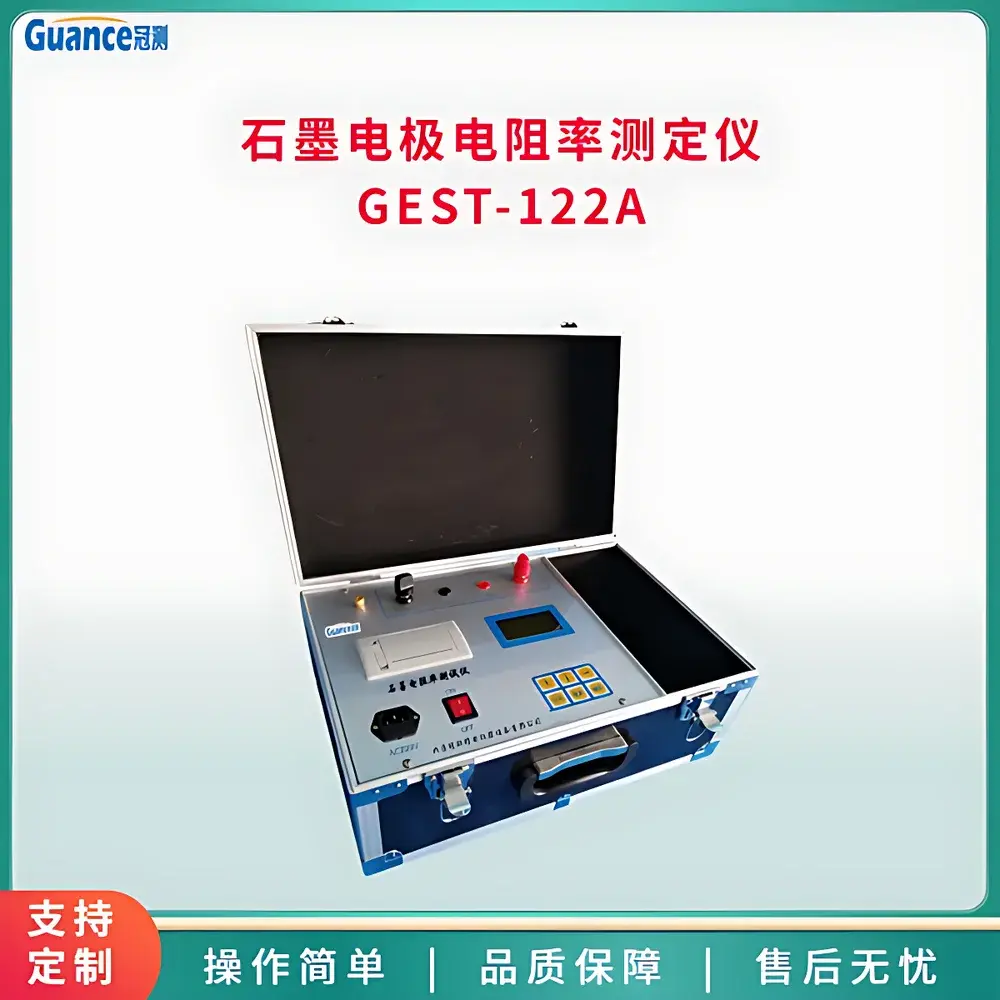
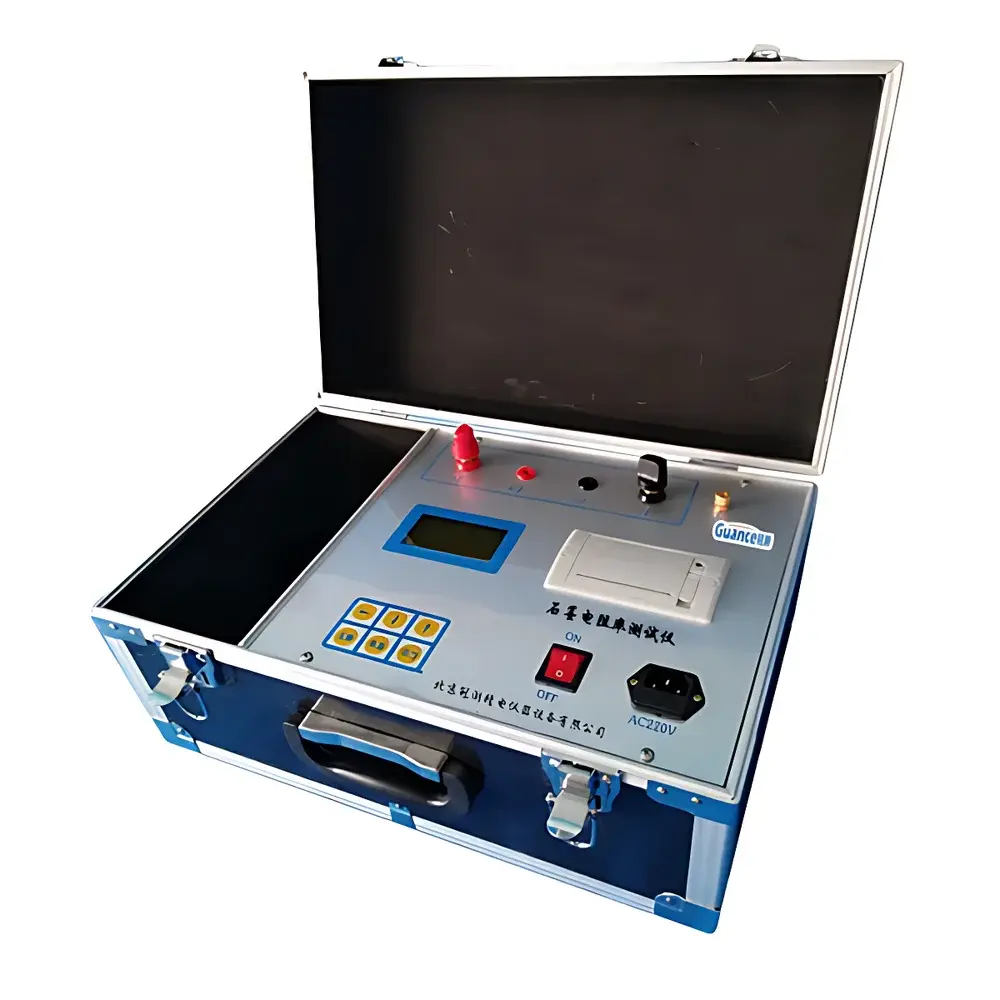
GuanCe Instruments GEST-122A2 Portable Graphite & Carbon Resistivity and Moisture Analyzer
| Brand | GuanCe Instruments |
|---|---|
| Origin | Beijing, China |
| Manufacturer Type | Authorized Distributor |
| Region Classification | Domestic (China) |
| Model | GEST-122A2 |
| Price | USD 1,890 (FOB Beijing) |
| Output Current | 35 A |
| Resistance Measurement Range | 0.2 µΩ to 200 mΩ |
| Resolution | 0.1 µΩ |
| Accuracy Class | 0.5 |
| Operating Temperature | −10 °C to +50 °C |
| Operating Humidity | 0–80 % RH (non-condensing) |
| Power Supply | AC 220 V ±10 %, 50 Hz ±1 Hz |
| Net Weight | 4 kg |
Overview
The GuanCe Instruments GEST-122A2 is a handheld, micro-ohmmeter-based resistivity analyzer engineered for rapid, field-deployable assessment of electrical resistivity in graphite electrodes, carbon anodes, calcined coke, and other conductive carbonaceous materials. Unlike conventional moisture analyzers that rely on loss-on-drying or Karl Fischer titration, the GEST-122A2 determines material condition—specifically, bulk conductivity degradation associated with moisture ingress—through high-current, four-terminal (Kelvin) DC resistance measurement. This method directly correlates resistivity changes with moisture-induced intergranular oxidation and surface adsorption effects, providing an indirect but highly responsive proxy for moisture content in non-porous, high-conductivity carbon structures. Designed for compliance with GB/T 24525–2009 (Determination of Electrical Resistivity of Carbon Materials), GB/T 24521–2009 (Resistivity of Coke), and YB/T 120–1997 (Carbon Material Resistivity Test Method), the instrument delivers traceable, repeatable measurements under ambient industrial conditions without requiring sample drying or chemical reagents.
Key Features
- Integrated 35 A constant-current source with automatic polarity reversal to minimize thermoelectric EMF interference and enhance long-term stability.
- Four-wire Kelvin sensing architecture eliminating lead resistance error—critical for sub-milliohm measurements in low-resistance carbon specimens (e.g., Ø400 mm graphite electrodes).
- High-resolution 0.1 µΩ digital readout with 0.5-class accuracy per IEC 61000-4-30 and JJG 1052–2019 (Chinese national verification regulation for micro-ohmmeters).
- Embedded MCU-controlled self-calibration routine using internal precision shunt references; no external calibration equipment required between scheduled metrological verifications.
- Ruggedized aluminum alloy housing (IP54-rated enclosure) and ergonomic hand-carried design (4 kg net weight) optimized for plant-floor mobility, furnace-side testing, and warehouse QA spot checks.
- Real-time temperature compensation algorithm based on built-in NTC sensor, enabling resistivity correction to standardized 20 °C reference per ASTM D374–22 (Standard Test Methods for Dielectric Constant).
Sample Compatibility & Compliance
The GEST-122A2 is validated for use with solid, electrically conductive carbon forms including but not limited to: monolithic graphite electrodes (RP, HP, UHP grades), carbon anode blocks (prebaked and baked), calcined petroleum coke, needle coke, and silicon carbide–graphite composites. Sample geometry must permit stable four-point contact via spring-loaded copper probes (standard probe set included). The instrument meets electromagnetic compatibility requirements per GB/T 18268.1–2010 (IEC 61326-1) and safety specifications per GB 4793.1–2007 (IEC 61010-1). All measurement procedures align with ISO/IEC 17025:2017 clause 7.2.2 for method validation and uncertainty estimation, supporting GLP-compliant documentation workflows.
Software & Data Management
Data output is provided via RS-232 serial interface (USB-to-serial adapter optional) compatible with Windows-based laboratory data acquisition systems. Raw resistance values, timestamped test records, ambient temperature/humidity metadata, and operator ID fields are exportable in CSV format. While the device lacks onboard storage or touchscreen UI, its deterministic command-response protocol enables integration into LIMS environments via custom Python or LabVIEW drivers. Audit trails—including calibration history, firmware version (v2.1.4), and user-defined test parameters—are maintained externally per FDA 21 CFR Part 11 requirements when paired with compliant host software.
Applications
- Quality control of graphite electrode batches prior to arc furnace installation—detecting moisture-related resistivity drift exceeding ±2% from baseline.
- In-process verification of coke drying efficiency in metallurgical coke plants per YB/T 120–1997 acceptance criteria.
- Field assessment of carbon anode integrity during aluminum smelter maintenance shutdowns.
- Research correlation studies linking resistivity hysteresis (after humidity cycling) to BET surface area and pore volume in activated carbon precursors.
- Supporting ISO 5725-2 repeatability studies for inter-laboratory carbon material characterization programs.
FAQ
Does the GEST-122A2 measure moisture content directly?
No. It measures DC resistivity at 35 A excitation current; moisture content is inferred indirectly through established empirical correlations between resistivity increase and water adsorption on carbon surfaces.
Can it be used on powdered carbon samples?
Not without custom fixture adaptation. The standard configuration requires solid, mechanically stable specimens with parallel, flat contact surfaces for reliable four-terminal measurement.
Is third-party calibration certification available?
Yes—traceable calibration to CNAS-accredited laboratories (e.g., Beijing Institute of Metrology) is offered as an optional service with full uncertainty budget reporting per ISO/IEC 17025.
What is the recommended recalibration interval?
Annually under normal use, or after 2,000 measurement cycles—whichever occurs first—as defined in the instrument’s Quality Assurance Manual (QAM-GEST122A2-Rev.3).
Does it comply with international standards beyond Chinese GB/YB specifications?
Its measurement methodology is technically aligned with ASTM D4292 (Standard Test Method for Resistivity of Graphite Electrodes) and IEC 60167 (Methods of Test for Insulating Liquids), though formal conformance declarations require site-specific validation per ISO/IEC 17025.



